

Mental health care doesn’t have to sit apart from physical health care. Integrated behavioral health brings behavioral health and medical professionals together to address emotional and physical needs as part of coordinated care. The benefits of integrated mental health care can include easier access to support, earlier attention to concerns, and care that better reflects a person’s whole health.
It makes sense to want mental health support that connects with the rest of your care, especially when ongoing health conditions affect daily life. The benefits of integrated mental health care can include coordinated treatment, routine progress reviews, and attention to behavioral health within a broader care plan. This article explains what integrated behavioral health means, how it may improve access, why coordination matters for people with chronic conditions, and how whole-person care brings these needs together. You’ll also learn what integrated care can and can’t do, so you can consider whether it fits your needs.
Key Takeaways
- Integrated behavioral health connects mental health support with medical care, helping care teams respond to the whole person.
- Bringing support into primary care can make it easier to discuss emotional health and identify concerns earlier.
- Addressing behavioral health alongside chronic conditions can help care teams support people’s broader health needs.
- Clear communication among providers can make treatment plans more coordinated and progress easier to follow.
- Learn how different care approaches work and what role psychotherapy or medication management may play in mental health support.
What is Integrated Behavioral Health?
Integrated behavioral health connects mental health support with medical care through coordinated teams. Depending on the setting, providers may share treatment planning, symptom monitoring, and responsibility for addressing physical and mental health needs.
Collaborative Care Outcomes and Cost-Effectiveness
The Collaborative Care Model brings together a primary care team, a behavioral health care manager, and a consulting psychiatrist. That structure lets the team review progress and adjust care rather than leaving each clinician to work separately. A psychiatrist using this model can serve approximately 226,800 patients over their lifetime, compared with about 17,500 outside the model, or about 13 times as many.
This coordination can make clinical expertise available across a broader patient population. It may also reduce inefficiencies such as duplicated tests, avoidable hospitalizations, or conflicting treatment plans. Cost-effectiveness depends on timely, coordinated support and how care is delivered. It does not mean every patient or health system will spend less.
Coordinated Treatment Results
Coordinated treatment means medical and behavioral health clinicians work together around a patient’s needs, with progress informing the care plan. A large analysis of 79 randomized controlled trials found better short- and long-term outcomes for people treated through Collaborative Care for depression or anxiety than for people treated otherwise.
For example, when anxiety or depression affects someone managing a physical condition, clinicians can consider both concerns while discussing treatment goals. Measurement-based care supports this work by using validated tools to screen for symptoms and track changes over time. Regular reviews can help the team identify when a plan needs adjustment and follow outcomes in both areas of health.
Integrated and Separate Care Compared
Separate services often involve distinct appointments and treatment plans, while integrated models coordinate behavioral health with medical care. Coordination can make it easier to raise mental health concerns in a familiar care setting and connect them with broader health needs. It also encourages attention to physical and mental health together, rather than treating them as unrelated measures.
Integrated care has limits. A primary care team may need to connect a patient with specialty services when more focused treatment is appropriate, and care can become fragmented if clinicians cannot communicate or coordinate decisions. To assess the model, look for shared goals, routine symptom monitoring, and a clear process for adjusting treatment. These features help patients understand how their care fits together, while recognizing that one model will not suit every situation.
Access to Behavioral Health Care Through Primary Care
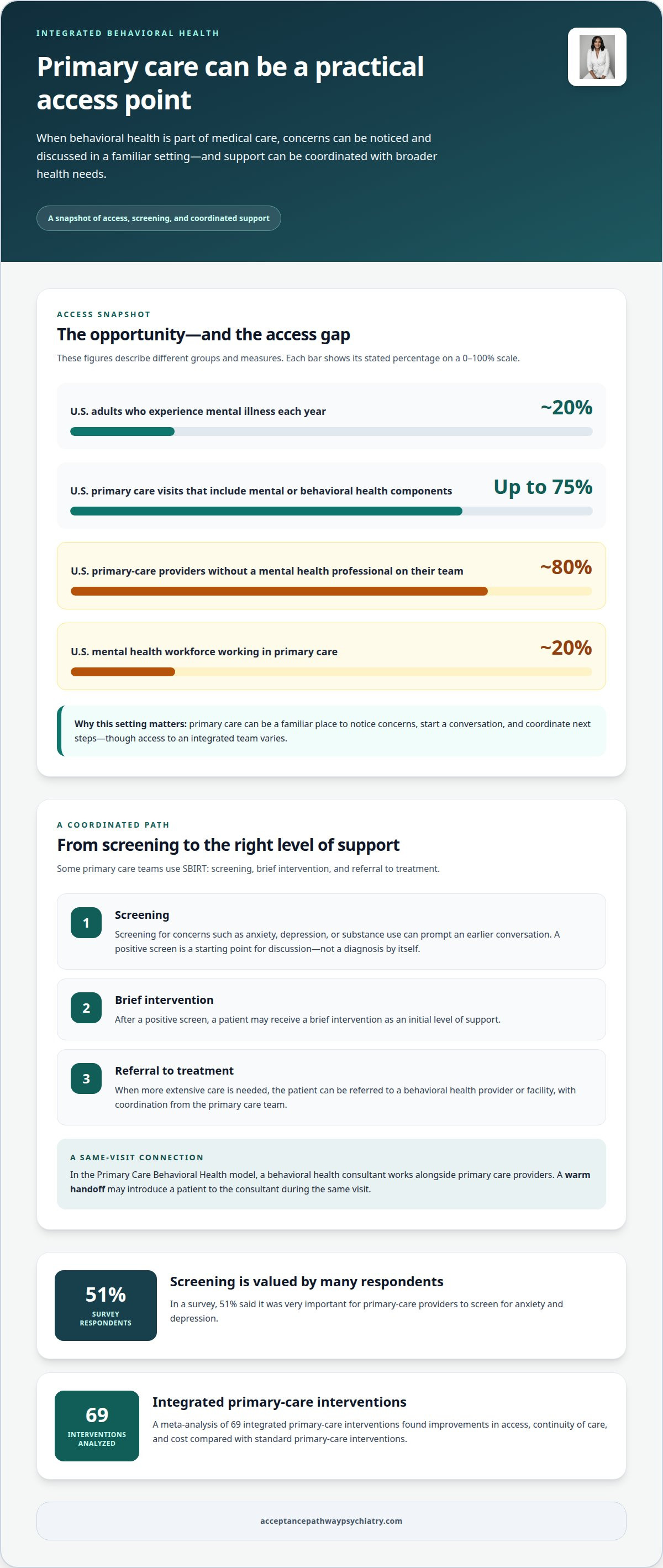
Patients in the United States can look for integrated mental health care through primary care settings that bring behavioral health support into medical care. About 20% of U.S. adults experience mental illness each year, while up to 75% of primary care visits include mental or behavioral health components. This makes primary care a practical place to notice concerns affecting daily life and physical health.
In an integrated setting, a primary care provider and behavioral health professional can coordinate support rather than work from disconnected plans. Yet access varies: about 80% of primary-care providers in the United States do not have a mental health professional on their team, while about 20% of the U.S. mental health workforce works in primary care. Integrated models can make support easier to reach and may reduce stigma by offering it in a familiar medical setting.
Screening gives care teams a way to identify concerns patients may not raise on their own. Regular screening for anxiety, depression, or substance use can prompt earlier conversations and timely support. In a 2024 survey, 51% of respondents said it was very important for primary-care providers to screen for anxiety and depression. A positive screen is a starting point for discussion, not a diagnosis by itself.
In the Primary Care Behavioral Health model, a behavioral health consultant works alongside primary care providers. A warm handoff may introduce a patient to the consultant during the same visit, making support part of the care experience. For example, someone who mentions stress while discussing a physical health concern can have an initial conversation about coping and next steps without beginning with a separate specialist appointment.
Some primary care teams also use SBIRT, which stands for screening, brief intervention, and referral to treatment. After a positive screen, a patient may receive a brief intervention. Someone needing more extensive care can be referred to a behavioral health provider or facility, with coordination from the primary care team. This creates a path from identifying a concern to connecting with an appropriate level of support.
Patients can begin by seeking a primary care practice that integrates behavioral health or uses a coordinated referral process. A meta-analysis of 69 integrated primary-care interventions found improvements in access, continuity of care, and cost compared with standard primary-care interventions. The approach matters when mental health concerns, such as anxiety, affect physical health or make ongoing care harder to manage.
Benefits for people with chronic conditions
Living with a chronic condition can involve more than physical symptoms. Diabetes, cardiovascular disease, and other ongoing illnesses can affect mood, sleep, motivation, and daily routines. Behavioral health concerns can also make it harder to keep appointments or follow treatment plans. Integrated care helps clinicians consider these connected needs together instead of treating emotional health and chronic disease management as unrelated tasks.
The connection works in both directions. People with chronic health conditions are more likely to experience related behavioral health concerns, and addressing those concerns can make chronic-condition management easier. For example, anxiety may make daily diabetes care feel overwhelming. A coordinated team can consider that emotional strain alongside the person’s physical health goals and clinical care.
Serious mental illness is also linked with physical health risks. People with serious mental illness die earlier than peers without mental illness, and most of these deaths are due to chronic physical conditions, including cardiovascular, respiratory, and infectious diseases, as well as diabetes and hypertension. Considering both areas of health can help care teams notice when a physical condition needs attention alongside behavioral health needs.
Integrated care can support earlier detection and management, which may improve health outcomes, reduce symptom chronicity, and increase patient satisfaction. Regularly reviewing symptoms and treatment progress can help clinicians notice when emotional distress or physical symptoms change. For instance, if anxiety makes it difficult to attend visits or follow a care plan, the team can address that barrier as part of the clinical conversation.
Coordinated care can also affect how often patients need higher-intensity services. In 2017, a team-based care model was associated with a 23% reduction in emergency room visits and a 10.6% reduction in hospital admissions. These findings describe an association, not a guaranteed result for each person. They illustrate why coordination matters: a team may be able to respond to health concerns before they escalate into urgent needs.
For chronic disease management, the practical value is a care plan that accounts for a person’s whole routine. A team can discuss how symptoms, emotional wellbeing, and treatment fit together, then follow changes over time. Medication management may be included when relevant. The aim is to make clinical decisions with physical health and behavioral health needs both in view.
These benefits can matter when repeated visits, ongoing symptoms, or difficulty following treatment begin to affect daily life. Integrated care gives clinicians a way to address these patterns together. For someone living with cardiovascular disease and depression, for example, care can account for both the medical condition and the emotional symptoms that affect everyday wellbeing.
Whole-person health and care coordination
Whole-person care connects medical, behavioral, and practical needs instead of treating each concern in isolation. Coordination can help clinicians understand how symptoms, daily functioning, and support systems affect one another.
Whole-Person Care
Whole-person care considers physical health, cognitive functioning, emotional wellbeing, family support, and daily abilities when planning treatment. For someone coping with illness and difficulty managing everyday tasks, these factors can shape which goals feel realistic. A plan based only on a diagnosis may miss barriers or strengths that influence progress.
For example, when discussing a treatment plan, a clinician can consider whether sleep disruption, stress, or caregiver responsibilities affect the patient’s ability to follow it. Integrated care may involve physicians, therapists, nurses, psychologists, social workers, and other specialists. Their perspectives can connect medical needs with emotional symptoms and functional goals, while keeping the patient’s preferences central.
Warm Handoffs and Care Coordination
A warm handoff is a direct introduction between clinicians that helps a patient move from one part of care to another. Instead of relying only on a referral, a primary care provider can introduce a behavioral health professional and explain the concern prompting the connection. This gives the patient a clearer next step and may reduce the chance that a need is missed between services.
For instance, if a patient describes distress during a medical visit, the provider can help connect that concern with behavioral health support. The patient’s symptoms and priorities guide the conversation. A warm handoff supports continuity, while follow-up helps the care team understand whether the intervention is addressing the original need.
Care Coordination and Communication
Care coordination links providers, settings, and disciplines so treatment decisions fit together. In Collaborative Care, teams can use a patient registry and regular caseload consultations to track symptoms, identify people who are not improving, and reduce the risk of patients falling through the cracks. This shared process helps the team recognize when a treatment plan needs attention.
Communication also matters when care spans hospitals, outpatient clinics, residential programs, or home-based services. For example, one clinician’s update about changing symptoms can inform another provider’s next discussion with the patient. Caregivers may also contribute to the care team, helping clinicians understand support needs and daily functioning.
Effective coordination keeps the patient’s goals visible as care changes. A team can review symptoms, agree on the next intervention, and clarify who will follow up. This shared process can limit conflicting recommendations and support more consistent care across services. Patients remain central to decisions, with their needs, preferences, and values guiding treatment planning.
Does integrated mental health care improve mental health and physical health outcomes?
Integrated care can support mental and physical health by connecting treatment, follow-up, and symptom monitoring. Outcomes depend on what the care team tracks and how it responds when needs change. For example, a team can review depression symptoms alongside progress managing a physical condition, then adapt care to address both concerns.
Collaborative Care findings show improvements in some measures of acute service use. People receiving Collaborative Care are 54% less likely to go to the emergency room and 49% less likely to require inpatient psychiatric care. These figures describe findings associated with the model, not a forecast for any one person. They show how coordinated attention may help teams address concerns before emergency or inpatient care is needed.
A Rhode Island study found integrated care was associated with a 7% reduction in emergency department visits. Fewer emergency visits are one measure, not a complete picture of health. Teams also need to consider mental health symptoms, physical health, daily functioning, and progress toward the patient’s own care goals. Looking across these outcomes can reveal whether a treatment plan addresses the person’s needs.
Measurement-based care gives clinicians a structured way to follow mental health symptoms over time. They use validated tools routinely and adjust treatment in relation to clinical goals. If a patient’s anxiety persists, for example, the team can review changes and discuss whether the plan needs to shift. Repeated assessment can help distinguish ongoing symptoms from improvement that still needs support.
Physical health outcomes also depend on communication between clinicians. Someone managing cardiovascular disease and depression, for instance, may have medical appointments and mental health treatment that affect the same routines. When clinicians share relevant updates and coordinate decisions, they can identify barriers and align recommendations. This makes the relationship between emotional wellbeing and physical care part of clinical planning.
Integrated care also emphasizes accountability. Teams can set measurable goals, track mental and physical health, and review whether care is moving toward those goals. If symptoms do not improve, that information can prompt a change in intervention rather than leaving the patient with an unchanged plan. Progress may involve symptom changes, the ability to follow a care routine, or fewer urgent episodes.
For patients, the practical value is a clearer connection between concerns and care decisions. Integrated mental health care can support earlier review, consistent monitoring, and coordinated treatment, while outcomes remain individual. If emotional symptoms are affecting your wellbeing or physical health, explore mental health support that can help address your needs.
Acceptance Pathway Psychiatry PLLC
Acceptance Pathway Psychiatry PLLC provides mental health care for people seeking support with concerns such as anxiety, depression, ADHD, PTSD, or bipolar disorder. If emotional symptoms affect daily life or make a chronic health condition harder to manage, psychotherapy and medication management may be part of an individualized care plan. Creyos Cognitive Testing and Integrative Wellness Services are also available.
Care is available in person and through telepsychiatry. Telepsychiatry requires a reliable internet connection and a private space. Mental health services can be part of your support, while coordination with your primary care team remains important. To discuss your needs and schedule an appointment, contact Acceptance Pathway Psychiatry PLLC.
Choose a Next Step That Feels Manageable
Integrated care is not a single plan that fits everyone. A useful next step is to discuss what you’re experiencing, what support matters to you, and how mental health care might fit alongside your other needs. The benefits of integrated mental health care are most meaningful when care reflects your priorities and gives you room to say what is or isn’t working.
You don’t need to have every answer before seeking support. Start by describing how symptoms affect daily life and what you hope will change. From there, you can discuss an approach that feels appropriate for your situation.
If you’re ready to talk about your mental health needs, contact Acceptance Pathway Psychiatry PLLC. Taking that first step can help you move toward care that feels more connected and personal.
Frequently Asked Questions
What is integrated care?
Integrated care connects services from different parts of health care around a person’s needs. For example, a primary care clinician and a behavioral health professional may coordinate when stress affects a patient’s ability to manage a medical concern. This approach can span prevention, treatment, and ongoing support. The key distinction is communication between involved providers, rather than delivering care as unrelated services.
What is integrated mental health care?
Integrated mental health care coordinates mental health support with medical care. For instance, a patient discussing sleep problems during a medical appointment may also talk about emotional wellbeing as part of the care plan. The model can include screening, treatment, and follow-up, with the patient’s priorities guiding decisions. It connects concerns that may affect one another instead of treating a mental health diagnosis in isolation.
What are the benefits of integrated mental health care for patients?
Patients may benefit from fewer disconnected conversations and a clearer path from identifying a concern to discussing support. For example, someone overwhelmed by a new diagnosis can raise that concern during a medical visit and explain how it affects daily life. Coordination can also help patients understand the purpose of different parts of their care plan and share what feels manageable or difficult.
How does integrated mental health care improve access and reduce treatment delays?
Integrated care can give patients a familiar place to begin discussing emotional concerns, rather than leaving them to arrange every connection independently. A primary care team may screen for symptoms, discuss the results, and connect the patient with behavioral health support. The pathway depends on the setting and the person’s needs, but an early discussion can clarify appropriate follow-up.
How does integrated care help people with chronic medical conditions and mental health disorders?
It lets the care team consider how ongoing symptoms, emotional health, and treatment routines interact. For example, low mood may make it harder for someone with a chronic condition to keep up with daily care. Discussing both concerns can help clinicians understand the barrier and shape support around the patient’s goals. This does not replace medical treatment for the condition; it includes behavioral health needs in care planning.
Can integrated mental health care reduce emergency visits and hospitalizations?
Research on coordinated care models has associated them with lower use of some emergency and inpatient services. These findings describe outcomes across groups, not predictions for individual patients. Integrated care can support monitoring and timely treatment discussions, but it cannot guarantee urgent services will never be needed. A person’s health needs, symptoms, and access to appropriate support all matter when considering how care may affect service use.
How much does integrated mental health care cost, and does insurance cover it?
Costs depend on the service, plan benefits, and whether care is in network; there is no single price for integrated care. Acceptance Pathway Psychiatry PLLC accepts TRICARE East, Humana Military, Aetna, Blue Cross and Blue Shield of North Carolina, BlueCross BlueShield Massachusetts, Cigna, Optum/United Healthcare, UMR, Oscar Health, Oxford, Medicaid, and Medicare. Coverage varies by service, and reimbursement for out-of-network or self-pay services is not guaranteed.


