

About 7.1% of U.S. adults experience social anxiety disorder in a given year, according to the National Institute of Mental Health. Treatment costs depend on the care involved, such as psychiatric assessment, medication management, psychotherapy, or a combination. An online psychiatrist for social anxiety can assess symptoms and discuss treatment options based on a person’s needs.
It’s understandable to want a clear picture of the process and potential costs before starting care. This article explains what can shape treatment costs, what to expect from a psychiatric assessment, and which medication and therapy approaches may be considered. It also looks at how fear of negative judgment can affect everyday life, helping you consider what support may fit your situation.
Key Takeaways
- Understand how an anxiety assessment explores symptoms, daily impact, and whether medication may be appropriate.
- Learn what can shape treatment costs, including the type of care and the support involved.
- See how CBT and exposure therapy can help people work with social fears in a guided setting.
- Review medication options and the factors a psychiatrist considers when discussing them.
- Recognize how fear of negative judgment can affect relationships, work, and everyday activities.
How can a psychiatrist assess anxiety and determine whether medication may help?
A psychiatrist considers your symptoms, clinical observations, and how anxiety affects daily life before discussing treatment. The assessment helps determine whether therapy, medication, or both may fit your needs.
CBT and Exposure Therapy
Cognitive behavioral therapy (CBT) helps people identify and examine automatic negative thoughts about social situations. For example, someone who fears being judged in a meeting can explore that prediction with a therapist. Exposure therapy involves gradual, guided practice with feared situations. Both approaches focus on developing different ways to respond to anxiety, rather than avoiding every uncomfortable situation. A psychiatrist can discuss how therapy may fit into your broader care.
Evidence and Online Versus In-Person Therapy
Video therapy has produced results about as good as in-person therapy in an analysis of more than 100 studies. A review of guided internet-based CBT and face-to-face CBT included 13 trials, including three on social anxiety disorder, and found equivalent overall effects. These findings suggest online care can be a meaningful format for therapy. The right setting depends on whether video sessions allow you to speak openly, stay engaged, and work with a licensed therapist.
Online Psychiatry and Therapy Care
Online psychiatric care can include a video assessment, discussion of symptoms, and consideration of medication. Therapy can address social anxiety through cognitive and behavioral approaches, including CBT and exposure therapy. When choosing an online psychiatrist for social anxiety, look for care that includes follow-up conversations about your experience and treatment plan. A psychiatrist assesses whether medication may be appropriate, while a therapist supports work on thoughts, feelings, and feared situations.
Privacy, Availability, and Clinician Quality
When comparing online care, review how the practice explains privacy, appointment access, and clinicians’ qualifications. Confirm that the clinician is licensed in your state, since therapists generally need a license in the state where their client lives. Look for a clear way to discuss concerns and follow-up needs. Privacy information should explain how sessions and personal health information are handled without making promises beyond what the practice states.
Finding Care and Recognizing Urgent Needs
To find an online psychiatrist who treats social anxiety in the United States, look for a psychiatric clinician who addresses anxiety and is licensed in your state. Describe the situations that cause distress and how they affect daily life; those details help shape the assessment. If you face a medical or mental health emergency, call 911 or go to a local emergency room. In a U.S. crisis, call or text 988, the Suicide and Crisis Lifeline, according to the Substance Abuse and Mental Health Services Administration.
How much does social anxiety disorder treatment cost?
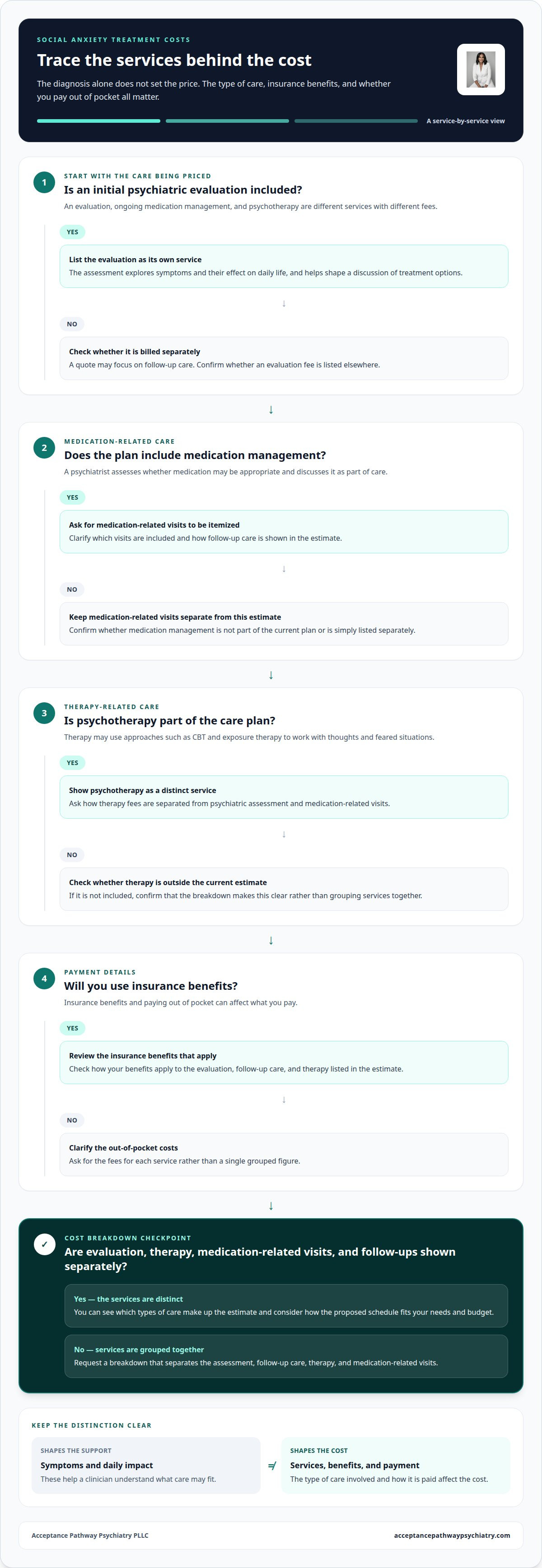
Treatment costs depend on the type of care, not simply on a social anxiety diagnosis. An initial psychiatric evaluation, medication management, and psychotherapy are different services with different fees. Insurance benefits and whether you pay out of pocket also affect your costs. Ask for a clear breakdown that distinguishes an assessment, follow-up care, and therapy rather than grouping them together.
Symptoms help shape the support a person may need. Social anxiety can involve persistent fear of attention, scrutiny, embarrassment, or negative judgment. Someone might dread speaking in a group, meeting unfamiliar people, or eating while others are watching. Anticipating these situations can also bring physical symptoms such as chest tightness, a pounding heart, blushing, or dizziness.
Avoidance can also affect work, relationships, and ordinary routines. A person may turn down a work opportunity that involves presenting, skip social plans, or avoid asking a question in class. Close to 30% of U.S. adults with social anxiety disorder in the past year had serious problems functioning in daily life. The effect on daily activities helps explain why a treatment plan may involve more than a single assessment.
For some people, the fear centers on particular situations. For others, it affects conversations, group settings, or interactions with unfamiliar people. A clinician considers the thoughts and symptoms that arise before, during, and after these situations. For example, expecting ridicule before a meeting and replaying perceived mistakes afterward can help describe the pattern. That information can guide a discussion about suitable care and follow-up.
Anxiety symptoms can include intense worry, physical tension, and difficulty concentrating during a feared interaction. The symptoms themselves don’t determine the cost of treatment. Instead, the services involved shape the cost: an assessment differs from ongoing therapy or psychiatric follow-up about medication. Insurance benefits and billing arrangements can also affect what you pay.
Before starting care, ask for a breakdown that separates evaluation, therapy, medication-related visits, and follow-ups. Then consider how the proposed schedule fits your needs and budget. A plan should connect the type of care with the symptoms and daily challenges being addressed. If you’re considering professional support, explore mental health care options as a next step.
Medication options for anxiety
After assessing your symptoms, an online psychiatrist may discuss medication and whether it fits your care. The type of medication, your clinical assessment, and applicable prescribing requirements all matter, including requirements for controlled substances.
Selective serotonin reuptake inhibitors (SSRIs) are one group of medications used in psychiatric treatment for social anxiety. Examples include escitalopram, sertraline, and fluoxetine, also known by the brand names Lexapro, Zoloft, and Prozac. SSRIs affect serotonin in the brain and may help with anxiety. A psychiatrist considers your symptoms and health history when discussing whether this option may be appropriate.
Medication isn’t the only option. Cognitive behavioral therapy (CBT) helps people work with thoughts and behaviors linked to fear and stress in social situations. Evidence reviewed for social anxiety found that combining medication with talk therapy did not work better than talk therapy alone. That finding doesn’t mean medication is never useful. It underscores why treatment choices should reflect a person’s needs and preferences.
A psychiatric evaluation gives the clinician information to guide treatment planning. They may ask when anxiety arises, what situations trigger it, how it affects daily life, and whether you’ve tried medication before. For example, fear before presentations may call for a different discussion than anxiety affecting conversations, appointments, and routine interactions. Share your other medications and relevant health information so the psychiatrist can consider possible concerns.
Starting medication may involve an introductory dose to allow time for adjustment. With guidance from your provider, the dose may later be increased. Follow-up appointments give the psychiatrist a chance to discuss your response, side effects, and whether an adjustment is appropriate. Keep track of questions or changes you notice between visits, and bring them to your next appointment.
Medication management is an ongoing process, not simply receiving a prescription. The clinician reviews whether treatment remains appropriate and discusses refills or changes as needed. Don’t change or stop a prescribed medication without discussing it with the prescriber. If you experience an unexpected reaction or your anxiety changes, contact the prescribing clinician for guidance rather than adjusting medication on your own.
Ask the psychiatrist to explain the medication’s purpose, adjustment process, and follow-up plan in clear terms. If a controlled medication is discussed, ask which prescribing requirements apply to that medication and your location. These conversations can help you understand the plan and make informed decisions, whether medication is considered alone or alongside cognitive behavioral therapy.
Psychiatrist assessment and diagnosis
A psychiatric assessment connects symptoms with their timing, triggers, and effect on daily life. A qualified mental health professional can diagnose an anxiety disorder using reported symptoms, clinical observations, and DSM-5 criteria. The discussion helps clarify whether anxiety treatment should focus on social fears, other concerns, or both.
A clinician may use the GAD-7, a brief screening tool about how often common anxiety symptoms occur. It can help organize information about symptoms, but a screening result isn’t the entire assessment. The psychiatrist also asks how anxiety appears in specific situations, such as meeting unfamiliar people or speaking during a group discussion.
An assessment for social anxiety explores the fear of being watched, judged, or embarrassed. A psychiatrist may ask what you expect to happen, how anxious you feel beforehand, and what you do during the situation. For example, leaving a gathering early or avoiding a work presentation can show how fear affects your choices and routines.
Details about how long anxiety has been present and how it affects you help put those examples in context. The clinician may ask whether anxiety occurs only in certain situations or across different interactions, and whether it interferes with relationships, work, or everyday activities. They may also ask about physical experiences, such as a pounding heart or dizziness when you anticipate a feared event.
An online psychiatric assessment uses a remote appointment to discuss the same core areas: symptoms, circumstances, and daily functioning. A private space can make it easier to describe sensitive experiences, and a reliable internet connection is required for telepsychiatry. The psychiatrist may ask for examples in your own words, such as avoiding a phone call because you fear sounding awkward.
Online therapy and psychiatric assessment have related but distinct purposes. Therapy focuses on working with thoughts, feelings, and behavior over time. A psychiatrist assesses mental health concerns and discusses whether medication may be part of anxiety treatment. Depending on the assessment, care may include therapy, medication, or further evaluation.
Comfort and clarity matter during a remote assessment. You should have space to explain what feels difficult without rushing through the details. If a question isn’t clear, ask the clinician to rephrase it. A concrete example, such as missing a social event after worrying about criticism, can help explain how anxiety affects you.
The assessment ends with a discussion of what the clinician has understood and possible next steps. You can ask how your symptoms relate to diagnostic criteria, which treatment options address your concerns, and how progress will be reviewed. A clear explanation helps you understand the reasoning behind the plan and take part in decisions about your care.
Social anxiety disorder and fear of negative judgment
Social anxiety disorder involves intense fear of negative judgment in social situations. A conversation, meal with others, or workplace presentation can feel exposing. Someone may worry about blushing, saying the wrong thing, or appearing awkward. The fear can cause distress before, during, and after an event. For example, someone might replay a brief comment for hours, looking for signs of disapproval. These feelings can make ordinary interactions difficult, even when others seem at ease.
About 7.1% of U.S. adults have social anxiety disorder in a given year, according to the National Institute of Mental Health. About 12.1% of U.S. adults will have social anxiety disorder at some point in their lives, according to the National Institute of Mental Health. Past-year rates are 8.0% for women and 6.1% for men, according to the National Institute of Mental Health. These figures describe population patterns, not whether a particular person has a disorder. An individual assessment considers the person’s experiences and daily functioning.
Shyness and social anxiety can look similar from the outside, but they don’t necessarily feel the same. Someone who is shy may feel quiet at a new gathering but become more comfortable over time. With social anxiety disorder, fear of scrutiny can lead a person to avoid gatherings, decline work opportunities, or endure interactions with intense distress. The impact matters: someone who wants to attend a friend’s celebration but repeatedly stays home may be experiencing more than a preference for solitude. A clinician considers the pattern, not just one isolated moment.
Fear of negative judgment can create a cycle of thoughts and behaviors. Before a meeting, someone may predict embarrassment; during it, they may focus on every pause or facial expression. Afterward, they might interpret a neutral response as criticism. Avoiding future meetings can bring short-term relief while limiting work or relationships. Physical reactions, such as a pounding heart, blushing, dizziness, or chest tightness, may arise as the feared situation approaches. These experiences are worth describing during an assessment.
Social anxiety can interfere with relationships, work, and everyday activities, such as asking a question or making an appointment. A treatment plan can address the situations that feel hardest and the changes you hope to make. If low mood or depression also affects daily life, mention it during your assessment. Specific examples, such as avoiding lunch with colleagues or turning down a social invitation, help a clinician understand the pattern and discuss suitable support.
If fear of judgment is narrowing your daily choices, explore support for social anxiety as a next step.
Acceptance Pathway Psychiatry PLLC
Acceptance Pathway Psychiatry PLLC offers psychiatric evaluations, psychotherapy, and medication management to help you explore care when social anxiety affects relationships, work, or everyday choices. An assessment can clarify your concerns and inform a discussion of treatment options. Care is available through telepsychiatry, which requires a reliable internet connection and a private space. The practice also offers Creyos Cognitive Testing and Integrative Wellness Services as part of its broader mental health care.
If you’re ready to discuss support for anxiety, contact Acceptance Pathway Psychiatry PLLC.
Take a Thoughtful Next Step Toward Support
You don’t need to have every answer before seeking care. You can start by describing what feels difficult, which situations bring anxiety, and what you hope will change. An online psychiatrist for social anxiety can help you discuss these concerns and consider a path that fits your needs. The first conversation can focus on understanding your experience, not on explaining it perfectly.
At Acceptance Pathway Psychiatry PLLC, you can discuss whether Medication Management, Psychotherapy, or Creyos Cognitive Testing may be relevant to your care. These services can support an individualized conversation about your concerns and possible next steps.
If you’re ready to talk through your concerns, contact Acceptance Pathway Psychiatry PLLC. Taking that first step can open space for a supportive conversation and a clearer way forward.
Frequently Asked Questions
What kind of therapist will treat my anxiety?
A licensed therapist trained in cognitive behavioral therapy can work with anxiety and social fears. CBT helps you examine thoughts and behaviors linked to distress, while exposure therapy can support gradual practice with feared situations. For example, therapy might address anxiety before speaking in a group. A psychiatrist can assess whether medication may also be relevant, while a therapist focuses on therapeutic strategies and ongoing emotional support.
What are the symptoms of anxiety?
Anxiety can involve persistent worry, fear, difficulty concentrating, and physical reactions. Before a social event, someone might notice a pounding heart, blushing, dizziness, or chest tightness. Symptoms can arise while anticipating a feared situation or during it. Their pattern and effect on daily life matter: anxiety that leads someone to avoid work conversations, appointments, or social plans deserves attention from a qualified mental health professional.
Are controlled substances prescribed?
Whether a controlled medication is considered depends on the assessment, the medication, and applicable prescribing requirements. Medication management involves discussing treatment choices and monitoring your response. It’s reasonable to ask the prescribing clinician why a medication is being considered, what follow-up involves, and what alternatives may fit. A prescription shouldn’t be assumed simply because anxiety is present; treatment decisions are based on your clinical needs.
Can you live a normal life with anxiety?
Yes. Anxiety doesn’t prevent someone from building a meaningful life, although it can make some activities harder. A person may work comfortably but struggle with presentations, or enjoy friendships while avoiding group gatherings. Identifying which situations cause difficulty can help clarify what support to seek. Therapy and psychiatric care can address those challenges and help make valued activities more manageable over time.
Does anxiety ever go away?
Anxiety can ease, and its intensity may change over time. Some people find that certain triggers become less disruptive, while other situations still bring anxious feelings. Progress may mean attending an event despite discomfort, speaking up at work, or recovering more quickly after a stressful interaction. A mental health professional can help assess changes and discuss whether your treatment plan still fits your needs.
What qualifications should an online psychiatrist have to diagnose and treat social anxiety?
Look for a psychiatrist qualified to assess mental health concerns and licensed to practice where you live. A qualified mental health professional can diagnose an anxiety disorder using reported symptoms, clinical observations, and DSM-5 criteria. Ask how the clinician evaluates social anxiety and discusses treatment choices. For example, an assessment should explore both feared situations and their effects on relationships, work, or everyday activities.
How does online psychiatric treatment for social anxiety work, including the first appointment?
Online treatment begins with a remote psychiatric evaluation, where the clinician asks about symptoms, health history, and daily concerns. Acceptance Pathway Psychiatry PLLC states that its initial psychiatric evaluation lasts 60-90 minutes. Telepsychiatry requires a reliable internet connection and a private space. The clinician discusses assessment findings and possible next steps, which may include medication management or psychotherapy based on the person’s needs.
How much does online psychiatry for social anxiety cost with and without insurance?
Costs depend on appointment type, insurance benefits, and whether you pay out of pocket. Acceptance Pathway Psychiatry PLLC lists TRICARE East | Humana Military, Aetna, Blue Cross and Blue Shield of North Carolina, BlueCross BlueShield Massachusetts, Cigna, Optum/United Healthcare, UMR, Oscar Health, Oxford, Medicaid, and Medicare. Self-pay fees vary by service. Reimbursement for out-of-network or self-pay services isn’t guaranteed, so review your benefits and the practice’s fee schedule.


