

Can one test explain why focusing, getting started, or keeping track of details feels so difficult? If you’re considering a cognitive assessment for ADHD, it’s understandable to hope the results will provide a clear answer. But a score can feel confusing, especially when it doesn’t seem to match your day-to-day experience. It isn’t a verdict, and it can’t diagnose ADHD on its own.
Cognitive testing can offer useful information about patterns in thinking and attention. Its findings become more meaningful when considered alongside your history, current symptoms, and the ways challenges show up in daily life. No single result defines your experience.
This article explains what cognitive testing can and can’t tell you, how to interpret results in context, and what steps may support a thoughtful evaluation. We’ll look at how testing can fit alongside conversations about symptoms, development, and everyday functioning, as well as how factors such as sleep, anxiety, or depression may affect attention. At Acceptance Pathway Psychiatry PLLC, Creyos Cognitive Testing can be one part of a broader, collaborative approach to care.
Key Takeaways
- A cognitive assessment for ADHD uses structured tasks to explore selected thinking skills. The areas assessed depend on the test.
- Test findings can add useful context, but they’re best understood alongside symptoms, personal history, and everyday functioning.
- Concrete examples from work, school, home, or relationships can help connect assessment findings to real-life concerns.
- Prepare for a results conversation by noting your main concerns and questions, then discuss what the findings may mean for your next steps.
- Creyos Cognitive Testing can be part of a collaborative conversation about your concerns and broader mental health care.
Why consider a cognitive assessment for ADHD?
Recurring trouble with attention, organization, memory, or finishing everyday tasks can be hard to make sense of. You may wonder whether these struggles point to ADHD, reflect a demanding season of life, or have another explanation. A cognitive assessment for ADHD may help explore selected thinking skills in a structured way. It provides information to discuss, not a verdict about who you are or what you’re capable of.
What questions might lead someone to explore cognitive testing?
People often consider testing when a pattern of difficulty keeps getting in the way. A student might understand class material but lose track of instructions or deadlines. At work, someone may have trouble prioritizing tasks, remembering the next step, or returning to a project after an interruption. At home, planning meals, keeping appointments, or completing chores may take more effort than expected. These examples can help identify concerns worth discussing, but none proves ADHD on its own.
Challenges may look different from one setting to another. Someone might stay organized at work by relying on reminders and routines, yet feel overwhelmed by household tasks. Another person may manage familiar responsibilities but struggle when demands change. Notice where and when difficulties arise: at school, work, home, or in relationships. Consider what strategies you already use and whether they help.
Difficulty focusing or remembering details is common and can have more than one explanation. The question isn’t whether one familiar experience matches a symptom list. It’s whether a persistent pattern deserves thoughtful exploration in the context of your life.
What does cognitive assessment mean in an ADHD context?
A cognitive assessment is a set of structured tasks that examines selected thinking skills. It provides information for an evaluation, not an ADHD diagnosis by itself. Depending on the assessment, tasks may look at processes such as attention, memory, or planning under specific conditions. They offer a snapshot of performance on those tasks, not a complete account of a person’s abilities or daily experience.
Findings are interpreted alongside other clinically relevant information, including reported symptoms, personal history, and how difficulties affect everyday functioning. This broader view matters because Attention deficit hyperactivity disorder (ADHD) is understood through its characteristics and their impact, rather than a single test result. A result that feels unexpected can still be useful. It may prompt questions about what the task measured and how that information fits with your lived experience.
Testing explores abilities, not worth, effort, or potential. If you’re unsure whether assessment makes sense, you don’t need to arrive with a conclusion. Start by describing what feels difficult, where it happens, and how it affects your routine.
What does cognitive testing measure, and how can it inform an ADHD evaluation?
Cognitive testing uses structured tasks to examine selected ways of thinking. Depending on the assessment, it may explore attention, memory, processing speed, or executive functions. These areas can frame useful questions about daily demands. For instance, is it hard to hold instructions in mind while starting a task, or to shift focus when priorities change? The exact tasks and skills assessed vary, so results should be understood in relation to the assessment used.
Which thinking skills may an assessment explore?
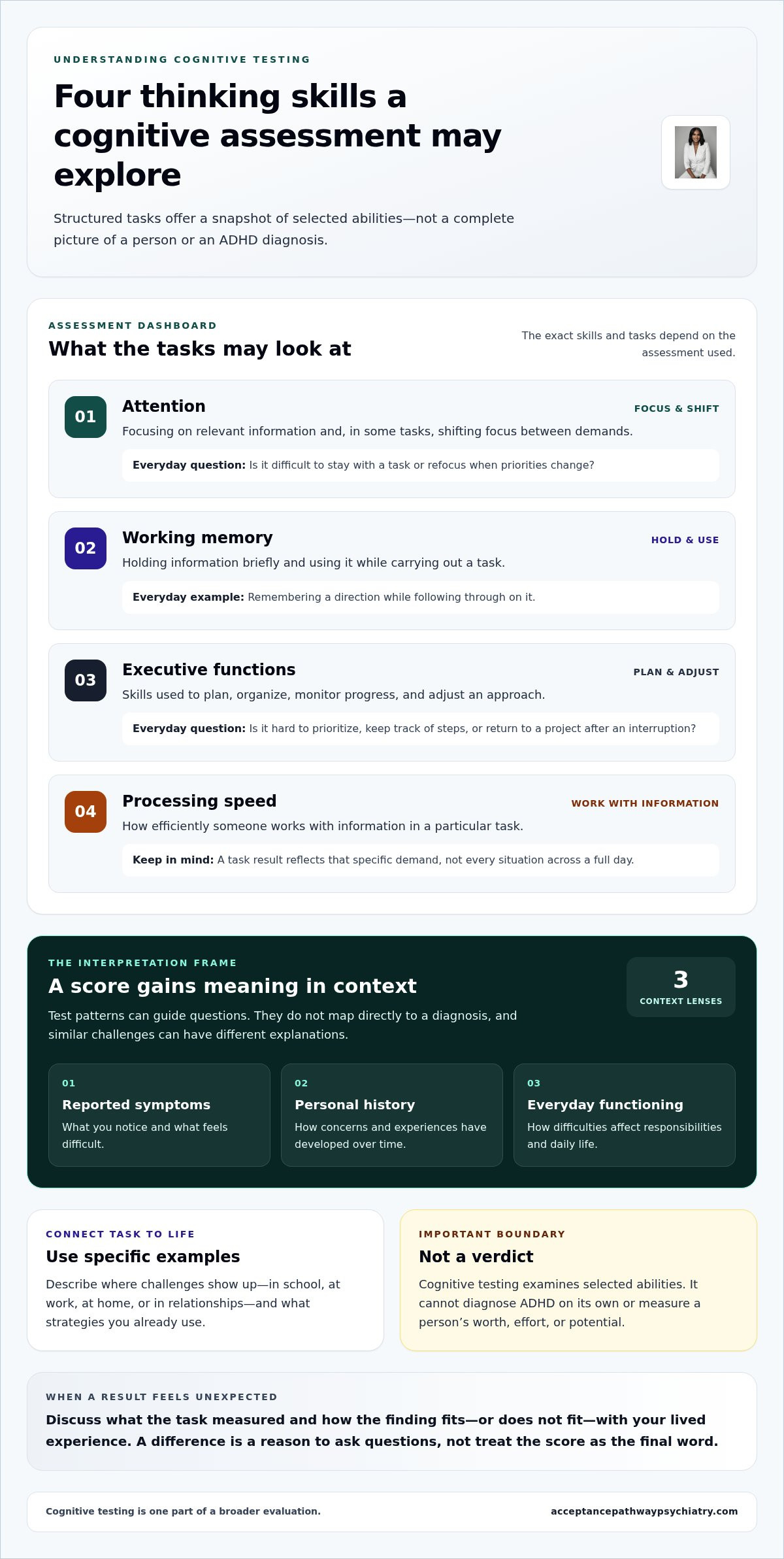
Attention involves focusing on relevant information and, in some tasks, shifting focus between demands. Working memory is the ability to hold and use information briefly, such as remembering a direction while carrying it out. Executive functions include skills used to plan, organize, monitor progress, and adjust an approach. Some assessments may also examine processing speed, or how efficiently someone works with information in a particular task. These are related but distinct abilities, not a complete measure of a person’s intelligence or potential.
Performance in a structured setting offers one perspective, but it doesn’t automatically capture how someone functions across a full day. A task may show how a person responds to a specific kind of demand. It can’t, by itself, explain every reason that demand feels difficult in everyday life.
How can findings add context to reported challenges?
Patterns across tasks may help guide follow-up questions. If someone reports losing track of multi-step directions, for example, findings related to attention or working memory might prompt a closer discussion of when that happens and what supports help. This is a starting point for exploration, not a formula that maps a test result to a diagnosis. Similar difficulties or test patterns can occur for different reasons, and no single cognitive profile should be treated as unique to ADHD.
Interpretation depends on the assessment and the broader clinical picture. A clinician may consider reported symptoms, personal history, and the effects of difficulties on daily functioning. The National Institute of Mental Health’s ADHD overview describes diagnosis as involving a broader assessment rather than relying on one cognitive score. If a result seems to fit poorly with your lived experience, discuss that difference rather than treating the score as the final word.
To make findings practical, connect them to specific questions: Which tasks seem hardest? What strategies help? Where do the challenges interfere with responsibilities or relationships? A cognitive assessment for ADHD can contribute information to that conversation, while the meaning of the results depends on the full context. If you’re considering Creyos Cognitive Testing, you can discuss testing questions and concerns as part of a broader conversation about your care.
Can a cognitive assessment diagnose ADHD by itself?
No. Cognitive test results alone shouldn’t be presented as an ADHD diagnosis. A score may describe performance on particular tasks, but it can’t establish whether someone’s experiences meet diagnostic criteria or explain the full story of their attention and daily functioning.
An ADHD evaluation considers a broader pattern: symptoms, personal history, how long concerns have been present, and whether they affect everyday life. Clinicians also consider other relevant context and possible explanations for similar difficulties. The CDC’s information on ADHD diagnosis explains that diagnosis involves several steps, rather than one test score. A cognitive assessment for ADHD may contribute useful information, but it’s one part of that wider clinical picture.
Why is one score not the whole picture?
A structured task captures selected performance in a particular testing context. It doesn’t reproduce every demand of a classroom, workplace, household, or relationship, and it can’t show on its own how a person manages responsibilities over time. Someone might perform well on a short, clearly explained task yet find it difficult to organize several open-ended responsibilities. Another person’s results may not reflect the strategies they rely on in daily life.
A test score describes performance in a specific context; it needs to be interpreted alongside the person’s broader experiences and functioning. An assessment isn’t a pass-or-fail exam. A result within an expected range doesn’t automatically rule out ADHD, and a result outside that range doesn’t confirm it. Neither result determines your effort, character, worth, or potential.
What else may shape the interpretation?
Testing conditions and a person’s circumstances can influence how a task feels and how they perform. Sleep, stress, mood, health, and distractions may all be relevant context to share. If you slept poorly or felt unusually anxious during testing, for example, mention that when reviewing the findings. This doesn’t make the results meaningless; it helps the clinician consider what they may and may not reflect.
Bring concrete observations to the conversation. Note what tends to go wrong, where it happens, how often it affects your routine, and what helps you manage it. A clinician can consider these details alongside relevant history and test findings, then discuss whether further evaluation or support makes sense. Avoid trying to diagnose yourself from a score or comparing your result with someone else’s. Its meaning depends on your individual context.
If you have questions about your results or whether testing could be part of a broader evaluation, discuss them with a clinician. At Acceptance Pathway Psychiatry PLLC, Creyos Cognitive Testing can be part of a collaborative conversation about your concerns and mental health care. The findings are considered in context, not assumed in advance.
How can you make cognitive assessment results more useful?
Results are easier to understand when you connect them to the questions that led you to testing. You don’t need a perfect timeline or a complete record of every difficulty. A few clear examples and questions can make the review more relevant to your life.
Use this sequence to guide the conversation:
- Identify your main concerns. Note what you’re hoping to understand, such as difficulty following instructions, starting tasks, or keeping track of commitments.
- Share relevant context. Describe where challenges tend to appear and mention circumstances that may matter, such as changes in sleep, stress, health, or mood.
- Review what was assessed. Ask which thinking skills the tasks explored and what the findings can reasonably suggest.
- Discuss questions and next steps. Talk through how the results relate to your experiences and whether further evaluation or support may be appropriate.
What context may help frame the conversation?
Specific examples are often more useful than broad labels. Instead of saying, “I’m disorganized,” you might describe forgetting appointments despite using a calendar or having trouble breaking a work assignment into steps. Consider whether a challenge happens at school, work, home, or in relationships, and whether it recurs or is tied to particular situations. You can also mention relevant changes in sleep, stress, health, or mood. Share what feels important; there’s no requirement to account for every detail.
If you’re preparing for an appointment, a brief note on your phone or a short list on paper can help you remember what you want to discuss. Include a recent example, the setting where it happened, and what you tried to do about it. Your own questions and examples are a useful place to start.
What questions can help clarify the results?
It’s reasonable to ask for plain-language explanations. You might bring questions such as:
- Which cognitive domains did the assessment examine, and what do the findings suggest about those tasks?
- How do the results relate to the concerns and symptoms I described?
- What can these findings tell us, and what can’t they establish on their own?
- Would further evaluation or support be appropriate, given my history and everyday functioning?
These questions keep the focus on understanding rather than judging a score as “good” or “bad.” The aim is to explore what the findings mean in context, including where they align with your experience and where they don’t. If something in the results is unclear, ask for an explanation or share what feels inconsistent. That difference can be part of the conversation.
If you’d like support discussing cognitive testing and how results fit into your concerns, connect with Acceptance Pathway Psychiatry PLLC for a thoughtful conversation about next steps.
How Acceptance Pathway Psychiatry PLLC can support a thoughtful next step
Deciding whether to pursue testing can bring up questions, especially if you’re unsure what an assessment might clarify. Acceptance Pathway Psychiatry PLLC offers Creyos Cognitive Testing as part of a broader range of mental health care. Testing can contribute information to a clinical conversation about your concerns, but it isn’t a stand-alone diagnosis or a promise of a particular outcome.
You can start by describing what prompted your interest. Perhaps you’re wondering about focus, planning, or follow-through, or you want to understand how a test result might relate to your daily experience. You don’t need to arrive with a conclusion. A collaborative discussion can make room for your questions and place testing in the context of your overall needs.
Where can Creyos Cognitive Testing fit into care?
Testing may be one part of exploring concerns alongside a broader clinical evaluation. The findings can inform discussion, while their meaning depends on the relevant context and the questions being considered. The earlier sections of this guide explain what cognitive assessment can and can’t establish. Keeping that distinction in mind can help you approach results with curiosity rather than pressure.
Creyos Cognitive Testing sits within the practice’s broader mental health services. Depending on individual needs and clinical judgment, care may also include psychiatric evaluation, medication management, or psychotherapy. The purpose of a conversation is to understand what support may be appropriate for you, not to assume in advance what testing will show or what care should follow.
What might a supportive next step look like?
Bring a few questions to a clinical conversation. You might ask how testing could relate to the concerns you’ve noticed, what the findings can help clarify, and what other information may matter. You can also share examples of how difficulties affect work, school, home, or relationships. There’s no need to prepare a perfect account; a starting point is enough.
Acceptance Pathway Psychiatry PLLC provides psychiatric care in person and through virtual appointments. If you’re considering a cognitive assessment for ADHD, a conversation about your questions can help you explore how testing fits into a broader evaluation. If your focus is shifting toward care options, learning about ADHD treatment approaches may help you identify topics to discuss, including whether medication management or psychotherapy could be relevant to your needs.
Explore the practice’s care options and consider what feels like a reasonable next step. The process can begin with a question, not a decision.
Let your next question guide the way forward
You don’t need to have every answer before seeking clarity. Start with the question that matters most to you, whether it’s understanding a persistent challenge, making sense of an assessment, or exploring what support might feel right. A cognitive assessment for ADHD can be part of that conversation, with your concerns and goals helping shape what comes next.
At Acceptance Pathway Psychiatry, Creyos Cognitive Testing is offered alongside psychiatric care, medication management, and psychotherapy. In-person and virtual appointments provide ways to explore care with a clinician. The aim is not to reduce your experience to a score, but to consider your questions thoughtfully and identify possible next steps together.
Explore mental health care and Creyos Cognitive Testing with Acceptance Pathway Psychiatry, and take the next step at a pace that feels right for you. You deserve care that makes room for your individual experience.
Frequently Asked Questions
Can a cognitive assessment diagnose ADHD on its own?
No. Cognitive testing alone cannot establish an ADHD diagnosis. A clinician considers findings alongside symptoms, relevant history, and how concerns affect functioning, then weighs the broader context. For example, a score may prompt questions about particular tasks without settling what causes difficulty during a demanding workday. A cognitive assessment for ADHD is one source of information, not a pass-or-fail judgment about you or a result that confirms or rules out ADHD.
Can someone have ADHD if their cognitive test results are typical?
Yes, typical results on selected tasks don’t settle whether someone has ADHD. A structured session may not reflect challenges that arise while juggling interruptions, deadlines, or several responsibilities at once. The clinician considers what the test examined alongside your experiences and other relevant information. If you continue to struggle, note situations where it affects your routine and discuss them with a clinician rather than using a score to decide for yourself.
Can anxiety or poor sleep affect cognitive assessment results?
They may be relevant. Poor sleep, stress, mood, health, or distractions during testing can influence how you feel and perform. That context doesn’t automatically invalidate findings, but it may help a clinician understand them. If you slept unusually poorly or felt anxious during the session, mention it when reviewing results. Avoid treating one score as a complete explanation; share what was happening and ask how it should factor into interpretation.
Is cognitive testing for ADHD only for children?
No. Cognitive assessment may be considered for adults as well as younger people, depending on the clinical questions and individual circumstances. Testing isn’t necessary for every person exploring possible ADHD. For an adult, it may offer information relevant to concerns such as managing competing tasks or remembering instructions, while the clinician also considers personal history and present-day functioning. The purpose is to inform the evaluation, not to label someone based on age or a score.
Does a cognitive assessment identify every reason someone has trouble focusing?
No. An assessment examines selected thinking skills, so it can’t provide a universal explanation for attention difficulties. Trouble concentrating during a stressful period, for instance, may raise different questions than a longstanding pattern across daily responsibilities. Test findings need to be considered with relevant clinical context, and testing can’t promise to identify a cause. Before an appointment, consider what you hope to understand, such as when focus feels hardest or what situations seem to affect it.
Can adults seek an ADHD evaluation even if their concerns began years ago?
Yes. Adults can discuss longstanding attention or organization concerns and how they affect life now. You might reflect on what you remember from earlier years, what responsibilities are difficult today, and whether your strategies are helping. Past difficulties alone don’t establish ADHD, but they can be part of a clinician’s review of relevant history. You don’t need a perfect record; an open, nonjudgmental conversation can help clarify what questions deserve attention.


