

If you’re wondering what to expect first psychiatry appointment, it may help to think of the visit not as a test you have to pass, but as a conversation about what support might help. It’s understandable to feel unsure, especially if you’re worried about being judged, diagnosed too quickly, or pressured into medication. You don’t need to have the perfect words ready. Your experiences matter, and you can share them at your own pace.
The first visit is an opportunity to understand what you’ve been going through and discuss possible next steps. Your psychiatrist may ask about your symptoms, health history, daily life, and any care you’ve tried before. A diagnosis or treatment plan may take more than one conversation, and medication isn’t automatic. This guide explains topics that may come up, what information may be useful to bring, and how evaluation and follow-up can work. You’ll have a clearer sense of the process and ways to take part in decisions about your care.
Key Takeaways
- A first psychiatry visit is a conversation about your concerns, history, and care goals, not a test you need to pass.
- To understand what to expect first psychiatry appointment, learn which topics may come up, from symptoms and their timeline to their impact on daily life.
- A diagnosis or medication may not be decided at the first visit. More discussion or follow-up may help clarify what support fits your needs.
- Jot down your main concerns, when they began, and a few examples of how they affect you. A short list can help you feel prepared without turning the visit into homework.
- Next steps are shaped by your needs and may include follow-up, medication management, psychotherapy, or further evaluation.
What to Expect at Your First Psychiatry Appointment
Feeling uncertain before a first psychiatry appointment is understandable. You may wonder what you’ll be asked, whether you need to explain everything clearly, or if decisions will be made before you’re ready. The visit is a conversation, not a test. You don’t need to arrive with a diagnosis or a complete account of what’s happening.
A psychiatric appointment is a clinical discussion about your concerns, relevant health history, and goals for care. Psychiatry is a medical specialty focused on mental health; the Psychiatry overview offers a general introduction to its scope. An initial evaluation gathers context before care decisions are made, helping the clinician understand your situation rather than viewing one symptom in isolation.
There isn’t one fixed script for the appointment. Its structure can vary with your needs, the type of visit, and the concerns you want to discuss. Some topics may take more time than others, and the conversation may lead to follow-up questions. Ask for clarification if a question feels confusing or you’re unsure why it matters.
Why the first visit focuses on understanding your experience
Your current concerns are only one part of the picture. A clinician may want to understand how you’re functioning day to day, what feels most difficult, and what you hope could change. For example, you might describe feeling on edge and explain that it’s affecting your sleep or making it harder to concentrate at work. Everyday examples provide useful context without requiring clinical language.
Share what you can, in your own words and at your own pace. It’s fine to say, “I’m not sure how to explain it,” or to pause and collect your thoughts. You don’t have to prove that something is wrong, choose a diagnostic label, or tell your story perfectly. Starting with what prompted you to seek care is enough to begin the discussion.
Who you may meet and how the visit can be structured
You’ll meet with a psychiatrist or psychiatric clinician who works with you to understand your mental health needs and discuss possible care pathways. The goal is to develop a clearer picture together, not to judge your choices or assume one approach will suit everyone. Bring up questions, preferences, and concerns as the conversation unfolds.
Appointments may take place in person or virtually. The format can affect how you connect, but both provide space to discuss what brings you in. There may not be a predictable order of topics: the clinician may follow up on details you share or shift focus as your needs become clearer. The conversation may cover your history, current experiences, and goals without following a rigid checklist.
Think of the first conversation as the beginning of a shared understanding. You can correct a misunderstanding, add a detail later, or let the clinician know when you need a moment. The discussion helps establish what may be useful to explore next, while leaving room for your questions and perspective.
What a Psychiatric Evaluation May Cover
A psychiatric evaluation isn’t a quiz with right answers. It helps a clinician understand what you’re experiencing and what context may help explain it. People searching “what to expect first psychiatry appointment” often want to know exactly what they’ll be asked. Topics vary, and questions are guided by your concerns rather than a mandatory checklist or a single diagnostic formula.
Clinicians consider patterns and context, not one answer alone. A feeling, symptom, or memory usually makes more sense alongside its timeline, impact, and other details of your life. The American Psychiatric Association’s What is Psychiatry? resource explains the specialty’s role in understanding and treating mental health concerns.
Symptoms, history, and day-to-day functioning
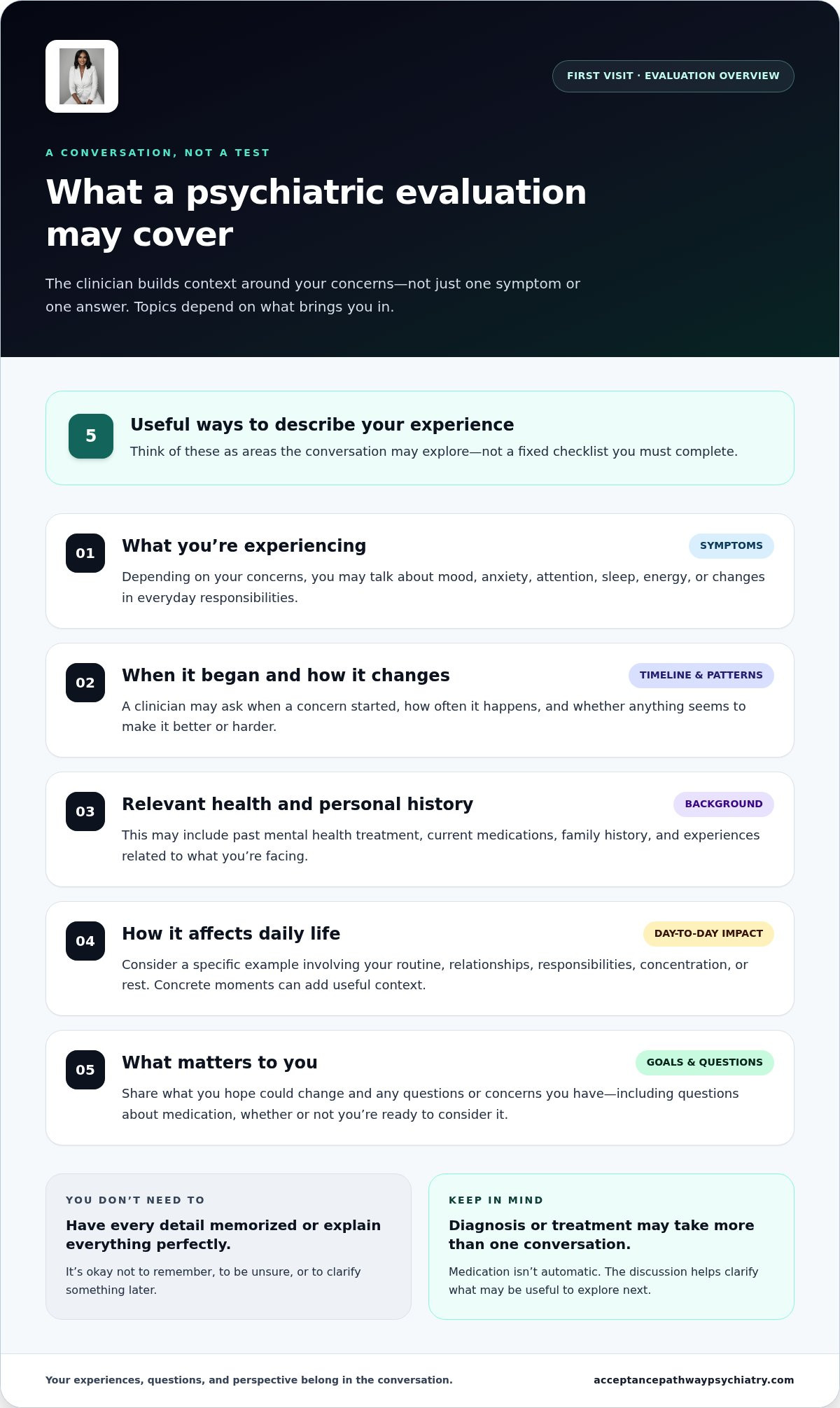
Depending on what brings you in, a clinician may ask about mood, anxiety, attention, sleep, energy, or changes in how you manage everyday responsibilities. They may ask when a concern began, how often it occurs, and whether anything seems to make it better or harder. For example, difficulty concentrating may need different context if it started recently than if it has been present across school, work, or home life for years.
Relevant health and personal history can add perspective. You may discuss past mental health treatment, current medications, family history, and experiences related to what you’re facing. You aren’t expected to recount every detail. If you can’t remember when something happened or aren’t sure of an answer, say so. You can clarify later if more information comes to mind.
Think of a specific example of how a concern affects your routine, relationships, responsibilities, or rest. A concrete moment can be easier to describe than a broad label, and the clinician can ask follow-up questions if more context would be useful.
Goals, questions, and what matters most to you
An evaluation is also a chance to share what you want help with. Maybe you hope to sleep more consistently, feel less overwhelmed in social situations, or focus more easily during the day. Naming a practical change gives the conversation direction and connects clinical concerns to the parts of life that matter to you.
Your questions belong in the discussion, too. If medication is on your mind, ask what options could be considered, what they’re intended to address, or what concerns to discuss before making a decision. The article Psychiatric Medication Management: A Compassionate Guide to Your Healing Journey explores medication management and related considerations. Questions are welcome even if you’re not ready to consider medication.
A psychiatric evaluation at Acceptance Pathway Psychiatry PLLC gives you space to discuss concerns, priorities, and possible next steps without assuming everyone needs the same plan.
Will I Be Diagnosed or Prescribed Medication at the First Visit?
Not necessarily. A first psychiatry appointment doesn’t have to end with a diagnosis or prescription. Some people receive an initial clinical impression or discuss possible next steps, while others need more conversation or information before the clinician can form a clearer understanding. There’s no single timeline that fits everyone.
That uncertainty can feel uncomfortable, especially if you’re hoping for answers or worried treatment might be decided for you. If you’re wondering what to expect first psychiatry appointment, remember that evaluation is a process of understanding your concerns and considering what may help, not an automatic commitment to a specific treatment.
How diagnosis may be discussed
A clinician may talk through possible explanations for what you’re experiencing, including what seems to fit and what still needs clarification. They may consider how symptoms began, how they’ve changed, and how they relate to your health and personal history. A working impression can guide further discussion without being the final word.
Diagnostic understanding can develop as more context becomes clear. If important details are missing, symptoms overlap, or you need time to reflect, follow-up may help. This doesn’t mean your concerns aren’t being taken seriously. It means the clinician is working toward an assessment grounded in your experience rather than forcing an answer from limited information.
How treatment choices are discussed collaboratively
Medication is one possible approach, not a requirement for everyone. Depending on your needs and the clinical discussion, care may include medication management, psychotherapy, another appropriate option, or a combination. Treatment decisions depend on clinical context and your preferences.
Share what you’re comfortable considering, what gives you pause, and what you’ve tried before. For example, if you’ve taken medication in the past, describe what felt helpful or difficult. If you’re unsure, ask what an option is intended to address, what other approaches might be considered, and what follow-up could involve. You don’t have to arrive with a decision already made.
For medication-specific background, the article Finding the Right Medication for Your Unique Journey can help you identify questions to bring to a medication discussion. Reading about options doesn’t obligate you to choose them. It can simply help you decide what you’d like to ask.
A collaborative plan leaves space for your perspective and the clinician’s professional judgment. Ask for an explanation in everyday language, share concerns as they arise, and take part in discussing next steps. The aim is to find an approach that makes sense for your circumstances, not to rush you into a decision.
How to Prepare for Your First Psychiatry Appointment
Preparing doesn’t mean completing a packet of homework or having every detail figured out. A few simple notes can help you remember what matters if nerves make it harder to find the words. If you’re researching what to expect first psychiatry appointment, remember that preparation should support the conversation, not make it perfect.
Use these steps as a flexible guide. Choose what feels useful and leave the rest.
- Write down your main concerns. Note what prompted you to seek care and when you first noticed it. If the timing is unclear, an estimate or “I’m not sure” is enough.
- Add a few everyday examples. Briefly describe how the concern affects sleep, focus, relationships, work, school, or routines. You don’t need a complete timeline; one or two moments can help make your experience easier to discuss.
- Gather relevant health and treatment details. If available, list current medications and supplements, past treatments, and anything you remember about those experiences. Bring existing information if it’s easy to access, but don’t delay the conversation because a record is missing.
- Choose questions and make a simple plan. Jot down anything you want to ask. For a virtual appointment, choose a private, comfortable space and check that your device, internet connection, and audio are working beforehand.
What information can be useful to bring
A concise medication list can include medication names, doses if you know them, and supplements you take. Notes about when symptoms tend to show up, what seems to affect them, and treatments you’ve tried can also provide helpful context. Keep notes brief and in your own words. If you don’t have a medication list, records, or a clear memory of past care, you can still start the discussion and fill in details as you’re able.
Questions to help you feel more prepared
Questions can help you understand the process and make your priorities part of the conversation. You might ask:
- What information would help you understand my concerns?
- What care approaches might fit, and what are their possible benefits or considerations?
- What could follow-up look like, and how will we review whether a plan is helping?
- How can I raise concerns about medication or psychotherapy?
Asking questions isn’t a sign of distrust. It’s part of making informed, collaborative choices. You can write down concerns about side effects, past treatment experiences, or starting therapy so they’re easier to bring up. You don’t have to ask everything at once; begin with what feels most important to you.
Explore psychiatric appointment options when you’re ready to discuss your concerns and prepare for an evaluation.
What Happens After Your First Psychiatry Appointment?
After the first conversation, you may have a clearer sense of what could happen next, even if every question hasn’t been answered yet. The plan depends on what you discussed, your clinical needs, and whether more information would help guide care. Some people are ready to consider an approach, while others may benefit from further evaluation or another conversation before deciding.
If you’re still wondering what to expect first psychiatry appointment, remember that the process can continue beyond the initial visit. You can revisit questions, share new information, or speak up if a recommendation isn’t clear. Care planning is a discussion, not a one-time decision you’re expected to accept without understanding.
Possible next steps in a personalized care plan
A follow-up can offer time to review your concerns, discuss how you’re doing, and consider whether the plan still fits. Depending on your circumstances, next steps may include medication management, psychotherapy, both approaches, or further evaluation. Follow-up keeps the conversation responsive as your needs and understanding become clearer.
If therapy and medication are both part of a discussion, you may want to explore how the approaches can work together. Combining Therapy and Medication for Holistic Healing offers more context on integrated care. The right mix, if any, depends on your situation and preferences. Ask how progress will be reviewed, what changes might prompt a conversation, and what to do if a plan feels difficult to follow.
Beginning care with Acceptance Pathway Psychiatry PLLC
Acceptance Pathway Psychiatry PLLC provides psychiatric evaluations, medication management, psychotherapy, and telehealth appointments. These are possible avenues for care, not a set sequence every person must follow. A clinician can work with you to understand your concerns and discuss options in a compassionate, collaborative way.
As care continues, it’s okay to bring back a question you didn’t get to ask or explain that your priorities have shifted. You might note what feels different, what remains challenging, or what you’d like to understand better. These reflections can help make follow-up conversations more focused, but you don’t need to track everything perfectly. Your own sense of what matters is useful information.
You don’t need to have the whole path mapped out before taking a first step. Explore Acceptance Pathway Psychiatry PLLC’s care options and consider which questions you’d like to bring to a conversation.
Take the Next Step at Your Own Pace
Knowing what to expect first psychiatry appointment can make reaching out feel more manageable, but you don’t need to feel completely ready or have every concern neatly explained. You can begin with one question, one goal, or simply the sense that something has been difficult. Let the conversation develop from there.
Acceptance Pathway Psychiatry PLLC offers psychiatric evaluations, medication management, psychotherapy, and telehealth appointments, with care for concerns including depression, anxiety, ADHD, PTSD, and bipolar disorder. Your needs and preferences can help shape which care options make sense to discuss. There’s no need to decide on a particular approach before learning more.
Schedule a psychiatric appointment with Acceptance Pathway Psychiatry PLLC to discuss your concerns and take a first step at your own pace.
Frequently Asked Questions
What should I bring to my first psychiatry appointment?
Bring a short list of medications and supplements if you have one, along with any notes that help you remember what you want to discuss. You might include medication doses or how often you take them, if known. A written question can be useful if you’re worried you’ll forget it. You don’t need to gather every record or prepare a complete history before you can begin.
Will a psychiatrist diagnose me during the first appointment?
Possibly, but a diagnosis isn’t guaranteed at the first visit. The clinician may share an initial impression, explain what they’re still considering, or recommend gathering more information. You can ask what a term means and whether it’s a firm diagnosis or a working understanding. If an explanation doesn’t seem to fit your experience, say so. Your perspective can help clarify the discussion.
Will I have to take medication after my first psychiatry appointment?
No, a first appointment doesn’t automatically mean you’ll be prescribed medication. Medication may be discussed as one possible approach, alongside options such as psychotherapy, depending on your needs. If it’s suggested, ask what it’s meant to address, what other options might be considered, and what questions to think over. Share concerns or past experiences so they can inform the conversation.
How long does a first psychiatry appointment take?
The appointment length can vary based on the clinician, your needs, and how much information the evaluation requires. Check the appointment details so you can plan your day, and consider leaving a little flexibility afterward in case you want time to reflect or write down next steps. If you have a scheduling constraint, mention it at the start so it can be part of the discussion.
Can I have my first psychiatry appointment online?
Yes. Acceptance Pathway Psychiatry offers telehealth appointments, so a first visit may be held virtually. Choose a private place where you feel comfortable speaking, and test your device, internet connection, and audio beforehand. Keep any notes or medication information nearby. If something disrupts the connection, let the clinician know and continue the conversation once you’re able.
What if I feel nervous and do not know what to say?
It’s okay to feel nervous or to have trouble finding the words. You can start by saying, “I’m not sure where to begin,” or describe what led you to make the appointment. A few notes can help you get started, but you don’t have to follow a script. If you need a pause, take one. The conversation can unfold at a pace that feels manageable.


