

What if starting psychotherapy didn’t mean sharing everything before you feel ready? Your first conversation can begin with what’s bringing you in, what you hope might change, and what feels comfortable to discuss. You and your clinician can build understanding and agree on a pace together.
It’s understandable to feel unsure about what happens in therapy or how to choose an approach. Psychotherapy isn’t a quick fix or a guarantee, but it can provide support as you explore concerns, develop ways to cope, and work toward meaningful goals. The process should reflect your needs, not follow a one-size-fits-all plan.
This guide explains what psychotherapy can and can’t do, what early sessions may involve, and how therapy approaches can differ. You’ll also learn about collaboration, confidentiality and its limits, and practical ways to begin care. Acceptance Pathway Psychiatry PLLC provides psychotherapy in person and virtually, with care shaped around your concerns and goals.
Key Takeaways
- Psychotherapy is collaborative care shaped around your concerns and goals, not a fixed script.
- You can discuss different therapeutic approaches with your clinician and consider what may fit your needs.
- Sessions can focus on what feels manageable, helping you identify priorities without sharing everything at once.
- Progress may show up in coping, daily life, self-understanding, or symptoms, and it can unfold gradually.
- Psychotherapy may be part of a broader care plan, including medication management when clinically appropriate.
What Is Psychotherapy, and When Might It Help?
Seeking support can feel unfamiliar, deeply personal, or difficult to explain. You may know something feels wrong without having a clear name for it, or wonder whether your concerns are serious enough to bring to a clinician. You don’t need a perfectly organized story before beginning. Start with what you’ve noticed and what you’d like to feel or handle differently.
Psychotherapy is a collaborative form of mental health treatment in which you and a qualified clinician explore concerns, patterns, and possible ways forward. Sessions may involve talking through experiences, understanding how thoughts and emotions affect daily life, and considering steps that align with your goals. Approaches vary, and care is shaped around the person receiving it. For a broader overview of psychotherapy’s aims, types, and practitioners, see What is psychotherapy?
People seek support for many reasons, including symptoms, major life changes, ongoing stress, or relationship difficulties. Therapy can support well-being and help address concerns, but it can’t promise a particular result or follow the same path for everyone. What feels useful may depend on your circumstances, priorities, and the working relationship you build with your clinician.
What concerns can psychotherapy help address?
People may seek help with experiences connected to depression, anxiety, trauma, or life stress. These examples don’t automatically point to a diagnosis. The same situation can affect people differently: worry might disrupt one person’s sleep, while another person may struggle to concentrate or manage everyday responsibilities.
A qualified clinician can help you consider how your experiences, circumstances, and goals fit together, then discuss what kind of support may be appropriate. You might begin by describing a recent difficult moment, a pattern you’ve noticed, or an area of life where you’d like more steadiness. You don’t need to know the clinical term for what’s happening.
Do you need a diagnosis to start psychotherapy?
No. People can seek therapy because they feel distressed, are facing a life challenge, or want help understanding a difficult pattern, even without a diagnosis. A single feeling or symptom doesn’t, by itself, establish a mental health condition. Assessment involves looking beyond one moment to understand the surrounding circumstances and how the concern affects you.
In an initial conversation, you can share what prompted you to seek support, what you’ve already tried, and what you hope might change. The clinician can ask questions to better understand your concerns and discuss possible next steps with you. If you’re unsure where to begin, “I’m having a hard time explaining it” is a valid place to start.
How Do Psychotherapy Approaches Work?
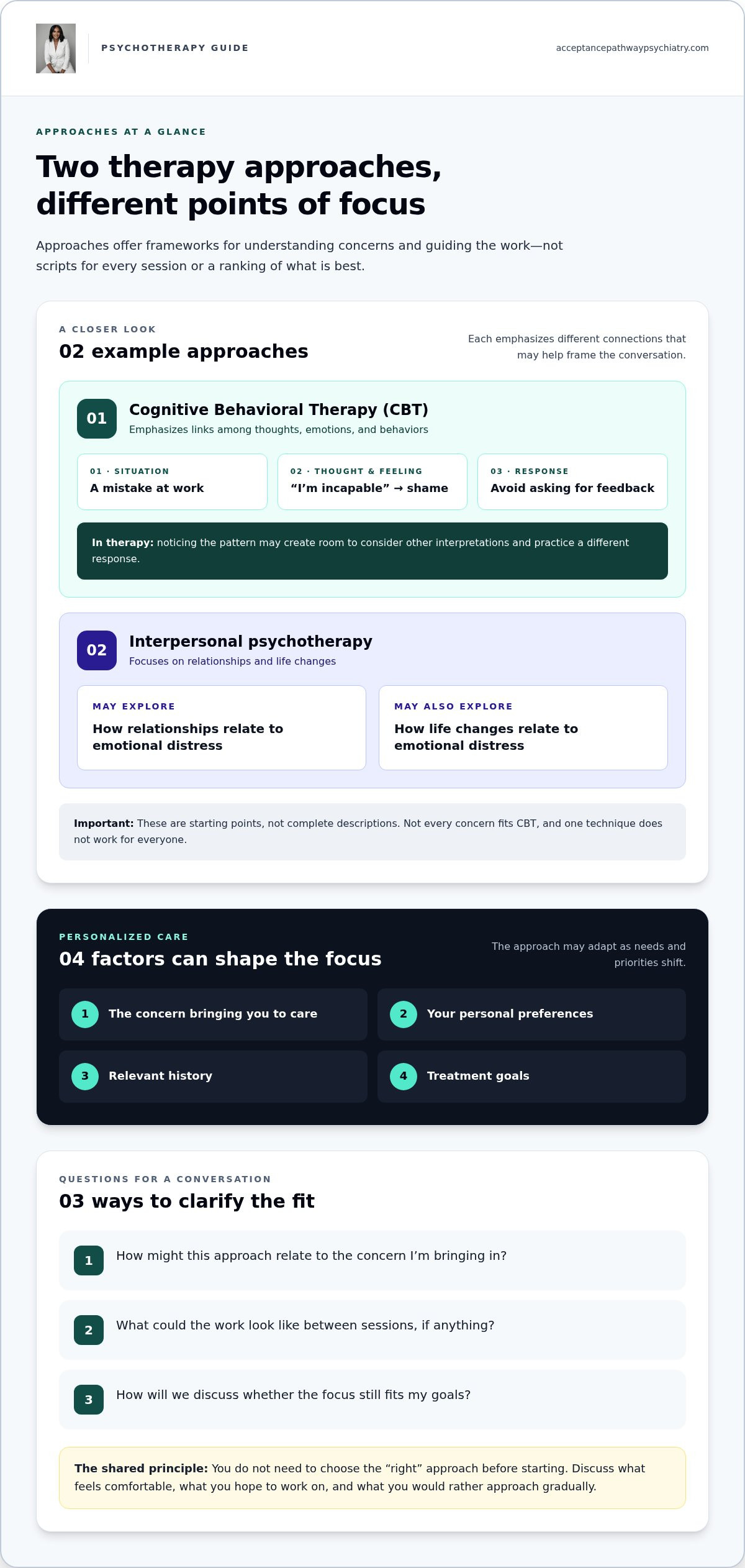
Therapy approaches are broad frameworks for understanding concerns and guiding the work, not scripts that dictate what happens in every session. They aren’t interchangeable quick fixes, either. Some approaches emphasize present-day patterns, relationships, past experiences, or practical ways of responding to challenges. Your clinician can explain how an approach relates to your concerns and goals, then work with you to identify a useful place to begin.
Two examples illustrate some of the differences. Cognitive Behavioral Therapy (CBT) generally explores links among thoughts, emotions, and behaviors. Interpersonal psychotherapy focuses on how relationships and life changes may relate to emotional distress. These descriptions are starting points, not complete accounts of either approach. The American Psychological Association offers an overview of Different approaches to psychotherapy and the varied ways treatment may be structured.
How does Cognitive Behavioral Therapy differ from other approaches?
CBT often draws attention to a cycle: a situation prompts a thought, the thought affects feelings, and those feelings may shape what someone does next. For example, after making a mistake at work, a person might assume they’re incapable, feel ashamed, and avoid asking for feedback. In therapy, noticing this pattern may create room to consider other interpretations and practice a different response. That doesn’t mean every concern fits CBT or that one technique works for everyone.
Other frameworks may focus more on relationship patterns, emotional experiences, or the meaning a person makes of past events. These are differences in emphasis, not a ranking of approaches. A clinician can explain the reasoning behind a possible method and how it might connect to what you want to address.
Why might therapy approaches vary from person to person?
The approach may reflect the concern bringing someone to care, personal preferences, relevant history, and treatment goals. A person who wants to understand recurring conflict may seek specialized support from providers like Counselling Anger Management Birmingham Citizen Coaching, whereas someone else might need help responding to anxious thoughts in daily life. Your preferences matter, too. You can discuss what feels comfortable, what you hope to work on, and what you’d rather approach gradually.
Care can also adapt as your needs shift. Your clinician may revisit the focus with you if a strategy feels unhelpful, circumstances change, or new priorities emerge. You don’t need to choose the “right” approach before starting. Useful questions to discuss include:
- How might this approach relate to the concern I’m bringing in?
- What could the work look like between sessions, if anything?
- How will we discuss whether the focus still fits my goals?
These questions can make the process clearer and more collaborative. Acceptance Pathway Psychiatry PLLC provides psychotherapy tailored to your concerns and goals. You can read about psychotherapy care at Acceptance Pathway Psychiatry PLLC.
What Happens in Psychotherapy Sessions?
You don’t need to arrive at a session with a complete explanation or a polished account of what’s wrong. A conversation can begin with a concern, a question, or uncertainty about what to say. You and the clinician can focus on what feels relevant to you, and you can ask to slow down, pause, or change direction.
There isn’t one session structure that works for everyone. You and the clinician might discuss what’s been happening, identify what feels most pressing, and choose a useful focus for the conversation. Over time, you may revisit your priorities and talk about whether the work still reflects what you need. Questions, feedback, and moments of discomfort belong in the conversation, too.
If choosing a starting point feels difficult, bring one example from daily life, such as a recurring worry, a strained interaction, or a situation you’ve been avoiding. You can also say you’re not ready to discuss a particular subject. The clinician can help you explore what feels manageable without making disclosure a requirement for care.
What can you expect when therapy begins?
Early conversations may cover what led you to seek support and what you hope could change. A clinician may ask about relevant personal history and current circumstances to understand your concerns in context. You can ask why a question matters or say when you’d rather not answer yet. The pace and focus depend on your needs, so one person’s first session won’t necessarily resemble another’s.
Think of goals as a direction, not a test you need to pass. Instead of trying to state a perfect outcome, describe what you’d like to handle differently, understand more clearly, or find less overwhelming. You can adjust your goals as you learn more about what matters to you.
How do trust and confidentiality shape therapy?
Trust can grow through repeated experiences of being heard and treated respectfully. You don’t have to feel fully comfortable right away. Confidentiality generally protects what you share, but it has limits. Those limits may involve safety concerns or legal requirements, and details can vary. Ask the clinician to explain how privacy is handled before sharing anything you’re unsure about.
It’s also okay to raise a question or discomfort directly. You might say, “I’m not sure I understand what stays private,” or “I’d like to take more time before discussing that.” A respectful conversation about privacy, boundaries, and pace can help you understand what to expect and decide how to participate.
After a session, it may help to reflect on what felt useful, what was unclear, and what you’d like to focus on next time. You can share that feedback with your clinician. If your priorities change or a topic feels too difficult to approach in the same way, say so. Psychotherapy is collaborative, and making adjustments is part of working together, not a sign that you’re doing it wrong.
How Can You Recognize Progress in Psychotherapy?
Progress isn’t always a sudden shift or a complete absence of difficult feelings. It may show up in small changes: recovering more quickly after a stressful moment, asking for support instead of withdrawing, or understanding what tends to intensify a concern. You might also notice changes in symptoms, daily functioning, or how clearly you can describe what you need. The signs depend on your starting point and goals.
Change can be gradual and uneven. A hard week doesn’t erase steps you’ve taken, and facing a difficult topic may feel uncomfortable without meaning that care is going badly. You don’t have to trust someone immediately or disclose every personal detail for therapy to be worthwhile. Being able to set boundaries and choose what to discuss can help you find a workable pace.
To make progress easier to notice, reflect between sessions on a few practical questions:
- What felt a little easier to manage since we last spoke?
- Is anything still getting in the way of daily life?
- Does our current focus connect with what matters to me now?
Your answers don’t need to show improvement every time. They can help you and your clinician understand what’s changing, what remains difficult, and whether the next phase of care should have a different focus.
What if psychotherapy feels difficult or progress seems slow?
Bring that experience into the conversation. You might say, “I’m not sure this is helping yet,” “I feel uncomfortable with this topic,” or “I don’t understand how this connects to my goal.” These aren’t signs of failure. They give your clinician useful information about your experience and create an opportunity to review the approach together.
You can also consider possible barriers without blaming yourself. Perhaps a goal feels too broad, your circumstances have changed, or the current focus doesn’t seem relevant. Discussing those details may help clarify what to adjust, what to continue exploring, or what support you need to participate comfortably.
How can you talk about goals and treatment fit?
Describe the difference you hope to notice in everyday life. Rather than aiming only to “feel better,” you might want to sleep more consistently, manage a recurring worry, or feel more able to speak up in an important relationship. Your goals can change as your circumstances and priorities shift. Reviewing them together helps keep care connected to what matters to you.
Feedback is part of collaboration. Let your clinician know what feels useful, confusing, too fast, or difficult to apply outside sessions. You don’t need to have a solution before raising a concern. Acceptance Pathway Psychiatry PLLC provides psychotherapy shaped around your needs and goals, as described in its psychotherapy care information.
How Can Psychotherapy Fit Into Your Mental Health Care?
Mental health care can take different forms, and a plan depends on your needs, concerns, and clinical circumstances. Therapy may be part of care on its own or combined with other support when appropriate. The aim is to consider what may be useful for you, rather than assume everyone needs the same combination.
Acceptance Pathway Psychiatry PLLC provides psychotherapy tailored to your concerns and goals, with both in-person and virtual appointments. You can bring questions about what you’re experiencing, what you hope to work on, and how therapy might fit alongside other parts of your mental health care.
Can psychotherapy and medication management work together?
Therapy and medication management address mental health in different ways. Therapy offers space to explore concerns, build understanding, and work toward personal goals. Medication management focuses on evaluating and managing medication as part of care. Depending on individual needs and clinical guidance, one or both may be considered; neither option is automatically right for everyone.
If medication is part of your care or a question you’re considering, discuss how it relates to your goals and overall plan with your clinician. You can also read this guide to psychiatric medication management for more context about that aspect of mental health care.
What can you do if you are ready to explore psychotherapy?
A practical first step is to make a short note of what has been weighing on you, what you’d like to feel or manage differently, and any questions you have about care. You don’t need to know exactly what kind of support you need before starting a conversation. Sharing your priorities can help shape a discussion around what may fit.
Acceptance Pathway Psychiatry PLLC offers in-person and virtual appointments. As you consider the next step, think about which format feels more comfortable and what you’d like a clinician to understand about your situation. Details about psychotherapy services and appointments are available online.
Take a Gentle Step Toward Support
You don’t need to have every concern sorted out before exploring care. A useful first step can be noticing what you’d like help with, what questions you want answered, or what would make a conversation feel more comfortable. You’re allowed to move at a pace that respects your needs.
Psychotherapy is one way to explore support in partnership with a clinician. At Acceptance Pathway Psychiatry, it’s part of a broader range of mental health services that also includes medication management and integrative wellness services. In-person and virtual appointments offer different ways to access care, while the focus can be shaped around your concerns and goals. No particular outcome is guaranteed, but your questions and preferences can help guide the conversation.
When you’re ready, explore psychotherapy and mental health care at Acceptance Pathway Psychiatry and take the next step that feels manageable.
Frequently Asked Questions
What is psychotherapy, in simple terms?
Psychotherapy is a guided conversation with a mental health clinician to help you understand and work through emotional or behavioral concerns. It isn’t simply getting advice or being told what to do. You and the clinician can explore what’s affecting you, notice patterns, and consider ways to respond that fit your life. The focus may change as you learn more about what you need.
Can psychotherapy help if I do not have a mental health diagnosis?
Yes. You can seek support for a difficult transition, persistent stress, or a concern affecting your relationships or daily routine without having a diagnosis. For example, you might want help adjusting after a major change even if you’re unsure how to describe your feelings. A clinician can discuss the context and impact with you without assuming that one experience automatically indicates a condition.
How often do people attend psychotherapy sessions?
There isn’t one schedule that fits everyone. Session frequency can depend on your goals, needs, clinical recommendations, and practical considerations. You can discuss what rhythm may be helpful and realistic, including how it fits with work, caregiving, or other commitments. If your circumstances change, bring that up so you and your clinician can revisit the plan rather than treating the original schedule as fixed.
What should I talk about in my first psychotherapy session?
Start with whatever feels most relevant, even if it seems small or hard to explain. Before the session, jot down a recent situation that bothered you, what you noticed in yourself, and what you’d like help understanding. It may also be useful to mention other care or medications you’re receiving. You can ask what the clinician would like to know and take time with sensitive topics.
Is psychotherapy confidential?
Psychotherapy conversations are generally private, but confidentiality has limits. These can depend on safety concerns, legal obligations, and the circumstances of care. Ask the clinician to explain what information is kept private, how records are handled, and when information might need to be shared. Understanding these boundaries can help you make informed choices about what you’re ready to discuss.
Can psychotherapy be combined with medication?
Yes, therapy and medication may be used together when they fit a person’s needs and clinical guidance. They support care in different ways, so it can help to keep the clinicians involved informed about relevant treatment changes. If you notice a new concern or have questions about how different parts of your care relate, bring them to your clinician or prescriber rather than changing medication on your own.
What if I do not feel comfortable with my therapist?
Tell the clinician what feels uncomfortable, if you can. You might explain that a question felt too personal, the pace feels too fast, or you’re unsure how the conversation connects to your concerns. That feedback can open a discussion about boundaries, communication, or a different focus. You don’t have to force trust or share more than feels manageable while you work out what would help you feel respected.


