

What if explaining psychiatric medication to family didn’t mean convincing everyone to agree with your treatment? You can share what feels safe, keep private details to yourself, and ask for support without handing over decisions about your care. If you’re worried relatives will misunderstand medication or pressure you to start, stop, or change it, the conversation may feel difficult before it even begins.
It makes sense to want understanding while protecting your privacy and independence. You don’t owe anyone a full account of your health or every clinical detail. This guide will help you decide whether to talk with family, choose what and when to share, and describe medication in plain language.
You’ll also find practical ways to ask for specific, respectful support and set boundaries if the conversation becomes uncomfortable. Medication decisions are collaborative between you and your clinician. Family can offer care and encouragement, but decisions about your treatment remain personal.
Key Takeaways
- Decide what you want the conversation to achieve, and remember that sharing is your choice.
- Use everyday language to describe how medication may support your well-being and daily life.
- Answer questions where you feel comfortable, while keeping private details private.
- Plan the timing, setting, and boundaries that can make explaining psychiatric medication to family feel more manageable.
- Bring treatment questions or difficult family reactions to your clinician to discuss possible next steps together.
Explaining Psychiatric Medication to Family Starts With Your Choice
You can want family support and still feel protective of your privacy. Those feelings can coexist. The aim of explaining psychiatric medication to family isn’t to persuade every relative that your treatment is right. It’s to share enough, if you choose, to help someone understand how to support you.
You decide whom to tell, when to talk, and how much to share. You might say that medication is part of your mental health care without naming a diagnosis, sharing the prescription, or describing your treatment history. Those details are yours to discuss only if you want to.
How to decide whether telling family feels right
Think about how this person has handled sensitive conversations before. Do they listen without jumping to conclusions? Have they respected your limits, or used personal information in ways that felt uncomfortable? Their past behavior can help you assess whether the conversation is likely to feel emotionally safe.
It may also help to name your reason for sharing. Perhaps you want understanding, practical help, or fewer misunderstandings about a change in your routine. If you can’t identify a benefit, or disclosure feels unsafe, you can wait or choose not to share. Talking the decision through with someone you trust or your clinician may help you weigh your options without involving family.
What family members need to know, and what they do not
For a useful conversation, you might share the broad picture: medication can be one part of an individualized mental health plan, with the aim of addressing symptoms and supporting daily functioning. Therapy or other forms of care may also be part of a person’s plan. For general background on medication types and uses, see this Psychiatric medication overview.
Choose details based on what would help your relative understand or support you. You could explain what kind of encouragement feels useful while keeping your diagnosis, prescription name, dosage, side effects, or past treatment private. You don’t have to provide a medical record or answer every question to make your needs clear.
Family members can listen, offer practical help, and ask how you’re doing. They don’t need to decide whether medication is appropriate or direct changes to your treatment. Those decisions are made collaboratively between you and your clinician. If a relative has concerns, you can acknowledge them without debating your care: “I hear that you’re worried. I’m discussing treatment with my clinician, and I’m not looking for advice about changing it.”
How to Explain Psychiatric Medication in Clear, Everyday Language
Once you know what you’re comfortable sharing, a simple structure can make explaining psychiatric medication to family feel less overwhelming. You don’t need a medical lecture. Focus on what the medication is meant to support, how it fits into your care, and what would help you feel supported.
Medication can be one tool for addressing symptoms and making daily life more manageable. It doesn’t guarantee a particular outcome, and people can have different experiences. Treatment plans are individualized, so you can speak about your own care without making broad claims about what medication does for everyone. The American Psychological Association also offers practical ideas for balanced support in its guide to Supporting a family member with serious mental illness.
A simple four-step way to start the conversation
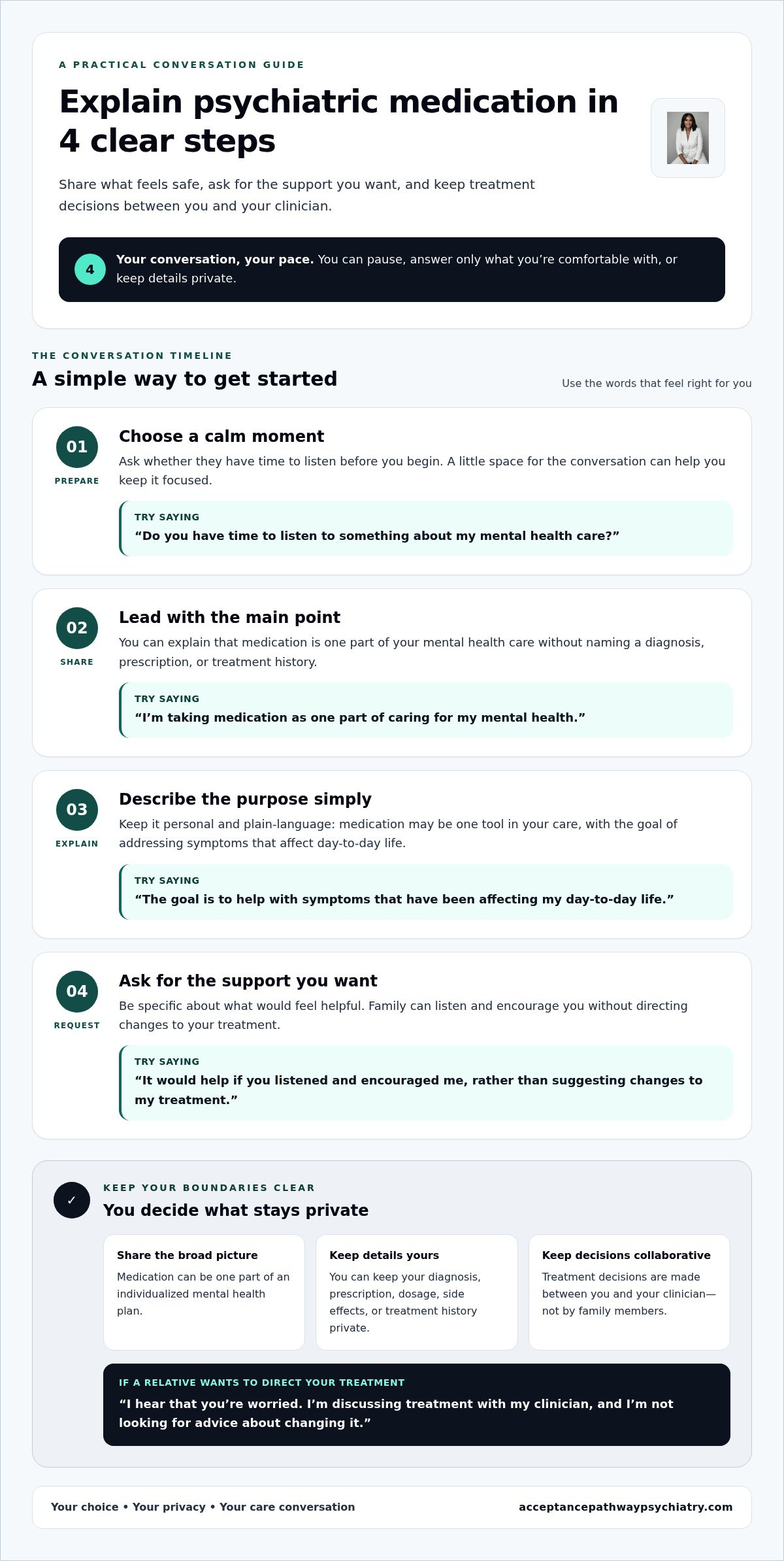
Try this sequence, adjusting the wording to suit your relationship and how much you want to share:
- Choose a calm moment. Ask, “Do you have time to listen to something about my mental health care?”
- Lead with the main point. “I’m taking medication as one part of caring for my mental health.”
- Explain the purpose simply. “The goal is to help with symptoms that have been affecting my day-to-day life.”
- Ask for the support you want. “It would help if you listened and encouraged me, rather than suggesting changes to my treatment.”
This keeps the conversation focused. You can pause after any step, answer a question, or say you’d rather not go into more detail. If you’re unsure how much to share, start with the main point and see how the person responds before adding anything else.
Sample phrases for common family questions
If someone asks why medication is part of your care, you might say, “My clinician and I are considering what could help with the symptoms I’m experiencing. Medication is one part of that plan.” If you’d rather not name a diagnosis or prescription, try, “I’m keeping those details private, but I wanted you to know I’m getting support.”
For questions about what to take, possible effects, or whether a medication is right for you, keep the answer grounded: those are questions to discuss with the prescribing clinician. You can say, “I’m discussing treatment questions with my clinician, and I’ll make decisions with them.” If you want help sorting through concerns or goals, psychiatric medication management involves working with a clinician on your treatment. Explore collaborative medication management as one option for clinical guidance.
Responding to Family Concerns Without Giving Up Your Boundaries
A relative may question medication because they care, feel uncertain, or have heard inaccurate claims. You can listen to their concern without accepting their assumptions. Their worry doesn’t make them responsible for deciding whether you take medication or how your treatment should change. Those decisions belong in a conversation between you and your clinician.
When explaining psychiatric medication to family, you don’t have to win an argument or prove that your diagnosis is valid. You can stay curious if the conversation feels respectful, while keeping your answers brief and your personal information private.
What to say when family members worry about medication
Try acknowledging the emotion, then respond only to what you’re comfortable discussing. For example: “I can hear that you’re worried. I’m talking with my clinician about what’s right for me.” This recognizes their concern without promising a particular outcome or agreeing that their fears are accurate.
If they have a genuine question, you might invite a general conversation: “What have you heard that worries you?” You can respond to misconceptions calmly, but you’re not responsible for educating them on every detail. General information can be discussed without turning the conversation into personal medical advice. Questions about your medication’s benefits, risks, side effects, or possible changes are best addressed with your prescribing clinician, who understands your treatment and circumstances.
When the same concern keeps coming up, a prepared line can help you avoid explaining yourself repeatedly: “I understand you see it differently. I’ve discussed my care with my clinician, and I’m not going to debate it.” A short response is enough.
How to set a boundary when advice becomes pressure
Be clear about what you will and won’t discuss. You might say, “I make treatment decisions with my clinician. Please don’t tell me to start, stop, or change medication.” If a family member asks for your prescription details or medical records, you can simply say, “I’m keeping those details private.” You don’t need to provide more information to earn their approval.
If the pressure continues, repeat your boundary rather than adding new explanations. You can also pause or end the conversation: “I’m not comfortable continuing this right now. Let’s talk another time.” If the exchange feels disrespectful or emotionally unsafe, stepping away is a reasonable way to protect your well-being. You can bring the interaction and any treatment questions it raised to your clinician, then decide what support you want from family going forward.
Plan the Conversation: Timing, Privacy, and Support
A little preparation can help you feel steadier and keep the conversation focused on what matters to you. Before explaining psychiatric medication to family, decide what you hope will come from the discussion. Your goal might be to help one person understand your care, ask for a specific kind of support, or simply share an update. You don’t have to cover every detail or settle every question in one conversation.
A brief checklist before you talk
Write down a few notes if that helps. Keep them simple: who you want to tell, what you’re comfortable sharing, and what support you’d like. Choose one or two points to communicate, such as “I’m working with a clinician on my mental health” and “It would help if you listened without trying to solve it.” You can also note which topics you want to keep private.
Consider the setting and timing. A calm, private moment with enough room to pause may work better than a rushed conversation or a family gathering. You can ask to talk for a few minutes or let your relative know you’d prefer to take the subject one step at a time. If you feel overwhelmed, a prepared phrase can help you close the conversation: “I need a break. We can continue another time.”
For broader context about the clinician’s role in treatment, read this guide to psychiatric medication management guidance. It can help you decide what general information might be useful to share while keeping personal treatment details private.
What supportive family involvement can look like
Support doesn’t need to mean managing your care. It might look like listening without judgment, checking in in a way you welcome, or helping maintain a calm routine. Be specific about what would help: “I’d appreciate a check-in,” or “Please ask before offering advice.” Small, agreed-on actions can make support feel more respectful and useful.
Any family involvement should reflect your preferences and, where relevant, your clinician’s guidance. A relative shouldn’t monitor medication, track symptoms, or take responsibility for treatment unless you’ve asked for that kind of help and it fits your care plan. If you’re working with a clinician on medication questions or treatment goals, explore collaborative psychiatric care as a source of professional support.
Keep Medication Decisions Personal and Find Support That Fits
A family conversation can help someone understand what support you want, but it doesn’t replace clinical guidance. Your relative may share concerns or ask questions, yet medication decisions are made between you and your clinician. You can consider a family member’s perspective without letting pressure determine your care.
When a clinician can help with medication questions
Bring questions about your treatment goals, possible benefits or risks, side effects, and any proposed changes to the clinician who prescribes your medication. If a family member’s comments have made you uncertain, uncomfortable, or ashamed, tell your clinician that too. Those reactions are part of your experience and can help shape a conversation about what you need.
Don’t start, stop, adjust, or share medication based on family advice alone. If you’re considering a change, talk it through with your clinician first. You can also bring notes from a family conversation, such as what they asked or what felt difficult, so you don’t have to remember every detail during your appointment.
A low-pressure next step for ongoing support
Explaining psychiatric medication to family can bring up questions that are easier to work through with a professional. Medication management offers a setting to discuss treatment and goals collaboratively. Psychotherapy can also support reflection on family dynamics, boundaries, and the emotional impact of these conversations. These approaches may be part of an individualized care plan, and family participation isn’t required.
At Acceptance Pathway Psychiatry PLLC, medication management and psychotherapy are available through in-person and telehealth appointments. You can seek care for your own questions and concerns, whether or not you choose to involve relatives. The next step can simply be learning more about support that fits your needs.
Explore compassionate psychiatric care
Move Forward With Support That Respects Your Choices
Explaining psychiatric medication to family can start with a small, clear conversation, not a complete account of your health. Choose what to share, describe medication in everyday language, and ask for the kind of support that would genuinely help. If a relative questions or pressures you, you can set a boundary without defending every part of your care.
Family conversations may help others understand your needs, but treatment decisions belong in a collaborative conversation with your clinician. Bring medication questions, concerns, or difficult family reactions to them so you can consider your care with informed support.
Acceptance Pathway Psychiatry offers psychiatric evaluations, ongoing medication management, and psychotherapy, with appointments available in person and virtually. You can explore care for yourself; involving family is not required. Explore compassionate medication management and psychotherapy.
You deserve support that honors both your well-being and your boundaries. Take the next step at a pace that feels right for you.
Frequently Asked Questions
How do I explain psychiatric medication to my family?
Start with a simple explanation of why medication is part of your mental health care and what support you’d welcome. For example: “I’m working with a clinician on symptoms that affect my daily life. Medication is one part of my care, and I’d appreciate your listening.” You can share more if you choose, but you don’t need to explain every clinical detail or persuade your family to agree.
Do I have to tell my family that I take psychiatric medication?
No. Whether to tell family is your choice. Consider whether sharing might help you feel understood or receive practical support, and whether the person has shown respect for your privacy. If you decide not to disclose, or to wait until you feel ready, that’s valid. You can also talk through the decision with a trusted person or clinician without involving relatives.
What should I say if my family thinks psychiatric medication is unnecessary?
You can acknowledge their concern without debating your treatment: “I understand you have questions, but my care is a decision I’m making with my clinician.” If they repeat inaccurate claims, you don’t have to answer every point or defend a diagnosis. For questions about your medication’s benefits, risks, or possible changes, speak with the prescribing clinician rather than relying on family opinions alone.
Can my family talk to my psychiatrist about my medication?
You can ask your clinician how family input may be included in your care and what information can be shared. You might choose to invite a relative to a conversation, or prefer to discuss their concerns yourself. A family member can also share information with a clinician, but that doesn’t automatically mean the clinician can discuss your personal treatment with them. Ask about privacy and consent directly.
How much detail should I share about my psychiatric medication?
Share only what feels useful and comfortable. You might explain that medication is part of your mental health care and describe the support you’d like, while keeping your diagnosis, prescription name, dosage, or treatment history private. If someone asks for more detail, you can say, “I’m not ready to discuss that,” or, “I’m talking about those questions with my clinician.” A brief answer can be enough.
What if my family reacts negatively when I tell them?
A negative reaction can feel painful, but it doesn’t mean you need to change your treatment or share more to gain approval. You can set a clear limit: “I’m willing to talk if we can do so respectfully.” If the conversation becomes upsetting, pause it or leave. Consider speaking with someone you trust or your clinician afterward, especially if the reaction affects your well-being or raises questions about your care.


