

What if therapy and psychiatry didn’t have to compete for a place in your care? You may wonder whether a therapist and psychiatrist do the same work, whether treatment will feel fragmented, or whether medication might take the place of therapy. Combined therapy and psychiatry can bring different kinds of support into a plan shaped around your needs and preferences.
Psychotherapy offers space to explore emotions, patterns, and coping strategies. Psychiatric care can assess mental health concerns and discuss medication as one possible option, not a requirement for everyone. When these approaches are thoughtfully considered together, you can talk about how each might support your goals and what feels manageable.
This article explains what psychotherapy and psychiatric care each contribute, what coordination may involve in practice, and how the two forms of care can complement rather than simply sit side by side. You’ll also find questions to help you prepare for a care conversation, whether you’re considering therapy, medication management, or both.
Key Takeaways
- Combined therapy and psychiatry can be considered as parts of a person-centered plan, with care shaped around individual priorities rather than a one-size-fits-all approach.
- Thoughtful coordination can keep goals and relevant progress in view while respecting consent and privacy.
- Therapy, psychiatric care, and coordinated services have different potential roles. The right fit depends on a person’s needs and preferences.
- Prepare for a care conversation by naming your concerns, identifying goals, listing questions, and sharing relevant history.
- Your preferences and goals can inform conversations about psychotherapy, psychiatric evaluations, and medication management.
Combined therapy and psychiatry: what each brings to care
Combined therapy and psychiatry means psychotherapy and psychiatric services may be considered together within a person-centered plan. The aim isn’t to automatically add more treatment. It’s to understand what you’re experiencing, clarify what matters to you, and discuss which forms of support may fit your needs and preferences.
Each role brings a different perspective. Psychotherapy helps you explore experiences and work toward therapeutic goals; psychiatric care can assess mental health concerns and discuss medication as one possible option. These approaches can complement each other, but they aren’t interchangeable.
This video offers an overview of two medication types. It’s educational, not a recommendation about what you should take.
What does psychotherapy address?
Therapeutic conversations offer space to describe concerns, notice patterns, and work toward goals you and your therapist agree on. Depending on your needs, sessions might explore emotional responses, relationships, coping skills, or behaviors you’d like to change. For example, you could describe a stressful situation, what you thought and felt in the moment, and how you responded. That can give you and your therapist a concrete starting point for discussing patterns and possible ways to respond differently. The focus and approach can vary; no single style or goal fits everyone.
What does psychiatry add to the picture?
A psychiatric evaluation is a conversation about your concerns and mental health needs. It can help inform discussion of possible care options, including medication. Talking about medication doesn’t mean you have to take it. You can share questions, preferences, or reservations and discuss what feels acceptable to you.
If medication is part of your care, medication management may include follow-up conversations and reassessment as your needs or experience change. You and the clinician can revisit the plan rather than treating an initial decision as permanent. Psychotherapy may continue alongside psychiatric care, or your needs may call for a different arrangement. Choices should reflect your circumstances, preferences, clinical assessment, and ongoing discussion.
Coordination can take different forms. In medical settings, Consultation-liaison psychiatry addresses the relationship between general medicine and psychiatric care. That’s one example of how mental health perspectives can connect with other aspects of care, though it isn’t the only model. Whatever the arrangement, clear goals and appropriate consent help keep your priorities central.
How combined therapy and psychiatry can work together
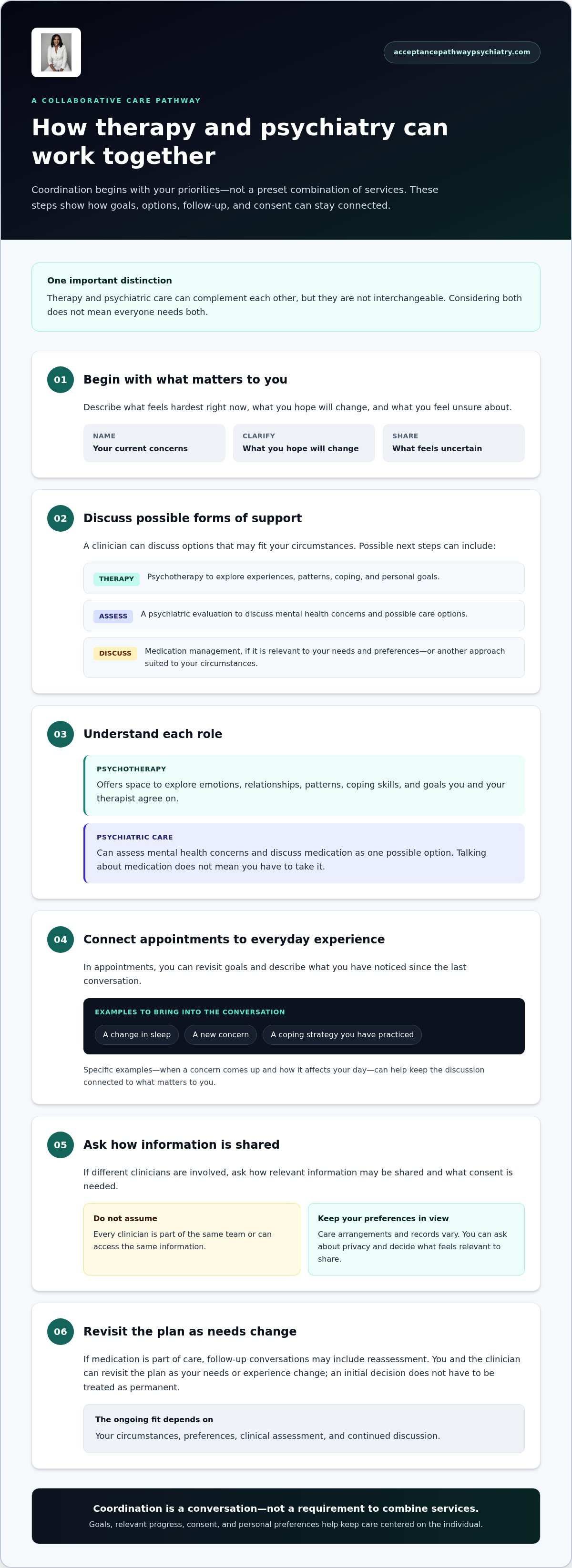
Coordination starts with your priorities, not a preset combination of services. Describe what feels hardest right now, what you hope will change, and what you’re unsure about. A clinician can then discuss possible next steps, which may include psychotherapy, psychiatric evaluation, medication management, or another approach suited to your circumstances.
Combining services doesn’t automatically mean every person needs both. Psychotherapy and medication management can address different aspects of care. Therapy may focus on patterns, coping, and personal goals, while psychiatric care can help assess concerns and discuss medication options. Whether either or both make sense depends on your needs, preferences, clinical assessment, and continued conversation.
What can coordination look like day to day?
In appointments, you can review your goals and describe what you’ve noticed since the last conversation. For example, you might mention a change in sleep, a new concern, or a coping strategy you’ve been practicing. Specific examples, such as when a concern comes up and how it affects your day, can help keep discussions connected to what matters to you.
If different clinicians are involved, ask how relevant information may be shared and what consent is needed. Care arrangements and records vary, so don’t assume every clinician is part of the same team or has access to the same information. You can ask about privacy and decide what feels relevant to share.
Why might someone consider both approaches?
Some people want space to build coping skills while also exploring a psychiatric evaluation or medication discussion. This may come up for people experiencing depression, anxiety, ADHD, PTSD, or bipolar disorder, but a diagnosis alone doesn’t determine what care is right. The person’s experience and clinical assessment matter.
A Psychiatric Times discussion describes ways psychotherapy and medication may work synergistically in the treatment of major depressive disorder. That’s a perspective, not a promise or a universal rule. Appropriate options depend on the condition, the treatments considered, and individual context. Combined therapy and psychiatry is best approached as a discussion about fit, not a requirement or a ranking of care options.
To make that discussion more useful, bring questions about your goals, what you’ve already tried, and any concerns about therapy or medication. You can explore psychotherapy and psychiatric care options as part of considering what feels right for you.
Combined care compared with therapy or psychiatry alone
There isn’t one care arrangement that fits everyone. Options differ in focus, and you may start with one form of support or consider coordinated services based on your concerns, preferences, history, and clinical assessment. The comparison below describes common possibilities, not a ranking or a treatment recommendation.
| Care arrangement | Common focus and activities | Possible role |
|---|---|---|
| Psychotherapy alone | Conversations about emotions, relationships, coping, behavior, and personal goals. | A possible starting point for working through concerns or life challenges with therapeutic support. |
| Psychiatric care alone | Evaluation of mental health concerns and discussion of care options, which may include medication and follow-up. | A way to explore symptoms and treatment possibilities with a psychiatric clinician. Medication isn’t automatic. |
| Coordinated services | Psychotherapy and psychiatric care considered in relation to a person’s goals and relevant progress. | An option when a person and clinician identify needs that may benefit from more than one kind of support. |
When might therapy alone be a reasonable starting point?
Someone seeking help with emotional patterns, coping, relationships, or a difficult life transition may choose to begin with psychotherapy. Sessions can provide room to explore concerns and clarify goals. If symptoms change, daily life becomes harder to manage, or new questions arise, discuss whether additional support may be helpful. You don’t need to diagnose yourself or make changes to prescribed care on your own.
When might psychiatric care or coordinated support be considered?
A psychiatric evaluation can help explore symptoms, relevant history, and possible treatment options. Psychiatry doesn’t always mean medication, and medication doesn’t automatically replace psychotherapy. You may choose to discuss medication while continuing therapy, or prefer to consider other options. The decision belongs in a conversation that includes clinical assessment and your preferences.
Coordinated services may be considered when someone wants both therapeutic support and psychiatric input. For example, a person might value space to work on coping and relationships while also discussing changes in mood, sleep, focus, or medication options. The combination should make sense for that individual, rather than being treated as a standard step for a particular diagnosis. Combined therapy and psychiatry is one possible care arrangement, not a requirement for everyone. Ask questions, share what matters to you, and work with a clinician to consider an appropriate next step.
How to make combined therapy and psychiatry feel collaborative
Good care conversations make room for your perspective. You don’t need to arrive with a perfect explanation or a ready-made plan. A few notes can help you describe what’s happening, what you hope to work toward, and what you’d like to understand about combined therapy and psychiatry.
Before an appointment, try this simple framework:
- 1. Name your concerns. Note what has been affecting you and what feels most important to discuss.
- 2. Identify goals. Think about what you’d like to be different, even if the goal is simply to understand your options.
- 3. List questions. Write down anything you’re unsure about, including questions about therapy, medication, or coordination.
- 4. Share relevant history. Mention past or current care, treatments you’ve tried, and experiences that may help inform the conversation.
Questions to bring to a care conversation
Clear questions can help you understand the purpose of each proposed service and take part in decisions. You might ask: “What would this service focus on?” “How will we review progress?” or “What other options could we consider?” Share your preferences and uncertainties, including concerns about medication or therapy. If multiple clinicians are involved, ask how relevant information may be shared and discuss consent and privacy.
What can help keep a care plan manageable?
Choose a small number of meaningful goals to revisit over time. These might relate to coping, daily routines, or understanding a concern. Between appointments, jot down questions or changes you want to remember. Brief notes can make it easier to describe what you’ve noticed without needing to track everything.
Follow-up conversations are an opportunity to revisit goals, discuss progress, and raise new questions. If something feels unclear or difficult, bring it to your clinician. Don’t start, stop, or change prescribed medication on your own; ask your clinician about concerns or possible changes. For more context on what medication follow-up may involve, read this psychiatric medication management guide. It offers general information, not a substitute for an individual evaluation.
At Acceptance Pathway Psychiatry, care conversations can include your concerns, preferences, and goals alongside psychotherapy, psychiatric evaluations, and medication management. Explore therapy and psychiatric care options as you consider what support may fit.
Explore therapy and psychiatric care with Acceptance Pathway Psychiatry
Understanding the options is a useful start. At Acceptance Pathway Psychiatry, psychotherapy, psychiatric evaluations, and medication management offer different ways to explore mental health concerns and possible support. A care conversation can begin with what’s been weighing on you, what you hope to address, and what you feel comfortable considering. You don’t need to arrive knowing which service is right for you.
Appointments are available in person and through telehealth. The format may shape how you meet, but the conversation can still center on your concerns, preferences, and goals. Treatment choices are individualized, and discussing medication doesn’t mean you’re expected to take it.
What can an initial conversation help clarify?
You can share relevant mental health history, describe current concerns, and identify what you’d like help understanding. For example, you might want to talk about emotional stress, difficulty coping, changes in mood, or questions about medication. The clinician can consider this information as part of an individual evaluation and discuss appropriate next steps with you.
That first conversation doesn’t have to settle every question. Your priorities may become clearer over time, and follow-up discussions can revisit goals or consider whether the plan still fits. Care may evolve as your needs and preferences become better understood. You can ask questions, raise concerns, and take time to consider the options discussed.
If you’re exploring support for a specific concern, note how it affects your daily life and what you’d like to understand. Sharing those details can give the clinician context for discussing possible next steps during an evaluation.
How to take a comfortable next step
Review the practice’s information about psychotherapy, psychiatric evaluations, and medication management, then note any questions you want to bring into a conversation. Consider what matters most to you, including your hopes, concerns, and preferences about different kinds of care. There’s no need to have everything figured out before seeking information.
Combined therapy and psychiatry may be part of a thoughtful care discussion, but there’s no single plan that fits everyone. The aim is to explore appropriate options together, with your perspective included and clinical assessment guiding the conversation.
Take a thoughtful next step toward care that fits
Combined therapy and psychiatry is not a fixed formula. Psychotherapy can offer space to work toward personal goals, while psychiatric care may include evaluation and a conversation about medication. The right arrangement depends on your concerns, preferences, and clinical assessment, and it can be revisited as your needs evolve.
At Acceptance Pathway Psychiatry, psychotherapy and medication management are available as part of care conversations centered on your goals and questions. In-person and telehealth appointments offer different ways to access care. You can take time to consider what you’d like support with and what feels comfortable to discuss.
Ready to explore your options? Learn more about psychotherapy, psychiatric evaluations, and medication management at Acceptance Pathway Psychiatry.
Frequently Asked Questions
Can therapy and psychiatry be done at the same time?
Yes, psychotherapy and psychiatric care can be part of care at the same time if they fit a person’s needs and goals. Therapy may focus on emotional patterns or coping, while psychiatric care can include evaluation and discussion of medication options. Combined therapy and psychiatry doesn’t require the same clinician for both services. You can discuss how the different parts might fit together and what information you consent to share.
Is combined therapy and psychiatry better than therapy alone?
Not necessarily. There’s no single arrangement that’s best for everyone, and suitability depends on the person’s concerns, preferences, history, and clinical assessment. Psychotherapy alone may be a reasonable starting point for someone seeking help with coping, emotions, or relationships. Another person may want a psychiatric evaluation or to discuss more than one kind of support. A clinician can help you consider options without treating combined care as a requirement.
What is the difference between a therapist and a psychiatrist?
A therapist provides psychotherapy, helping people explore concerns, emotions, patterns, and coping strategies. A psychiatrist is a medical doctor who specializes in mental health and can conduct psychiatric evaluations and discuss medication as one possible treatment option. Their roles are different, though both can contribute to mental health care. The specific services in an appointment depend on the clinician and the care being discussed.
Can I receive psychiatric medication management without therapy?
Yes. Psychiatric medication management can be considered without psychotherapy. Medication management may involve discussing your concerns, reviewing how a medication is working if you take one, and talking about possible next steps with a clinician. A psychiatric evaluation can help inform those conversations. You can also ask about therapy if you’re curious, but pursuing medication management doesn’t mean you must participate in psychotherapy.
How do a therapist and psychiatrist coordinate care?
Coordination can involve keeping relevant goals, questions, and progress in view across care conversations. If different clinicians are involved, you can ask how they communicate and what information may be shared. Sharing should take your consent and privacy into account. Don’t assume clinicians have the same records or automatically communicate with each other. You can help connect conversations by sharing updates that feel relevant to your care.
Can combined therapy and psychiatry be done through telehealth?
Telehealth can be a way to access mental health appointments. Acceptance Pathway Psychiatry offers both in-person and telehealth appointments. Whether a particular service is appropriate by telehealth depends on your circumstances and clinical needs, which can be discussed during a care conversation. You can also ask how the appointment format may support your goals and preferences. No treatment format is a fit for every person or situation.
Do I have to take medication if I see a psychiatrist?
No. Seeing a psychiatrist doesn’t mean you have to take medication. An evaluation can help you discuss your concerns and consider possible care options, which may include medication or other support. You can share questions, preferences, or reservations before making decisions. If you already take prescribed medication, talk with your clinician about concerns or possible changes rather than stopping or adjusting it on your own.


