

What if managing bipolar disorder wasn't a choice between the stability of medication and the vitality of a natural lifestyle? Many people find themselves trapped in a frustrating cycle, feeling numbed by prescriptions or anxious about long-term side effects while still bracing for the next mood swing. You deserve a path that respects your need for clinical safety without sacrificing your sense of self or your daily rhythm.
Finding a truly holistic treatment for bipolar disorder means moving beyond the "either-or" mindset. It's about creating a collaborative partnership where medication acts as a grounding force, allowing you to engage deeply with psychotherapy and integrative wellness practices. You don't have to navigate this journey alone or settle for a life that feels muted. It's possible to achieve lasting clarity and emotional balance through a more inclusive approach to care.
In this article, we'll explore how combining clinical excellence with evidence-based lifestyle strategies can help you manage your symptoms effectively. From the precision of Creyos cognitive testing to practical tools for stress management, you'll discover a comprehensive framework designed to help you reclaim your life and find your steady ground.
Key Takeaways
- Understand that a holistic treatment for bipolar disorder integrates clinical safety with wellness strategies to support your whole self, not just your symptoms.
- Learn how evidence-based supplements and nutrition work with your biology to improve cognitive clarity and focus.
- Discover the power of social rhythms and your internal clock as essential tools for maintaining long-term mood stability.
- Gain confidence in building a partnership with your provider by knowing exactly what to look for in an integrative psychiatric evaluation.
- Explore how medication management can serve as a grounding foundation for your deeper emotional and personal evolution.
What Does Holistic Treatment for Bipolar Disorder Mean in 2026?
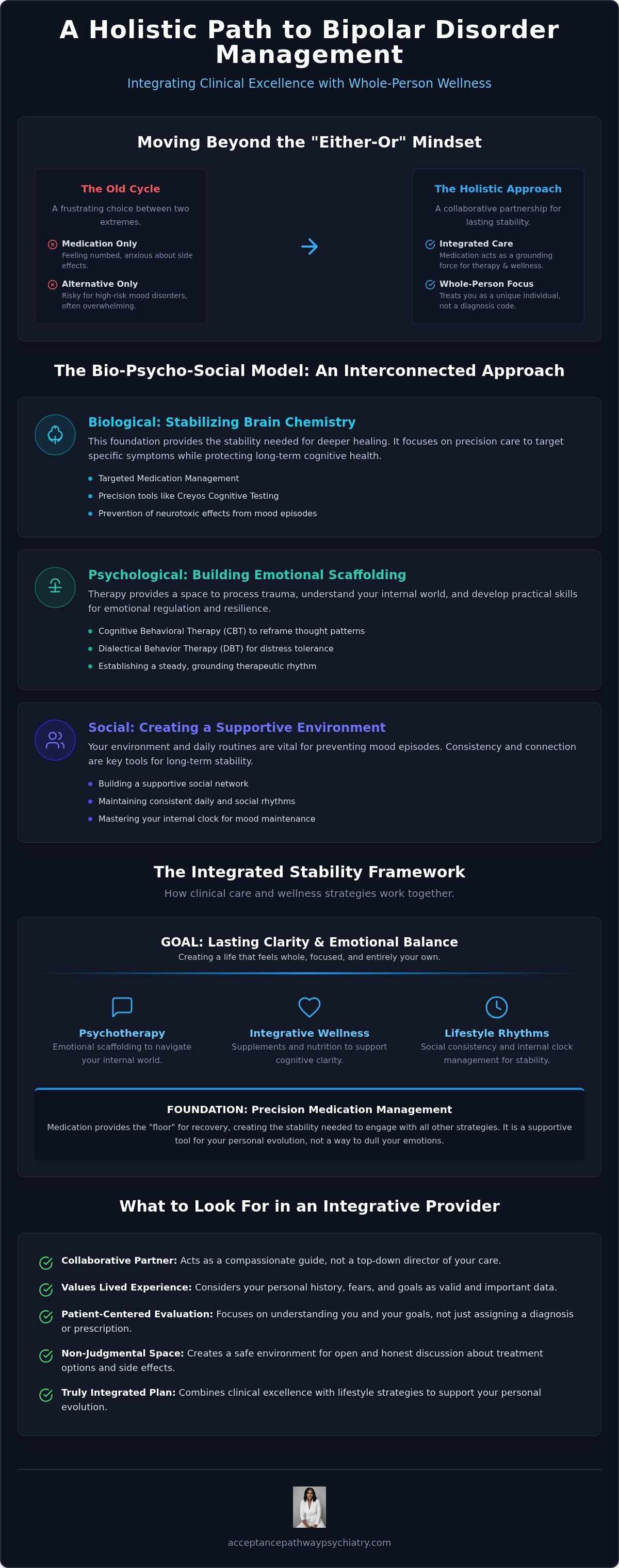
In the past, people often viewed mental health care as a choice between two extremes: traditional clinical psychiatry or alternative wellness. Today, we understand that true holistic treatment for bipolar disorder isn't about choosing sides. It's about moving beyond simply masking symptoms with a prescription. Instead, it's a whole-person approach that treats you as a unique individual rather than a diagnosis code. This method seeks to understand the root causes of your distress while providing the tools you need to build a resilient, fulfilling life.
Holistic bipolar treatment is the synthesis of biological, psychological, and lifestyle interventions.
This shift requires a collaborative expert who acts as a compassionate guide. Instead of a top-down medical model where a doctor dictates your care, you become a partner in your own healing. This relationship values your lived experience as much as clinical data. When you feel heard and respected, the path to stability becomes much clearer.
The Bio-Psycho-Social Model of Care
To achieve lasting stability, we must address three interconnected areas of your life:
- Biological: This involves stabilizing brain chemistry. Using tools like Creyos cognitive testing helps provide precision care, ensuring that medication management is targeted and effective for your specific needs.
- Psychological: Therapy helps you process past trauma and develop the emotional scaffolding needed to handle life's stressors. It's about learning why you feel the way you do and how to respond differently.
- Social: Your environment matters. Building a supportive social network and maintaining consistent daily rhythms are vital for preventing mood episodes and staying grounded.
Why Integration is the Key to Long-Term Recovery
Relying solely on alternative methods can be risky for high-risk mood disorders. Without a biological foundation, the cyclical nature of mania and depression can become overwhelming. Think of medication as the "floor" of your recovery. It provides the stability you need to stand up and engage with other holistic strategies. Without that floor, it's difficult to focus on nutrition or therapy.
When you enter a patient-centered psychiatric evaluation, the goal isn't just to find a drug. It's to understand your history, your fears about side effects, and your goals for the future. This non-judgmental space allows for a truly integrated plan where clinical excellence supports your personal evolution. By combining these elements, you aren't just surviving; you're creating a life that feels whole, focused, and entirely your own.
The Clinical Foundation: Medication and Therapy as Holistic Pillars
When we talk about a holistic treatment for bipolar disorder, we often start with the clinical foundation. This isn't because medication is the only answer, but because it provides the necessary stability for all other healing to take place. We view modern psychiatric medication management as a supportive tool for your personal evolution rather than a way to simply dull your emotions. It's about finding the right balance so you can feel like yourself again, possessing the clarity to make meaningful life choices.
Precision Medication Management
Precision care focuses on targeting specific symptoms like mania, mixed states, or deep depression while keeping side effects to an absolute minimum. This process is deeply collaborative. We work together to find the exact dosage and timing that fits your unique biology and daily routine. Beyond just mood stability, medication plays a vital role in protecting your brain. By preventing the neurotoxic effects that can occur during severe mood episodes, we help preserve your long-term cognitive health and focus.
Psychotherapy: More Than Just 'Talk'
If medication provides the floor, psychotherapy offers the emotional scaffolding. It's a space where you can learn to navigate the complexities of your internal world. Cognitive Behavioral Therapy (CBT) is incredibly effective for identifying the distorted thought patterns that often accompany mood shifts. Meanwhile, Dialectical Behavior Therapy (DBT) provides practical skills for emotional regulation and distress tolerance. Establishing a steady, reliable therapeutic rhythm creates a sense of grounding that helps you stay resilient even when life feels chaotic.
A major part of this journey involves trauma-informed care. Many people living with bipolar disorder have experienced significant stress or trauma that can act as a trigger for mood episodes. By addressing these roots in a safe, non-judgmental environment, we can reduce the power of those triggers. We choose to move away from cold, detached medical jargon. Instead, we use a human-centric dialogue that focuses on your strengths and potential. This supportive approach ensures that you feel like a person, not a patient. If you're ready to explore a more compassionate way to manage your health, you can learn more about our integrative wellness services and how they fit into your recovery.
Integrative Wellness: Supplements, Nutrition, and Cognitive Health
Integrating wellness strategies into a holistic treatment for bipolar disorder allows us to address the biological factors that medication might not fully cover. While prescriptions stabilize the primary mood shifts, targeted wellness interventions support your brain's resilience and energy levels. It's helpful to view supplements as targeted biological supports rather than generic cures. When used under professional guidance, they help fine-tune your internal environment to better sustain stability.
Research highlights specific supports like Omega-3 fatty acids for their anti-inflammatory properties and N-acetylcysteine (NAC) for its role in regulating glutamate and reducing oxidative stress. These aren't "natural alternatives" but evidence-based tools that work alongside your clinical care to improve overall outcomes. By addressing these biological pathways, we can often reduce the intensity of symptoms and improve your overall quality of life.
Nutritional Psychiatry for Mood Stability
The gut-brain axis plays a significant role in how you feel. Your digestive system is responsible for producing a large portion of your neurotransmitters, so what you eat directly influences your mood. Adopting an anti-inflammatory diet helps manage the neuroinflammation often associated with bipolar disorder. Additionally, maintaining blood sugar stability is crucial. Frequent glucose spikes and crashes can mimic or trigger mood swings, making a consistent eating pattern essential for stability. Key nutrients like Vitamin D, Magnesium, and B-complex vitamins also provide the foundational support your nervous system needs to function optimally.
Measuring Progress with Creyos Cognitive Testing
Tracking your recovery shouldn't rely solely on subjective feelings, which can change from hour to hour. Using cognitive testing for mental health provides an objective look at your "brain fog" and recovery progress. We utilize Creyos cognitive testing to identify your unique strengths and weaknesses in areas like memory, focus, and processing speed. This allows us to move beyond guesswork and see how your brain is actually functioning during different phases of your treatment.
This data-driven approach allows us to adjust your care with clinical precision. If you're struggling with cognitive clarity, we can look at the data to see where the breakdown is happening and pivot your strategies accordingly. By monitoring these metrics over time, we ensure your holistic treatment for bipolar disorder is actually moving the needle, helping you reclaim the mental sharpness you need to navigate your career, relationships, and daily responsibilities.
Building Your Personalized Stability Framework
Achieving long-term wellness requires more than just clinical visits. It involves building a daily life that supports your biology. A central part of a holistic treatment for bipolar disorder is the practice of Interpersonal and Social Rhythm Therapy (IPSRT). This evidence-based framework emphasizes that stabilizing your daily routines directly stabilizes your moods. When your body knows exactly what to expect from your environment, it doesn't have to work as hard to maintain balance. By focusing on the timing of your sleep, meals, and social interactions, you create a predictable rhythm that protects you from the extremes of mania and depression.
Many people worry that a consistent routine will feel restrictive or boring. It's helpful to reframe this: routine isn't a cage, it's a foundation for freedom. When you aren't constantly negotiating when to eat or sleep, you free up immense cognitive energy for your passions and relationships. By creating non-negotiable anchors for your day, you provide your nervous system with the predictability it craves. This structure allows you to move through the world with a sense of safety and confidence rather than constantly reacting to shifting internal states.
Step 1: Mastering Your Circadian Rhythm
Your internal clock is perhaps the most influential factor in managing bipolar symptoms. There is a critical link between light exposure and mood regulation. To keep your rhythm steady, focus on a consistent wake time every single day. This helps prevent "social jetlag," which occurs when weekend schedules differ wildly from weekdays and trigger hypomanic episodes. Incorporating an evening wind-down ritual, such as dimming lights and unplugging from screens, signals your brain to begin its natural repair process. Exposure to natural morning light is equally important, as it helps set your biological clock for the next 24 hours.
Step 2: Stress-Relief and Calming Techniques
Learning to listen to your body's early warning signs is vital for staying ahead of mood shifts. Mindfulness-based stress reduction (MBSR) allows you to observe your thoughts without being swept away by them. If you feel your anxiety rising, somatic tools like controlled breathwork can physically calm your nervous system in real-time. By focusing on the physical sensation of the breath, you can interrupt the cycle of racing thoughts before they escalate into a full episode. Additionally, regular movement acts as a natural mood stabilizer by reducing neuroinflammation and improving your body's stress response. If you're ready to build your own framework for stability, you can schedule a telehealth appointment to begin your collaborative care journey with a provider who values your unique experience.
Choosing an Integrative Provider: What to Look For
Finding the right support system is a pivotal step in your journey toward stability. Traditional medical models often rely on a top-down approach where a provider dictates care based on a brief checklist of symptoms. In contrast, a holistic treatment for bipolar disorder thrives on a mutual partnership. You deserve a provider who sees you as the expert on your own life and works alongside you to navigate the complexities of your health. This collaborative relationship is the bridge between clinical excellence and your personal well-being.
When you're looking for an integrative provider, it's helpful to gauge their openness to a whole-person approach during your initial meeting. Don't hesitate to ask questions that reflect your goals. You might ask how they integrate nutritional psychiatry into their care plans or how they handle the collaborative process of medication management. A provider who values your input will welcome these questions and treat the psychiatric evaluation as a shared discovery rather than a one-sided interrogation.
The Collaborative Psychiatric Evaluation
A truly integrative evaluation goes much deeper than a simple diagnosis. It's a deep dive into your unique history, including your experiences with trauma, your metabolic health, and your daily social rhythms. At Acceptance Pathway Psychiatry PLLC, we move beyond the checklist to understand the "why" behind your symptoms. We set mutual goals that prioritize both your clinical stability and your desire for personal growth. This ensures that every part of your treatment plan, from psychotherapy to integrative wellness services, feels relevant to the life you want to lead.
Consistency is vital for bipolar management, and modern technology makes this easier than ever. Telehealth appointments offer the flexibility to maintain your care across the country without the stress of a commute. These virtual visits lower the barrier to consistent support, allowing you to stay connected with your provider even when your schedule is demanding. This accessibility ensures that your path to stability remains uninterrupted and grounded in a steady therapeutic relationship.
The Path Toward Wholeness and Evolution
We believe that managing bipolar disorder is a journey of personal evolution, not just a series of problems to "fix." Our collaborative expert model is designed to provide a steady, non-judgmental presence as you navigate this process. When you feel safe to share your honest internal experiences, real healing can begin. This environment of psychological safety allows us to use tools like Creyos cognitive testing with precision, adjusting your care based on how you're actually functioning in the world.
Taking the first step toward a more integrated life can feel like a significant shift. You don't have to carry the weight of this condition alone or settle for a treatment plan that feels incomplete. By choosing a provider who treats you as a whole person, you're reclaiming your agency and your future. Reaching out for a consultation is the first step toward a partnership that values your unique path to wholeness.
Your Path to Lasting Emotional Balance
Reclaiming your life from the cycles of bipolar disorder requires a shift in perspective. It's about moving from simply managing symptoms to nurturing your whole self. By combining clinical foundations like compassionate medication management with evidence-based wellness strategies, you create a resilient framework for stability. True holistic treatment for bipolar disorder uses objective tools like Creyos cognitive testing to track your progress and social rhythms to ground your daily life. This integrated approach ensures you aren't just surviving; you're evolving toward a life of clarity and purpose.
You don't have to navigate this journey alone. A collaborative partnership with a provider who values your unique experience can make all the difference. Begin your journey toward integrated stability with Acceptance Pathway Psychiatry PLLC. Our integrative wellness services are designed to support your whole-person healing in a safe, non-judgmental environment. You have the strength to find your steady ground, and we're here to walk beside you as you reclaim your vitality.
Frequently Asked Questions
Can holistic treatments replace medication for bipolar disorder?
No, for most people, holistic strategies are meant to complement medication rather than replace it. Medication provides the biological floor or stability you need to engage with other wellness practices effectively. A truly holistic treatment for bipolar disorder integrates these clinical foundations with lifestyle changes to achieve the best results. Relying solely on alternative methods can be risky because of the severe nature of mood cycles.
What are the most effective supplements for managing bipolar depression?
Evidence-based research points to several supplements that can support mood stability. Omega-3 fatty acids are widely studied for their anti-inflammatory effects on the brain. N-acetylcysteine (NAC) helps regulate glutamate levels, which can be beneficial during depressive episodes. Magnesium and Vitamin D also play vital roles in nervous system health. It's essential to discuss these with your provider to ensure they don't interfere with your current prescriptions.
How does Interpersonal and Social Rhythm Therapy (IPSRT) work?
IPSRT focuses on stabilizing your social rhythms, which are the daily routines that set your internal clock. By maintaining consistent times for waking, eating, and social interactions, you reduce the stress on your circadian system. This predictability helps prevent the biological triggers that often lead to mania or depression. It's a practical framework that empowers you to take control of your environment to support long-term mood stability.
Is cognitive testing necessary for bipolar disorder treatment?
While not strictly required for a diagnosis, cognitive testing provides invaluable data for personalizing your care. We use Creyos cognitive testing to measure specific metrics like memory, attention, and processing speed. This allows us to move beyond how you feel and see how your brain is actually functioning. This objective data helps us adjust your medication and wellness plan with much greater precision to address issues like brain fog.
How can I improve my sleep hygiene if I have mania-induced insomnia?
Managing sleep during hypomania requires a strict wind-down ritual. Start by dimming lights and avoiding screens at least two hours before bed to support natural melatonin production. Use somatic techniques like deep breathing or progressive muscle relaxation to signal safety to your nervous system. If you can't sleep, stay in a dark, quiet room rather than engaging in stimulating activities. Consistency in your wake-up time is also vital for resetting your rhythm.
What should I look for in a holistic psychiatrist or psychiatric provider?
Look for a provider who values a collaborative partnership rather than a top-down medical model. They should be open to discussing nutrition, lifestyle, and supplements alongside traditional medication management. A good provider will conduct a thorough psychiatric evaluation that considers your whole history, including trauma and metabolic health. They should act as a compassionate guide, treating you as a whole person rather than just a set of symptoms to be fixed.
Can diet really impact my mood swings and energy levels?
Yes, your diet significantly influences your energy levels and mood stability through the gut-brain axis. Anti-inflammatory foods help reduce neuroinflammation, which is often linked to bipolar symptoms. Maintaining stable blood sugar is also critical, as glucose spikes and crashes can trigger irritability or fatigue. By focusing on nutrient-dense foods and consistent meal timing, you provide your brain with the steady fuel it needs to maintain emotional balance throughout the day.
Is telehealth effective for complex conditions like bipolar disorder?
Telehealth is highly effective for managing complex conditions like bipolar disorder. It provides flexible access to consistent care, which is a major factor in long-term stability. Virtual appointments allow you to meet with your provider from the comfort of your own home, reducing the stress and barriers associated with travel. This consistency ensures that your medication management and psychotherapy stay on track, regardless of your location or your busy schedule.


