

What if the medication you're hesitant to start isn't a way to mask your personality, but a tool to finally help you feel safe in your own mind? When considering medication management for PTSD, it's common to feel a mix of hope and deep anxiety. Living with trauma often feels like being trapped in a cycle of hypervigilance, where intrusive thoughts and flashbacks make every day an exhausting battle. It's completely natural to feel overwhelmed by the complexity of recovery or worried about how treatment might change your internal world. You deserve a path forward that respects your unique experience and prioritizes your comfort.
This guide explores how a collaborative approach to care can provide the neurological stability you need to reclaim your life. We'll look at the latest 2026 treatment options, including first-line medications and innovative neurobiological devices that help quiet the noise of trauma. You'll discover a supportive roadmap for your treatment that focuses on reducing nightmares and emotional volatility. Our goal is to help you find the steady ground necessary to engage more deeply in therapy and move toward a future defined by wholeness rather than fear.
Key Takeaways
- Understand that medication management for PTSD is a collaborative clinical partnership designed to target specific symptoms like hyperarousal, insomnia, and emotional volatility.
- Learn about the foundational roles of SSRIs and SNRIs in stabilizing mood, as well as how off-label medications can provide relief for persistent trauma-related nightmares.
- Discover how medication creates the necessary neurological space and stability to help you engage more safely and effectively in trauma-focused psychotherapy.
- Get a clear roadmap of the treatment process, from the initial comprehensive psychiatric evaluation to the development of a plan that honors your unique history.
- Address common concerns about dependency and personality changes by learning how professional support is designed to help you feel more like yourself, not less.
What is Medication Management for PTSD?
Medication management for PTSD is a dynamic, ongoing clinical partnership designed to optimize your mental health and provide a foundation for long-term healing. It's a common misconception that psychiatric care is simply about "getting a prescription." In reality, true management involves a continuous dialogue between you and your provider to ensure your treatment aligns with your evolving needs. By targeting specific symptoms such as hyperarousal, sleep disturbances, and persistent low mood, medication acts as a supportive tool. It doesn't change who you are or replace your personality. Instead, it aims to clear away the fog of trauma so your true self can resurface.
The Role of Medication in Trauma Recovery
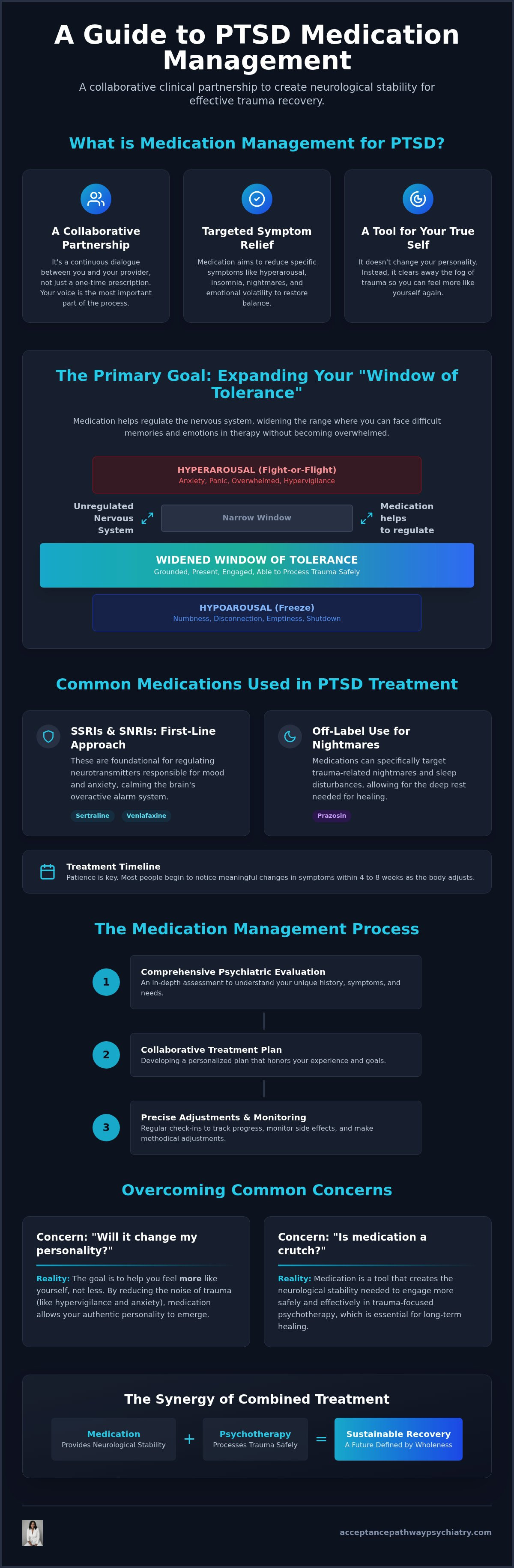
When you experience trauma, your nervous system often becomes stuck in a state of high alert. This constant fight-or-flight response can make everyday life feel exhausting and unpredictable. Medication helps by "lowering the volume" of these physiological reactions, restoring a sense of chemical balance to the brain. This process is a vital component in the Management of post-traumatic stress disorder, as it helps expand what clinicians call your "window of tolerance." When your nervous system is regulated, you're better equipped to face difficult memories in psychotherapy without becoming completely overwhelmed. It transforms your recovery from a state of survival into a journey of active growth.
Why 'Management' is the Key Word
The word "management" is intentional because PTSD treatment is never one-size-fits-all. What works for one person may not be the right fit for another, which is why regular check-ins are so important. These appointments allow us to track your progress, monitor for side effects, and make precise adjustments to your dosages as you heal. This steady, methodical approach ensures that your treatment remains effective and safe as you move through different stages of your recovery. It's a collaborative relationship where your voice is the most important part of the process. Your provider acts as a supportive witness and expert guide, but you are the partner in every decision. Through consistent medication management for PTSD, you can achieve the stability needed to reclaim your daily life.
Common Medications Used in PTSD Treatment
Selecting a medication is a deeply personal step in your healing journey. It's not about finding a "magic pill" but about choosing a tool that helps stabilize your biological responses to stress. When you begin medication management for PTSD, it’s important to remember that these treatments require patience. Most people start to notice meaningful changes in their symptoms within 4 to 8 weeks as the body adjusts. This timeline allows your provider to see how your system responds and ensures any adjustments are made with care and precision.
SSRIs and SNRIs: The First-Line Approach
Selective Serotonin Reuptake Inhibitors (SSRIs) and Serotonin-Norepinephrine Reuptake Inhibitors (SNRIs) are considered the foundational medications for treating PTSD symptoms. These options, such as Sertraline or Venlafaxine, work by regulating the neurotransmitters responsible for mood and anxiety. The VA/DoD Clinical Practice Guideline for PTSD identifies these as primary choices because of their proven ability to lower the intensity of trauma-related distress. These medications help reduce the "edge" of hypervigilance by calming the brain's overactive alarm system. By smoothing out these emotional peaks and valleys, you can feel more grounded in your daily life.
Addressing Nightmares and Sleep Disturbances
Restorative sleep is often the first casualty of trauma, yet it's the very thing your brain needs to process difficult memories. When nightmares make the night feel like a second battlefield, providers may suggest "off-label" medications to target these specific disturbances. Prazosin is one such option that has shown significant promise in reducing the frequency and intensity of trauma-related nightmares. By quieting the physical adrenaline spikes that happen during sleep, these treatments allow you to achieve the deep rest necessary for neurological recovery. Improving your quality of sleep isn't just about feeling less tired; it's about giving your mind the space it needs to heal.
Every person’s biology is unique, which makes a professional psychiatric evaluation the most critical step before starting any new regimen. A thorough assessment ensures that your treatment plan is safe, effective, and tailored to your specific history. If you're feeling overwhelmed by these choices, our team provides compassionate medication management to guide you through every step of the process. You don't have to navigate these complex decisions alone; having a steady partner can make all the difference in finding the right path for your evolution.
The Medication Management Process: What to Expect
The process begins with a structured yet deeply personal journey toward stability. Medication management for PTSD isn't just about a single appointment; it's a multi-step sequence designed to ensure you feel supported at every turn. By following a clear roadmap, we remove the guesswork from your recovery and replace it with a predictable, science-backed framework. This methodical approach allows you to focus on your healing while we handle the clinical complexities of your care.
Your First Evaluation: A Safe Space for Your Story
Your journey starts with a comprehensive 60-minute psychiatric evaluation. This is a non-judgmental space where you can share your history, current challenges, and goals for the future. To provide the most accurate care, we often integrate Creyos Cognitive Testing during this initial phase. This tool helps us establish a baseline for your brain health, measuring how trauma may be impacting your memory, focus, and processing speed. It's a supportive way to quantify your internal experience and guide our clinical decisions.
Once we understand your unique biological and emotional landscape, we work together to develop a collaborative treatment plan. We align our recommendations with APA's PTSD treatment guidelines to ensure your path is rooted in proven clinical evidence. You'll receive thorough education on any initial prescriptions, including what benefits to expect and how to manage potential side effects. This transparency helps lower the anxiety often associated with starting psychiatric medication, positioning it as a helpful tool rather than a source of worry.
The Follow-Up: Tracking Progress and Side Effects
Healing is a gradual evolution that requires careful observation. In the early stages of medication management for PTSD, follow-up visits typically occur every 2 to 4 weeks. These sessions are vital for fine-tuning your dosage and ensuring the treatment remains a helpful ally in your recovery. While some people worry about side effects, most are temporary and can be managed easily through open, honest communication. These check-ins provide the order and predictability necessary for you to feel safe in the process.
During these check-ins, you are the expert on your own internal experience. We rely on your feedback to understand how the medication is affecting your daily life. We look for signs of progress, such as a reduction in hypervigilance or more restful sleep. This data allows us to make precise adjustments for optimal results. Finally, we ensure your medication is perfectly aligned with other services, such as psychotherapy or integrative wellness practices. This holistic integration ensures that every part of your treatment plan works in harmony toward your ultimate goal of wholeness.
Combining Medication with Psychotherapy and Wellness
Recovery is a multidimensional process that involves more than just balancing brain chemistry. While medication provides a necessary biological foundation, it works most effectively when integrated with psychotherapy and holistic wellness practices. This combination is widely recognized as the "Gold Standard" of care for a reason. By addressing both the physiological symptoms and the psychological roots of trauma, you create a comprehensive environment for personal evolution. Healing is a whole-person experience. It's not just about reducing a checklist of symptoms; it's about restoring your capacity for joy, connection, and peace.
The Synergy of Therapy and Medication
Medication management for PTSD plays a crucial role in preparing the mind for the deep work of therapy. When your nervous system is constantly in a state of high alert, it's incredibly difficult to process traumatic memories without becoming re-traumatized. Medication helps manage the physical symptoms, such as a racing heart, shakiness, and hyperarousal. This creates the stability needed to face emotional roots in a safe, controlled way. Engaging in psychiatric medication management provides a pillar of stability, allowing a trauma-informed therapist to guide you through your story without your body's alarm system taking over. It's a partnership between biological support and psychological insight.
Integrative Wellness: Supporting Your Nervous System
Beyond clinical interventions, your daily environment and habits significantly impact your recovery. Our Integrative Wellness Services offer a way to nourish your system from the inside out. Simple changes in nutrition can stabilize energy levels, while structured sleep hygiene protocols ensure your brain has the time it needs to repair. Mindfulness and movement act as gentle anchors, helping you stay present when the world feels overwhelming. These practices are empowering tools that give you agency in your healing journey. When you nourish your body, you provide a stronger vessel for the work being done in therapy and medication management.
Wellness is an active, empowering choice that complements your clinical care. When you combine medication management for PTSD with intentional stress management and movement, you aren't just managing a condition. You are actively rebuilding a regulated nervous system that can handle the complexities of life with resilience and grace. If you're ready to explore a holistic approach to your recovery, we invite you to learn more about our Integrative Wellness Services and how they can support your path to wholeness. We treat the individual, not just the diagnosis, ensuring every part of your lifestyle supports your growth.
Overcoming Common Concerns and Moving Forward
Choosing to begin medication management for PTSD is a brave step that often comes with deep-seated questions. Many people fear that medication will turn them into a "zombie" or strip away their personality. In reality, the goal of treatment is the exact opposite. Proper psychiatric care should help you feel more like yourself, not less. By calming the overactive parts of your brain, medication allows your true interests and humor to emerge from behind the wall of trauma. It's about finding the lowest effective dose that offers the highest quality of life.
Another frequent concern involves the fear of dependency. It's vital to understand the difference between clinical support and addiction. While some medications require a gradual tapering process to stop safely, this is a biological adjustment rather than a sign of being "hooked." You aren't weak for needing support; you're taking a proactive role in your health. We provide a clear roadmap for when and how to discuss changing or stopping medication. These decisions are always made together, ensuring you feel in control of your journey at every stage.
Am I Just 'Masking' My Problems?
Think of medication as "glasses for the brain." If you can't see clearly, you don't blame yourself for wearing lenses to help you focus. Medication management for PTSD works in much the same way. It doesn't bypass the hard work of healing; it makes that work possible. By stabilizing your nervous system, you gain the clarity needed to process traumatic events in therapy without being flooded by physical panic. It's a tool for engagement, not an escape from reality. This biological support ensures you can move through your recovery with a clear mind and a steady heart.
Next Steps: Taking the First Pathway Toward Healing
You don't have to carry the weight of trauma on your own. Whether you're just starting to explore your options or looking for a more collaborative partnership, help is available. We offer telehealth appointments that provide national access to compassionate, trauma-informed care from the comfort of your own home. This flexibility ensures you can prioritize your healing without the added stress of travel or rigid scheduling.
Your journey is unique, and you deserve a provider who acts as a supportive witness to your progress. Scheduling an initial consultation is the first step toward reclaiming your stability. We are here to walk this path with you, offering the clinical expertise and deep empathy you need to move toward wholeness. Take the first step today and discover how a collaborative approach to medication management can change your future.
Reclaiming Your Future with Collaborative Care
Healing from trauma is a continuous journey of evolution, and you don't have to walk it alone. We've explored how medication management for PTSD serves as a vital foundation for this process, providing the neurological stability needed to engage deeply with therapy. By combining clinical expertise with comprehensive cognitive testing and integrative wellness services, your treatment becomes a whole-person experience rather than just a series of prescriptions. This collaborative approach ensures that your biological and emotional needs are addressed in harmony, allowing you to move beyond survival mode.
Our trauma-informed care philosophy ensures that your story is heard and respected through every adjustment. You deserve a partnership rooted in professional humility and high-level clinical knowledge. This expert-patient relationship is built on trust and the shared goal of reclaiming your daily quality of life. If you're ready to move toward a future defined by wholeness and peace, we are here to walk beside you. Begin your journey toward stability with a compassionate psychiatric evaluation. Your path to recovery is unique, and it's a journey we are honored to witness and support.
Frequently Asked Questions
Is medication management for PTSD always necessary for recovery?
Medication isn't a universal requirement for recovery, but it's a highly effective tool for many. Some individuals find relief through psychotherapy alone. However, if your symptoms are so severe that you can't focus in therapy or manage daily tasks, medication provides the stability needed to do that work. It acts as a supportive foundation, lowering the intensity of your nervous system's responses so you can engage fully in healing.
How long do I need to stay on medication for PTSD?
The duration of treatment varies significantly based on your unique history and progress. Clinical guidelines often suggest staying on a helpful medication for at least 6 to 12 months after your symptoms have stabilized. This period allows your brain to reinforce new, healthier patterns. We work together as a collaborative partnership to determine the right time to consider tapering, ensuring you feel safe and supported throughout any transition.
What are the most common side effects of PTSD medications?
Most people experience mild side effects that typically fade as the body adjusts within the first few weeks. Common experiences include nausea, dry mouth, or changes in sleep patterns. In our practice, medication management for PTSD involves close monitoring to ensure these effects remain manageable. If a side effect is disruptive, we can adjust the dosage or try a different option. Your comfort and quality of life are always our primary concerns.
Can I do medication management and psychotherapy at the same practice?
Yes, we offer both medication management and psychotherapy to provide a seamless, integrated experience. Having these services in one place allows your providers to communicate more effectively about your progress. This approach ensures that your biological support and emotional healing are perfectly aligned. Whether you choose telehealth or in-person care, this unified strategy helps create a more cohesive and predictable roadmap for your long-term recovery and personal growth.
What happens if the first medication I try doesn't work?
It's quite common for the first medication to require adjustments or for a patient to try a different class of drug. If you don't feel relief, we don't view it as a failure but as a piece of data to guide our next step. We may use tools like Creyos Cognitive Testing to better understand your brain health. We'll continue to explore options together until we find the combination that works for your unique biology.
Is medication for PTSD addictive or habit-forming?
The primary medications used for PTSD, such as SSRIs and SNRIs, aren't considered addictive or habit-forming. They don't produce a "high" or lead to cravings. However, your body does become accustomed to the medication over time. If you decide to stop, it's important to do so gradually under clinical supervision to avoid temporary withdrawal symptoms. We prioritize education so you understand exactly how your body interacts with your treatment plan.
How often will I need to see my psychiatrist for medication management?
Frequency depends on where you are in your journey. During the initial phase of medication management for PTSD, we typically meet every 2 to 4 weeks to monitor your response and fine-tune dosages. Once you've reached a stable point where you feel consistent relief, appointments often shift to every 3 months. These check-ins are essential for maintaining your progress and ensuring your treatment plan continues to serve your evolving needs.


