

Imagine waking up and, for the first time in months, the heavy weight of hypervigilance doesn't immediately pull at your chest. For many survivors, the world feels perpetually unsafe, and the thought of trying another medication brings more anxiety than hope. You might have spent hours searching for a psychiatrist for PTSD Fayetteville NC who sees you as a whole person rather than just a list of symptoms. It's exhausting to manage flashbacks while searching for a provider who truly understands trauma-informed care.
We know that healing isn't a linear path, and you deserve a partner who respects your pace. You can discover how specialized psychiatric care and integrative medication management help you move through trauma to reclaim your sense of peace. This guide explores how a collaborative medical partnership, combined with tools like Creyos cognitive testing and psychotherapy, reduces the intensity of your symptoms. We'll look at how a holistic plan creates a steady foundation for your long-term wellness and personal evolution.
Key Takeaways
- Learn how a trauma-informed clinical evaluation provides a stable foundation for diagnosing and managing complex PTSD symptoms.
- Understand how medication management serves as a supportive tool to regulate your nervous system, making it easier to focus on your internal healing.
- Discover how integrating psychotherapy with Creyos cognitive testing allows for a more precise and personalized path toward wholeness.
- Identify the essential qualities to look for in a psychiatrist for PTSD Fayetteville NC to ensure your provider offers a non-judgmental and supportive environment.
- Explore how the flexibility of telehealth appointments helps you maintain a consistent and collaborative partnership from the comfort of your own home.
What to Expect from a Psychiatrist for PTSD
Seeking help for trauma is a profound act of self-advocacy. Many individuals searching for a psychiatrist for PTSD Fayetteville NC are looking for more than just a prescription; they're looking for a path to reclaim their lives from the shadows of the past. A psychiatrist focuses on the physiological side of PTSD, working to stabilize your nervous system and provide a clear, clinical diagnosis. While a therapist often focuses on the narrative of your experiences, a psychiatrist evaluates how your brain and body respond to stress. This medical expertise ensures you have the physical stability necessary to engage fully in the emotional work of recovery. It's about creating a biological foundation for peace.
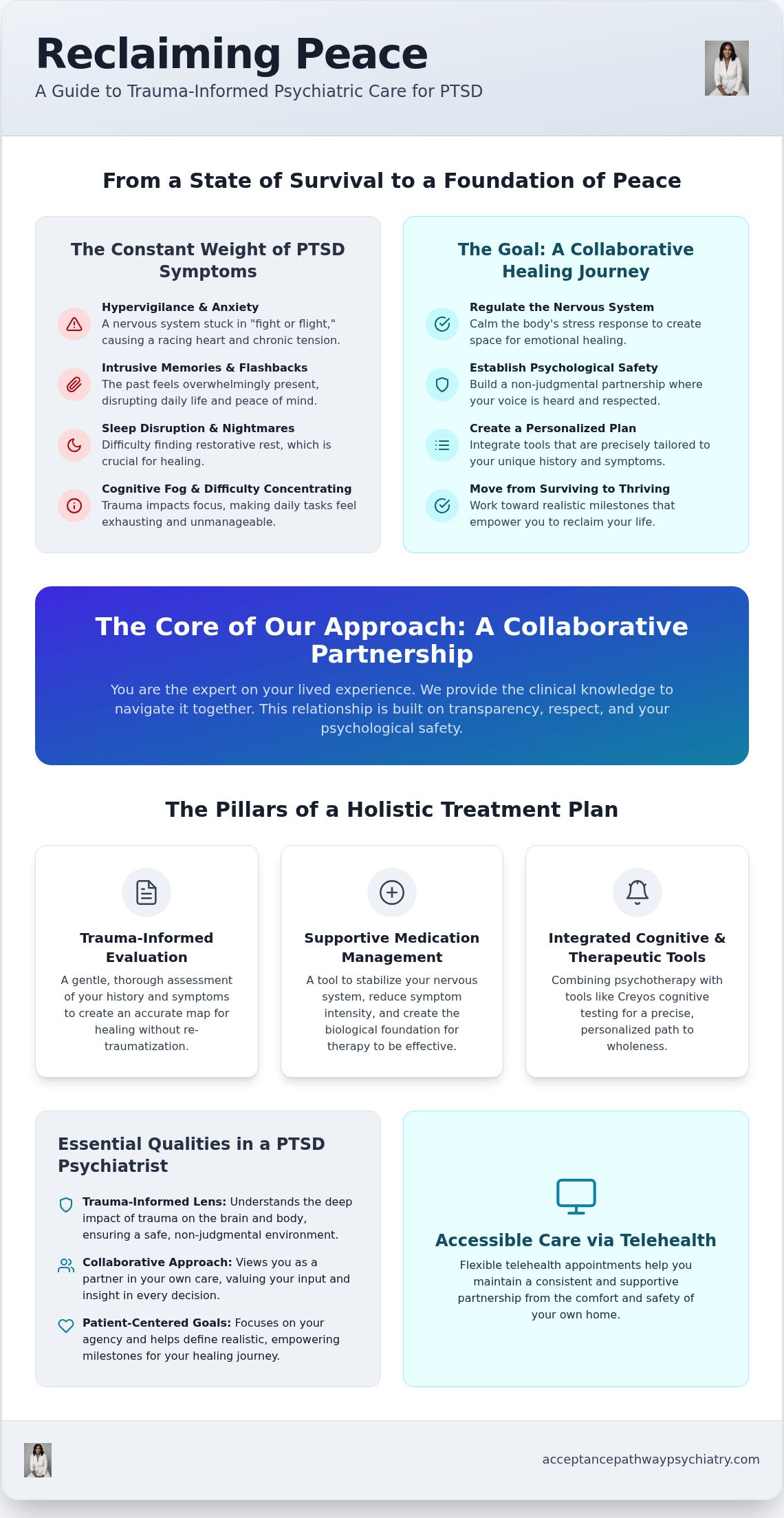
We view our role as a collaborative partnership. You're the expert on your own lived experience, and we provide the clinical knowledge to help you navigate it. This relationship is built on a foundation of psychological safety, where your concerns about medications or symptoms are addressed with transparency and respect. By working together, we can dismantle the barriers that keep you stuck in a cycle of hypervigilance and fear.
The Clinical Evaluation Process
A clinical evaluation is a deep dive into your history, but it's conducted with a gentle, trauma-informed lens. Unlike a standard therapy intake that might focus primarily on life stories, this evaluation looks at the duration, frequency, and intensity of your symptoms. We explore how trauma affects your sleep, your focus, and your physical health. We often look for specific signs such as:
- Disruptions in sleep patterns or frequent nightmares.
- Difficulty concentrating or feeling "foggy" in daily tasks.
- Physical symptoms of anxiety, like a racing heart or chronic tension.
- Signs of co-occurring conditions like depression or panic disorders.
You don't have to worry about being judged or rushed through your history. Your story is heard with deep empathy, and every piece of information helps us build a more accurate map of your unique path to wholeness. This thoroughness ensures that your treatment plan is as precise as it is compassionate.
Setting Goals for Your Healing Journey
Healing isn't about simply erasing the past; it's about shifting from a state of constant survival to one where you can truly thrive. We work together to define realistic milestones that matter to you, whether that's attending a social event without panic or finally getting a full night's rest. This process is a mutual partnership where your voice is the most important one in the room. Trauma-informed psychiatry is a practice that prioritizes the patient’s sense of safety and agency. By centering your choices, we ensure that every step of the treatment plan feels manageable and empowering. We focus on small, sustainable wins that lead to a significant reduction in the intensity of your PTSD symptoms over time.
Medication Management: A Supportive Tool for PTSD Recovery
Many people hesitate when they consider medication for trauma. They worry it might numb their emotions or change who they are at their core. In reality, psychiatric medication management is designed to be a bridge to your deeper work, not a replacement for it. When your nervous system is stuck in a state of perpetual "fight or flight," it's nearly impossible to process traumatic memories or engage in traditional therapy. Medication helps quiet the physiological noise. It lowers the volume on hypervigilance and helps you find the restorative sleep you've been missing. This stability creates a foundation where healing can actually begin.
Finding the Right Balance
Choosing a psychiatrist for PTSD Fayetteville NC means finding a guide who values your input as much as their medical degree. We don't just hand over a prescription and send you on your way. It's a steady, methodical process of checking in and listening. We monitor how you feel, not just how the symptoms change. Our goal is to move past the frustrating cycle of trial and error. We want you to reach a state of wholeness where you feel in the driver's seat of your own mind again. If you're ready to see how a collaborative plan can help, you might explore our approach to care today. Every adjustment we make is a mutual decision focused on your comfort and progress.
Common Medications for Trauma Symptoms
We often utilize specific classes of medications, such as SSRIs, to help stabilize mood and reduce the intensity of intrusive thoughts. Other tools may be used specifically to address the physical toll of nightmares or chronic insomnia. These aren't meant to be permanent fixtures if they don't need to be. Instead, they create the vital mental space required for psychotherapy to be effective. Think of medication as the scaffolding for a building under repair. It keeps the structure steady while you do the significant work of rebuilding your life. We always prioritize the lowest effective dose. This ensures you experience the highest quality of life while maintaining your sense of self. Your plan is regularly reviewed to ensure it still serves your evolving needs.
Beyond Medication: Integrating Psychotherapy and Cognitive Testing
While medication provides the physiological floor, it's rarely a complete solution on its own. True healing involves processing the memories and patterns that trauma leaves behind. This is where psychotherapy becomes an essential partner to medical treatment. When you search for a psychiatrist for PTSD Fayetteville NC, you're often looking for a professional who can bridge the gap between biological symptoms and the human experience of trauma. By integrating these two approaches, we address both the brain's chemistry and the heart's need for resolution. It's about moving from simply managing symptoms to achieving a lasting state of wholeness.
The Power of Integrated Care
Integrated care means your medication and therapy aren't happening in silos. They work in tandem to rewire the brain's stress response. Medication can lower the intensity of a panic attack, but therapy gives you the tools to understand the trigger. Having one unified clinical team manage both aspects provides a depth of care that's hard to find elsewhere. It's more than just convenience. It allows for a seamless adjustment of your plan based on real-time progress. The "Acceptance Pathway" approach focuses on this holistic healing, ensuring that every part of your journey is seen and supported by a single, steady guide.
Cognitive Assessments in PTSD Care
Trauma doesn't just affect your emotions; it often changes how your brain processes information. You might find it harder to focus, remember appointments, or make quick decisions. This is because trauma can significantly impact executive function and memory. To understand these shifts, we use Creyos cognitive testing to get an objective look at your brain function. This provides a clear picture of your cognitive health beyond what a standard conversation can reveal.
Instead of guessing why you feel "foggy," we use data to refine our treatment strategies. This testing isn't about finding what's "wrong," but about understanding how your unique brain is adapting to your experiences. Cognitive testing provides a baseline for measuring progress over time. As your symptoms decrease and your nervous system stabilizes, we can see the tangible improvements in your mental clarity and focus. This data-driven approach ensures that your psychiatrist for PTSD Fayetteville NC is providing care that's as precise as it is compassionate.
How to Choose a Trauma-Informed Psychiatric Provider
Finding the right professional is a deeply personal decision that goes beyond checking boxes on a list of credentials. When you search for a psychiatrist for PTSD Fayetteville NC, you're looking for a partner who respects your boundaries and understands the delicate nature of trauma recovery. A truly trauma-informed provider prioritizes your sense of agency. They don't just dictate a treatment plan; they invite you into the process. This collaborative relationship is essential because it restores the power that trauma often takes away.
You should also look for a practice that offers a unified approach. Receiving medication management and psychotherapy from the same clinical team ensures that your goals remain aligned. Consistency is another vital factor to consider. Many people find that telehealth and virtual access provide the long-term stability they need. It allows you to continue your care from a space where you already feel safe, removing the stress of a commute or a clinical waiting room.
Questions to Ask Your Potential Psychiatrist
Before committing to a provider, it's helpful to have a conversation about their philosophy. You might ask how they involve patients in the decision-making process for medication. A collaborative expert will explain the logic behind their suggestions and listen to your concerns about side effects. Ask what integrative wellness services they suggest alongside clinical treatment, such as mindfulness or nutritional support. It's also important to understand how they handle urgent needs between sessions. Knowing there's a predictable system for communication provides a much-needed sense of security.
The Importance of a Compassionate Guide
Research consistently shows that the therapeutic alliance, which is the bond between you and your provider, is the strongest predictor of success in PTSD treatment. Clinical expertise is necessary, but it's the feeling of being understood and safe that allows for real progress. Trust your intuition during your first interaction. If a provider feels cold or dismissive, they likely aren't the right guide for your healing journey.
A comprehensive provider also looks for overlapping conditions that might complicate your recovery. For example, ADHD treatment for adults often requires a similar trauma-informed lens, as symptoms of focus and executive function can be intertwined with trauma responses. A psychiatrist who sees the whole picture can create a plan that addresses all your needs at once. If you're looking for a partnership based on mutual respect and expertise, you can connect with our team to start your journey toward wholeness.
Acceptance Pathway: Your Partner in Mental Health Excellence
Acceptance Pathway Psychiatry was built to be a steady, reliable presence in your life. We believe that clinical excellence and deep compassion aren't mutually exclusive. When you choose a psychiatrist for PTSD Fayetteville NC, you aren't just selecting a medical provider; you're choosing an ally who views your healing as a mutual partnership. Our practice focuses on creating an immediate sense of psychological safety, ensuring that every interaction feels warm, welcoming, and entirely non-judgmental. We're here to be a supportive witness to your personal evolution, providing the clinical expertise you need to move toward a state of wholeness.
Our approach goes beyond traditional symptom management. We offer integrative wellness services that round out the clinical experience, looking at your health from every angle. By combining medication management and psychotherapy with a focus on overall well-being, we help you build a life that feels stable and peaceful. We understand that the search for a psychiatrist for PTSD Fayetteville NC often comes from a place of deep exhaustion, and we're committed to making your path to care as smooth and encouraging as possible.
A Compassionate Approach to Telehealth
We've designed our telehealth appointments to provide the same level of empathy and connection you'd expect from an in-person visit. For many survivors of trauma, leaving the house or sitting in a traditional medical office can trigger a sense of hypervigilance. Virtual sessions allow you to receive expert care in the comfort and safety of your own environment, where you already feel in control. This removes the barriers of travel and stressful commutes, ensuring that your support remains consistent even on difficult days. You deserve access to high-quality care without the added burden of logistical stress. Our national telehealth platform ensures that you can maintain a collaborative partnership with your provider, no matter where you're located.
Begin Your Pathway to Healing
The first step toward reclaiming your peace is often the hardest, but you don't have to take it alone. We've made the process of starting your journey simple and intentional. It begins with a comprehensive initial evaluation where we listen to your story and discuss your goals for recovery. This is a space where your input is prioritized and your agency is respected. You'll work with a medical expert to create a personalized plan that includes the tools you need to thrive. If you're ready to move from a state of survival to one of progress, we invite you to schedule your initial evaluation today. A more stable and peaceful future is possible, and we're here to help you reach it.
Embrace Your Personal Evolution
Reclaiming your life from trauma is a journey that requires both clinical precision and a gentle, human touch. You've seen how integrating medication management with psychotherapy and advanced tools like Creyos cognitive testing can build a foundation for lasting stability. By choosing a partner who values your agency, you move from a cycle of hypervigilance toward a future of genuine peace. Finding a psychiatrist for PTSD Fayetteville NC who offers this level of trauma-informed care is the first step in shifting your focus from surviving to thriving.
Our team provides seamless telehealth access nationwide, ensuring you receive supportive care in the environment where you feel safest. We're here to offer the steady guidance and integrative wellness services you need to feel whole again. You don't have to navigate this path alone; we're ready to stand as a supportive witness to your progress. Every step you take toward mental health excellence is a step toward the life you deserve.
Begin your journey to healing with a compassionate psychiatric evaluation.
Your path to wholeness is waiting, and we're honored to walk it with you.
Frequently Asked Questions
Is a psychiatrist or a therapist better for treating PTSD?
Both professionals are valuable, but they serve different roles in your healing journey. A psychiatrist focuses on the biological aspects of PTSD, offering clinical diagnosis and medication management to stabilize your nervous system. A therapist helps you process the emotional narrative and develop coping skills. Many people find the best results when these two disciplines work together in a unified plan that treats both the brain's chemistry and the heart's experiences.
Can PTSD be managed without medication?
Yes, it's possible to manage PTSD symptoms through psychotherapy and integrative wellness alone, depending on the severity of your experience. However, medication is often a helpful tool to lower the intensity of hypervigilance or flashbacks, creating the mental space needed for therapy to be effective. We respect your choice and work with you to determine the most supportive path, whether that includes a prescription or focuses entirely on holistic and therapeutic interventions.
How long does a typical psychiatric evaluation for PTSD take?
A typical psychiatric evaluation for PTSD usually takes about 60 to 90 minutes. This time allows your provider to conduct a thorough review of your history and current symptoms without making you feel rushed. When searching for a psychiatrist for PTSD Fayetteville NC, it's vital to find someone who takes this time to listen deeply. This initial conversation is the foundation of your collaborative partnership and ensures your treatment plan is precise and compassionate.
What are the benefits of telehealth for PTSD patients?
Telehealth offers a unique sense of safety by allowing you to attend appointments from your own home. For those dealing with trauma, avoiding a clinical waiting room or a stressful commute can prevent unnecessary triggers. It also ensures consistent care if you travel or have a busy schedule. This flexible access makes it easier to maintain a long-term relationship with your provider, which is one of the strongest predictors of a successful recovery process.
What is Creyos cognitive testing and how does it help with trauma?
Creyos cognitive testing is an objective tool used to measure how trauma has impacted your brain's executive function, memory, and focus. Instead of relying solely on how you feel, this testing provides data to help us refine your treatment. It helps identify why you might feel "foggy" or struggle with concentration. By establishing a clear baseline, we can track your cognitive improvements as your nervous system stabilizes and your symptoms begin to decrease over time.
How often will I need medication management appointments?
In the beginning, you might meet with your psychiatrist every two to four weeks to monitor how you're feeling and adjust dosages. Once your symptoms are stable and you feel comfortable with your plan, these appointments usually shift to once every three months. These check-ins are collaborative discussions where we review your progress and ensure the medication continues to support your quality of life. We always prioritize your comfort and input during these sessions.
Will I have to take medication for the rest of my life?
Not necessarily; the goal of medication is often to provide temporary support while you do the deep work of healing. Some individuals use medication as a "bridge" for a specific period, while others find long-term use helps them maintain their sense of wholeness. We regularly review your plan to see if adjustments are needed. The ultimate objective is always the lowest effective dose that allows you to feel in control and at peace.
Does Acceptance Pathway Psychiatry accept insurance for PTSD treatment?
Acceptance Pathway Psychiatry works with various insurance providers to help make trauma-informed care more accessible. When looking for a psychiatrist for PTSD Fayetteville NC, we recommend contacting our office directly to verify your specific coverage details. We're committed to transparency regarding costs and will help you understand your benefits. Our goal is to lower the barriers to seeking help so you can focus entirely on your recovery and personal evolution.


