

What if trauma therapy didn’t mean telling your whole story before you feel ready? It can begin with what’s affecting you now, what might help you feel safer, and what you hope will change. If you’re unsure whether your experience “counts” as trauma, or worried that therapy will ask you to relive painful events, those questions are understandable.
Trauma can affect people in different ways. Feeling on edge, avoiding reminders, or having trouble sleeping does not, on its own, confirm a diagnosis. Support can be shaped around your needs and pace. You can talk with a therapist about what’s been difficult without sharing details you’re not ready to discuss.
This guide explains what trauma therapy may involve, how approaches such as Cognitive Processing Therapy, Prolonged Exposure, and EMDR differ, and how trauma-focused treatment relates to psychotherapy more broadly. You’ll also learn what an initial conversation may cover and how to consider a manageable next step toward care. Psychotherapy can be part of an individualized plan, developed collaboratively and without pressure to move faster than feels right.
Key Takeaways
- Trauma can affect people differently, and you don’t need to label your experience before exploring support.
- Learn how trauma therapy approaches can differ in their focus and ways of working with difficult experiences.
- Therapy should be collaborative, with room to discuss present-day concerns without sharing more than you’re ready to.
- Prepare for an initial conversation by noting your concerns, questions, access needs, and goals, not by rehearsing painful details.
- Explore how compassionate, individualized psychotherapy can help you consider a next step at a pace that feels manageable.
What Is Trauma Therapy, and Who Might Consider It?
Trauma therapy is psychotherapy that addresses the lasting effects a distressing or traumatic experience may have on a person’s thoughts, emotions, relationships, and sense of safety. It isn’t one fixed treatment or a requirement to tell a particular story. The approach and pace can vary according to a person’s concerns, preferences, and goals.
People respond to difficult experiences in different ways. An event that feels overwhelming to one person may affect someone else differently, and there’s no single response that proves an experience was or wasn’t traumatic. You don’t need to decide on a label before talking with a clinician. You can start by describing what has been difficult, how it affects you now, and what kind of support you’re hoping for.
What experiences and responses can lead someone to seek support?
People may seek support after a single, acute experience, such as an accident or assault; repeated experiences, such as ongoing bullying or exposure to violence; or complex circumstances involving prolonged or repeated distress, sometimes within close relationships. These are broad educational categories, not predictions. The same event can affect people differently, and a person may seek help without identifying with any category.
Effects can show up in everyday life, sometimes in ways that are hard to connect to the past. Someone might feel persistently on edge, avoid reminders, have trouble sleeping or concentrating, or find it harder to trust and feel safe in relationships. Others may notice changes in mood or a sense of disconnection. These experiences can have many causes, so they don’t establish a diagnosis on their own.
A trauma-informed perspective recognizes that a person’s history may shape their needs and experience of care. The overview of Trauma-informed care describes a framework that emphasizes understanding trauma’s effects and responding with care. In practice, that perspective can make space for a person’s preferences and sense of safety rather than assuming everyone needs the same support.
Does seeking trauma therapy mean someone has PTSD?
No. A history of distressing experiences and a diagnosis of post-traumatic stress disorder (PTSD) are not the same thing. People may explore support for anxiety, disrupted sleep, relationship strain, or other concerns without having PTSD. Experiencing a traumatic event does not, by itself, mean someone has the disorder.
A qualified clinician can consider symptoms, how long they’ve been present, their context, and how they affect daily life. They may also ask about other factors that could be contributing to what you’re experiencing. That conversation is more useful than trying to diagnose yourself from a list of symptoms. You can begin by describing what’s troubling you, even if you’re unsure what to call it.
How Do Trauma Therapy Approaches Help People Work Through Difficult Experiences?
Trauma therapy isn’t a single method. Approaches vary in what they focus on, how sessions are structured, and whether they work directly with trauma-related thoughts, memories, or avoidance. Some use a more defined sequence of exercises, while others may be adapted to a person’s needs and readiness. Comparing these differences can help you prepare questions for a clinician without feeling you have to choose an approach on your own.
Treatment choice depends on a person’s needs, preferences, and clinical assessment. A clinician can discuss the purpose of an approach, what it may involve, and whether it seems appropriate for your situation. The examples below describe approaches used in the broader field of mental health care. They can help you understand possible areas of focus as you discuss psychotherapy and your goals.
What distinguishes trauma-focused cognitive and exposure-based therapies?
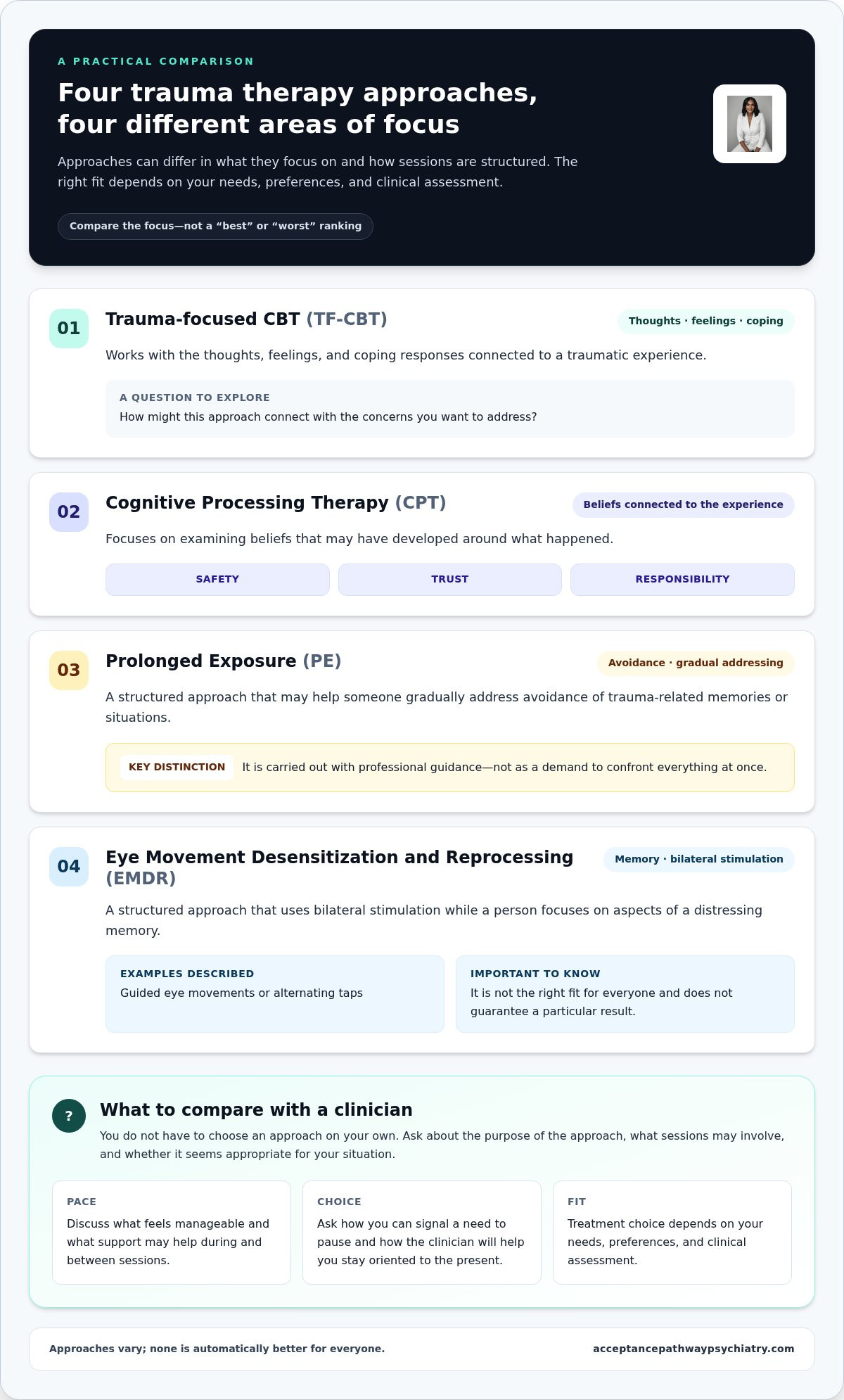
Trauma-focused cognitive behavioral therapy (TF-CBT) works with the thoughts, feelings, and coping responses connected to a traumatic experience. Cognitive processing therapy (CPT) focuses more specifically on examining beliefs that may have developed around the experience, such as beliefs about safety, trust, or responsibility. In discussing these approaches, you can ask how the work connects to the concerns you want to address.
Prolonged exposure (PE) is a structured approach that may help a person gradually address avoidance of trauma-related memories or situations. It’s carried out with professional guidance, not as a demand to confront everything at once. The pace and focus of any work should be discussed together, including what feels manageable and what support may help during and between sessions.
How does EMDR fit among trauma therapy approaches?
Eye Movement Desensitization and Reprocessing (EMDR) is a structured therapy approach that uses bilateral stimulation, such as guided eye movements or alternating taps, while a person focuses on aspects of a distressing memory. In plain terms, the clinician guides a process intended to help the person work with how the memory is experienced. EMDR isn’t the right fit for everyone, and it doesn’t guarantee a particular result.
A clinician can explain the EMDR process and discuss whether it may be appropriate for your situation. You can ask what a session might involve, how you can signal a need to pause, and how the clinician will help you stay oriented to the present. Understanding the plan can make it easier to decide whether you feel ready to explore that approach.
There’s no need to treat these names as a checklist or assume that one method is automatically better. A useful discussion can include what you want help with, your preferences about structure, and any concerns about working with memories. Psychotherapy can be part of an individualized mental health plan, and a thoughtful conversation can help clarify possible next steps. If you’re considering support, you can explore individualized psychotherapy care in a collaborative setting.
Will Trauma Therapy Make Me Relive Everything? Safety, Choice, and Common Concerns
It’s understandable to worry that trauma therapy will mean describing painful experiences in detail before you feel ready. Therapy should be collaborative, not a demand to disclose more than you choose. Depending on your concerns and the approach, sessions may focus on current stress, coping skills, relationships, sleep, or personal goals rather than recounting memories. If working with a memory is part of a plan, the clinician should explain why and discuss how to approach it with you.
You can tell your clinician when something feels uncomfortable and talk together about slowing down or changing the pace. That conversation is part of care, not a failure or a setback. Progress can take different forms and timelines, and it may not move in a straight line. A difficult day doesn’t automatically mean therapy isn’t helping, but changes in how you feel are worth discussing so the plan can be adjusted thoughtfully.
Can someone begin therapy before feeling ready to share details?
Yes. An initial conversation can start with what is affecting you now, what you hope will feel different, and what you’d prefer not to discuss yet. You might say, “I’m not ready to go into details,” or ask how the clinician handles pacing. You can also name boundaries or ask to pause. Some approaches don’t require detailed retelling in every session, and you can discuss what a particular method involves before deciding whether to proceed.
What if difficult feelings arise during or after a session?
Strong feelings can arise in therapy, though they don’t happen for everyone. If you feel unsettled during or after a session, tell your clinician. Together, you can discuss grounding or coping strategies, what helps you feel present, and what support may be useful between sessions. You might also agree on a way to signal that you need a pause. These conversations help shape care around your experience rather than assuming one pace works for all.
It may help to notice and share what tends to steady you, such as taking a break, focusing on your surroundings, or discussing a practical next step. Your clinician can help you consider which strategies fit your circumstances. If distress feels more intense than expected, bringing it up is useful information; you don’t have to wait until the next appointment to mention it through the usual contact channels for your care.
Routine emotional discomfort is different from immediate danger. If you or someone else is in immediate danger, contact local emergency services or an appropriate crisis service for urgent help. For concerns that aren’t an emergency, discussing your needs and pace with a clinician can help clarify what support feels manageable. You deserve to be heard, and you can take part in decisions about how therapy proceeds.
How Can You Prepare for a First Trauma Therapy Conversation?
You don’t need to rehearse a painful story or write down traumatic details before seeking trauma therapy. A little preparation can help you feel more grounded and make it easier to share what matters to you. Keep it simple: think about what has been difficult lately, what you hope might change, and what would help you feel comfortable during the conversation.
You might jot a few notes or keep them in mind. They can include:
- Current concerns, such as sleep, concentration, mood, or relationships.
- Questions about the clinician’s approach, session structure, or how progress is discussed.
- Preferences, access needs, or boundaries you’d like the clinician to understand.
- A personal goal, even if it’s as broad as feeling more supported or making sense of what’s been happening.
For an in-person appointment, consider what would help you arrive with enough time and feel settled. For a telehealth appointment, you may want a private space, a reliable device, and a way to reduce interruptions. These are practical options, not requirements for having a meaningful conversation. Your needs may be different, and you can share what would make the appointment more accessible.
What questions can help make the first conversation feel clearer?
Questions can help you understand what to expect and whether the approach feels comfortable. You might ask how the clinician works with safety, consent, and pacing, or how you can signal that you want to pause. Other questions could cover what sessions generally focus on, how you and the clinician set goals, and how you’ll talk about progress or adjust the plan.
You don’t need polished wording. “I’m nervous about discussing the past” or “I need to understand what we’ll do before we begin” communicates a real concern. You can also mention preferences or accommodations that could support your participation. The conversation can help clarify what feels manageable now, without requiring you to decide every next step in advance.
What details may be useful to share without recounting the whole experience?
Start with what’s happening in the present. For example, you could describe feeling tense in certain situations, avoiding a place, struggling to sleep, or finding it harder to connect with people. You can explain how often a concern comes up and how it affects daily routines without giving a full account of the experience behind it.
If you feel comfortable, you may also mention relevant past care, medications, or people and practices that support you. Share only what seems useful to you at this point. The clinician can help you work out what information may matter for care and when to discuss it. It’s okay to say, “I’m not ready to talk about that yet.”
Preparing isn’t a test, and there’s no perfect way to begin. If you’re ready to explore a supportive first conversation, connect with Acceptance Pathway Psychiatry about psychotherapy.
How Can Compassionate Psychotherapy Support Your Next Step?
Considering trauma therapy can bring up practical questions as well as personal ones: What might care focus on? How much choice will I have? What if my needs change? At Acceptance Pathway Psychiatry, psychotherapy is compassionate, collaborative, and individualized. A care plan can begin with what’s affecting you now, what matters to you, and what you hope to work toward. You don’t need to arrive with a diagnosis or a complete account of past experiences to start a conversation.
Psychotherapy can be one part of a broader mental health plan. Early conversations may involve clarifying your concerns, discussing your preferences, and identifying goals that feel relevant to daily life. Your priorities help shape the discussion, and care can be revisited as circumstances, needs, or goals change.
What does collaborative mental health care mean in practice?
Collaboration means discussing options together rather than treating a care plan as something decided for you. You can share what you want help with, what feels comfortable, and what you’re unsure about. The clinician can explain possible directions and invite your perspective as you consider what may fit. Questions and differing preferences belong in that discussion.
Goals don’t have to be elaborate. You might want to understand patterns in your reactions, feel more supported in everyday life, or work through a concern affecting relationships. As therapy continues, you and your clinician can revisit those goals and talk about whether the focus still feels useful. This leaves room for care to respond to you as a person, not just to a label or a single experience.
When might psychotherapy and medication management be discussed together?
Psychotherapy and medication management have different roles. Psychotherapy offers a space to discuss concerns, goals, and ways of coping; medication management involves clinical discussion of medication as part of mental health care. They may be considered together when clinically appropriate, but combined care isn’t a requirement for everyone. A clinician can discuss your needs and preferences with you when considering whether either or both may be relevant.
Acceptance Pathway Psychiatry provides psychotherapy and medication management, with in-person and telehealth appointments. Your care preferences and practical access needs can be part of the conversation alongside the concerns you want to address. For a closer look at medication management, the article Psychiatric Medication Management: A Compassionate Guide to Your Healing Journey offers related context.
A manageable next step may simply be exploring whether psychotherapy feels right for you. You can begin with your current concerns and the kind of support you’re hoping for, then discuss possible directions in a compassionate, collaborative conversation.
Take a Gentle First Step Toward Support
You don’t need to have every answer before reaching out. Curiosity, uncertainty, or simply wanting daily life to feel more manageable can be enough to begin a conversation about trauma therapy. You can start with what feels important today and let the next steps take shape through a thoughtful, collaborative discussion.
At Acceptance Pathway Psychiatry, psychotherapy and medication management are available, with in-person and virtual appointment options. Care can be shaped around your concerns, preferences, and goals. You don’t need to arrive with a perfect explanation of what you’re experiencing. A first step can be as simple as learning more about the support available and deciding what feels right for you.
Explore compassionate psychotherapy and mental health care and take a first step at a pace that feels manageable. Seeking support is meaningful, and you don’t have to take it all at once.
Frequently Asked Questions
Is trauma therapy only for people diagnosed with PTSD?
No. People may seek support for distress connected with difficult experiences without having a PTSD diagnosis. A diagnosis requires clinical assessment; one event alone doesn’t determine whether someone has PTSD. If you’re unsure what to call your experience, you can describe what’s affecting you and ask a clinician whether therapy may be appropriate. You don’t need to diagnose yourself, and having a trauma history doesn’t mean everyone needs treatment.
Can trauma therapy help if I do not remember every detail?
Yes, a complete account of what happened isn’t necessarily needed to seek support. You can begin by talking about what concerns you now, such as feeling uneasy in certain situations or finding daily routines difficult, and what you’d like help with. Memory gaps don’t prove that trauma occurred, and there’s no need to try to recover forgotten memories. A clinician can discuss your uncertainty and help keep the conversation manageable.
How long does trauma therapy take?
There isn’t one timeline that applies to everyone. The length of care can depend on your goals, history, needs, the approach you and your clinician choose, and how you respond to treatment. You can ask how progress will be reviewed and raise questions if your priorities change. Rather than treating a set number of sessions as a promise, use ongoing conversations with your clinician to consider whether the plan remains useful.
What happens during a first trauma therapy session?
An initial appointment may include a discussion of what prompted you to seek support, what you hope to address, and any questions or preferences you have. You can ask how the clinician handles sensitive topics and share boundaries around what you’re comfortable discussing. You don’t have to prepare a detailed account. Together, you can consider possible next steps based on the concerns you choose to bring forward.
Is it normal to feel worse after a trauma therapy session?
Emotional responses differ, and feeling unsettled after a session doesn’t automatically mean therapy is harmful or failing. Let your clinician know what you noticed, such as trouble concentrating afterward or feeling more emotional than expected. You can discuss whether to adjust the pace and what coping strategies or support may help. If you’re in immediate danger, call 911 or go to an emergency department.
Can trauma therapy be done through telehealth?
Some psychotherapy can take place virtually, depending on clinical appropriateness, your circumstances, and applicable requirements. A telehealth conversation can still give you room to discuss what you hope to address and what you prefer from care. Before an appointment, consider whether you have a private, comfortable place to speak and a reliable device. Not every approach or situation is suited to virtual care, so this can be discussed with a clinician.
What should I do if I feel unsafe or am in immediate crisis?
If you’re in the United States and need crisis support, call or text 988. If you or someone else is in immediate danger, call 911 or go to an emergency department. A scheduled therapy appointment or article can’t provide immediate crisis intervention, so use urgent services for immediate safety concerns. If you can, let someone you trust know what’s happening while you seek help.


