

What if the most effective part of your mental health treatment isn't just the prescription, but the person who actually hears what you're saying? Many people searching for a psychiatrist for depression Fayetteville NC worry they'll be treated like a set of symptoms on a clinical chart rather than a human being with a unique story. You might feel like a number in a cold medical system, or perhaps you fear being over-medicated without a clear explanation of why. It's common to feel confused about whether you need therapy, medication, or a combination of both to finally feel like yourself again.
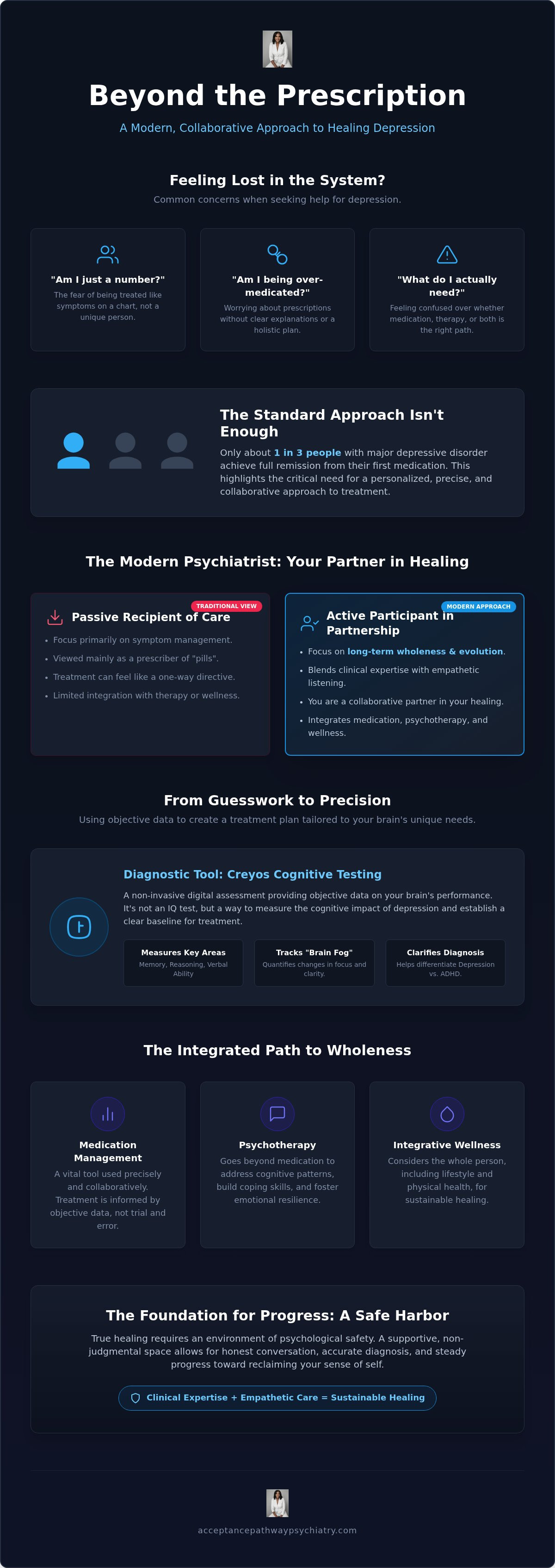
We understand these concerns because we believe that true healing requires a partnership. Only about one third of people with major depressive disorder achieve full remission from their first medication, which is why a personalized, precise approach is so vital. This article will show you how a blend of clinical precision and empathetic care can help you navigate depression and reclaim your life. We'll explore the benefits of modern diagnostic tools like Creyos cognitive testing and explain how a collaborative plan involving both medication management and psychotherapy creates a steady, intentional path toward wholeness.
Key Takeaways
- Learn how a collaborative partnership with your provider shifts the focus from managing symptoms to achieving wholeness and personal evolution.
- Explore how objective data from Creyos cognitive testing removes the guesswork, allowing for a treatment plan tailored to your brain's unique needs.
- Understand the synergy between medication management and integrative wellness in building a sustainable and steady path toward healing.
- Prepare for your evaluation with a psychiatrist for depression Fayetteville NC and learn how telehealth makes accessing care more manageable when energy is low.
- Discover how a supportive, non-judgmental environment creates the psychological safety you need to reclaim your sense of self and maintain steady progress.
What Does a Psychiatrist for Depression Actually Do?
A psychiatrist is much more than a prescriber; they are medical doctors who have completed extensive training in the medical specialty of psychiatry. This background allows them to understand how your physical health, brain chemistry, and emotional life intersect. Unlike a standard check-up that might focus on physical vitals, a psychiatric evaluation for adults dives deep into your history, cognitive patterns, and lifestyle. Whether you choose an in-person visit or a telehealth appointment, it's a collaborative process where you aren't just a passive recipient of care. You're an active participant in a partnership designed to foster long-term wholeness.
One of the biggest misconceptions is that these professionals only offer "pills." While medication management is a vital tool, it's never the only answer. A modern approach integrates biological treatments with psychotherapy and integrative wellness support. Finding a psychiatrist for depression Fayetteville NC who values this balance is essential for those who want to move beyond just managing symptoms and instead focus on genuine personal evolution. By treating the whole person rather than a diagnosis, the process becomes a shared journey toward healing.
The Clinical and Empathetic Balance
Clinical expertise provides the map, but empathy is what makes the journey possible. To be effective, a provider must pair their clinical authority with deep, non-judgmental listening. You deserve to feel heard during your consultation. When you share sensitive emotional experiences, the environment should feel like a safe harbor. This psychological safety lowers the barrier to seeking help and allows for a more accurate understanding of your needs. It's this blend of high-level knowledge and human-centric care that creates a foundation for progress.
When to Seek Professional Psychiatric Support
Depression often feels like a heavy fog that won't lift, no matter how many lifestyle changes you make. While exercise and diet are helpful, they can't always address the complex biological factors at play. If your low mood is persistent and interferes with your ability to function, it's time to seek a specialist. A psychiatrist identifies the root causes of depressive symptoms by looking at brain function and chemical imbalances. Using tools like Creyos cognitive testing, they can gather objective data to see how depression is affecting your focus and memory. This precision helps move the conversation from "what's wrong with me" to "how can we help your brain heal."
Modern Diagnostic Tools: Precision in Depression Treatment
For a long time, mental health care relied heavily on subjective descriptions of how someone felt. While your personal experience is the most important part of the conversation, modern medicine now offers tools to add objective clarity to that story. Precision psychiatry is a shift toward tailoring treatment to your specific brain function. By using measurable data, a psychiatrist for depression Fayetteville NC can move away from the traditional trial and error approach. This ensures that your care plan isn't based on a best guess, but on a clear understanding of how your brain is currently processing information.
Depression often causes "brain fog," which is a clinical way of saying your focus, memory, and processing speed are impaired. Establishing a baseline of these functions is a critical step in Depression diagnosis and treatment. When we have a clear picture of your cognitive starting point, we can better understand the biological impact of your symptoms and choose the most effective path forward. This data removes the guesswork, giving you and your provider confidence in the chosen strategy.
Understanding Creyos Cognitive Testing
Creyos is a non-invasive, digital tool used to measure brain health and cognitive performance. It isn't an IQ test or a pass-fail exam. Instead, it assesses key areas like memory, reasoning, and verbal ability. This is particularly helpful because the symptoms of various conditions often overlap. For example, the lack of focus caused by depression can look very similar to ADHD. By using this tool, your provider can gain clarity on whether your struggles stem from mood-related cognitive slowing or a different underlying issue. You can read more about how these tools work in our guide on Understanding Cognitive Assessment for ADHD.
Using Data to Inform Your Care Plan
The results from your cognitive testing act as a vital piece of the puzzle. They help your psychiatrist decide whether a specific medication, a particular type of psychotherapy, or an integrative wellness approach is most likely to help. If you're struggling with severe executive function issues, your care plan will look different than if your primary struggle is emotional regulation. Re-testing at later dates allows us to track your progress objectively, showing us exactly how your brain is recovering as your mood improves. If you're ready to see how this data can support your healing, you can connect with our team to discuss your options. Ultimately, Creyos provides a clear and objective map for your recovery journey.
Medication Management vs. Holistic Wellness: A Combined Approach
Medication management is often misunderstood as a one-way street where a doctor simply hands over a prescription. In reality, it's an ongoing, collaborative dialogue between you and your provider. When you work with a psychiatrist for depression Fayetteville NC, the goal is to find tools that support your biological health while you do the emotional work of healing. Medications are not "happy pills" that mask your personality or create a false sense of euphoria. Instead, they are supportive instruments designed to stabilize brain chemistry, effectively lowering the "noise" of depression so you can engage more fully in your daily life.
Research consistently shows that combining medication with psychotherapy often yields the most robust results. While medication addresses the physiological aspects of depression, therapy provides the safe space to process emotions and develop sustainable coping strategies. You can learn more about how these elements work together in our Psychiatric Medication Management: A Compassionate Guide. This dual approach ensures that every facet of your experience is being addressed with equal care and clinical precision.
The Role of Integrative Wellness
True stability requires looking at the whole person, not just a list of symptoms. We focus on how lifestyle factors influence your mental state and overall resilience. The mind-body connection is particularly strong in chronic depression, where physical fatigue and emotional low mood often feed into one another in a cycle. By addressing foundational elements, we create a more supportive environment for your clinical treatment to succeed. Key areas of focus include:
- Sleep Hygiene: Restoring natural circadian rhythms to improve mood regulation.
- Nutritional Support: Understanding how gut health and diet impact brain function.
- Movement: Using physical activity as a natural tool for neurotransmitter balance.
- Mindfulness: Integrating techniques that calm the nervous system and reduce stress.
Finding the Right Balance for Your Body
It's natural to have fears about side effects or potential changes to your sense of self. A compassionate psychiatrist acts as a steady witness to your progress, carefully adjusting your treatment as you evolve and your needs change. Regular follow-up appointments are essential for fine-tuning dosages and ensuring the plan remains perfectly aligned with your personal goals. Knowing what to expect at your first appointment can help lower the initial anxiety of starting this process. Your provider's role is to guide you through these adjustments with professional humility and clinical expertise, ensuring you always feel like a partner in your own care.
What to Expect During Your First Appointment
Taking the first step to meet with a psychiatrist for depression Fayetteville NC is a courageous move toward personal evolution. It's completely natural to feel a mix of hope and apprehension before your initial visit. We view this meeting as a mutual partnership where you're the expert on your own life. Unlike a typical medical check-up, this evaluation is a methodical, calm process designed to create a sense of psychological safety from the moment we begin.
To make the most of our time together, it helps to come prepared. Having a few key items ready can lower your anxiety and ensure we cover the most important details of your journey. Consider bringing:
- A list of current and past medications, including dosages and how they affected you.
- A brief summary of your medical history and any physical health concerns.
- A list of specific questions or goals you have for your treatment.
- Notes on your current symptoms and how they impact your daily routine.
The Step-by-Step Evaluation Process
The first stage of our meeting involves sharing your story in a supportive, non-judgmental environment. This isn't an interrogation; it's an intentional conversation about your current challenges and what led you to seek support. We'll then move into a review of your medical history to understand any biological factors that might be influencing your mood. Finally, we'll discuss your goals. We want to know what "feeling better" looks like to you specifically, as this provides the map for your personalized care plan.
The Convenience of Telehealth for Depression
When you're struggling with the low energy and fatigue that often accompany depression, even a short commute can feel like an impossible task. Telehealth appointments offer a vital lifeline, allowing you to access professional care from the comfort of your own home. To prepare for a virtual session, find a private space where you feel safe and comfortable. Ensuring a stable internet connection and using headphones can help make the experience feel as seamless and personal as an in-person visit. If you're ready to take this step, you can schedule your initial psychiatric evaluation to begin your path toward healing.
Acceptance Pathway Psychiatry: Your Partner in Healing
Acceptance Pathway Psychiatry was founded on the principle that mental health care should be as unique as the person receiving it. We don't believe in one-size-fits-all solutions or cold, clinical transactions that leave you feeling like a number. Instead, we offer a blend of high-level clinical expertise and deep human empathy. As a psychiatrist for depression Fayetteville NC, our role is to act as a compassionate guide and a supportive witness to your journey. We provide the tools and professional guidance you need to reclaim your sense of self and move toward a life of personal evolution.
Our practice integrates modern diagnostic tools like Creyos cognitive testing with traditional medication management and psychotherapy to ensure your care is both precise and compassionate. We also emphasize integrative wellness, looking at how sleep, nutrition, and lifestyle support your clinical progress. We understand that depression can make even the simplest tasks feel overwhelming. That's why we've streamlined our process to be as accessible as possible. Whether you choose the convenience of telehealth or prefer an in-person visit, your experience will be defined by a sense of psychological safety and professional humility.
A Personalized Path to Wholeness
Every treatment plan we create is a collaborative effort, tailored specifically to your life, goals, and biological needs. We recognize that depression doesn't exist in a vacuum. It often intersects with other challenges, such as anxiety or persistent focus issues. For those who find their symptoms overlapping with concentration difficulties, our ADHD Treatment for Adults: A Guide to Integrated Care provides further insight into how we manage complex, co-occurring conditions. Our commitment is to remain a steady, reliable presence, adjusting your care plan as you evolve and grow. We aren't just treating a diagnosis; we're helping you navigate a path toward wholeness.
Taking the First Step Toward Relief
It's vital to remember that progress is possible, even when it feels out of reach. Healing isn't a linear process, but with the right support, the fog of depression can lift. Getting started with a psychiatrist for depression Fayetteville NC is a straightforward process designed to lower your stress. You can reach out to our team to schedule your initial psychiatric evaluation, where we'll begin the process of understanding your story and building your personalized map to recovery. We'll walk through your history, discuss your goals, and decide together which combination of medication, therapy, and integrative wellness services is right for you. Choosing a provider who truly listens is the first step toward the life you deserve. We're here to be your partner in that change.
Your Journey Toward Personal Evolution
Reclaiming your sense of self is an intentional process that requires both scientific precision and a supportive, human connection. We've explored how modern tools like evidence-based Creyos cognitive testing provide a clear, objective map for your recovery, while personalized medication management ensures your biological needs are met with clinical care. Choosing a psychiatrist for depression Fayetteville NC means finding a professional partner who values your unique story and treats you as a whole person, not just a set of symptoms on a chart.
You don't have to navigate the complexities of mental health alone. By combining clinical expertise with a warm, non-judgmental approach, it's possible to move beyond just managing symptoms and start focusing on genuine growth. If you're ready to take the next step in your healing, begin your journey to healing with Acceptance Pathway Psychiatry. Our team is dedicated to providing compassionate, trauma-informed care that honors your individual experience. There is a path forward, and it begins with a single, courageous step toward the life you deserve.
Frequently Asked Questions
How do I know if I need a psychiatrist for depression or just a therapist?
A psychiatrist for depression Fayetteville NC is often necessary when symptoms feel biologically driven or when talk therapy alone isn't providing enough relief. While a therapist focuses on emotional processing and coping skills, a psychiatrist is a medical doctor who evaluates brain chemistry and provides medication management. Many people find that an integrated approach combining both therapy and clinical oversight offers the most comprehensive path toward reclaiming their sense of self.
What happens during a psychiatric medication management appointment?
A medication management appointment is a collaborative dialogue focused on your progress and any challenges you're facing. We review the effectiveness of your current treatment, monitor for potential side effects, and make adjustments as you evolve. It's much more than a simple prescription refill. It's an opportunity to discuss how your treatment plan aligns with your life goals and to ensure you feel supported as you move toward long-term stability.
Is cognitive testing like Creyos necessary for depression treatment?
Creyos cognitive testing is an objective tool used to establish a baseline for brain health and cognitive performance. Depression often impacts memory, focus, and processing speed; these results help us see exactly how your brain is functioning. Having this data removes much of the guesswork from your care. It allows us to build a more accurate treatment plan and track your cognitive recovery as your mood begins to improve over time.
Can I do my psychiatry appointments via telehealth?
Yes, we offer telehealth appointments to ensure that accessing quality care is as manageable as possible. When you're struggling with the low energy often caused by depression, even a short drive can feel like a significant barrier. Virtual sessions provide a safe, private environment for you to connect with a psychiatrist for depression Fayetteville NC from the comfort of your own home. This flexibility helps maintain the steady rhythm of care essential for your healing journey.
How long does it take to see results from depression treatment?
The timeline for seeing results from depression treatment is unique to every individual, though most people notice changes within a few weeks. While some notice subtle shifts in energy or sleep early on, medications often take four to eight weeks to reach their full clinical effect. Psychotherapy is a longer-term commitment focused on sustainable personal evolution. We focus on steady, incremental progress rather than immediate fixes, acting as a supportive witness to your gradual improvement.
Will I have to stay on depression medication forever?
The duration of medication use varies based on your history, symptoms, and personal goals. For some, medication is a temporary tool used to stabilize brain chemistry during a difficult season of life. For others, it provides the necessary long-term support to maintain wholeness. We treat this as an ongoing conversation, regularly reviewing your progress together. The decision to continue or taper off medication is always a mutual partnership based on your clinical needs.
How do I prepare for my first psychiatric evaluation?
To prepare for your evaluation, it's helpful to gather your medical history and a list of any current or past medications. Think about what "feeling better" looks like for you and write down any specific questions you have. During the session, you'll be encouraged to share your story in a non-judgmental environment. Bringing these details helps us create a clear, personalized treatment plan that respects your unique experience and sets a firm foundation for your growth.
What is integrative wellness in the context of psychiatry?
Integrative wellness looks at the whole person by exploring how lifestyle factors like sleep, nutrition, and physical movement support your mental health. In psychiatry, this means we don't just look at brain chemistry in isolation. We recognize the powerful mind-body connection and how foundational habits influence your resilience and mood regulation. By addressing these elements alongside medication and therapy, we create a more comprehensive and sustainable path toward long-term psychological safety and wholeness.


