

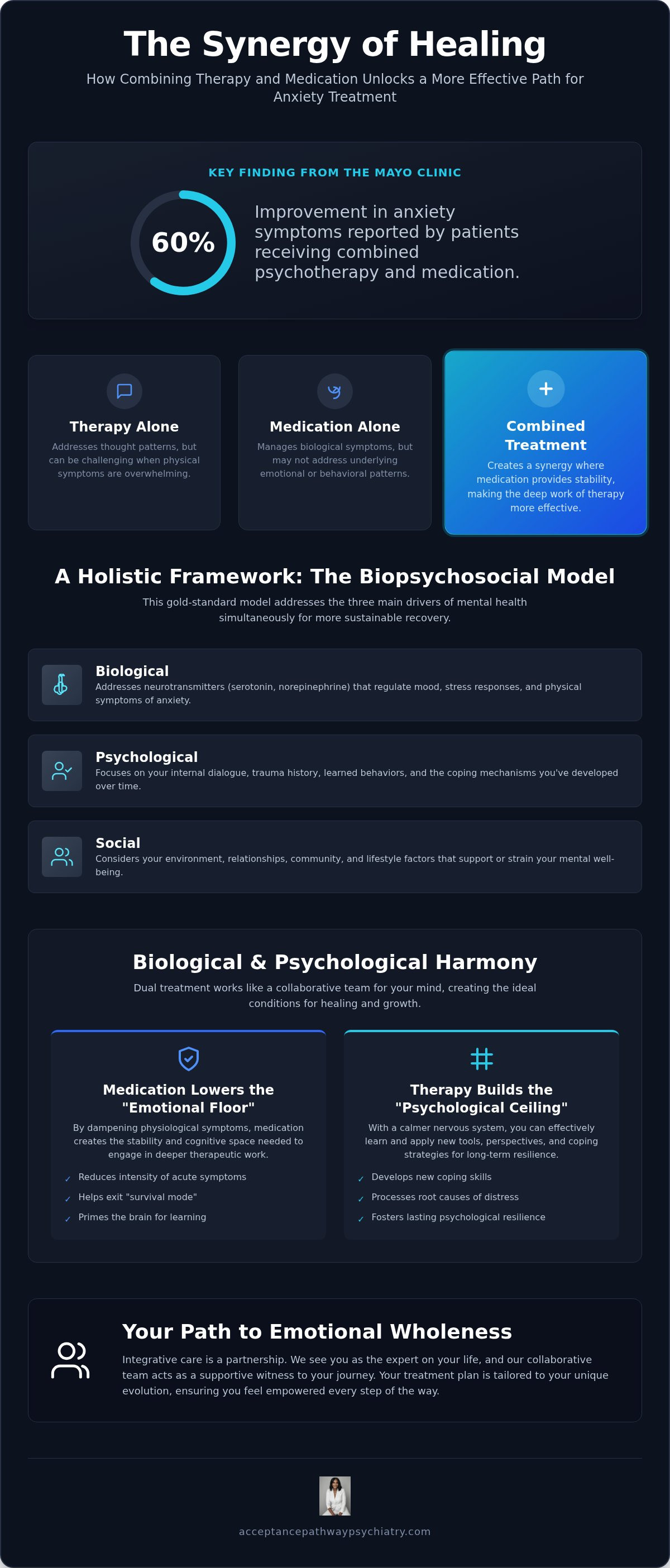
Recent data from the Mayo Clinic indicates that patients who receive both psychotherapy and pharmacotherapy report a 60% improvement in their anxiety symptoms. This statistic is more than just a number. It represents a path forward for those who feel stuck. You might feel like a failure because therapy alone hasn't silenced your racing thoughts, or perhaps you worry that medication is merely a band-aid for deeper emotional wounds. These feelings are valid, but they don't have to be your reality. You deserve a treatment plan that addresses both your biology and your lived experience.
In this guide, we at Acceptance Pathway Psychiatry PLLC will explore the synergistic power of combined therapy and medication for anxiety. You'll discover how medication management can provide the essential biological stability that allows the deep, transformative work of psychotherapy to actually take root. We'll demystify how different mental health professionals collaborate as a supportive team on your behalf. By understanding the connection between your brain chemistry and behavioral change, you can move toward emotional wholeness with a plan that feels both scientific and deeply human. Let's look at how this holistic approach can accelerate your healing and provide the steady ground you've been seeking.
Key Takeaways
- Learn how the biopsychosocial model addresses your brain, mind, and environment simultaneously to create a more stable foundation for healing.
- Discover why combined therapy and medication for anxiety often outperforms single treatments by lowering your emotional distress while raising your psychological resilience.
- Reframe your perspective on medication as a supportive bridge that helps you move past survival mode so you can engage more effectively with therapeutic tools.
- Understand the value of a collaborative care team that acts as a supportive witness, ensuring your treatment plan is tailored to your unique personal evolution.
- Gain confidence in a holistic path that integrates psychiatric expertise with wellness services to support your long-term emotional wholeness.
The Synergy of Healing: Understanding Combined Therapy and Medication for Anxiety
Healing isn't a one-size-fits-all process. For many, the choice between medication and therapy feels like a fork in the road. You might wonder if you should focus on your brain chemistry or your thought patterns. The truth is that these two paths often work best when they merge. Combined therapy and medication for anxiety is the intentional integration of psychiatric support and psychotherapy. It's not just about adding one to the other; it's about creating a synergy where the biological stability from medication creates a fertile ground for the emotional work of therapy to flourish.
This approach moves beyond the false dilemma of "pills versus talk." Instead, it creates a safe space where your biology meets your emotional exploration. When your nervous system is consistently overwhelmed, it's difficult to focus on deep psychological growth. Medication acts as a stabilizing force, lowering the volume of physical anxiety symptoms so you can actually hear what your therapist is saying. This integration ensures that we address the root causes of distress from every possible angle.
The Biopsychosocial Model of Care
A truly holistic approach requires a framework that respects your complexity. The biopsychosocial model is the gold standard for understanding anxiety disorders because it addresses the three main drivers of mental health simultaneously.
- Biological: This involves neurotransmitters like serotonin and norepinephrine that regulate mood and stress responses.
- Psychological: This focuses on your internal dialogue, trauma history, and the coping mechanisms you've built over time.
- Social: This considers your environment, relationships, and lifestyle factors that either support or strain your peace of mind.
By addressing all three pillars, we create a path to recovery that is more sustainable than single-modality care. You aren't just managing a condition; you're building a resilient life that can withstand the natural ebbs and flows of the human experience.
Addressing the Whole Person, Not Just Symptoms
In our practice, we don't view you as a set of symptoms to be "fixed." We see you as an individual in the midst of a personal evolution toward wholeness. Our collaborative model treats the relationship between clinician and patient as a mutual partnership. You're the expert on your own life, and we serve as a supportive witness to your journey.
Integrative care honors your unique internal experience. It recognizes that while combined therapy and medication for anxiety provides the clinical structure, the ultimate goal is your sense of internal peace and empowerment. This partnership ensures that every step we take together respects your values and your pace, moving you toward a future where you feel supported by a dedicated team rather than just a prescription pad.
Biological and Psychological Harmony: How Dual Treatment Works
Dual treatment works like a collaborative team for your mind. Medication lowers the "emotional floor," which means it reduces the intensity of acute symptoms so you aren't constantly in a state of crisis. Meanwhile, therapy builds the "psychological ceiling" by providing the tools and resilience needed for long-term growth. By dampening the physiological sirens of a panic response, medication creates the cognitive space required for you to engage meaningfully in therapy sessions without being hijacked by physical fear. This harmony is why combined therapy and medication for anxiety is often the most effective path toward stability.
This synergy is deeply rooted in the concept of neuroplasticity. Scientific studies, including research on combined therapy effectiveness, suggest that medication can prime the brain for the learning that happens in psychotherapy. When your nervous system is in survival mode, it's difficult to form new neural pathways. Medication helps exit that survival state, making your brain more receptive to the new perspectives and behavioral changes your therapist introduces. It's about preparing the soil so the seeds of therapy can actually take root.
Medication as the Foundation for Growth
Think of medication as a way to reduce the "noise" of anxiety. When the mental static is loud, it's nearly impossible to focus on complex techniques like trauma processing or cognitive restructuring. By stabilizing your brain chemistry, medication allows for clear thinking and intentional action. This is the essence of precision psychiatry. It isn't about masking your personality; it's about providing a stable platform where you can finally do the work you've been wanting to do. Our integrative wellness services focus on this balance, ensuring your biological needs are met so your personal evolution can begin.
Therapy as the Engine for Long-Term Change
While medication handles the biological foundation, therapy addresses the root causes that a prescription cannot reach. Medication won't resolve old wounds, grief, or the limiting belief systems that keep you stuck. Therapy serves as the engine for change, helping you process your history and build a toolkit of coping strategies. These skills remain with you even if your medication needs change over time. The psychiatric medication management pillar explains this balance in detail, highlighting how we use both tools to foster true internal wholeness. This dual approach ensures you don't just feel better temporarily, but actually grow into a more resilient version of yourself.
Breaking Through Plateaus: Why Integration Often Outperforms Single Modalities
Hitting a plateau in your mental health journey can feel incredibly discouraging. You might be attending every therapy session and practicing your coping skills, yet still find yourself paralyzed by a racing heart or a sense of impending doom. This "stuck" feeling often happens because your mind and your biology are out of sync. While you are working hard on your thoughts, your nervous system might still be trapped in a survival loop. Choosing combined therapy and medication for anxiety is a strategic way to break through these barriers by addressing both the software of your mind and the hardware of your brain.
Research from the Cleveland Clinic suggests that personalized plans combining psychotherapy with SSRIs can lead to a 60% improvement in anxiety symptoms. This significant progress is often what allows individuals to move past a standstill. Seeking comprehensive care isn't a sign of failure. It's a profound act of strength and a commitment to your long term wholeness. It shows that you're willing to use every available tool to reclaim your life and support your personal evolution.
Debunking the "Crutch" Misconception
One of the biggest hurdles to starting medication is the fear that it's a "crutch" or a sign of weakness. We prefer to view medication as a bridge. It provides the temporary support needed to cross over from a state of constant crisis to a place of stability. This biological ally doesn't bypass the work of therapy; it makes the work possible. By stabilizing neurotransmitters, you aren't masking your problems. You're creating the internal environment necessary for permanent psychological breakthroughs. Our non-judgmental approach ensures that we find the right balance for your unique journey, treating you as a partner in your own care.
Signs You May Be Plateauing
If you have been in talk therapy for months but your physical symptoms haven't budged, you might be experiencing a therapy plateau. Common signs include persistent insomnia, digestive issues linked to stress, or an inability to use your coping skills when you're actually anxious. In some cases, these hurdles are tied to underlying biological patterns. For example, understanding the role of cognitive assessment for ADHD can help identify if executive function challenges are complicating your anxiety. When we identify these biological factors, adding medication management can "unlock" your progress, allowing you to finally apply the wisdom you've gained in therapy to your daily life.
For individuals managing complex conditions like PTSD or Bipolar Disorder, this integration is even more vital. Medication provides the safety net required to dive into deep trauma work without the risk of a total nervous system collapse. It keeps you within your "window of tolerance," so you can process difficult memories and emerge stronger on the other side.
Navigating the Journey: What to Expect from an Integrated Care Plan
Starting a new treatment path can feel overwhelming, especially when you're already carrying the weight of anxiety. An integrated care plan isn't a series of disconnected hurdles. It's a structured, collaborative process designed to support your unique needs. By engaging in combined therapy and medication for anxiety, you're entering a partnership where every step is intentional and focused on your personal evolution. This journey begins with a clear roadmap, ensuring you never feel lost or alone in the process.
The rhythm of your care is built around stability and predictability. You'll participate in regular medication management check-ins to monitor efficacy and minimize potential side effects. These are paired with consistent psychotherapy sessions where you'll work through your internal experience and build practical coping tools. To make this process as accessible as possible, telehealth appointments offer the flexibility to maintain your schedule from the safety of your own home. This consistency is vital for long term success.
The Role of the Psychiatric Evaluation
Your journey starts with a comprehensive psychiatric evaluation. This is much more than a standard doctor visit; it's an in-depth clinical consultation that looks at your biological history, lifestyle, and emotional environment. We use precision psychiatry tools like Creyos cognitive testing to gather objective data on your brain health. This information helps us create a personalized treatment plan that aligns your physical health with your mental health goals. If you're ready to begin this process, you can schedule your initial evaluation with our team today.
Adjusting Your Journey Over Time
Integrated care is dynamic, not static. It evolves as you progress. Your needs today may be very different from your needs six months from now. As you achieve deeper breakthroughs in psychotherapy, we may collaboratively decide to adjust or taper your medications. This process is always a mutual partnership. We maintain a steady, methodical rhythm in your treatment flow to ensure you feel grounded and empowered. By treating the relationship as a collaboration, we ensure that your care plan remains a supportive witness to your growth rather than a rigid set of rules.
Your Path to Emotional Wholeness: Collaborative Care at Acceptance Pathway
Emotional wholeness is more than just managing a diagnosis. It's a return to yourself and a discovery of internal peace. At Acceptance Pathway, we focus on combined therapy and medication for anxiety as a way to facilitate this return. We believe your journey deserves a clinician who acts as a supportive witness. This means we aren't here to simply dictate a treatment plan. We're here to walk alongside you, offering a non-judgmental space where you can explore your emotions while receiving the biological support you need. This compassionate register is designed to lower your barriers to seeking help and create an immediate sense of psychological safety.
A Partnership in Progress
We treat the relationship between you and our clinical team as a mutual partnership based on trust and deep empathy. It's vital for you to feel that your story is heard and that your internal experience is valued. A psychiatrist who truly listens can make all the difference in how you perceive your progress. This collaborative model ensures that you aren't just a number in a medical system. Instead, you're an active participant in your healing. Our framework for integrated care for adults utilizes this partnership to identify the specific tools that will help you thrive. Whether we are discussing medication management or therapeutic techniques, your input is the primary guide for our work together.
Embracing Integrative Wellness
Our integrative wellness services complement both medication and psychotherapy by focusing on your environment and lifestyle. These strategies help you build a life that supports your mental health stability over time. We emphasize a methodical and steady rhythm in our care, mirroring a therapeutic pace that avoids high-pressure tactics. This intentional flow allows you to absorb information and make changes at a speed that feels manageable and grounding. By embracing a holistic view of health, we help you move toward a future where you feel supported by a dedicated team. You don't have to navigate this path alone. With a steady and reliable partnership, the potential for personal progress and a sense of internal wholeness is within your reach.
Embracing Your Holistic Path to Peace
Choosing to address both your brain chemistry and your thought patterns is a powerful step toward lasting stability. We've explored how combined therapy and medication for anxiety creates a necessary synergy, allowing biological stability to support deep psychological growth. By breaking through plateaus and navigating a clear roadmap, you can move beyond survival mode and into a state of personal evolution. You don't have to choose between science and empathy; a truly effective plan honors both.
At Acceptance Pathway Psychiatry, we provide a compassionate, non-judgmental environment where your unique experience is the priority. We use precision psychiatry tools like Creyos cognitive testing to ensure your care is data-driven and tailored to your needs. Whether you prefer in-person visits or the flexibility of telehealth appointments, we're here to act as a supportive witness to your progress. It's time to feel heard and supported by a team that views treatment as a mutual partnership. Begin your journey toward integrated healing with Acceptance Pathway Psychiatry. You deserve a future defined by wholeness and hope.
Frequently Asked Questions
Is it better to start therapy or medication first for anxiety?
The decision depends on the severity of your symptoms and your personal goals. If your anxiety is so intense that it's difficult to focus or leave your home, starting with medication management can provide the biological stability needed to engage in psychotherapy. Many people choose to begin both simultaneously to address the biological and psychological aspects of their experience from day one, ensuring a more comprehensive foundation for their healing journey.
Can I eventually stop medication if I stay in psychotherapy?
Yes, many individuals use medication as a temporary bridge rather than a lifelong requirement. Psychotherapy helps you build a robust toolkit of coping strategies and emotional resilience. As you develop these skills and your internal environment stabilizes, you and your provider may collaboratively decide to taper your medication. This process is always methodical and based on your unique progress toward emotional wholeness and long term stability.
How long does it take to see results from combined treatment?
Most people begin to notice physical relief from medication within two to six weeks. While the biological shift happens relatively quickly, the deep, transformative work of psychotherapy is a gradual process that unfolds over several months. Using combined therapy and medication for anxiety often accelerates the overall healing timeline because you aren't fighting against overwhelming physical symptoms while trying to learn and implement new behavioral patterns.
Are there specific conditions where combination therapy is most effective?
Combination therapy is particularly effective for complex conditions like PTSD, Bipolar Disorder, and Generalized Anxiety Disorder. In these cases, medication provides a vital safety net that prevents the nervous system from becoming overwhelmed during difficult trauma processing. It is also highly beneficial for those who have hit a plateau with a single treatment modality and need a more holistic, collaborative approach to reach their personal goals.
Will medication change my personality or make therapy less effective?
Modern psychiatric medications are designed to reduce distressing symptoms, not alter your core personality. In fact, many patients find that medication makes therapy more effective by clearing the mental noise that once made self-reflection impossible. By lowering your emotional floor, medication allows your true self to emerge. This gives you the cognitive space to participate fully in your personal evolution during your therapy sessions.
How do I know if my current treatment plan needs to be integrated?
You might consider an integrated plan if you feel stuck despite consistent effort in a single modality. If you have the tools from therapy but your heart still races uncontrollably, or if you're on medication but haven't addressed the root causes of your distress, integration may be the answer. A comprehensive psychiatric evaluation can help determine if your biology and psychology are currently out of sync.
Can I receive combined therapy and medication management via telehealth?
Yes, you can access our full range of services, including psychiatric evaluations and psychotherapy, through telehealth appointments. Virtual care offers the flexibility to maintain consistency in your integrated treatment plan without the stress of a commute. This ensures that your path to healing remains steady and accessible, regardless of your schedule or location, providing a reliable partnership that fits into your daily life.
What if I am already seeing a therapist elsewhere but need medication management?
We frequently work in a collaborative expert model with outside providers. If you already have a trusted relationship with a therapist, we can provide specialized medication management that complements your existing work. Our clinicians act as a supportive witness to your journey, coordinating with your current team to ensure your treatment plan is cohesive, non-judgmental, and focused on your total internal wholeness.


