

You can't actually fail a cognitive test for ADHD, even if the low percentiles on your report make you feel like you've fallen short. It's completely natural to feel a sense of anxiety when you're staring at a clinical document filled with complex jargon like "spatial span" or "response inhibition." You might worry that these scores prove you're "broken" or that you won't get the help you need. We understand that this process can feel overwhelming and deeply personal.
The truth is that interpreting ADHD cognitive test results is not about assigning a grade to your intelligence. Instead, think of these results as a biological weather report for your brain. This data provides a clear, objective look at your neurobiology, validating that your daily struggles have a real basis in how your mind functions. In this guide, we'll decode the markers and data in your report to help you identify your cognitive strengths and weaknesses. By the end, you'll have the clarity needed to move toward precision psychiatry and a personalized treatment plan that truly supports your unique way of thinking.
Key Takeaways
- Understand the shift from subjective symptoms to objective data, providing a biological map of how your brain functions in real-world scenarios.
- Learn the practical steps for interpreting ADHD cognitive test results by translating clinical markers like reasoning and memory into your daily experiences.
- Discover why percentile scores are comparisons rather than grades, removing the fear of "failing" and replacing it with clinical clarity.
- See how objective data from Creyos testing helps your provider reduce the trial-and-error phase of medication management and psychotherapy.
- Gain a sense of hope by viewing your results as a foundation for a personalized treatment plan designed for your unique neurobiology.
Beyond the Symptoms: What ADHD Cognitive Test Results Really Reveal
Living with ADHD often feels like a constant battle against your own intentions. You know what you need to do, but your brain seems to have other plans. While your personal experience is vital, it's only one piece of the puzzle. When we look at your cognitive test results, we're moving past the "what" of your symptoms and into the "why" of your unique neurobiology. This data doesn't replace your story; it provides the biological context that makes your story make sense.
Objective Data vs. Subjective Experience
Traditional methods for diagnosing ADHD in adults rely heavily on self-report questionnaires and clinical interviews. These are essential for understanding your history and daily hurdles, but they are inherently subjective. Cognitive markers act as the invisible engines of your focus. They measure how your brain actually performs tasks in real-time. By interpreting ADHD cognitive test results, we can separate how you feel from how your brain functions. This is the heart of "Precision Psychiatry." We use objective data to stop the guessing game, allowing us to see exactly where your cognitive processes are most efficient and where they need support.
The Purpose of the ADHD Report
Receiving an ADHD report can be an emotional experience. For many, seeing their struggles reflected in scientifically backed data provides a profound sense of relief. It validates that your challenges aren't a lack of willpower or a character flaw; they have a clear biological basis. At Acceptance Pathway Psychiatry, we use Creyos Cognitive Testing to establish a baseline for your progress. This data doesn't just highlight deficits. It often reveals hidden strengths, such as high verbal ability or exceptional reasoning skills, that your executive function challenges might be masking.
Removing the guilt associated with ADHD is a critical part of the healing journey. When you see that your response inhibition or working memory scores are lower than average, it transforms a personal "failure" into a clinical data point. The process of interpreting ADHD cognitive test results allows us to build a treatment plan on facts, not just feelings. A cognitive report is a tool for collaborative care that guides our partnership, rather than a final judgment on your potential.
Decoding Your Cognitive Markers: Attention, Memory, and Processing
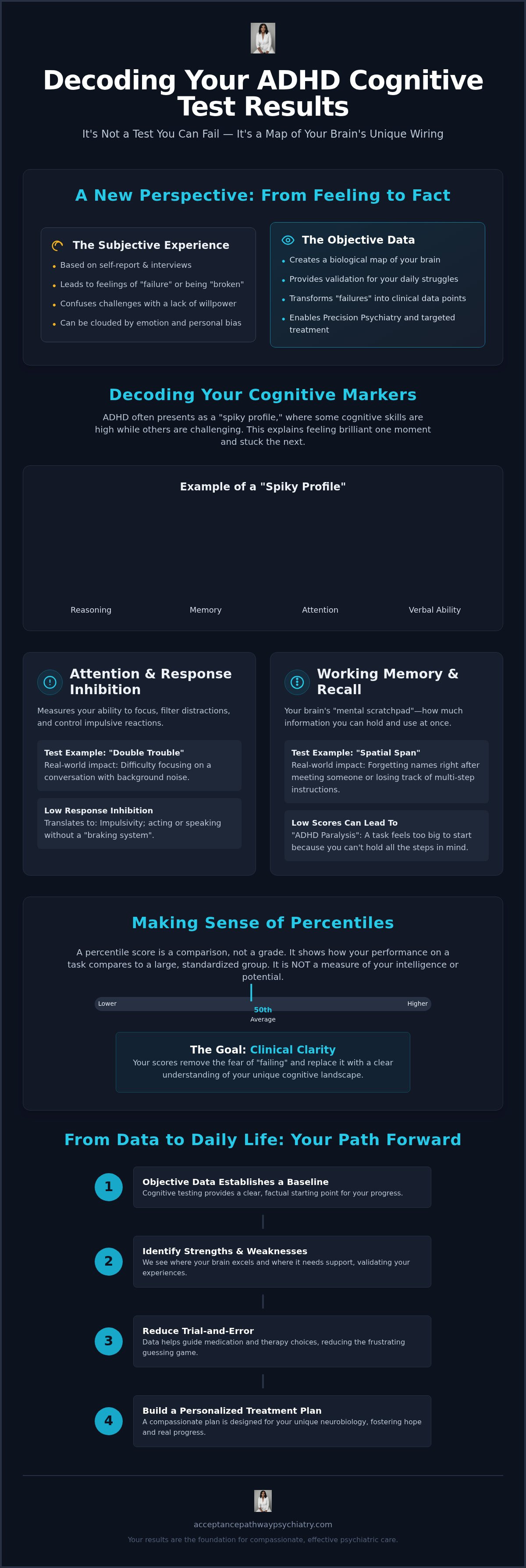
A clinical report can look like a wall of data, but it's actually a story about how you move through the world. When we begin interpreting ADHD cognitive test results, we look for patterns across four main pillars: Reasoning, Memory, Attention, and Verbal Ability. Most people don't have a flat profile where every score is the same. Instead, many individuals with ADHD have a "spiky profile." You might find that your reasoning skills are exceptionally high, while your processing speed or attention scores are much lower. This gap explains why you might feel brilliant in some moments and completely stuck in others.
Attention and Response Inhibition
The "Double Trouble" task is a classic example of how we measure focus. It requires you to identify the color of a word while the word itself spells out a different color. This mirrors the real-world struggle of filtering out distractions. If your score is low here, it's likely why you find it impossible to focus on a conversation when there's background music playing. Another task, "Feature Match," looks at your ability to spot small differences in complex patterns. This relates to detail-oriented work like proofreading or managing spreadsheets. Low scores in response inhibition often translate to impulsivity; your brain simply doesn't have the "braking system" needed to pause before acting or speaking.
Working Memory and Short-Term Recall
Working memory is often described as your brain's mental scratchpad. In the Creyos suite, tasks like "Spatial Span" and "Token Search" measure how much information you can hold and manipulate at once. When these scores are low, it explains why you might forget a person's name immediately after meeting them or lose track of a three-step instruction by the time you reach the second step. This deficit is a major contributor to "ADHD paralysis." When your brain can't hold all the steps of a project at once, the task feels insurmountable, and you simply can't start. The "Number Ladder" task further explores this by testing your ability to sequence and plan. If you're struggling to organize your day, Creyos Cognitive Testing can provide the objective evidence needed to tailor your treatment and build better coping strategies.
Making Sense of Percentiles: Why There Is No 'Failing' an ADHD Test
When you first look at your report, your eyes might immediately jump to the percentile numbers. It's common to feel a rush of anxiety, especially if you see scores that seem low. However, a percentile is not a grade. In school, a 10% is a failure, but in the context of interpreting ADHD cognitive test results, the 10th percentile simply means that 90% of people in your age group performed better on that specific task. It's a comparison, not a measure of your worth or your intelligence.
Many people worry that they "scored too high" on certain tasks, fearing this means they aren't "ADHD enough" to qualify for support. This is a common misconception. High scores in areas like verbal ability or reasoning often highlight the strengths you've used to mask your symptoms for years. We use a massive database of peers to ensure your results are weighted fairly against others of the same age. This helps us see if a struggle is a minor quirk or a significant clinical marker, regardless of how high your other scores might be.
Understanding the Percentile Curve
A score in the 50th percentile is considered exactly average. If you land in the 10th percentile for a task like attention, it's actually a win for your treatment plan because it gives us a specific, objective target. We now know exactly which cognitive "engine" needs the most support. These numbers help us understand why you might feel like you're working twice as hard as everyone else just to stay at the same level. Cognitive testing is a snapshot in time, not a permanent limit on your potential.
The Validity Indicator: Did You Try Your Best?
The Creyos software includes a validity indicator to ensure the data we collect is reliable. It's not a "lie detector." Instead, it's a tool that looks for patterns suggesting you were too anxious, fatigued, or distracted to perform at your true baseline. Invalid results are common and don't mean you "messed up" the test. They often happen when ADHD symptoms are particularly high on the day of the assessment. This is why we prioritize taking the test in a calm, telehealth-optimized environment where you feel safe. If a result comes back as invalid, we simply view it as a sign that we need to try again when you're feeling more grounded. This ensures that interpreting ADHD cognitive test results leads to the most accurate and helpful treatment path possible.
From Data to Daily Life: How Results Shape Your Treatment Plan
The real power of interpreting ADHD cognitive test results lies in what happens after the testing is over. Data shouldn't just sit in a file; it should actively guide your healing journey. By looking at your specific markers, we move away from a "one-size-fits-all" approach and toward a strategy that honors your brain's unique architecture. This objective foundation allows us to build "environmental scaffolding." These are practical, personalized changes to your daily surroundings that support your specific memory and attention scores, making your day-to-day life feel more manageable and less chaotic.
Precision Medication Management
Choosing the right medication often feels like a frustrating process of trial and error. Data changes that. If your report shows low attention but high reasoning, we may prioritize different options than if your response inhibition is the primary challenge. The process of interpreting ADHD cognitive test results ensures that your medication plan is backed by actual performance data. Since telehealth regulations for ADHD stimulants are extended through December 31, 2026, you can access psychiatric medication management conveniently from home while we use your data to fine-tune your plan.
Tailoring Psychotherapy to Your Brain
Effective therapy targets your specific cognitive "spikes." If you have high reasoning but low working memory, we use your logic to build systems that bypass memory gaps. This personalized strategy is central to ADHD treatment for adults. Since 69.6% of adults with ADHD have a co-diagnosed disorder, we use testing to ensure therapy supports your entire mental health landscape. We also integrate wellness practices, such as sleep hygiene and nutrition, to nourish your brain alongside clinical care.
We often recommend re-testing after several months of treatment. This provides tangible proof of your progress and helps us adjust your medication or therapy goals as your brain begins to function more efficiently. Seeing your scores climb is a powerful form of validation that your hard work and treatment are paying off. It transforms the recovery process from a feeling of "hoping it works" into a visible, measurable evolution of your cognitive health. To begin this data-driven process, you can connect with our collaborative experts to review your options and start your path toward clarity.
Your Path Forward: Integrating Testing with Compassionate Psychiatric Care
While the data provided by Creyos is incredibly precise, it only reaches its full potential when paired with a supportive clinical relationship. At Acceptance Pathway Psychiatry PLLC, we believe that you are far more than a collection of scores on a screen. The process of interpreting ADHD cognitive test results is a collaborative effort between you and your provider. We use these numbers as a foundation, but we also listen to your story, your frustrations, and your goals. This human-centric approach ensures that the data serves you, rather than defining you.
A Collaborative Approach to Healing
Our philosophy centers on transitioning you from a passive patient to an active partner in your mental health journey. We don't just look at ADHD in isolation. Because about 69.6% of adults with ADHD have a co-diagnosed mental health disorder, we must consider the whole person. We examine how anxiety, trauma, and lifestyle factors interact with your cognitive profile. This integrative perspective gives you the comfort of knowing your care is based on both objective evidence and deep empathy. You aren't just getting a prescription; you're gaining a steady ally who values your unique experience.
Start Your Journey Today
Think of your cognitive report as the first page of a new chapter rather than a final verdict. When you prepare for your follow-up psychiatric evaluation for adults, come ready to discuss which results resonated most with your daily life. Did the attention scores explain your workday fatigue? Did the memory markers finally make sense of your struggles with organization? Interpreting ADHD cognitive test results together allows us to validate your past and plan for your future. Clarity is the first step toward stability, and with the right support, ADHD is a manageable part of a full and productive life. We invite you to book a consultation to walk through your results and begin building a path that honors the way your brain actually works.
Embracing Clarity for a Better Tomorrow
Understanding your cognitive profile is the first step toward a life of greater stability and self-compassion. Your Creyos report acts as a biological map, highlighting the specific markers like attention and memory that drive your daily experience. By interpreting ADHD cognitive test results through a clinical and empathetic lens, we move away from guesswork and toward precision psychiatry. This data-backed approach allows us to tailor your medication management and psychotherapy to your unique neurobiology, ensuring your treatment is as individual as you are.
At Acceptance Pathway Psychiatry, we combine expert Creyos interpretation with integrative, trauma-informed care and compassionate medication management. You don't have to navigate these complex findings alone. Schedule your cognitive assessment review and start your personalized care plan today. Your journey toward wholeness is a collaborative process, and we're here to be a steady witness to your progress. You have the potential for incredible personal evolution, and we're honored to provide the map that helps you get there.
Frequently Asked Questions
What is a 'normal' score on an ADHD cognitive test?
A "normal" score typically falls within the 25th to 75th percentile range, with the 50th percentile representing the exact average for your age group. Scores outside this range aren't necessarily bad; they simply indicate areas where your cognitive performance is either a distinct strength or a challenge that needs support. We look at the whole profile rather than isolated numbers to understand your brain's unique rhythm.
Can I 'fail' an ADHD cognitive assessment?
You cannot fail an ADHD cognitive assessment because it's a measurement of performance rather than a test of knowledge. The goal of interpreting ADHD cognitive test results is to identify your unique cognitive architecture. Even a very low score is useful data. It helps your provider target specific areas for improvement, such as response inhibition or working memory, rather than indicating a personal failure.
How do cognitive test results differ from a standard ADHD diagnosis?
Cognitive test results provide objective data on brain function, while a standard ADHD diagnosis is a clinical conclusion based on your history and DSM-5-TR criteria. A diagnosis is the "label" for your symptoms, but the test results are the "map" of how those symptoms manifest in your brain. Testing adds a layer of precision that helps your provider confirm the diagnosis and refine your treatment plan.
Will my insurance cover the cost of interpreting these results?
Insurance coverage for the interpretation of cognitive results depends entirely on your specific plan and provider. Many insurance companies cover cognitive testing when it's part of a psychiatric evaluation or medication management plan. We recommend contacting your insurance carrier directly to ask about your benefits for "neuropsychological or cognitive testing" to avoid unexpected costs during your care journey.
What if my test results don't match how I feel every day?
It's common for results to differ from your daily experience, often because you may be "masking" or using high levels of effort to compensate for challenges. You might score well on a short, structured task while still struggling in a messy, real-world environment. We use these discrepancies as a starting point for a deeper conversation about how your brain functions under different levels of stress.
How often should I retake the cognitive assessment?
Most patients benefit from retaking the assessment every six to twelve months or after a significant change in their treatment plan. Re-testing is a vital part of interpreting ADHD cognitive test results over time. It allows us to see if your medication or therapy is effectively improving your cognitive markers, providing tangible evidence of your progress and helping us fine-tune your care.
Can anxiety or depression affect my ADHD test scores?
Anxiety and depression can significantly impact your test scores by slowing your processing speed or reducing your working memory capacity. Because about 69.6% of adults with ADHD have a co-occurring condition, we take these factors into account. Your results are interpreted through a trauma-informed lens to ensure we're treating the whole person rather than just a single set of symptoms.
What is the difference between Creyos and other ADHD tests like QbCheck?
Creyos uses a series of varied tasks to measure specific cognitive domains like reasoning and verbal ability, while tests like QbCheck focus on continuous performance. QbCheck specifically tracks motion and sustained attention over a longer period. Creyos provides a broader "spiky profile" of your cognitive strengths and weaknesses, which we find essential for building a truly integrated and personalized wellness strategy.


