

What if managing your ADHD didn't have to feel like a constant battle with jittery nerves or monthly pharmacy hurdles? For many of the 8.7 million American adults living with this diagnosis, the traditional stimulant route brings unwanted side effects or feels like a temporary fix that wears off just when you need it most. It's understandable to want a treatment plan that feels safe and sustainable, which is why many are now exploring non-stimulant ADHD medication options for adults to find a sense of calm and consistency.
These medications offer a path toward steady, 24-hour focus and improved emotional regulation. Unlike stimulants, these options work by gradually shifting your brain chemistry over four to eight weeks to provide a reliable foundation for your daily life. This guide walks you through the diverse range of treatments available as of August 2026. You'll discover how a personalized, integrative approach, combining medication management with tools like Creyos cognitive testing, can help you find the lasting balance you deserve.
Key Takeaways
- Learn how non-stimulants offer steady, 24-hour coverage that eliminates the evening "crash" often felt with other treatments.
- Discover the diverse non-stimulant ADHD medication options for adults, from established FDA-approved choices to effective off-label alternatives.
- Understand the difference between medications that target norepinephrine and those that help with emotional regulation and impulsivity.
- Explore the value of an integrative approach that uses Creyos cognitive testing to track your progress with objective data.
- Find out how a collaborative partnership with your provider ensures your treatment plan feels safe, sustainable, and tailored to your life.
Why Consider Non-Stimulant ADHD Medication Options for Adults?
For many, the journey with ADHD treatment starts and ends with stimulants. However, exploring non-stimulant ADHD medication options for adults is a proactive step toward finding a more balanced life. These medications work by fine-tuning the levels of norepinephrine and dopamine in your brain without the rapid-release mechanism found in traditional stimulants. This difference is vital for those who need support that lasts through the evening, long after a standard dose would have worn off. Choosing this path isn't about settling for a "second-best" treatment; it's about choosing a sustainable approach that respects your body's unique limits.
You might find these options particularly helpful if you struggle with co-occurring anxiety, sleep disturbances, or cardiovascular concerns. By treating Attention deficit hyperactivity disorder with a long-term view, you're investing in your overall wellness rather than just a narrow window of productivity. It removes the pressure of the "controlled substance" stigma and provides a sense of quiet, reliable stability that integrates into your lifestyle.
The Mechanism of Action: How They Differ from Stimulants
Non-stimulants primarily act as norepinephrine reuptake inhibitors (NRIs). By increasing the availability of this neurotransmitter in the prefrontal cortex, they help strengthen the brain's executive functions like planning, memory, and emotional control. Unlike stimulants, which provide an immediate "on" and "off" experience, non-stimulants require a gradual build-up over four to eight weeks to reach their full effect. A steady-state concentration refers to the point where the medication level in your bloodstream stays consistent, ensuring your focus doesn't disappear when the sun goes down.
Common Reasons for Transitioning Away from Stimulants
The decision to switch often comes from a place of self-care. Many adults experience uncomfortable physical side effects from stimulants, such as a racing heart, elevated blood pressure, or a total loss of appetite. For those already living with ADHD and co-existing anxiety, stimulants can sometimes make internal restlessness or "jitters" feel even more intense. There's also the logistical burden to consider. Stimulants are Schedule II controlled substances, which often means monthly pharmacy hurdles and strict refill windows. Exploring non-stimulant ADHD medication options for adults offers a reprieve from these stressors, allowing you to focus on your personal growth rather than the paperwork.
Primary FDA-Approved Non-Stimulant Options: Atomoxetine and Viloxazine
When you're looking for stability, the two heavy hitters in the non-stimulant world are Atomoxetine and Viloxazine. Unlike stimulants that work almost instantly, these medications require patience and a bit of grace for yourself. Your body needs a "ramp-up" period, usually taking four to six weeks to reach full efficacy. This slow build is actually a benefit. It allows your brain to adjust gradually, creating a steady foundation for focus that doesn't fluctuate throughout the day. Exploring these non-stimulant ADHD medication options for adults is often the first step toward a treatment plan that feels reliable and safe.
Atomoxetine: The Gold Standard of Non-Stimulants
Atomoxetine, known by the brand name Strattera, was the first non-stimulant medication to receive FDA approval for treating ADHD Medications for Adults. It has a long-standing track record of improving both inattentive and hyperactive symptoms. Because it isn't a controlled substance, it carries no risk of addiction or abuse. Clinicians typically recommend a "start low and go slow" approach to dosing. This helps your system acclimate and minimizes initial discomfort. It's a gentle way to introduce positive change into your daily routine without the intensity of a rapid-release stimulant.
Qelbree: Understanding the Newer Alternative
Viloxazine, marketed as Qelbree, is a newer addition to the landscape. While it's also a selective norepinephrine reuptake inhibitor, its chemical structure is slightly different from Atomoxetine. Some clinical data suggests it might have a slightly faster onset of action for certain individuals. As of August 2026, it remains a robust, FDA-approved option for adults seeking alternatives to traditional stimulants. It's vital to discuss potential drug interactions with your provider, especially if you take other medications that affect liver enzymes. This collaborative approach ensures that your non-stimulant ADHD medication options for adults are safe for your specific health profile.
Adjusting to a new medication is a journey that requires support. You might experience initial side effects like nausea or mild fatigue during the first two weeks. These are usually signs that your body is recalibrating. Taking your dose with a meal or shifting the timing to the evening can often alleviate these hurdles. If you're feeling unsure about which path to take, a personalized medication management consultation can help you weigh these options with a compassionate expert who understands your unique goals.
Beyond the Basics: Alpha-Agonists and Off-Label Alternatives
While Atomoxetine and Viloxazine are the primary FDA-approved paths, the landscape of non-stimulant ADHD medication options for adults is much broader. Sometimes, the most effective treatment isn't the one with the most famous brand name, but the one that aligns with your specific brain chemistry. This is the heart of precision psychiatry. We look beyond general symptoms to understand which neurotransmitters need support. This ensures your treatment plan feels like a perfect fit rather than a forced one. Older medications and off-label choices often provide the missing piece for complex cases involving mood swings or intense emotional reactions.
Guanfacine and Clonidine: Managing the "Hyper" in ADHD
Guanfacine and Clonidine belong to a class called alpha-2 adrenergic agonists. Originally developed for blood pressure, they work by strengthening the signals in the prefrontal cortex. This area of the brain manages executive function, helping you filter out distractions and pause before acting. For adults who experience rejection sensitive dysphoria (RSD), these medications can be life-changing. They soften the sharp edges of emotional pain and reduce the "all-or-nothing" intensity of feelings. Because they affect the cardiovascular system, your provider will monitor your blood pressure and heart rate during the adjustment period to keep you safe and comfortable.
Wellbutrin and the Mood-ADHD Connection
Bupropion, commonly known as Wellbutrin, is an antidepressant that serves as a powerful off-label tool for ADHD. It works by increasing the levels of both dopamine and norepinephrine in the brain. It's often the preferred choice for adults who feel "unmotivated" or "sluggish" rather than just physically hyperactive. If you struggle with co-occurring depression alongside your ADHD, this dual-action approach can lift the fog and provide the energy needed to start your day. Although the FDA hasn't specifically labeled it for ADHD, Bupropion is widely supported by clinical practice guidelines and remains one of the most common non-stimulant ADHD medication options for adults prescribed today.
For very specific patient profiles, tricyclic antidepressants (TCAs) like Desipramine might be considered. These are older medications that require careful monitoring but can be highly effective when other options haven't provided the desired relief. Every brain is different. Finding the right medication is a collaborative process of discovery. We focus on your internal experience to ensure the path we choose leads toward wholeness and clarity.
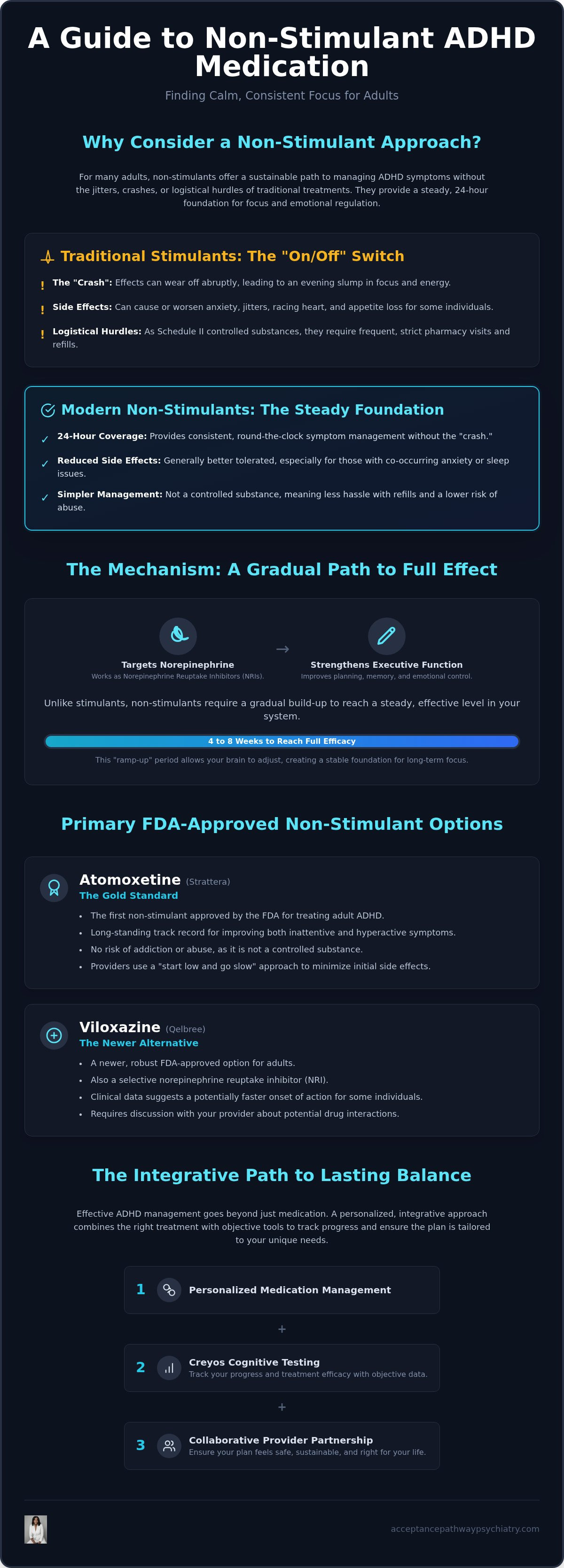
The Integrative Path: Combining Medication with Cognitive Support
Choosing to start treatment is a powerful act of self-care. While non-stimulant ADHD medication options for adults provide a stable physiological foundation, they're often most effective when viewed as one part of a larger, holistic picture. You've likely heard the saying in the neurodivergent community: "pills don't build skills." This perspective reminds us that while medication can lower the barrier to focus, it doesn't automatically teach you how to organize a calendar or manage a complex project. By combining clinical support with practical lifestyle changes, you create a comprehensive environment where your brain can truly thrive.
Creyos Cognitive Testing: Measuring Real Progress
One of the most grounding parts of this journey is seeing objective proof that you're moving forward. We use Creyos cognitive testing to provide a clear baseline of your cognitive health before you even begin a new regimen. This isn't a "pass or fail" exam; it's a supportive tool that measures executive functions like memory, attention, and processing speed. By re-testing at regular intervals, we can see exactly how your chosen non-stimulant ADHD medication options for adults are helping you. This data-driven approach removes the guesswork, allowing us to adjust your care plan with confidence and precision.
Holistic Strategies for ADHD Success
Your nervous system doesn't exist in a vacuum. Simple, consistent changes in your environment can amplify the benefits of your medication. Regular movement, even a short daily walk, naturally boosts dopamine and norepinephrine levels, providing an extra layer of support for your focus. Mindfulness practices also play a vital role. They act as a bridge, helping you stay grounded and present between your doses. When you pair these habits with proper sleep hygiene and nutrition, you're not just treating a set of symptoms; you're nurturing your entire self. Integrative wellness services help you weave these threads together into a sustainable lifestyle.
Addressing the emotional weight that often comes with a late-stage diagnosis is just as vital as the medication itself. Years of struggling with procrastination or "lazy" labels can leave behind a heavy layer of shame. Psychotherapy serves as a compassionate partner in this process, helping you unpack that baggage and build a kinder internal monologue. We believe that true healing happens when you feel seen, heard, and supported in every aspect of your life. If you're ready to explore a more comprehensive way to manage your focus, our team is here to provide integrative wellness services that honor your unique experience.
Your Journey Forward: Personalized Medication Management at Acceptance Pathway Psychiatry PLLC
Finding the right balance for your neurodivergent brain is a deeply personal process. At Acceptance Pathway Psychiatry PLLC, we believe that you are the primary expert on your own life. Our role is to serve as your clinical guide, providing the scientific expertise needed to navigate your choices. When exploring non-stimulant ADHD medication options for adults, the relationship you have with your provider is the most significant factor in your success. We prioritize a partnership built on mutual respect and transparency, ensuring you never feel like just another chart in a medical system.
Accessing high-quality care shouldn't be a source of stress. Through our telehealth appointments, you can engage in psychiatric medication management from the comfort of your own home. This environment often allows for more open, honest conversations about your symptoms and goals. By removing the logistical hurdles of travel and waiting rooms, we make it easier for you to stay consistent with your ADHD treatment for adults.
What to Expect in Your First Appointment
Your initial evaluation is a dedicated time for us to listen. We take a deep, non-judgmental dive into your history, your previous experiences with medication, and what you hope to achieve. This session isn't about rushing to a prescription; it's about understanding your whole-person health. We look at your physical well-being, your sleep patterns, and your emotional landscape. If you've had negative experiences with stimulants in the past, your concerns will be heard and respected. We'll discuss how non-stimulant ADHD medication options for adults might offer the gentler, more sustainable path you've been looking for.
Building a Sustainable Care Plan
Once we have a clear picture of your needs, we work together to build a plan that lasts. This isn't a "set it and forget it" approach. We integrate medication management with objective data from Creyos testing and the emotional support of psychotherapy for a truly holistic approach. Regular check-ins allow us to fine-tune your dosage and celebrate the progress you're making in your daily life. You deserve a steady, reliable presence throughout your mental health journey. If you're ready to move toward a clearer, more focused future, take the first step and reach out to us today. We're here to walk this path with you.
Finding Clarity and Balance on Your Terms
Choosing a treatment path is about more than just managing symptoms; it's about reclaiming your sense of self. By exploring non-stimulant ADHD medication options for adults, you're investing in a stable, 24-hour rhythm that supports your brain without the physical stress of stimulants. This approach provides a foundation of calm focus that doesn't disappear when the workday ends, allowing you to be present for the people and passions that matter most.
At Acceptance Pathway Psychiatry PLLC, we provide a steady, supportive environment where your unique experience is the priority. We use objective data from Creyos cognitive testing to track your progress and ensure your care plan is working effectively. Our telehealth appointments provide national accessibility, ensuring you can receive compassionate, expert medication management regardless of your location. We treat the relationship as a partnership, acting as a supportive witness to your personal evolution and growth.
Begin your collaborative healing journey with a personalized psychiatric evaluation. You deserve a treatment plan that feels safe, sustainable, and entirely focused on your wholeness.
Frequently Asked Questions
Are non-stimulant ADHD medications as effective as stimulants for adults?
Stimulants are effective for about 70 to 80 percent of patients. While non-stimulants might have a slightly different effect size, they provide consistent, 24-hour support that many adults prefer. They're a robust choice for those who don't tolerate stimulants well or have co-occurring conditions. Effectiveness is often measured by improved executive function and emotional stability rather than just a quick burst of energy or focus.
How long does it take for non-stimulant ADHD medication to start working?
Most non-stimulant ADHD medication options for adults require four to eight weeks to reach their full therapeutic effect. Unlike stimulants that work within hours, these medications gradually shift brain chemistry to create a steady-state concentration in your bloodstream. This slow build-up helps your nervous system adjust gently, minimizing the "on and off" feelings associated with faster-acting treatments. Patience is a key part of the healing process.
Can I take a non-stimulant alongside a stimulant for ADHD?
Yes, clinicians sometimes prescribe a non-stimulant alongside a stimulant to provide more comprehensive coverage throughout the day. This combination can help smooth out the "crash" that occurs when a stimulant wears off in the evening. It also allows for a lower dose of the stimulant, which may reduce side effects like jitters or heart rate increases. Your provider will carefully monitor this dual approach to ensure your safety.
What are the most common side effects of non-stimulant ADHD medications?
Side effects vary depending on the specific medication but often include initial nausea, fatigue, or dry mouth. For alpha-agonists like Guanfacine, you might experience sleepiness or a slight drop in blood pressure. Most of these symptoms are temporary and tend to fade as your body adjusts over the first two weeks. Taking your medication with food or shifting the dose to the evening can often help manage these early hurdles.
Is Wellbutrin (Bupropion) FDA-approved for ADHD?
Bupropion is not currently FDA-approved specifically for ADHD; however, it's frequently used off-label based on strong clinical evidence. It works by targeting both dopamine and norepinephrine, making it a valuable tool for adults who experience both ADHD and depression. Many providers consider it a reliable part of the non-stimulant ADHD medication options for adults because it supports motivation and energy levels without the intensity of a traditional stimulant.
Do non-stimulant ADHD medications cause weight loss like stimulants do?
Non-stimulants generally don't cause the significant appetite suppression or rapid weight loss often seen with stimulants. While Atomoxetine can sometimes lead to mild appetite changes, other options like Guanfacine or Clonidine do not typically have this effect. This makes non-stimulants a safer choice for individuals who struggle to maintain a healthy weight or those who have a history of disordered eating and need a more neutral approach.
Can I stop taking non-stimulant ADHD medication abruptly?
It's important not to stop taking these medications abruptly without consulting your provider. Some options, particularly alpha-agonists like Guanfacine and Clonidine, require a gradual tapering process to prevent a sudden spike in blood pressure. Stopping suddenly can disrupt the steady-state concentration your brain has relied on for weeks. Your provider will help you create a safe, step-down plan if you decide a medication is no longer right for you.
Will non-stimulants help with my ADHD-related anxiety?
Non-stimulants are often more effective than stimulants for managing co-occurring anxiety. Because they don't increase heart rate or cause jitters, they provide a calmer foundation for focus. Medications like Guanfacine specifically target the brain's emotional centers, helping to reduce the "fight or flight" feeling that many adults with ADHD experience. This steady approach allows you to address both your focus and your emotional well-being simultaneously.


