

What if the most important part of your medication journey isn't the prescription itself, but the partnership you build with your provider? It's natural to feel overwhelmed when you're trying to figure out the psychiatrist vs psychologist for medication puzzle. You want relief, but you also want to be seen as a whole person, not just a set of symptoms to be managed. Many people worry that seeking medical help means entering a cold, detached system where their unique experiences get lost in the shuffle.
You deserve a treatment plan that feels like a collaborative evolution rather than a clinical checklist. We understand that the decision to explore medication is deeply personal, and having the right guide makes all the difference. This article will clarify the essential differences in prescribing authority and clinical focus between these two vital roles. We'll also provide a clear framework to help you choose the right path for your healing journey, ensuring your care is both medically sound and deeply supportive. By the end, you'll have the tools to find a provider who views medication as one supportive step toward your personal wholeness.
Key Takeaways
- Understand the medical training that allows psychiatrists to prescribe and how this expertise supports your physical well-being during treatment.
- Learn how the psychiatrist vs psychologist for medication choice impacts your daily care experience and your path to personal progress.
- Discover how clinical evaluations and cognitive testing provide a precise, stable foundation for your unique healing journey.
- See why the combination of medication management and psychotherapy creates a holistic environment for deep and lasting change.
- Gain a clear framework to help you decide when to seek medical symptom relief and when to focus on therapeutic counseling.
Navigating Mental Health Care: Who Can Prescribe Medication?
Choosing the right support is a vital step in your personal evolution. The central question often centers on the psychiatrist vs psychologist for medication debate, specifically who holds the authority to manage your pharmacological needs. While both professionals are dedicated to your mental well-being, their paths to care follow different clinical foundations. Understanding these roles helps you build a support system that feels safe, stable, and tailored to your unique journey.
The Legal Distinction: MDs, DOs, and Prescribing Rights
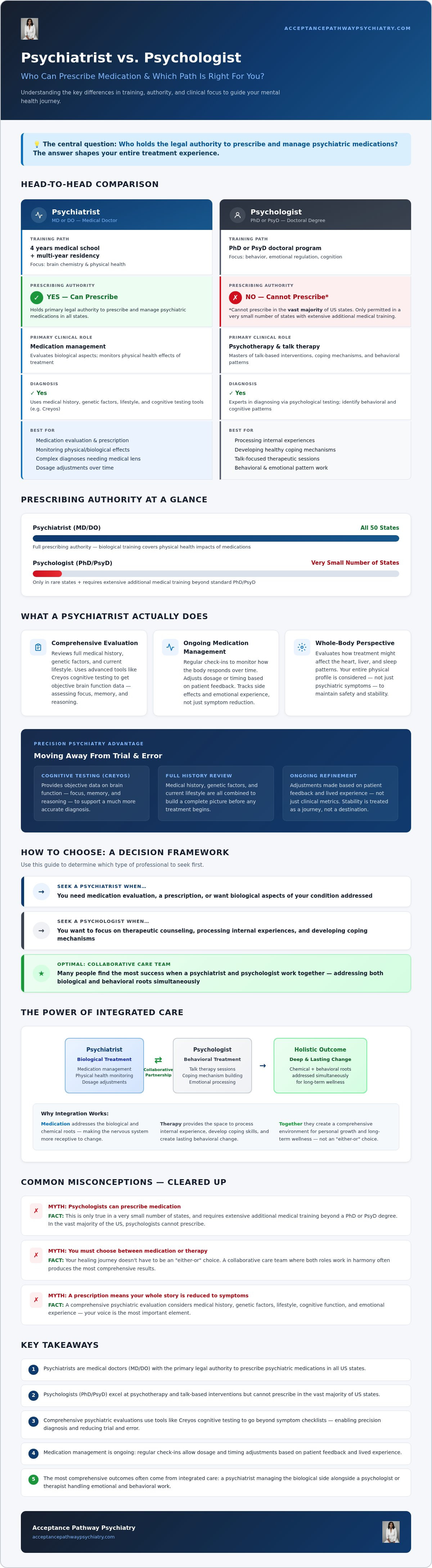
To understand who can prescribe, we must look at the educational journey. A psychiatrist is a medical doctor who specializes in the diagnosis and treatment of mental health through a biological lens. They attend four years of medical school followed by a multi-year residency, focusing on the complex relationship between brain chemistry and physical health. This medical background is why they hold the primary legal authority to prescribe and manage medications. They don't just look at symptoms; they evaluate how a treatment might affect your heart, liver, or sleep patterns. This rigorous training ensures that when you start a new prescription, your entire physical profile is considered to maintain your safety and stability.
The Clinical Focus of Psychologists
Psychologists typically earn a PhD or PsyD, focusing deeply on human behavior, emotional regulation, and cognitive patterns. They are masters of psychotherapy and talk-based interventions. While they are experts in diagnosing mental health conditions, they don't prescribe in the vast majority of the United States. There is a common misconception that psychologists can provide prescriptions, but this is only true in a very small number of states and requires extensive additional medical training. Instead, psychologists excel at using psychological testing to identify behavioral patterns. They provide the space for you to process your internal experience and develop healthy coping mechanisms through consistent, talk-focused sessions.
Your healing journey doesn't have to be an "either-or" choice. Many people find the most success through a collaborative care team where these roles work in harmony. In this model, a psychiatrist manages the biological aspects through medication management, while a psychologist or therapist provides the space for emotional work. This partnership ensures your care is holistic, addressing both the chemical and behavioral roots of your experience. By combining these perspectives, you create a comprehensive environment for your personal growth and long-term wellness.
The Role of a Psychiatrist in Medication Management
A psychiatrist's role extends far beyond writing a prescription. When exploring the psychiatrist vs psychologist for medication path, it's helpful to view the psychiatrist as the architect of your biological treatment plan. This process begins with an evaluation that seeks to understand your unique story. We look at your medical history, genetic factors, and current lifestyle to build a complete picture of your health. It's a collaborative discovery process where your voice is the most important element. We want to ensure you feel heard and understood before any treatment begins.
Comprehensive Psychiatric Evaluations
A thorough evaluation is the foundation of safe care. Instead of just checking off symptoms, we use advanced tools like Creyos cognitive testing to get objective data about your brain function. This precision psychiatry approach helps us move away from trial and error. It allows us to see how your focus, memory, and reasoning are affected, leading to a much more accurate diagnosis. These insights are combined with a deep dive into your medical history and lifestyle. This happens in a warm, non-judgmental environment where you can feel safe sharing your experiences without fear of being reduced to a number.
Ongoing Medication Management and Support
Stability is a journey, not a destination. Regular check-ins are essential because they allow us to monitor how your body responds over time. We don't just look at whether the symptoms are fading; we care about your emotional experience and any side effects you might feel. Adjusting a dosage or timing isn't just a clinical change; it's a way to ensure the treatment fits into your life seamlessly. We believe in a mutual partnership where we adjust the plan based on your feedback and progress. You can learn more about this process in our Psychiatric Medication Management: A Compassionate Guide to Your Healing Journey.
Our goal is to be a steady, reliable presence as you navigate these changes. If you are ready to start this collaborative process, our medication management services are designed to support you every step of the way. We treat you as a partner in your own healing, ensuring you have a clear plan and a compassionate guide to witness your progress. This methodical approach creates the grounding and order necessary for you to focus on your personal evolution.
Psychiatrist vs. Psychologist: A Practical Comparison for Patients
When you're deciding on a path to wellness, it's helpful to look past the degrees and focus on what your actual experience will be. The psychiatrist vs psychologist for medication choice isn't just about who writes the script; it's about the rhythm of your care. For most people, a visit with a psychiatrist feels like a medical check-up for the mind. These appointments are often shorter, focusing on how your body is responding to a specific treatment plan. In contrast, a session with a psychologist is usually longer, providing a dedicated space to unpack emotional patterns and life stressors through conversation.
Comparing Education, Scope, and Treatment Tools
The differences in their training lead to distinct tools in their professional kits. A psychiatrist completes medical school and a residency, which allows them to treat mental health as a part of your overall physical system. They use pharmacological tools to balance brain chemistry and may order lab work or cognitive testing to ensure your safety. A psychologist spends years in graduate school and a clinical internship, mastering the art of behavioral change. Their primary tools are psychotherapy, cognitive behavioral techniques, and emotional regulation skills. Both professionals use evidence-based practices, but they approach your recovery from different angles: one from the biological foundation and the other from the behavioral architecture.
When to See One vs. the Other (or Both)
Your starting point often depends on the intensity of your symptoms. If you're experiencing severe mood swings, debilitating ADHD, or symptoms that make daily functioning impossible, a psychiatrist is often the essential first step. They can provide the medical stabilization needed to "lower the noise" in your mind. If your challenges are more situational, such as relationship issues or mild anxiety related to a life transition, starting with a psychologist is often ideal.
- Psychiatrist: Best for symptom relief, complex biological conditions, and medication adjustments.
- Psychologist: Best for developing long-term coping strategies, processing trauma, and behavioral change.
- The Dual Approach: For complex conditions like PTSD or Bipolar Disorder, using both professionals is often the gold standard.
Practical factors like cost and insurance also play a role. Psychiatrist visits are billed as medical specialist appointments, while psychologists fall under behavioral health. Because their session lengths differ, the frequency of your visits will also vary. A psychiatrist might see you once a month for a check-in, while a psychologist might see you weekly for therapy. We believe that regardless of the path you choose, your care should feel like a steady partnership where you are the central focus of every decision.
How to Decide: Choosing the Right Path for Your Mental Health
Deciding between a psychiatrist vs psychologist for medication is a deeply personal choice that often depends on where you are in your journey. There is no "wrong" door to enter, but understanding your current needs can help you find the most efficient path to relief. If you're feeling a sense of urgency because your symptoms are interfering with your ability to work or maintain relationships, seeking a medical evaluation is often a wise first step. On the other hand, if you feel stable but want to understand why you repeat certain life patterns, a psychologist’s focus on behavioral shifts might be the right fit.
When you begin your search, look for a provider who values active listening and treats the relationship as a mutual partnership. You aren't just a collection of symptoms; you're the expert on your own internal experience. A supportive guide will witness your story and collaborate with you on a plan that feels safe and manageable. Preparing for your first visit by writing down your goals and concerns ensures your voice remains central to the process. This preparation creates a sense of order and predictability that is inherently grounding.
Questions to Ask Yourself Before Booking
Before making an appointment, take a quiet moment to reflect on these questions:
- Are my symptoms making it difficult to function in my daily life?
- Am I looking for immediate chemical stabilization or a long-term behavioral shift?
- Do I prefer a provider who looks at the mind-body connection holistically?
Your answers will guide you toward the professional whose tools best match your needs. Remember that your path can evolve over time; you might start with one and eventually decide to incorporate both. This flexibility is a natural part of your personal evolution toward wholeness.
The Role of Objective Testing in Decision Making
Objective data can provide a sense of stability when your internal world feels chaotic. Cognitive testing removes the guesswork by providing a clear map of how your brain processes information. This data-driven approach is especially vital when exploring ADHD treatment for adults, where the diagnostic authority of a psychiatrist is often necessary for safe and effective care. Using these insights allows you to advocate for yourself with confidence, knowing your treatment is based on more than just subjective observations.
If you're ready to find a partner who respects your unique experience and uses precise tools for your care, we invite you to schedule a consultation with us today. We are here to support your personal progress with compassion and clinical expertise.
The Power of Integrated Care: Why Medication and Therapy Work Together
The journey to healing is rarely a straight line. While the psychiatrist vs psychologist for medication debate often focuses on choosing one path or the other, the most effective route usually involves a combination of both. This integrated approach is widely considered the gold standard in mental health care. By addressing both the biological and behavioral aspects of your experience, you create a comprehensive foundation for lasting change. We believe that your treatment should be as unique as your own story, combining the best of medical science and therapeutic support.
The Synergy of Biological and Behavioral Treatment
Medication and therapy perform different but complementary functions. Think of medication as a way to stabilize your internal environment. It helps "lower the noise" of intense symptoms like overwhelming anxiety or deep depression. When your brain chemistry is balanced, you have the mental space and energy to engage deeply in the work of therapy. It's much easier to learn new coping skills when you aren't fighting a constant uphill battle against your own biology.
Therapy is where you build the skills and neural pathways necessary for long-term progress. While medication manages the biological symptoms, psychotherapy helps you process trauma, identify behavioral triggers, and develop healthy coping mechanisms. Integrated care treats the whole person, not just the diagnosis. This dual approach ensures that you aren't just managing symptoms but actively evolving toward a state of wholeness. There's no shame in needing support from both sides of the clinical fence; it's a strategic and compassionate way to prioritize your well-being.
Acceptance Pathway: Your Partners in Integrated Wellness
Finding a single practice that offers both medication management and psychotherapy simplifies your healing process. It removes the stress of coordinating between different offices and ensures that your providers are always on the same page. At Acceptance Pathway Psychiatry, we're committed to providing a non-judgmental, empathetic environment where your unique story is valued. We treat the relationship as a mutual partnership, standing as a supportive witness to your personal progress.
Our integrative wellness services are designed to support your personal evolution at every stage. Whether you need the diagnostic precision of a psychiatrist or the consistent support of a therapist, you can find it in one supportive space. We understand the nuances of the psychiatrist vs psychologist for medication choice and help you navigate those decisions with clinical authority and deep empathy. Taking the first step can feel daunting, but you don't have to navigate this alone. We invite you to reach out for a compassionate consultation to discuss how we can support your journey toward a brighter, more stable future.
Your Path to Lasting Wholeness
Finding clarity in the psychiatrist vs psychologist for medication decision is a significant step toward reclaiming your well-being. We've explored how psychiatrists provide the medical foundation for chemical stability, while psychologists offer the behavioral tools for emotional growth. By understanding these distinct yet complementary roles, you can build a treatment plan that feels both safe and empowering. Your healing isn't just about managing a diagnosis; it's about a personal evolution toward wholeness and peace.
At our practice, we combine an integrative wellness approach with specialized Creyos cognitive testing to ensure your care is precise and patient-centered. We provide a warm, non-judgmental clinical environment where you're treated as a partner rather than a number. Whether you're seeking symptom relief or long-term behavioral change, our goal is to be a steady, supportive witness to your journey. You deserve a path to healing that respects your unique experience and prioritizes your long-term stability.
Begin your journey toward wholeness with a compassionate psychiatric evaluation today. You don't have to carry the weight of these decisions alone. We're here to offer the clinical expertise and deep empathy you need to move forward with confidence and hope.
Frequently Asked Questions
Can a psychologist prescribe medication in any US states?
Yes, psychologists can prescribe in a small number of US states, provided they have completed specialized post-doctoral medical training. However, in the vast majority of the country, the primary distinction in the psychiatrist vs psychologist for medication debate remains the psychiatrist's medical degree. Most patients will need to see a psychiatrist or another medical provider for pharmacological treatments to ensure their physical and mental health are managed in a safe, integrated way.
Is it better to see a psychiatrist or a psychologist for anxiety?
The choice depends on the severity of your symptoms and your personal preferences for treatment. If anxiety is making it impossible to function or sleep, a psychiatrist can provide medical stabilization to lower your distress quickly. If you want to explore the root causes and build long-term coping skills, a psychologist is an excellent partner for talk therapy. Many people find that combining both medical management and psychotherapy yields the most comprehensive results.
Do I need a referral to see a psychiatrist for medication management?
You generally don't need a formal medical referral to schedule a psychiatric evaluation, although some insurance plans may require one for coverage purposes. It's always wise to check with your insurance provider first to understand your specific benefits. We encourage you to reach out directly if you feel ready to explore medication as a tool for your healing. Taking this first step is a courageous act of self-care and personal evolution.
Will a psychiatrist also provide therapy during my medication check-up?
While some psychiatrists offer brief therapeutic support during medication management appointments, their primary focus is usually on your biological response to treatment. These sessions are typically shorter than traditional therapy and center on dosage, side effects, and symptom tracking. For deep, talk-based processing, we often recommend working with a dedicated therapist or psychologist. This partnership ensures you receive specialized attention for both your chemical balance and your emotional growth.
Can I see both a psychologist and a psychiatrist at the same time?
Yes, seeing both professionals at the same time is often considered the gold standard for mental health care. This collaborative model allows you to address the biological roots of your symptoms with a psychiatrist while working on behavioral changes with a psychologist. Having both roles on your care team provides a stable, holistic environment for your progress. It ensures that every aspect of your well-being is witnessed and supported by an expert in that field.
How do I know if I need medication or just talk therapy?
A comprehensive clinical evaluation is the best way to determine the right path for your unique needs. If your symptoms feel overwhelming or prevent you from engaging in daily life, medication might provide the necessary breathing room for therapy to be effective. Conversely, if your challenges are situational or related to life transitions, talk therapy alone may be sufficient. We use data-driven tools like cognitive testing to help remove the guesswork from this important decision.
What is the difference in cost between a psychiatrist and a psychologist?
Psychiatrists are medical specialists, so their initial evaluations and follow-up visits often have a higher per-session cost than those of a psychologist. However, psychiatric appointments for medication management are usually less frequent and shorter in duration. Psychologists typically see patients weekly for longer sessions, which can affect your total investment over time. Most insurance plans cover both services, but we recommend verifying your specific co-pay and deductible details before your first visit to our office.
Can a primary care doctor prescribe psychiatric medication instead?
Yes, primary care doctors can prescribe many common psychiatric medications, but they may lack the specialized training required for complex mental health conditions. A psychiatrist offers a deeper level of expertise in brain chemistry and can provide more precise adjustments for your safety. For conditions like ADHD or bipolar disorder, the specialized diagnostic authority of a psychiatrist ensures your treatment plan is both accurate and grounded in the latest clinical science and precision testing.


