

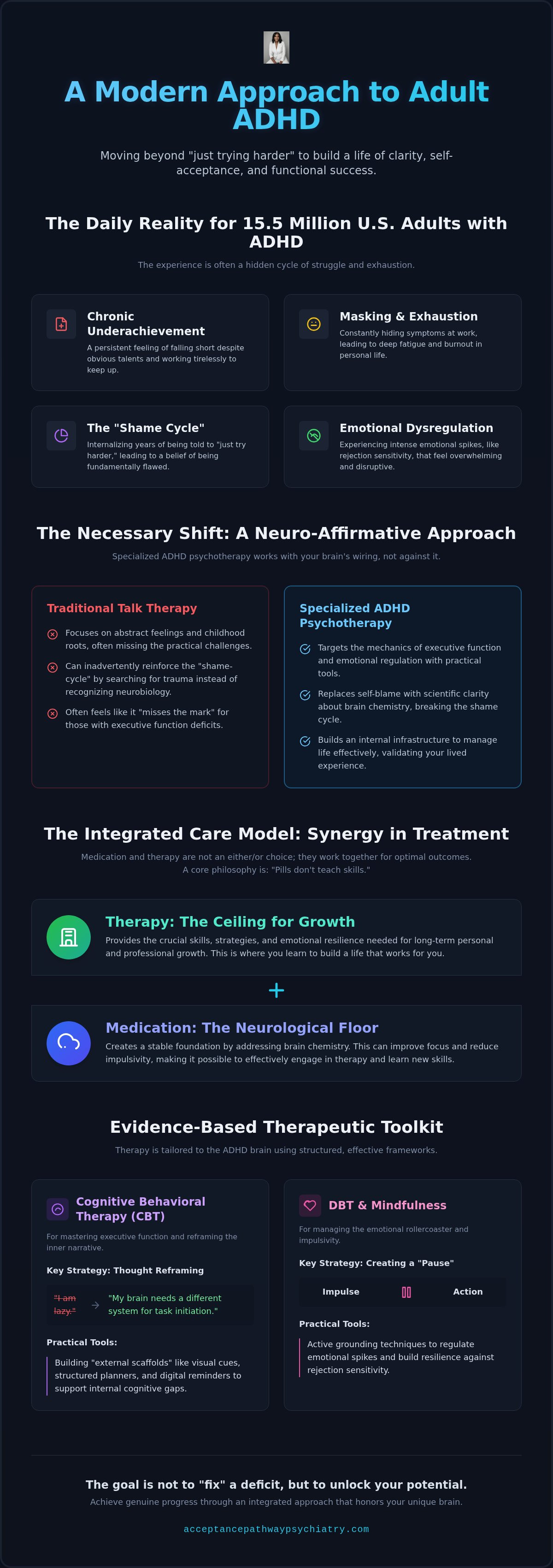
What if the goal of managing your ADHD wasn't to work harder, but to finally stop apologizing for the way your mind processes the world? For many of the 15.5 million adults in the U.S. currently living with this diagnosis in 2026, the daily reality is often a cycle of masking symptoms at work and facing the deep exhaustion of emotional dysregulation at home. You might feel like you're constantly playing catch-up, battling a persistent sense of underachievement despite your obvious talents and best efforts.
We understand that "just trying harder" isn't a sustainable strategy. Specialized psychotherapy for adult ADHD offers a transformative shift from simply coping to achieving true functional success. This collaborative approach focuses on reducing the shame often attached to neurodivergence while sharpening your executive function through practical, compassionate tools. In this guide, we'll explore how an integrated care model creates a stable balance between medication and behavioral strategies. You'll discover how to move past the weight of rejection sensitivity and build a professional and personal life rooted in self-acceptance, clarity, and genuine progress.
Key Takeaways
- Understand why specialized psychotherapy for adult ADHD is more effective than traditional talk therapy by targeting specific executive function and emotional regulation needs.
- Learn how the "pills don't teach skills" philosophy uses medication to create a neurological floor, while therapy provides the ceiling for personal growth.
- Discover how a collaborative expert approach helps you move past the exhaustion of masking and the heavy weight of chronic underachievement.
- Explore the advantages of an integrated care model where cognitive testing, medication management, and therapy work together to support your unique brain.
- Identify evidence-based strategies designed specifically for neurodivergent adults to build sustainable daily habits and lasting emotional resilience.
Why Specialized Psychotherapy for Adult ADHD is Essential
Many adults seeking support find that traditional talk therapy doesn't quite hit the mark. While insight-oriented approaches focus on childhood roots or abstract feelings, Adult attention deficit hyperactivity disorder requires a more practical, targeted intervention. Specialized psychotherapy for adult ADHD is specifically designed to address the mechanics of executive function and the intensity of emotional regulation. It isn't just about understanding why you feel a certain way; it's about building the internal infrastructure to manage life more effectively.
For those who grew up undiagnosed or unsupported, a heavy "shame-cycle" often takes hold. Years of being told to "just pay attention" or "try harder" create a deep-seated belief that you're fundamentally flawed. Traditional therapy can sometimes inadvertently reinforce this by searching for deep psychological trauma where there is actually a neurobiological difference. Neuro-affirmative care changes this dynamic by working with your brain's natural wiring rather than trying to force it into a neurotypical mold.
Moving Beyond the "Broken Brain" Narrative
We view ADHD not as a collection of clinical deficits, but as a unique way of processing information that requires specific adaptations. This shift in perspective allows for personal evolution rather than constant "fixing." Within a warm and non-judgmental environment, you can explore how your mind works without the fear of being "wrong" or "too much." Psychotherapy for adult ADHD is a collaborative partnership where we work together to foster your growth and functional success.
The Role of Neurodiversity in Modern Treatment
Understanding the neurobiology of ADHD is incredibly liberating because it replaces self-blame with scientific clarity. When you realize your struggles with task initiation or focus are tied to brain chemistry, the burden of "laziness" begins to lift. In 2026, standards of care prioritize the internal experience of the patient, recognizing that you are the primary expert on your own life. We act as a supportive witness to your journey, providing the clinical expertise needed to turn self-awareness into sustainable action. This approach validates your lived experience while offering the tools to bridge the gap between your intentions and your outcomes.
Evidence-Based Modalities: Tailoring Therapy to the ADHD Brain
Effective treatment requires more than general encouragement. It demands specific, structured frameworks that account for how the ADHD brain processes information. When we engage in psychotherapy for adult ADHD, we move past the stage of simply understanding the diagnosis. We focus on active, functional adaptation. This means adapting traditional therapeutic tools to fit shorter attention spans and higher levels of impulsivity. The goal is to create a life where you aren't constantly fighting your own biology.
A vital part of this process involves manageable "homework." For someone with executive dysfunction, a complex multi-step assignment can feel like an impossible mountain. Instead, we focus on micro-habits and "external scaffolds" that provide immediate support. This practical approach ensures that therapy feels like a resource rather than another item on an overwhelming to-do list.
Cognitive Behavioral Therapy (CBT) for Executive Function
CBT is highly effective for addressing the internal narrative that often haunts adults with ADHD. Years of missed deadlines or forgotten appointments often lead to a harsh inner critic. We work together to reframe thoughts like "I am lazy" into "My brain needs a different system for task initiation." Beyond mindset, CBT provides concrete techniques for organization and time management. By building external scaffolds, like visual cues and digital reminders, we support the internal cognitive gaps that make daily life feel chaotic.
DBT and Mindfulness: Managing the ADHD Emotional Rollercoaster
While CBT handles the logic, Dialectical Behavior Therapy (DBT) helps manage the intense emotions. Many adults experience rejection sensitivity, where a small perceived slight feels like a devastating blow. DBT provides the skills to regulate these spikes. Similarly, mindfulness in an ADHD context doesn't mean sitting still in silence for an hour. It involves active grounding techniques that help you develop a "pause" between an impulse and an action. If you're looking for a way to integrate these strategies into your life, you might explore our Psychotherapy services designed specifically for neurodivergent minds.
These modalities work together to move you from "learning about ADHD" to "living successfully with ADHD." It's a transition from being a passive observer of your symptoms to becoming a collaborative architect of your own success. By tailoring these evidence-based methods within psychotherapy for adult ADHD, we ensure the work we do in session translates into real, sustainable change in your professional and personal world.
The Synergy of Psychotherapy and Medication Management
Many adults start their treatment journey with a prescription, hoping for a singular solution to their daily struggles. While medication can be life-changing, it rarely addresses the years of habits and coping mechanisms built around a neurodivergent brain. We often use the philosophy that "pills don't teach skills." Medication acts as a stable floor, quieting the neurological noise and providing the focus needed to engage with the world. However, psychotherapy for adult ADHD provides the ceiling, determining how high you can reach by teaching you how to navigate your life with intention and clarity.
When medication stabilizes your neurochemistry, therapeutic strategies finally have the space to take root. You're no longer just trying to survive the next hour; you're able to practice the organizational tools and emotional regulation techniques discussed in your sessions. Our role as your psychiatric provider is to act as a collaborative ally, monitoring both your biological response to treatment and your behavioral progress. This integrated approach ensures that your care is never fragmented into separate silos. For a deeper look at how we approach this balance, you can read our Psychiatric Medication Management: A Compassionate Guide.
Precision Psychiatry: The Role of Creyos Cognitive Testing
We believe in using objective data to inform every step of your psychotherapy for adult ADHD. By utilizing Creyos cognitive testing, we move beyond subjective symptoms to see exactly how your brain manages memory, attention, and reasoning. This data allows us to identify your unique cognitive strengths and pinpoint the specific areas where you need the most support. Instead of a generic treatment plan, we build a roadmap based on your actual cognitive profile. To learn more about this process, explore our guide on Understanding Cognitive Assessment for ADHD.
Adjusting the Plan as You Evolve
Your needs won't stay the same as you progress through your healing journey. Regular check-ins are essential to balance any side effects with the functional gains you're making in your career and relationships. As you master new behavioral strategies through therapy, some patients find they can eventually coordinate with their provider to adjust their medication dosage. We maintain a holistic view of your health, incorporating integrative wellness to support your long-term evolution. This constant refinement ensures your treatment remains a mutual partnership focused on your wholeness and success.
Practical Skills and Strategies: What Happens in a Session?
Entering a therapy session for the first time can feel intimidating, especially when your mind is already racing with a dozen other priorities. We want to demystify this process to lower the barrier for your healing. Our approach to psychotherapy for adult ADHD is rooted in the "collaborative expert" model. While we bring clinical knowledge of neurobiology, you are the true expert on your own lived experience. We work as allies to bridge the gap between where you are and where you want to be.
Many of our patients find that the flexibility of telehealth is essential for managing what we call "ADHD-chaotic" schedules. Removing the stress of a commute or the fear of being late to a physical office allows you to show up as your authentic self. Over time, our sessions shift from managing acute, daily crises to maintaining long-term wellness and personal evolution. This steady rhythm helps you build a life that feels predictable and grounded rather than reactive.
The Anatomy of an ADHD-Focused Session
A typical session follows a methodical flow designed to provide stability and focus. This structure helps ground the conversation and ensures you leave with something practical you can use immediately.
- Step 1: The "Check-in". We begin by reviewing the past week. We celebrate your wins, no matter how small, and look honestly at the hurdles you faced without any judgment.
- Step 2: The "Skill-Build". We identify one specific pain point, such as a difficult project at work or a recurring conflict at home. We then introduce a targeted strategy to address it.
- Step 3: The "Scaffold". Before we finish, we create a concrete plan to implement that strategy. This might involve setting digital reminders or adjusting your physical environment to support your focus.
Measuring Success Beyond the Clinical Checklist
Progress isn't always a straight line, and it isn't always captured on a standard medical form. We look for "invisible wins" that signal deep growth in your internal experience. This might be a sudden realization that you handled a social interaction without the usual spike in anxiety or that you practiced self-compassion after a mistake instead of falling into a shame-cycle.
We also use objective data from Creyos cognitive testing to track improvements in your memory and attention over several months. Seeing these numbers move provides a grounding sense of confidence in your progress. It turns abstract feelings of "getting better" into visible, clinical evidence of your hard work. If you're ready to start this collaborative process, you can schedule a telehealth appointment to begin your journey toward functional success and self-acceptance through psychotherapy for adult ADHD.
Choosing Your Path: How Acceptance Pathway Psychiatry Supports You
Finding the right support for neurodivergence shouldn't feel like another overwhelming task on your to-do list. At Acceptance Pathway Psychiatry, we provide a steady, reliable, and non-judgmental presence for every patient we serve. We believe that psychotherapy for adult ADHD is most effective when it's part of a cohesive, integrated plan. By keeping your cognitive testing, medication management, and therapeutic support under one virtual or physical roof, we ensure that your care is consistent and your progress is tracked accurately.
Our "Acceptance" philosophy is the heartbeat of our practice. It means finding a profound sense of peace with how your brain is wired while still holding space for growth and functional success. We don't want to change who you are; we want to help you become the most effective version of yourself. This approach allows you to step out of the cycle of shame and into a life of personal evolution. Right now in 2026, we're seeing more adults than ever reclaim their confidence through this balanced, neuro-affirmative model.
A Collaborative Partnership for Your Future
We treat every interaction as a mutual partnership where your voice is the most important one in the room. Our trauma-informed care model ensures you feel psychologically safe and truly heard, especially if you've had frustrating experiences with medical institutions in the past. We also understand that life is busy. Our telehealth appointments offer the ease and flexibility you need to maintain consistent support without the added stress of a commute. You aren't just a diagnosis to us; you're an individual with unique strengths and a whole life ahead of you.
Getting Started: Your First Comprehensive Evaluation
Your journey begins with a thorough initial psychiatric evaluation. During this time, we'll discuss your history, your current challenges, and the specific outcomes you hope to achieve. We look beyond clinical checklists to consider how your ADHD impacts your relationships, your career, and your self-image. Every treatment plan we create incorporates integrative wellness, ensuring we support your brain and body as a complete system. If you're ready to move beyond "coping" and start thriving, we invite you to Begin your journey with a compassionate psychiatric evaluation today.
Moving Toward Functional Success and Self-Acceptance
Your journey with ADHD doesn't have to be defined by a cycle of underachievement or the constant exhaustion of masking. By choosing specialized psychotherapy for adult ADHD, you're investing in a collaborative partnership that values your unique perspective while providing the clinical tools you need to thrive. We've explored how integrating precision-based care with Creyos Cognitive Testing and medication management creates a stable foundation for lasting change. This approach ensures that your treatment is never fragmented but instead works as a cohesive system designed specifically for your brain.
Our compassionate, trauma-informed providers are here to act as supportive witnesses to your evolution, helping you bridge the gap between your intentions and your daily actions. This seamless integration of therapy and medication management ensures that every part of your care is aligned with your personal goals. You deserve a life that feels balanced, authentic, and successful on your own terms. We're ready to walk this path with you as you move toward a future of clarity and quiet confidence.
Schedule your comprehensive ADHD evaluation and start your pathway to acceptance.
Frequently Asked Questions
Is psychotherapy effective for ADHD if I am not taking medication?
Yes, psychotherapy is highly effective as a standalone treatment. While medication can quiet the neurological noise, it doesn't teach you how to organize your life or manage complex emotions. Specialized psychotherapy for adult ADHD focuses on building the practical skills and psychological resilience you need to succeed. By working with a therapist, you can develop personalized systems that support your brain's unique wiring without relying on pharmaceutical interventions if that is your preference.
How long does it usually take to see results from ADHD therapy?
Every person's journey is unique, but most individuals begin to notice improvements in their self-talk and emotional resilience within the first few weeks. Significant changes in executive function and daily habits typically emerge after three to six months of regular sessions. This period allows you to test different strategies in real-world scenarios and refine them with your therapist. Consistency is the key to turning these new behaviors into lasting, automatic habits.
Can psychotherapy help with "ADHD Paralysis" or chronic procrastination?
Absolutely. ADHD paralysis often stems from a combination of overwhelm and the fear of not doing a task perfectly. In our sessions, we use specialized techniques to lower the emotional stakes of task initiation. We help you create external scaffolds and use micro-steps to bypass the brain's resistance. By addressing both the biological and emotional sides of procrastination, you can find a sustainable way to start and finish your most important work.
What is the difference between an ADHD coach and a psychotherapist?
The primary difference lies in clinical depth and training. Psychotherapists are licensed mental health professionals who can treat the whole person, including co-occurring anxiety or trauma. ADHD coaches focus primarily on productivity and organizational systems. Specialized psychotherapy for adult ADHD provides a trauma-informed space to explore the deep-seated shame or rejection sensitivity that often accompanies the condition. This ensures your progress is rooted in emotional healing as well as practical, functional success.
Will I need to do cognitive testing like Creyos before starting therapy?
Starting therapy doesn't always require testing, but we find that Creyos Cognitive Testing provides an invaluable baseline for your care. This objective data helps us see exactly how your brain handles memory, focus, and reasoning. Instead of guessing which strategies might work, we use your test results to build a precision-based plan. This collaborative approach ensures that your time in therapy is spent on the interventions that will have the greatest impact on your life.
Is telehealth as effective as in-person therapy for adult ADHD?
Telehealth is an excellent and evidence-based option for adult ADHD. Many patients find that virtual sessions actually increase their consistency because it eliminates the stress of travel and physical waiting rooms. Telehealth allows you to receive high-quality care from the comfort and privacy of your own home or office. This accessibility is vital for maintaining the steady rhythm required for therapeutic strategies to take root and produce meaningful, long-term results.
Can therapy help with the relationship problems caused by my ADHD?
Relationship struggles are a frequent reason adults seek support. ADHD can lead to misunderstandings regarding forgetfulness, impulsivity, or emotional outbursts. Therapy helps you develop the self-awareness and regulation skills needed to communicate more effectively with your partner. By addressing rejection sensitivity and learning to manage your symptoms, you can reduce the strain on your relationships and build a partnership based on mutual understanding rather than frustration and resentment.
What if I was only diagnosed with ADHD as an adult?
Being diagnosed as an adult is a significant life event that often brings both relief and grief. Therapy is essential for navigating this transition and unlearning the "broken brain" narrative you may have carried for years. We focus on dismantling the shame-cycle and helping you view your past through a neuro-affirmative lens. This process allows you to stop masking and start building a future that honors your authentic self and your unique strengths.


