

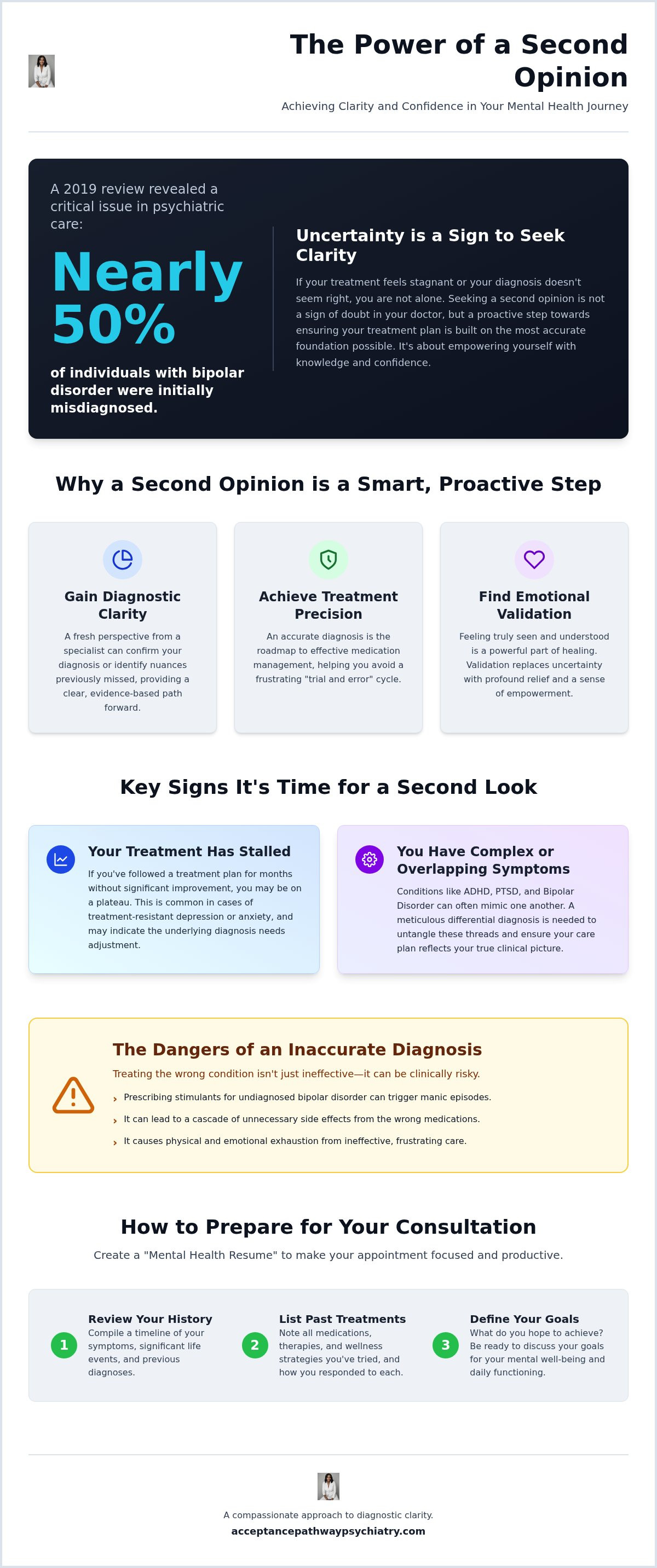
Did you know that a 2019 review found nearly 50% of individuals with bipolar disorder were initially misdiagnosed? When you're living with symptoms that don't seem to improve, it's natural to feel stuck or even anxious that your current treatment plan isn't hitting the mark. You might worry about offending your current doctor, but your journey toward health deserves absolute certainty. Seeking a second opinion for psychiatric diagnosis is a proactive step toward precision and personal empowerment, not a rejection of your previous care.
We understand the weight of feeling unheard or misunderstood in your mental health journey. This article will show you how a psychiatric second opinion can provide the diagnostic clarity and treatment precision you need to move forward with confidence. We'll walk through the process of seeking validation for your symptoms and how tools like Creyos cognitive testing can offer the objective data needed for a clear, evidence-based path. By the end, you'll see how a collaborative approach can finally create a plan that feels right for your unique experience.
Key Takeaways
- Understand that seeking a second opinion for psychiatric diagnosis is a standard, proactive step in your healthcare journey that provides the clarity you need to move forward.
- Discover how a precise diagnosis reduces the risk of "trial and error" with medications, creating a more effective and stable foundation for your long-term wellness.
- Learn what to expect during a clinical consultation, including a thorough review of your psychiatric history and an in-depth interview centered on your current experience.
- Find out how to prepare a "mental health resume" of your past treatments and goals to make your time with a specialist as productive and focused as possible.
- See how a compassionate, collaborative approach to diagnostic review can help you feel heard and validated while establishing a clear, evidence-based path toward healing.
Why Seek a Second Opinion for Psychiatric Diagnosis?
A second opinion for psychiatric diagnosis is a formal, structured review of your mental health history, current symptoms, and previous treatment outcomes. It’s a standard part of proactive healthcare. You wouldn't hesitate to seek a specialist's perspective for a persistent physical injury or a complex medical condition. Your mental well-being deserves that same level of dedication and precision. This process isn't about doubting your current provider's skills. Instead, it’s about inviting a fresh set of eyes to look at your unique clinical picture.
The common myth that seeking another perspective will offend your doctor is simply not true. With 2026 data showing that over 63% of adults seeking care are struggling with anxiety or depression, the mental health system is more strained than ever. In this environment, it’s easy for subtle nuances in a diagnosis to be overlooked. Most psychiatric professionals welcome clinical collaboration because they want the best for their patients. When you advocate for your own clarity, you're participating in a mutual partnership with your care team. The emotional relief that comes from diagnostic validation is profound. It replaces uncertainty with a clear sense of direction, helping you feel seen and understood for the first time in your treatment journey.
When Your Current Treatment Feels Stagnant
If you've been following a treatment plan for months without significant improvement, you might be experiencing a plateau. This stagnation is common in cases of treatment-resistant depression or anxiety. Sometimes, the struggle isn't about the intensity of your therapy or your commitment to wellness. It might be that the underlying diagnosis needs a slight adjustment. A second opinion for psychiatric diagnosis ensures that your medication management is built on the most accurate foundation possible. Matching the right treatment to the correct diagnosis is the only way to break through a period of stagnation and start moving forward again.
Complex Cases and Overlapping Symptoms
Mental health conditions rarely exist in isolation, and many disorders share remarkably similar symptoms. ADHD, PTSD, and Bipolar disorder can often mimic one another, leading to a confusing clinical history. Untangling these threads requires a meticulous differential diagnosis. Understanding The Clinical Process: What to Expect During a Consultation is the first step in this journey. A specialist looks at the nuances of your experience to see how different conditions might be overlapping or masking one another. Life transitions, such as career shifts or changes in family dynamics, can also change the way a diagnosis manifests. A fresh evaluation ensures your care plan reflects your current life stage and internal reality.
The Value of Diagnostic Clarity in Mental Health
A correct diagnosis serves as the vital foundation for all future clinical decisions. When you're managing mental health, the diagnosis isn't just a label; it's the roadmap for effective medication management. Without this clarity, treatment often feels like a series of guesses. A second opinion for psychiatric diagnosis helps transition your care from a reactive "trial and error" cycle to a proactive, evidence-based strategy. This shift reduces the time spent on ineffective treatments and limits the frustration of managing medications that don't address the root cause of your symptoms.
Beyond the clinical benefits, there’s a profound psychological weight to receiving an accurate diagnosis. Many people describe a sense of relief when they finally find a name for their experience that resonates with their internal reality. This validation empowers you to move from being a passive recipient of care to an active participant in your healing journey. You're no longer just dealing with symptoms. Instead, you're working within a framework that makes sense for your life and your goals.
Avoiding Misdiagnosis and Its Consequences
Treating the wrong condition can be more than just frustrating; it can be clinically risky. For example, prescribing stimulants for someone with undiagnosed bipolar disorder can inadvertently trigger manic episodes or severe sleep disturbances. Misdiagnosis often leads to a cascade of unnecessary side effects from medications that were never intended for your actual condition. Differential diagnosis is the process of distinguishing between similar conditions to ensure the clinical path is accurate. This meticulous approach protects you from the physical and emotional exhaustion that comes with ineffective care.
Precision Psychiatry: Beyond the DSM-5
While the DSM-5 provides a necessary framework, modern mental health care is moving toward a more individualized, patient-centered model. Precision psychiatry looks beyond broad categories to see the whole person, including your unique lifestyle, environment, and wellness goals. A second opinion for psychiatric diagnosis can also uncover trauma-informed perspectives that might have been missed in earlier evaluations. By integrating clinical data with your personal history, we create a more holistic picture of your health. If you're ready for a fresh perspective, exploring comprehensive psychiatric evaluations can be the first step toward the clarity and relief you deserve.
The Clinical Process: What to Expect During a Consultation
The process of seeking a second opinion for psychiatric diagnosis is designed to be methodical and grounding. It provides a structured space to re-examine your history with the benefit of hindsight and expert insight. Unlike a standard intake, this consultation is specifically geared toward identifying what might have been missed or misinterpreted in the past. We treat this as a mutual partnership where your experience is the primary source of truth.
The journey typically unfolds in four intentional steps:
- Comprehensive Records Review: We begin by examining your psychiatric history, including previous diagnoses, medication trials, and therapy outcomes. This allows us to see the patterns in your care over time.
- In-Depth Clinical Interview: This is a patient-centered conversation. We focus on your current lived experience, exploring the nuances of your symptoms that might not fit neatly into a standard checklist.
- Objective Testing: We supplement clinical observations with data-driven tools to ensure diagnostic accuracy. This helps bridge the gap between how you feel and how your brain is functioning.
- Collaborative Summary Meeting: We meet to discuss the findings in detail. This is where we share our clinical perspective and work together to outline a clear path forward.
Incorporating Creyos Cognitive Testing
Objective data is often the missing piece in mental health evaluations. By incorporating Creyos Cognitive Testing, we can measure brain functions like memory, attention, and reasoning. This is particularly helpful for ADHD and mood disorders, where subjective reports of "brain fog" or "distraction" can be hard to quantify. Having measurable benchmarks allows us to differentiate between focus issues caused by anxiety and those rooted in executive function deficits. It gives us a baseline to track your progress as you move through treatment.
The Role of Telehealth in Modern Consultations
Telehealth appointments have revolutionized access to specialized care. You can now seek a second opinion for psychiatric diagnosis from the safety and comfort of your own home. This often lowers the anxiety associated with medical visits and makes it easier to fit a consultation into a busy schedule. We utilize secure, HIPAA-compliant platforms to ensure your privacy is protected while providing national accessibility. This virtual environment fosters a sense of psychological safety, allowing for a more open and honest clinical dialogue that is essential for an accurate assessment.
How to Prepare for Your Second Opinion Appointment
Preparing for a second opinion for psychiatric diagnosis is an act of self-advocacy that empowers you to take control of your healing. While the clinical team will handle the medical review, your role is to provide the context that only you possess. By arriving prepared, you ensure that every minute of your consultation is focused on finding the clarity you deserve. This preparation isn't just about paperwork; it's about centering your voice and your experience in the clinical process.
Start by gathering what we call a "mental health resume." This document should include a comprehensive list of every medication you’ve tried, the specific dosages, and the approximate timelines for each. It’s also helpful to prepare a list of specific questions about your current symptoms or concerns regarding your previous diagnosis. If you're worried about discussing this with your current provider, remember that most professionals value collaborative care. You can simply state that you're seeking a fresh perspective to ensure your treatment plan is as precise as possible. This transparency often strengthens the relationship with your care team rather than damaging it.
Organizing Your Treatment History
Creating a simple timeline of your symptoms can reveal patterns that were previously hidden. Note when your symptoms first began and how they have evolved during major life transitions. Be sure to record what has worked in the past, even if the relief was only temporary or partial. Medication management is the professional oversight of psychiatric prescriptions to ensure safety and efficacy. Having this history organized allows your new provider to build on what you've already learned rather than starting from zero. This methodical approach saves time and reduces the need for repetitive questions during your second opinion for psychiatric diagnosis.
Defining Your Success Criteria
Take a moment to consider what "feeling better" actually looks like in your daily life. For some, success means improved focus at work; for others, it’s a sense of calm during social interactions or better sleep quality. Communicating your personal values and preferences regarding medication versus therapy is essential for a collaborative plan. Be honest about previous side effects or concerns you've had with past treatments. This transparency ensures your new care plan is not only clinically sound but also feels right for your unique lifestyle. If you're ready to begin this process, you can schedule a comprehensive evaluation to start your journey toward clarity.
Acceptance Pathway: A Compassionate Approach to Clarity
At Acceptance Pathway Psychiatry PLLC, we believe your mental health journey deserves a steady, reliable presence. Our approach to a second opinion for psychiatric diagnosis is rooted in professional humility and clinical excellence. We don't see ourselves as distant authorities; instead, we act as collaborative experts who value your unique experience. By creating a space of psychological safety, we allow for an honest review of your history that honors the work you've already put into your healing. This partnership ensures that the path forward is built on mutual trust and evidence-based clarity.
Our practice focuses on the wholeness of the individual. We provide medication management and psychotherapy as part of a cohesive, integrative wellness strategy. Instead of looking at symptoms in isolation, we consider how your biology, environment, and lifestyle interact. This comprehensive view helps us develop a sustainable plan for stability that feels right for you. We aim to move beyond the immediate crisis to help you achieve personal evolution and long-term peace. This methodical flow ensures you aren't just managing symptoms, but moving toward a state of complete well-being.
A Supportive Partner in Your Mental Health Journey
We treat the relationship between provider and patient as a mutual partnership. Our commitment is to listen to your story without bias, acting as a supportive witness to your progress. This non-judgmental environment is essential for a successful second opinion for psychiatric diagnosis. When you feel heard and understood, the clinical data becomes much more meaningful. We use this collaborative insight to ensure your diagnosis reflects your internal reality, allowing for treatment that truly resonates with your goals and values.
Getting Started with a Consultation
Starting your consultation is designed to be a calm and methodical process. We offer telehealth appointments across the United States, providing national accessibility from the comfort of your own home. Virtual evaluations lower the barrier to seeking help, allowing you to engage in a thorough clinical review at a relaxed and manageable speed. When you're ready to seek the precision you need, you can begin your journey toward clarity with our dedicated team. We're here to guide you toward the stability and confidence you deserve.
Your Journey Toward Diagnostic Clarity and Hope
Your mental health journey is deeply personal, and you deserve a roadmap that reflects your unique needs. Seeking a second opinion for psychiatric diagnosis is a powerful act of self-care that transitions you away from the frustration of stagnant treatment toward a future of precision and stability. By combining clinical expertise with objective data from Creyos cognitive testing, we help you uncover the answers you've been searching for. This process isn't about doubting your past; it's about refining your future.
We've explored how diagnostic clarity serves as the foundation for effective medication management and why a collaborative, integrative approach is essential for long-term wellness. Whether you're navigating complex symptoms or simply feel unheard in your current care, you don't have to walk this path alone. Through our telehealth accessibility across the US, we're here to provide the supportive, expert guidance you need. Schedule your compassionate diagnostic consultation today to begin your evolution toward wholeness. You're worthy of a life that feels balanced, clear, and bright.
Frequently Asked Questions
Is it common to get a second opinion for a psychiatric diagnosis?
Seeking a second opinion for psychiatric diagnosis is a standard and common practice in modern mental health care. Because conditions like ADHD, PTSD, and bipolar disorder share many overlapping symptoms, a fresh perspective often provides the clarity needed for accurate treatment. Many patients choose this path when their current symptoms don't improve or when they feel their original diagnosis doesn't fully capture their internal experience. It's a proactive step toward your wellness.
How do I ask my current psychiatrist for a second opinion?
You can ask your current provider by being direct and emphasizing your desire for clinical clarity. Most professionals welcome a collaborative approach and understand that psychiatric care is a mutual partnership. You might say, "I'd like to get another perspective to ensure my treatment plan is as precise as possible." This transparency helps your current doctor support your journey without feeling like their expertise is being rejected or questioned.
Will insurance cover a second opinion for mental health?
Most insurance plans cover second opinions under the Mental Health Parity and Addiction Equity Act. This law requires mental health coverage to be comparable to medical care. You'll typically pay a specialist copay, which averaged $45 in 2025. If you're paying out-of-pocket, an initial assessment typically costs between $250 and $500. It's always best to verify your specific plan's requirements for prior authorization before your appointment to avoid surprises.
What is the difference between a psychiatric evaluation and a second opinion?
A psychiatric evaluation is the comprehensive process used to assess your mental health, while a second opinion for psychiatric diagnosis is the specific application of that process to review an existing diagnosis. During a second opinion, the specialist focuses on your treatment history and previous clinical findings to identify missed nuances. While both involve in-depth interviews, the second opinion specifically aims to validate or refine a path that has already been established.
Can a second opinion change my medication plan immediately?
Medication changes usually don't happen immediately unless there's a significant safety concern or an obvious misdiagnosis. The goal of a consultation is to build a stable, long-term foundation rather than making impulsive adjustments. Your new provider will work with you to create a transition plan that prioritizes your safety and comfort. This methodical approach ensures that any new medication management strategy is evidence-based and tailored to your unique biology and history.
How long does a typical diagnostic consultation take?
A typical diagnostic consultation usually takes between 60 and 90 minutes for the initial clinical interview. This timeframe allows for a deep dive into your history and current symptoms without feeling rushed. If your provider uses tools like Creyos cognitive testing, you might spend additional time completing those objective assessments. This patient-centered pace ensures that every detail of your unique story is heard and considered in the final diagnostic summary and plan.
Do I have to switch doctors if I get a second opinion?
You don't have to switch doctors after receiving a second opinion. Many patients use the findings from a consultation to collaborate more effectively with their current provider. You might choose to stay with your original psychiatrist while implementing the new diagnostic insights. However, some individuals find that the rapport built during the second opinion leads them to transition their care permanently to the new practice for ongoing medication management and psychotherapy.
What should I do if the second opinion contradicts my first diagnosis?
If a second opinion contradicts your first diagnosis, you should ask both providers to explain the clinical reasoning behind their conclusions. Focus on the evidence, such as specific symptom patterns or objective data from cognitive testing. This discrepancy is often where the most valuable insights are found. You can then choose the path that feels most resonant with your experience and offers a clearer, more logical plan for your long-term stability and healing.


