

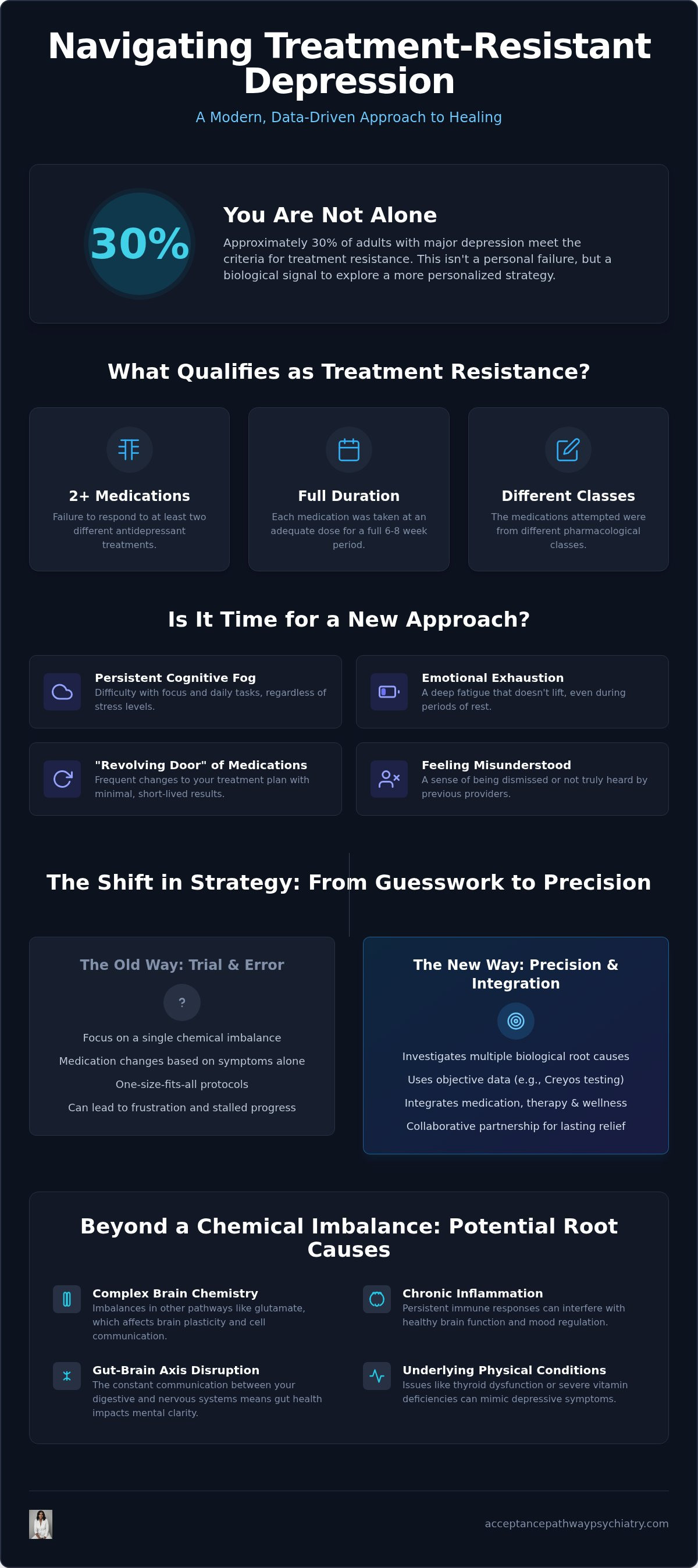
What if the reason your recovery has stalled isn't a lack of willpower, but a mismatch between your unique biology and a one-size-fits-all treatment plan? Finding effective treatment-resistant depression help begins with acknowledging that your journey is distinct. Research shows that approximately 30% of adults with major depression meet the criteria for treatment resistance. You are not alone in the exhaustion you feel right now. It's draining to endure the cycle of trial and error, switching medications only to be met with persistent cognitive fog and emotional fatigue. You deserve to feel seen by a provider who understands that your struggle isn't a personal failure.
You're likely looking for a path that respects your history while using modern tools to find a solution that finally works. This article provides a roadmap for moving beyond standard protocols toward a precision-based, integrative approach. We'll explore why standard treatments often fall short and how a combination of clinical expertise, objective data like Creyos cognitive testing, and compassionate medication management can help you find relief. By viewing your health through a lens of wholeness, we can work together as partners to clear the fog and support your personal evolution.
Key Takeaways
- Discover why a lack of progress is often a biological signal rather than a failure, and how identifying root causes like inflammation can offer a new start.
- Learn how objective data from Creyos cognitive testing eliminates medication guesswork and provides a clear baseline for your recovery journey.
- Explore the synergy of combining medication management with psychotherapy to address both the neurological and emotional layers of your health.
- Understand the roadmap for treatment-resistant depression help that prioritizes your unique experience and long-term stability through collaborative care.
- See how Acceptance Pathway Psychiatry PLLC uses a compassionate, trauma-informed approach to guide you toward wholeness and personal evolution.
Understanding Treatment-Resistant Depression: When Standard Care Stalls
When you've tried multiple medications and attended countless therapy sessions without finding relief, it's natural to feel like you've reached a dead end. The clinical label of being "resistant" can feel heavy, as if the responsibility for the lack of progress rests on your shoulders. However, seeking treatment-resistant depression help isn't about trying harder; it's about shifting the strategy to better match your unique biological needs. In the current landscape of 2026, we understand more than ever that a lack of response to standard care is a signal to look deeper, not a sign to give up. A comprehensive psychiatric evaluation is the first step in moving beyond the frustration of stalled progress.
What Qualifies as Treatment Resistance?
Clinically, a diagnosis of treatment-resistant depression (TRD) occurs when a person does not respond sufficiently to at least two different antidepressant treatments. These medications must be from different classes and taken at an adequate dose for a full duration, typically six to eight weeks. Understanding what is treatment-resistant depression involves looking at the nuances of your response. Some individuals experience a partial response, where symptoms improve slightly but don't reach a level of wellness, while others see no response at all. Statistics show that roughly 30% of adults with major depressive disorder meet these criteria, making it a significant clinical challenge that requires a specialized approach. Treatment-resistant depression is a biological reality rather than a personal failure.
The Emotional Journey of Seeking Help
The term "resistant" can inadvertently create a sense of stigma, suggesting that a patient is somehow difficult or unwilling to heal. This couldn't be further from the truth. Most people seeking treatment-resistant depression help are incredibly resilient, having navigated persistent symptoms while continuing to search for answers. A non-judgmental, warm approach in the clinical setting is essential for creating psychological safety. When you feel seen and heard by a provider who acts as a supportive witness, the therapeutic relationship becomes a partnership rather than a top-down directive. Empathy during the first consultation sets the tone for a collaborative journey toward wholeness.
If your current plan feels like it has hit a plateau, it may be time for a strategic pivot. Common signs that a new approach is necessary include:
- Persistent cognitive fog that interferes with daily tasks and focus.
- Emotional exhaustion that doesn't lift even when stressors decrease.
- A "revolving door" of medication changes with minimal results.
- Feeling misunderstood or dismissed by previous providers.
In 2026, we have the tools to move beyond the traditional "trial and error" method. By integrating objective data and clinical expertise, we can begin to build a roadmap that honors your experience and targets the root causes of your symptoms.
The Biological and Psychological Roots of Treatment Resistance
For decades, the medical community focused almost exclusively on the "serotonin hypothesis." While serotonin is important, we now understand that depression is far more complex than a single chemical imbalance. If standard SSRIs haven't worked for you, it may be because your symptoms are tied to different neurotransmitter pathways, such as glutamate. Glutamate is essential for brain plasticity and helps your neurons communicate effectively. When this system is out of balance, the brain struggles to repair the "wiring" responsible for mood regulation. Identifying these specific factors in treatment resistance is a vital part of finding a path forward.
Biological factors often extend beyond the brain itself. Chronic inflammation can act as a persistent weight on your mental health, triggering immune responses that interfere with healthy brain function. The gut-brain axis also plays a major role; your digestive system and nervous system are in constant communication, meaning gut health often dictates mental clarity. Additionally, underlying physical conditions like thyroid dysfunction or severe vitamin deficiencies can mimic depressive symptoms so closely that they're easily mislabeled as TRD. Unresolved trauma also leaves a biological footprint, keeping the nervous system in a state of high alert that traditional antidepressants simply aren't designed to soothe.
Misdiagnosis and Differential Factors
Effective treatment-resistant depression help requires an accurate starting point. Sometimes, what appears to be a "stubborn" depression is actually Bipolar II disorder, where the depressive phases are long and the manic phases are subtle enough to be missed. In other cases, untreated ADHD or PTSD creates a layer of cognitive and emotional exhaustion that standard medications cannot reach. A thorough review of your medical history ensures we aren't treating the wrong condition. If you're ready for a more personalized look at your symptoms, our medication management services can help bridge the gap between a vague diagnosis and a clear plan for recovery.
The Cognitive Component of Depression
Depression is more than an emotional state; it's a cognitive one. Many people with TRD struggle with "brain fog" and executive dysfunction, which makes focusing, planning, or remembering details feel like an uphill battle. These cognitive symptoms often reinforce the depressive cycle, leading to a sense of paralysis in daily life. Standard antidepressants often fail to target these specific areas of brain function. This is where Precision Psychiatry makes a difference. By viewing your brain as a unique system with specific needs, we can move toward treatment-resistant depression help that restores your ability to think clearly and engage with the world again.
Precision Medication Management: Moving Beyond Trial and Error
The traditional approach to mental health care often relies on a cycle of "trial and error" that can leave you feeling like a test subject rather than a patient. When standard antidepressants fail to provide relief, the answer isn't always to keep trying the same types of medication. Precision psychiatry represents a shift toward data-driven care, where we use objective information to guide our choices. This method reduces the guesswork and helps us find the right treatment-resistant depression help more efficiently. By focusing on your specific biological and cognitive profile, we can develop a plan that is as unique as your experience.
The Role of Creyos Cognitive Testing
One of the most effective ways to move beyond subjective reporting is through Creyos cognitive testing. While your personal experience is vital, it can be difficult to accurately track changes in memory, attention, and reasoning when you're in the midst of a depressive episode. Creyos provides an objective symptom baseline, allowing us to see exactly how depression is impacting your brain's processing speed and executive function. This data is more reliable than self-reporting alone because it removes the bias of how you feel on any given day. By measuring cognitive performance, we can identify "hidden" symptoms like executive dysfunction that often persist even when mood begins to lift. This ensures that we are treating the whole brain, not just the emotional symptoms.
Advanced Medication Strategies for 2026
As we move through 2026, the options for treating persistent depression have expanded significantly. We are no longer limited to older classes of drugs that only target serotonin or norepinephrine. Modern strategies often involve exploring newer medications that affect different pathways, such as the glutamate system or metabolic regulators. Augmentation is another key tool; this involves adding a complementary treatment to your current regimen to boost its overall effectiveness. According to the UTHealth Houston Center for Interventional Psychiatry, a comprehensive approach that includes these advanced strategies is often necessary for those who haven't found success with standard care.
Effective medication management is a collaborative process. You are the expert on your own body, and your feedback is the most important data point we have. Consistent follow-ups allow us to optimize your dose and monitor for side effects in real-time. We work as partners to ensure that every adjustment is made with intention and care. This steady, methodical pace helps create a sense of order and predictability, which is essential for long-term stability and personal progress. We use cognitive data to track the actual efficacy of a new prescription, ensuring that your treatment is moving you closer to wholeness rather than just masking symptoms.
Integrative Strategies: Combining Psychotherapy and Wellness
Precision medication provides a necessary foundation for recovery, but medication alone is rarely the complete answer for those navigating persistent symptoms. Effective treatment-resistant depression help recognizes that the brain does not exist in a vacuum. It is part of a complex, interconnected system that includes your nervous system, your gut, and your personal history. When we combine medication management with Psychotherapy and Integrative Wellness Services, we create a synergy that supports more than just symptom reduction. This collaborative approach aims for true wholeness rather than a temporary lift in mood.
Healing from treatment resistance often requires a trauma-informed perspective. Unresolved trauma can keep the nervous system in a state of chronic dysregulation, making it difficult for even the most advanced medications to take hold. We focus on healing the nervous system as a whole, not just targeting specific brain chemicals. By addressing these underlying patterns, we help the body feel safe enough to begin the process of lasting recovery. This methodical pace allows you to absorb changes at a speed that feels manageable and grounding.
Psychotherapy as a Biological Intervention
Many people think of Psychotherapy as a purely emotional process, but it is also a biological one. Engaging in individual sessions helps foster neuroplasticity, which is the brain's ability to form new neural connections and reorganize itself. When you work through "stuck" emotions or negative thought patterns, you are physically changing the structure and function of your brain. This is why finding a therapist who aligns with your specific psychiatric goals is so important. A collaborative relationship ensures that your therapeutic work complements your medication plan, creating a unified front against depression.
The Mind-Body Connection in Recovery
Integrative wellness is not an "extra" or a set of lifestyle tips; it is a core clinical tool. We view sleep quality, nutritional balance, and stress management as essential components of your treatment plan. Depression often manifests in physical symptoms like chronic pain, digestive issues, or extreme lethargy. Addressing these physical markers through Integrative Wellness Services helps lower the overall burden on your system. This comprehensive care model supports long-term stability by providing you with a diverse toolkit for managing both the mind and the body. If you are ready to move beyond a medication-only approach, you can explore our Integrative Wellness Services to see how a holistic plan can support your journey toward health.
Your Path Forward: Collaborative Care for Lasting Relief
Reclaiming your life after years of struggle requires more than just a new prescription. It requires a partnership built on trust and a shared vision for your health. A comprehensive psychiatric evaluation serves as the foundation for this new chapter. Unlike the rushed appointments you may have experienced in the past, this evaluation takes a deep look at your history, your biology, and your personal goals. We explore the factors that have kept your progress stalled and identify the specific tools, like objective cognitive data or integrative wellness strategies, that can help you move forward. This process is the first step in finding the treatment-resistant depression help you've been searching for.
Consistency is vital when you are navigating a complex recovery. Life is often unpredictable, and the symptoms of depression can make it difficult to leave the house or manage a commute. Telehealth Appointments offer a bridge to consistent care, allowing you to meet with your provider from the safety and comfort of your own home. This flexibility ensures that your treatment stays on track, even on your most difficult days. By removing the logistical barriers to care, we create a more sustainable path toward long-term stability and relief.
The Acceptance Pathway Approach
Our philosophy is rooted in the idea of being a supportive witness to your journey. We combine high-level clinical authority with deep, human empathy to create an environment where you feel truly seen and understood. We don't view you as a diagnosis to be managed, but as a whole person with a unique story and distinct needs. Our approach is designed to lower the barrier to seeking treatment-resistant depression help by prioritizing your psychological safety. Whether you choose virtual support or in-person care, you will find a steady, non-judgmental presence dedicated to your personal evolution and wholeness.
Beginning Your Journey Toward Wholeness
Preparing for your first appointment is about more than gathering medical records. It's an opportunity to define what wholeness looks like for you. Instead of focusing only on the absence of symptoms, we encourage you to identify specific goals, such as regaining focus at work, reconnecting with loved ones, or simply feeling more present in your daily life. This clarity helps us build a roadmap that targets the outcomes most meaningful to you. When you enter a collaborative partnership, the anxiety of seeking help begins to lift, replaced by a sense of order and a clear plan for the future.
If you're ready to move beyond the cycle of trial and error, a personalized treatment plan can provide the structure and support you need to heal. We are here to guide you through every step of the process with clinical expertise and compassionate care. Take the first step toward a personalized treatment plan today.
Reclaiming Your Future with Precision Care
Finding sustainable treatment-resistant depression help means looking beyond standard protocols that haven't met your needs. We've explored how moving from medication guesswork to data-driven precision can finally clear the cognitive fog. By combining specialized Creyos Cognitive Testing with an integrative wellness approach, we create a roadmap that respects both your biology and your personal history.
You don't have to navigate this journey alone. Our compassionate, trauma-informed care is designed to provide the psychological safety you need to focus on healing. Whether you're seeking clarity through a new medication strategy or looking to integrate wellness practices into your recovery, we're here to serve as a supportive witness to your progress. This collaborative partnership ensures that your unique experience is always at the center of your care.
It's time to move toward wholeness with a partner who values your unique experience. Schedule your comprehensive psychiatric evaluation today to begin building a plan that prioritizes your long-term relief. You've shown incredible resilience in reaching this point; let's take the next step together toward a life of renewed purpose and clarity.
Frequently Asked Questions
What exactly is treatment-resistant depression?
Treatment-resistant depression is a clinical diagnosis for major depressive disorder that hasn't responded sufficiently to standard care. It's a biological state where the brain's mood-regulating pathways require a more specialized, data-driven approach than typical first-line treatments provide. This diagnosis isn't a dead end; it's a signal that your unique biology needs a more precise strategy to find relief.
How many medications do I have to try before it's considered TRD?
The industry standard for a TRD diagnosis is the "two-medication rule." This means you've tried at least two different classes of antidepressants, each at an adequate dose for six to eight weeks, without seeing significant improvement. If you've reached this point, seeking treatment-resistant depression help through a comprehensive evaluation can help you move beyond the frustration of repetitive trial and error.
Can cognitive testing like Creyos really help my depression?
Yes, Creyos cognitive testing provides objective data that moves beyond how you feel on any given day. By measuring your brain's processing speed, memory, and attention, it identifies "hidden" cognitive symptoms that standard mood scales often miss. This information allows your provider to see if a medication is actually improving your brain function, ensuring your treatment is based on facts rather than guesswork.
Is it possible to have TRD and still find a medication that works?
It's absolutely possible to find an effective medication even after standard options have failed. Precision psychiatry explores newer classes of medications or uses augmentation strategies that target different neurotransmitter pathways, such as glutamate. Finding treatment-resistant depression help involves looking at your specific biological profile to find the right match for your nervous system.
What is the difference between a psychiatrist and a therapist for TRD?
A psychiatrist is a medical doctor who focuses on the biological side of care, including medication management and diagnostic testing. A therapist provides psychotherapy to help you process emotions and develop coping skills for daily life. For those with TRD, these two professionals work as a team to address both the neurological and emotional aspects of the condition.
How does integrative wellness fit into a clinical depression treatment plan?
Integrative wellness treats the physical environment where your brain lives by addressing factors like sleep, nutrition, and inflammation. Instead of viewing these as "lifestyle tips," we use them as clinical tools to lower the overall burden on your nervous system. This holistic support helps your body become more responsive to medication and therapy, creating a foundation for long-term stability.
Does insurance typically cover help for treatment-resistant depression?
Most major insurance providers cover standard psychiatric evaluations and medication management for treatment-resistant depression. While coverage for specialized services like Creyos or certain wellness programs can vary, many clinics will help you verify your benefits beforehand. It's important to work with a provider who is transparent about costs and helps you maximize your available coverage.
What should I do if I feel like my current psychiatrist isn't listening to me?
You have the right to a therapeutic relationship that feels like a mutual partnership. If you feel misunderstood or dismissed, it's okay to seek a second opinion from a provider who uses a trauma-informed, non-judgmental approach. Your personal experience is the most valuable data point in your recovery, and you deserve an ally who treats your voice with the respect it deserves.


