

What if seeing a psychiatrist for burnout could help you understand what’s happening without automatically leading to medication? If you’re asking, “can a psychiatrist help with burnout,” the answer depends on your symptoms and how they affect your life. Persistent exhaustion, detachment, or difficulty functioning can overlap with other mental health concerns, and sorting through them can feel like a lot to manage alone.
It makes sense to want clarity before choosing a next step. A psychiatrist can evaluate your symptoms, consider whether another condition may be contributing, and discuss support options with you. Burnout itself doesn’t always call for medication. Psychotherapy or other forms of support may be appropriate, while medication management may be discussed when clinically relevant.
This article explains what psychiatric care can and can’t address, what to expect from an evaluation, and when psychotherapy may be useful. You’ll also find ways to prepare for a first appointment at your own pace, with questions and concerns welcome. Seeking an evaluation doesn’t commit you to a particular treatment. It can simply help you understand what support may fit your needs.
Key Takeaways
- Can a psychiatrist help with burnout? An evaluation can clarify symptoms and whether another mental health concern may also be involved.
- The WHO describes burnout as an occupational phenomenon linked to chronic workplace stress, not a standalone medical diagnosis.
- Notice whether distress is mainly tied to work or also affects other parts of life, and share that context during an assessment.
- Prepare for an appointment by noting when symptoms began, what seems to affect them, and how daily functioning has changed.
- Support may include psychiatric care, psychotherapy, practical workplace changes, or a combination, depending on your needs.
Can a Psychiatrist Help With Burnout? Start With What Burnout Means
Yes, a psychiatrist may help assess symptoms that feel like burnout and consider whether another mental health concern could be contributing. Asking “can a psychiatrist help with burnout” doesn’t mean you need to arrive with a diagnosis or a treatment decision. An evaluation can help you understand what’s going on and discuss support that fits your situation.
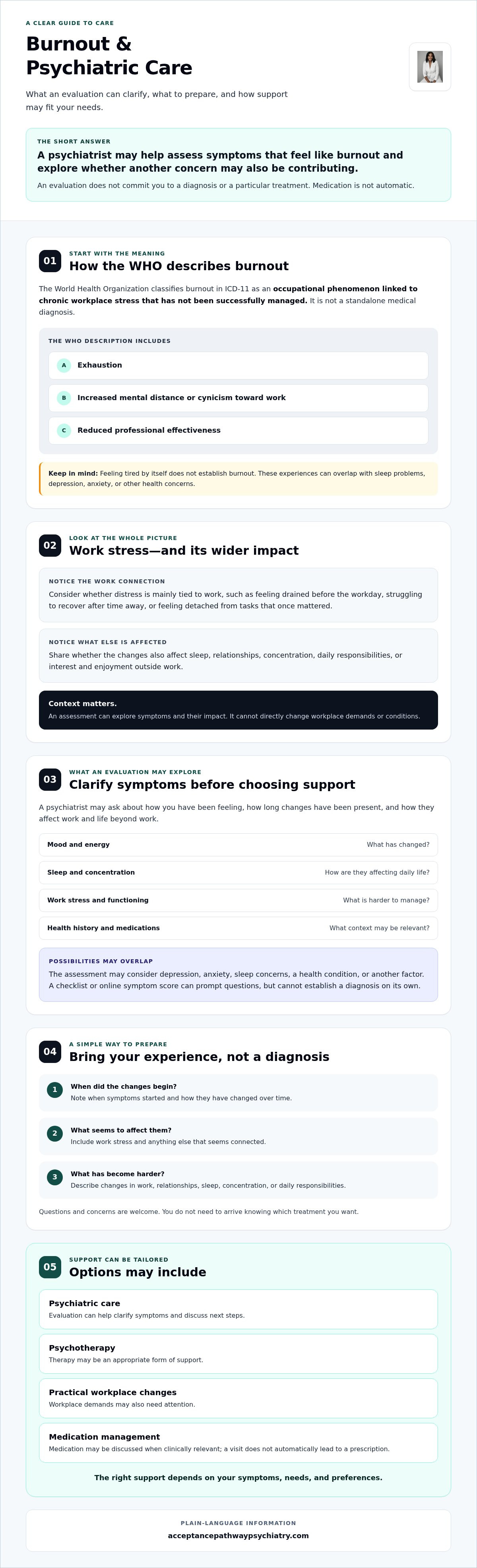
The World Health Organization classifies burnout in ICD-11 as an occupational phenomenon linked to chronic workplace stress that hasn’t been successfully managed. It isn’t a standalone medical diagnosis, and feeling tired by itself doesn’t establish that someone is experiencing burnout. The WHO describes exhaustion, increased mental distance or cynicism toward work, and reduced professional effectiveness. You can read more about occupational burnout and how the concept is used.
This overview from the Cleveland Clinic offers another way to understand burnout and its common signs:
What does burnout feel like in everyday life?
Work-related exhaustion may show up as feeling drained before the workday begins or struggling to recover after time away. You might feel detached from tasks that once mattered, become more cynical about your job, or find it harder to complete work to your usual standard. Experiences vary, and these signs can overlap with sleep problems, depression, anxiety, or other health concerns. They don’t confirm a diagnosis on their own.
When might it be time to ask for help?
Consider reaching out when distress persists, feels hard to manage, or starts affecting sleep, relationships, concentration, or daily responsibilities. You don’t have to wait until you’re unable to work or function. A professional can explore what you’re experiencing and whether further assessment or support may be useful. Asking for help is a reasonable step, not a judgment about your resilience.
Burnout also points to the role of the work environment. An appointment can help clarify the impact on your well-being, but a psychiatrist can’t directly change workplace demands or conditions. Recognizing both parts of the picture can help you consider support for your health alongside practical changes that may be needed at work.
What a Psychiatrist Can Do for Burnout-Related Concerns
A psychiatric evaluation can help make sense of symptoms you’ve been calling burnout. Rather than relying on that label alone, a psychiatrist can ask how you’ve been feeling, how long the changes have been present, and how they affect work and life outside it. The goal is to understand your individual situation, not to fit you into a predetermined treatment plan.
How an evaluation can clarify the picture
You may be asked about mood, energy, sleep, concentration, work stress, and whether you still find interest or enjoyment in activities outside work. A clinician may also review your health history and current medications, and ask about changes in daily functioning. These details help guide clinical judgment. A checklist or online symptom score may prompt useful questions, but it can’t establish a diagnosis on its own.
The assessment may consider whether symptoms could be related to depression, anxiety, sleep concerns, a health condition, or another factor. Some experiences overlap, and context matters. For example, difficulty concentrating may be connected to ongoing stress, poor sleep, or a separate mental health concern. A psychiatrist can discuss which possibilities may fit and whether additional evaluation or support could be helpful.
After gathering this information, the psychiatrist can talk through options with you. Treatment decisions should reflect the findings, your needs, and your preferences, not the word “burnout” by itself. You can ask questions, share concerns, and discuss what feels manageable. You don’t need to arrive knowing which treatment you want.
When might medication be discussed?
A psychiatric appointment doesn’t automatically mean you’ll be prescribed medication. Medication may be considered if an evaluation identifies a condition for which it could be clinically appropriate. If it comes up, you can discuss potential benefits, possible risks, and follow-up before making a decision together. You can also ask about other forms of support, including psychotherapy, if they may suit your needs.
Medication can’t change a heavy workload, workplace culture, or job demands. Those conditions may need practical attention alongside care for your well-being. A psychiatrist can help assess and address clinical concerns, while you consider what changes or other support might be possible in your work environment.
If you’re considering an evaluation, reviewing psychiatric evaluation and medication management services may help you understand what care options are available through Acceptance Pathway Psychiatry PLLC.
Burnout, Depression, or Anxiety: How a Psychiatrist May Tell the Difference
Burnout, depression, and anxiety can affect energy, concentration, and motivation, so it isn’t always easy to tell what’s behind a difficult stretch. Burnout is specifically tied to work-related stress. Depression or anxiety may affect experiences beyond work, though symptoms and circumstances vary. These patterns can provide context, but they aren’t a way to diagnose yourself.
| Concern | Context and possible experiences | Why assessment may help |
|---|---|---|
| Burnout | Work stress may be central, with exhaustion, detachment, or a sense that work effectiveness has declined. | A clinician can explore how symptoms relate to work and whether other concerns may also be present. |
| Depression | Low mood, reduced interest, low energy, or difficulty concentrating may affect work and other parts of life. | Similar experiences can have different causes. An assessment considers the broader pattern and its impact. |
| Anxiety | Persistent worry or tension may arise around work or other areas of life, and may affect rest or focus. | A clinician can consider the nature of the worry, its context, and whether it’s disrupting daily functioning. |
Why burnout and depression can feel similar
Both can involve exhaustion, reduced motivation, trouble concentrating, or pulling back from activities. With burnout, distress may feel closely linked to work. With depression, changes may also show up in relationships, interests, or routines outside the job. These aren’t firm dividing lines, however. Symptoms can overlap, and a work-related pattern alone can’t confirm or rule out a condition.
Why anxiety or sleep concerns may also matter
Prolonged stress may come with worry, tension, or disrupted sleep. Poor sleep can affect concentration and energy, while anxiety can make it harder to rest. None of these experiences automatically means you have a specific disorder. A qualified clinician looks at the whole picture, including symptom patterns, health history, stressors, and effects on daily life.
People can experience more than one concern at once. A psychiatrist assesses the individual rather than labeling symptoms based on a table or a single sign. If you’re wondering, can a psychiatrist help with burnout, an evaluation may help clarify what needs attention and what support could make sense. Share what you’ve noticed, including where symptoms show up and what has changed. You don’t need to work out the explanation before asking for help.
How to Prepare for a Psychiatrist Appointment About Burnout
You don’t need a perfect record of every difficult day to make an appointment useful. A few notes can help you describe what’s changed and what you hope to understand. If you’re wondering “can a psychiatrist help with burnout,” preparation can start by noticing how you’ve been feeling and which parts of daily life are affected.
What information may be useful to bring?
Consider jotting down when the changes began, what seems to ease or worsen them, and how they affect work and life outside work. If it feels manageable, note patterns in sleep, mood, energy, and concentration. A brief example can help, such as finding it harder to focus after a poor night’s sleep or feeling especially detached before a workday.
You may also want to bring:
- A current list of medications and supplements, including doses if you know them.
- Relevant health history or previous mental health care.
- A few questions about evaluation, psychotherapy, medication, privacy, or follow-up.
These notes are prompts, not homework. If you don’t have a list or can’t recall details, share what you can. A clinician can ask follow-up questions and help fill in the picture during the conversation.
What can you ask during the appointment?
You’re allowed to ask how the clinician is thinking about your concerns. For example: “What possible explanations are you considering?” or “What information would help clarify this?” You can also ask which support options may fit your situation, what their limits are, and how you and the clinician would review whether a plan is helping.
If medication is discussed, ask why it’s being considered, what potential benefits and risks to weigh, and what follow-up could involve. You can share hesitation or ask for time to think. The conversation should make room for your questions and preferences.
Confirm practical details directly before an appointment. Ask whether telehealth is available for your state, and check current insurance, payment, and scheduling information with the provider. If privacy is on your mind, ask how your information is handled and what to expect during the visit.
The first conversation is collaborative. You can share at a pace that feels comfortable, say when you’re unsure, and ask the clinician to explain unfamiliar terms. If you’d like to explore psychiatric evaluation or medication management, you can review available care options through Acceptance Pathway Psychiatry PLLC.
Choosing Support for Burnout: Psychiatry, Therapy, and Practical Changes
Support for work-related distress doesn’t have to come from one place. Psychiatry may help clarify whether symptoms involve a clinical concern that needs attention. Psychotherapy can offer space to explore how you’re coping and which patterns or boundaries may be worth examining. Practical changes at work may also matter. A clinician can support your well-being but can’t directly change your workload or workplace conditions.
What different kinds of support may contribute
A psychiatric evaluation considers symptoms and their effects, then helps guide next steps. Depending on what the assessment finds, a psychiatrist may discuss treatment options, including medication management when clinically appropriate. Medication isn’t an automatic response to burnout, and it can’t replace changes to job demands or workplace culture.
Psychotherapy may help you reflect on stress, coping, and boundaries, and consider how to respond to difficult patterns. You might also explore practical workplace steps, if feasible, such as discussing priorities, workload, or available support with an appropriate person at work. These conversations are separate from psychiatric care, and what feels possible will depend on your circumstances.
Some people consider more than one kind of support. For example, someone might use psychotherapy to work through stress and seek a psychiatric evaluation to better understand persistent changes in mood, sleep, or concentration. The right mix depends on individual needs and clinical assessment. If you’re still asking, “can a psychiatrist help with burnout,” psychiatry can help address related clinical concerns, while broader workplace factors may call for separate action.
A low-pressure next step with Acceptance Pathway Psychiatry PLLC
Acceptance Pathway Psychiatry PLLC offers psychiatric evaluations, psychotherapy, and medication management. These are options to discuss, not a predetermined plan. A conversation can help you understand what support may be relevant and decide on a next step at a pace that feels manageable.
Telehealth appointments are offered, but eligibility depends on clinician availability and whether care can be provided in your state. Confirm those details, along with current scheduling, insurance, and payment information, directly with the practice. You can learn about psychiatric care and appointment options and consider whether the available services fit what you’re looking for.
Take a Thoughtful First Step Toward Support
So, can a psychiatrist help with burnout? A psychiatric evaluation may help clarify whether your symptoms are related to work stress, another mental health concern, or a combination of factors. Burnout is work-related, but exhaustion, detachment, and concentration changes can overlap with other concerns, so an individual assessment can offer useful perspective.
Care doesn’t automatically mean medication. Support may include psychotherapy, practical changes at work, or medication management when clinically appropriate. These options can be discussed collaboratively, based on your needs and preferences. A psychiatrist can address clinical concerns, though workplace conditions may require separate conversations or changes.
Acceptance Pathway Psychiatry offers psychiatric evaluations, psychotherapy, and medication management. Telehealth appointments are also offered, subject to clinician availability and eligibility in your state. If you’d like to explore whether the practice’s services fit what you’re looking for, learn about psychiatric care and appointment options.
You don’t need every answer before reaching out. Visit Acceptance Pathway Psychiatry’s website to review care options and take a manageable next step toward understanding what support may feel right for you.
Frequently Asked Questions
Can a psychiatrist diagnose burnout?
Burnout is classified by the World Health Organization as an occupational phenomenon, not a standalone medical diagnosis. A psychiatrist can evaluate symptoms you associate with burnout, explore their connection to work, and consider whether depression, anxiety, sleep concerns, or another health issue may also be involved. This can help clarify what kind of support may be appropriate. A label or symptom checklist alone can’t replace an individual clinical assessment.
Should I see a psychiatrist or therapist for burnout?
Either may be a reasonable place to seek support, depending on your needs. Psychotherapy can help you explore coping, boundaries, and stress patterns. A psychiatrist can assess symptoms and related clinical concerns, and discuss medication management if appropriate. Some people choose both forms of care. Consider the level of support you want and how symptoms affect daily life. You don’t need to have the answer figured out before asking for help.
Will a psychiatrist prescribe medication for burnout?
Not automatically. Medication isn’t a routine treatment for burnout itself, which the World Health Organization classifies as an occupational phenomenon. A psychiatrist may discuss medication if an evaluation identifies a separate condition for which it could be clinically appropriate. You can ask about potential benefits, risks, and alternatives, and make decisions collaboratively. Medication also can’t directly change workplace demands, workload, or culture.
How can I tell if burnout is depression?
You can’t reliably determine this from one symptom or a simple checklist. Work-linked exhaustion and detachment may fit a burnout experience, while depression can affect mood, interest, and functioning across different areas of life. These patterns can overlap, and people may experience more than one concern. A qualified clinician can consider your symptoms, context, health history, and daily functioning to help assess possible explanations.
Can burnout go away without professional help?
Some people may feel better as stressors ease or practical circumstances change, but there’s no single course that applies to everyone. Rest or changes at work may help address some contributors, while persistent distress or symptoms affecting sleep, relationships, concentration, or daily responsibilities may benefit from professional support. You don’t need to wait until things feel unmanageable to talk with a clinician about what’s happening.
What should I tell a psychiatrist about burnout?
Share what has changed and how it affects you. It may help to mention when symptoms began, what seems to worsen or ease them, and whether they affect work, sleep, relationships, or activities outside work. Bring a list of current medications and supplements, relevant health history, and questions you have. You don’t need a complete record. The clinician can ask follow-up questions and help organize the details.
Can I see a psychiatrist online for burnout?
Online psychiatric appointments may be an option, depending on the provider and your location. Acceptance Pathway Psychiatry offers telehealth appointments, but clinician availability and eligibility in your state must be confirmed before making plans. Ask the practice directly whether a clinician can see you by telehealth and check current appointment, insurance, and payment details. An online visit can still include a conversation about symptoms, history, and possible next steps.


