

Have you ever felt like your mental health struggles are invisible, leaving you to wonder if your brain is simply working against you? It's deeply frustrating to describe a foggy mind or a lack of focus to a provider, only to feel like those symptoms are dismissed as subjective. You know your experience is real, but finding the words to prove it shouldn't be your burden alone. When treatment feels like a series of trial and error medication changes, it's natural to crave something more concrete than a conversation.
We believe your journey deserves the same objective clarity as any other part of your physical health. By incorporating cognitive testing for mental health, we can transform those internal struggles into clear, actionable data. This modern approach provides the evidence needed to personalize your treatment and validate your unique experience through measurable metrics. In this article, you'll discover how these assessments establish a baseline for your brain function, support data-backed medication adjustments, and help you track your healing journey with absolute precision.
Key Takeaways
- Learn how cognitive testing for mental health replaces subjective guesswork with measurable, neuroscientific data to validate your internal experience.
- Understand how the Creyos platform allows you to complete scientifically validated tasks from the comfort of your home through secure telehealth appointments.
- Discover how objective brain function reports empower your provider to make more precise medication adjustments and set realistic goals for psychotherapy.
- See how establishing a clear baseline of your cognitive function allows for accurate tracking of your progress over time; this ensures your treatment plan stays on course.
- Explore how a collaborative, data-informed approach creates a safe space where your symptoms are seen, measured, and treated with compassionate expertise.
What is Cognitive Testing for Mental Health?
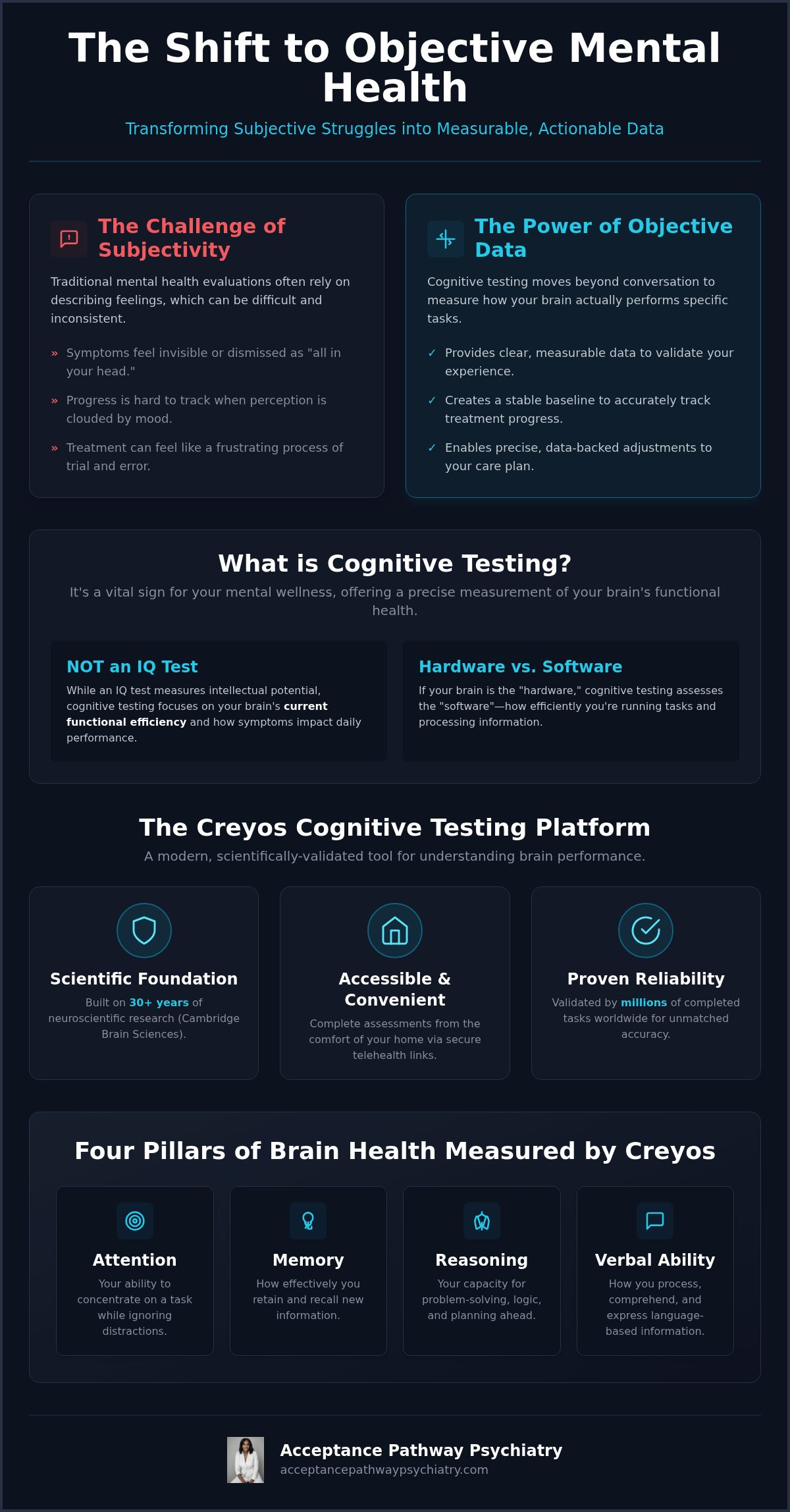
Cognitive testing for mental health is a structured approach to understanding how your brain processes information in real-time. It's not just a conversation; it's a series of scientifically validated tasks designed to measure specific functions like memory, attention, and reasoning. By using Neuropsychological tests, providers can move away from relying solely on how you feel on a particular day and instead look at how your brain is actually performing. This shift from subjective reporting to objective neuroscientific data allows for a much clearer, more stable picture of your mental wellness.
Psychiatrists use these assessments to look beyond outward symptoms like sadness or restlessness. They want to see if there are underlying cognitive hurdles, such as executive function gaps, that make daily life feel more difficult. It's also helpful to distinguish these from IQ tests. While an IQ test measures your general intellectual potential, a psychiatric cognitive assessment focuses on your current functional efficiency and how your symptoms impact your daily performance.
Measuring the 'Wholeness' of Brain Function
Think of your brain's physical structure as the "hardware" and your cognitive processes as the "software." Cognitive testing focuses on the software, identifying how efficiently you're running daily tasks. Sometimes, "silent" symptoms like slowed processing speed or difficulty switching between tasks aren't obvious during a regular check-in. Testing brings these hidden challenges to light, ensuring your treatment plan addresses the full scope of your experience.
Cognitive testing for mental health serves as a vital sign for your mental wellness, offering a precise measurement of your brain's functional health.
Why Subjective Reporting Isn't Always Enough
When you're struggling with anxiety or depression, it can be incredibly hard to accurately assess your own progress. These conditions often cloud your perception, making it difficult to remember if your focus was better last week or if your memory has truly slipped. You don't have to carry the burden of proving your symptoms through words alone.
Objective data provides a neutral ground for discussions between you and your provider. Instead of feeling like your struggles are "all in your head," you can see them reflected in measurable performance metrics. This validation is often a profound relief. It transforms your internal experience into something tangible that we can track, adjust for, and improve together.
Understanding the Creyos Cognitive Testing Platform
Creyos represents a significant leap forward in how we understand the brain's daily performance. Unlike traditional assessments that might require a trip to a specialized hospital lab, Creyos is a web-based tool designed for modern life. It's built on more than 30 years of neuroscientific research, specifically the Cambridge Brain Sciences methodology. This foundation ensures that when we use cognitive testing for mental health, we aren't just guessing. We're using a platform that has been validated by millions of completed tasks across the globe, providing a level of reliability that brief office screenings simply can't match.
One of the most supportive features of this platform is its accessibility. You can complete your assessment from the comfort of your own home via secure telehealth links. This environment often leads to more accurate results because you're in a space where you feel safe and relaxed. It removes the stress of a clinical setting, allowing us to see how your brain functions in a natural context. When we integrate cognitive testing for mental health into your care, we're looking for patterns that help us understand your unique cognitive profile rather than just a list of symptoms.
The Core Domains Measured by Creyos
The platform focuses on four primary pillars of brain health. First, it measures attention, which is your ability to concentrate on a task while ignoring the noise around you. Memory tasks look at how you retain and recall information, which is often a major concern for those dealing with chronic stress or depression. Reasoning assessments evaluate your problem-solving and planning capabilities. Finally, verbal ability tasks measure how you process and express language-based information. Understanding these areas is a standard part of Cognitive Testing, helping us screen for subtle changes in function that might otherwise go unnoticed during a standard evaluation.
What the Assessment Experience Looks Like
Many people worry that a brain test will feel like a high-stakes exam, but the Creyos experience is different. The tasks are designed to be engaging, often resembling simple "brain games" rather than a medical test. A typical session is efficient, usually lasting about 20 to 30 minutes. You don't need to study or prepare in any way. In fact, the most reliable results come from your natural, everyday state. The platform is HIPAA and SOC 2 compliant, ensuring your data is handled with the highest level of security. By using these objective metrics, we can build a treatment plan that truly reflects your needs. If you're ready to see what your data reveals, you can explore our telehealth appointments to get started.
Objective Data vs. Traditional Evaluations
Traditional psychiatric evaluations are the foundation of modern care, but they often have inherent limitations. These assessments rely heavily on your memory and your ability to articulate complex, shifting feelings during a brief window of time. If you're feeling overwhelmed or foggy, it's difficult to accurately recall if your memory was slightly better or worse over the last month. Mental status testing is a common part of this process, yet it often lacks the granular, millisecond-level detail that modern digital tools provide. By introducing cognitive testing for mental health, we move away from subjective impressions and toward measurable facts.
This data-driven approach also helps mitigate clinician bias. Even the most empathetic providers are influenced by their own clinical experiences and internal frameworks. Objective metrics act as a neutral witness in the room, providing a baseline that isn't influenced by how a patient presents on a single day. This is especially vital when differentiating between overlapping conditions. For example, both ADHD and high-functioning anxiety can manifest as a lack of focus. Testing reveals whether the issue is a core deficit in attention or a result of an overactive emotional response. Having a visual report makes these distinctions clear, allowing you to see exactly where your brain is thriving.
The Precision Psychiatry Advantage
Precision psychiatry means your treatment plan is as unique as your fingerprint. While paper-and-pencil tests were once the standard, they can't capture the subtle nuances of processing speed or reaction time variability that digital tasks can. Digital assessments are far more sensitive to these small but significant markers. We don't just look for what's difficult; we identify your specific cognitive strengths. If your reasoning scores are high but your verbal memory is lower, we can tailor your psychotherapy to lean into those problem-solving skills, making your sessions more effective and empowering.
Reducing the Time to Effective Treatment
One of the most painful parts of mental health care is the "trial and error" phase of medication management. It's exhausting to wait weeks only to realize a dosage isn't quite right. With cognitive testing for mental health, we establish a baseline before you start a new regimen. By re-testing at specific intervals, we can see if a medication is improving your cognitive markers long before you might "feel" a definitive emotional change. Objective data shortens the path to stability by replacing clinical guesswork with precision tracking of your actual brain function.
How Testing Enhances Your Mental Health Treatment Plan
Many people view assessments as a one-time event, perhaps to confirm a diagnosis or screen for memory loss. However, cognitive testing for mental health is most powerful when it's used as a living part of your ongoing care. It provides a roadmap that helps us understand how your symptoms interfere with your productivity at work or your presence in relationships. By identifying these specific friction points, we can move from general support to highly targeted interventions that respect your unique brain chemistry.
Recovery is rarely a straight line, and follow-up testing allows us to celebrate small victories that might not be obvious in your daily routine. We can see measurable improvements in your attention span or reasoning skills even during weeks when you feel emotionally stuck. This objective evidence keeps you motivated and ensures your treatment plan evolves as you do, providing a clear sense of progress and purpose.
Informing Medication Management Decisions
Choosing the right medication is a collaborative process, and objective data makes that process much smoother. Some psychiatric medications can cause subtle "brain fog" or slowed processing speed as a side effect. By measuring these markers before and after starting a new prescription, we can differentiate between the symptoms of your condition and the effects of the treatment itself. This allows us to adjust dosages with confidence, ensuring you receive the maximum benefit with the fewest obstacles. For a deeper look at this process, explore our Psychiatric Medication Management guide.
Cognitive Insights in Psychotherapy
Have you ever felt like certain therapeutic tasks, such as organizing a schedule or practicing mindfulness, feel physically impossible? This often isn't a lack of willpower; it's a reflection of executive dysfunction. Your cognitive profile reveals exactly how your brain manages planning and emotional regulation. When your therapist understands these results, they can choose tools that align with your brain's natural strengths. If testing shows your verbal memory is a challenge, we might use more visual aids or written summaries to help you retain the insights from your sessions.
By integrating cognitive testing for mental health into your psychotherapy, we can address the "why" behind your struggles. If you're ready to add this level of precision to your care, schedule your telehealth appointment today to begin your journey with a provider who sees the whole picture.
Beginning Your Journey with Acceptance Pathway Psychiatry
At Acceptance Pathway Psychiatry PLLC, we believe you're the ultimate expert on your own life. Our role is to serve as a compassionate guide, providing the high level clinical tools needed to illuminate your path forward. By integrating cognitive testing for mental health into our practice, we ensure our collaboration is rooted in objective clarity. Whether you choose to meet with us via telehealth or in person, this data informed approach allows us to build a bridge between how you feel and how your brain is functioning. We don't view these reports as a final verdict. Instead, we see them as a starting point for a deeper conversation where you're an active partner in analyzing the results.
Our commitment to a non-judgmental environment means that every piece of data is handled with care. We use the Creyos platform to create a safe space for healing, where your struggles are met with curiosity rather than criticism. This partnership allows us to move beyond the surface of your symptoms. We work together to understand the biological patterns that influence your daily life, ensuring your treatment feels like a mutual effort toward wholeness.
A Supportive Witness to Your Progress
We approach every assessment with a focus on your personal evolution. It's not about finding what's wrong, but about understanding your wholeness and potential. When we review your results together, we explain the findings with clinical clarity and deep empathy. This process helps demystify your symptoms, showing you that challenges with focus or memory are often biological markers rather than personal failings. For those specifically curious about how these tools apply to neurodivergence, our guide on Understanding Cognitive Assessment for ADHD offers more detailed insights into that specialized process.
Next Steps: Scheduling Your Evaluation
Starting this process is simple and fits naturally into your existing care. You can request a cognitive assessment during your initial consultation or any follow up visit. Once you complete the tasks from the comfort of your home, we'll schedule a dedicated session to walk through the findings together. We'll discuss how the data aligns with your daily experiences and how it will shape your medication management or therapy goals. Always remember that you aren't a set of scores on a page. You're a person in progress, and cognitive testing for mental health is simply one of the many supportive witnesses we use to help you reach your full potential.
Empowering Your Path to Precision Wellness
You deserve a mental health journey that feels grounded in evidence and tailored to your unique brain function. By embracing cognitive testing for mental health, we move beyond the limitations of memory and guesswork. This approach provides the objective data needed to validate your internal experience. It ensures every medication adjustment and therapeutic goal is backed by clear, measurable metrics. As a Creyos-certified provider, our team is dedicated to offering compassionate, trauma-informed care that respects your personal evolution.
Take the first step toward objective insights. Schedule your evaluation today.
Through our seamless telehealth integration, you can access these sophisticated tools from the comfort of your home. You're not just a patient in our care; you're an active partner in your own healing process. We're here to support you with steady, non-judgmental expertise as you navigate the road toward stability and wholeness. Your progress is measurable, and your potential is truly limitless.
Frequently Asked Questions
Is cognitive testing the same as an ADHD diagnosis?
Cognitive testing is a supportive tool rather than a standalone diagnosis for ADHD. While it provides objective data on attention and executive function, a formal diagnosis requires a comprehensive clinical evaluation by a professional. At Acceptance Pathway Psychiatry, we use these results to validate your symptoms and build a more precise treatment plan. It's one piece of a larger puzzle that includes your history and current experiences.
Can I take the cognitive test online through telehealth?
Yes, you can complete your assessment entirely through our secure telehealth platform. We send a secure link directly to your email, allowing you to perform the tasks on your own computer or tablet. This flexibility ensures you're in a familiar, low stress environment, which often leads to more accurate results. Our virtual appointments make it easy to integrate cognitive testing for mental health into your busy schedule without needing to visit an office.
Do I need to stop taking my medications before the test?
Generally, you don't need to stop your current medications before taking the test. In fact, testing while on your usual regimen helps us understand how well your current treatment is working. If we're establishing a baseline before a new medication starts, we'll coordinate that timing with you. Always follow the specific instructions provided during your consultation to ensure we're capturing the most useful data for your unique situation.
How long does a typical cognitive assessment take?
A typical session using the Creyos platform is efficient and usually takes between 20 and 30 minutes to complete. The assessment consists of several short, engaging tasks that feel more like "brain games" than a medical exam. Because the platform is web-based, you can move through the tasks at a steady pace. We'll then schedule a follow up appointment to review your visual report and discuss the next steps in your care.
Will my insurance cover cognitive testing for mental health?
Insurance coverage for cognitive testing varies significantly between different plans and providers. At our practice, this service is often offered as a self-pay, provider-referred assessment. We recommend contacting your insurance carrier directly to verify your specific benefits for neurocognitive testing. Our team can provide you with the necessary information to help you navigate these payment options and ensure you understand any potential out of pocket costs before moving forward.
What happens if my scores are lower than average?
Lower than average scores aren't a sign of failure; they're simply objective data points that help us understand your challenges. These results allow us to pinpoint specific areas, such as memory or processing speed, that may be impacted by your mental health condition. We use this information to adjust your medication or choose therapeutic tools that lean into your strengths. You're a person in progress, and these scores help us support your personal evolution.
Can cognitive testing help with depression and anxiety, or just ADHD?
Cognitive testing for mental health is highly beneficial for depression, anxiety, and PTSD, not just ADHD. These conditions often cause "silent" symptoms like brain fog or difficulty with decision making. By measuring these cognitive markers, we can track how your symptoms are improving over time. This objective insight helps us differentiate between emotional distress and functional cognitive hurdles, leading to a more comprehensive and effective treatment plan for any condition you're facing.
How often should I repeat the cognitive assessment?
The frequency of re-testing depends on your specific treatment goals and any changes in your care plan. Many patients find it helpful to repeat the assessment after a medication change or every few months to track their progress. This ongoing monitoring provides a clear visual of your improvement over time. It allows us to make data-backed adjustments to your treatment, ensuring you stay on the most effective path toward long term stability and wellness.


