

What if the most vital tool in your mental health journey isn't a specific pill, but the quality of the conversation you have with your provider? Many people feel a sense of quiet anxiety when they consider how to talk to a psychiatrist about medication. You might worry about being judged for your symptoms, fear the impact of potential side effects, or feel like a passive observer in your own treatment. It's completely natural to feel hesitant when discussing something as deeply personal as your internal well-being and your path toward wholeness.
We believe that you're the foremost expert on your own lived experience. This guide will help you transform that initial uncertainty into a sense of quiet strength and confidence. You'll learn how to prepare for your appointment, ask the hard questions, and ensure your treatment plan aligns perfectly with your personal evolution and life goals. We want you to feel like a true partner in your care, rather than a passenger in the process.
We'll walk through practical steps to help you initiate these vital discussions. From tracking your symptoms to understanding the collaborative nature of medication management, you'll gain the tools needed to advocate for yourself. By the end of this article, you'll have a clear roadmap for navigating your next session with clarity and peace of mind.
Key Takeaways
- Prepare for your visit by reflecting on your personal wellness goals and tracking your symptoms to provide a clear, steady picture of your daily experience.
- Learn how to talk to a psychiatrist about medication using "I" statements that focus on your internal feelings to foster a collaborative and non-judgmental partnership.
- Discover the essential questions to ask regarding how specific treatments function and what clinical goals are being targeted for your unique journey.
- Navigate concerns about side effects by learning how to rank their impact on your quality of life and distinguishing between temporary adjustment periods and long-term effects.
- Understand how to shift from being a passive observer to an active partner in a care plan that respects you as the expert on your own life.
Preparing Your Mind and Notes Before the Appointment
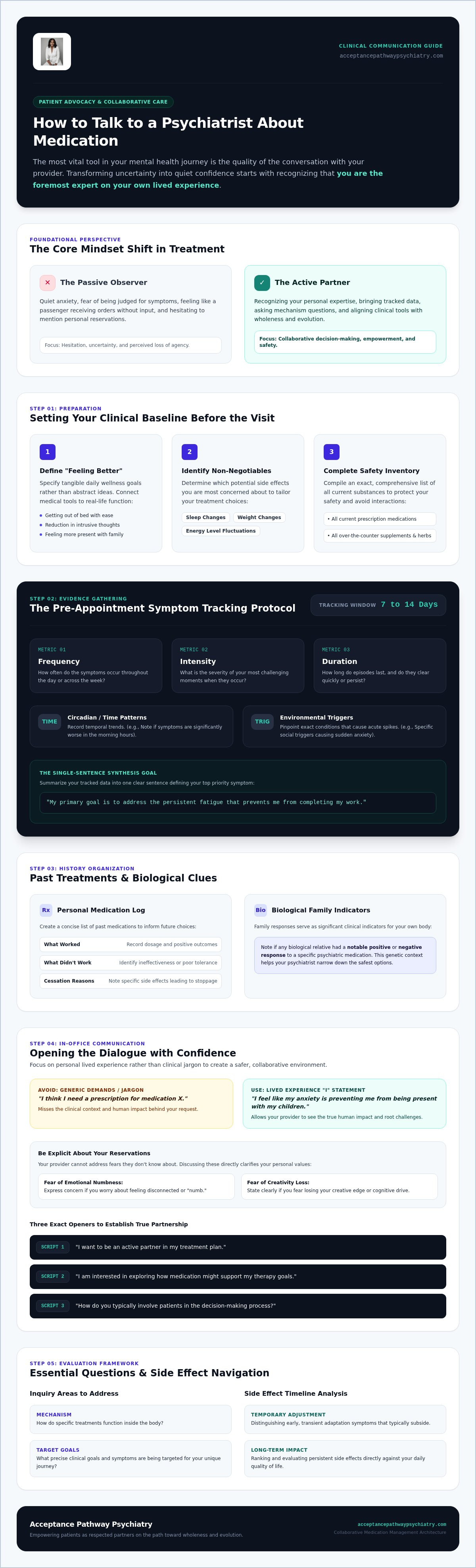
Preparing for a psychiatric evaluation can feel overwhelming, but it's the first step in taking an active role in your healing. Learning how to talk to a psychiatrist about medication starts with clarity. Before your session, take a moment to reflect on what "feeling better" actually looks like for you. Is it the ability to get out of bed with ease, a reduction in intrusive thoughts, or feeling more present with your family? Defining these goals helps your provider align clinical tools with your personal values. It's about finding a path that supports your wholeness.
You should also identify your "non-negotiables." Every person reacts differently to psychiatric medications; knowing which side effects you are most concerned about, such as changes in sleep, weight, or energy levels, allows for a more tailored approach. Bring a complete list of all current supplements and medications you're taking. This simple step is vital for your safety. It helps your provider avoid potential interactions and ensures your treatment plan is both safe and effective from the start.
The Power of Symptom Tracking
Data provides a steady foundation for your conversation. For 7 to 14 days before your appointment, track your symptoms using a simple log or a digital app. Don't just note what you feel. Record the frequency, intensity, and duration of your most challenging moments. Are your symptoms worse in the morning? Do specific social triggers cause a spike in anxiety? Try to summarize this data into a single sentence that defines your "top priority" symptom. For example, you might say, "My primary goal is to address the persistent fatigue that prevents me from completing my work." This level of specificity helps your psychiatrist understand your internal experience with greater precision.
Organizing Your Medical History
Organizing your history is a practical part of learning how to talk to a psychiatrist about medication effectively. Your past experiences are valuable guides for your future care. Create a concise list of any medications you have taken in the past. Be sure to note what worked, what didn't, and any specific side effects that led you to stop a treatment. It's also helpful to mention your family history. If a biological relative had a positive or negative response to a specific medication, that information can be a significant clinical indicator for your own journey. Keeping these notes brief and organized ensures you maximize your time during the evaluation, leaving more room for a deep, supportive dialogue about your path forward.
How to Start the Conversation About Medication
Starting the dialogue often feels like the most difficult hurdle. It's common to feel a mix of hope and apprehension when you step into the office. When considering how to talk to a psychiatrist about medication, focusing on your personal experience rather than clinical jargon can create a safer, more productive environment. Use "I" statements to anchor the conversation in your lived reality. For example, saying "I feel like my anxiety is preventing me from being present with my children" carries more weight than simply asking for a prescription. It allows your provider to see the human impact of your symptoms. Learning how to talk to a psychiatrist about medication also involves being honest about your fears or reservations. If you're worried about feeling "numb" or losing your creative edge, say so. These concerns are valid and help your prescriber understand your values.
Using resources like the tips for talking with a health care provider can help you build the confidence needed to initiate these honest exchanges. When you frame your request as a search for tools to support your overall wellness, you move the focus toward progress and wholeness.
Setting the Stage for Partnership
Collaboration is a two-way street. You can set the tone for your care by expressing your desire for a partnership from the very first minute. Try an opening like: "I want to be an active partner in my treatment plan." This statement signals that you value your own agency and expertise. You might also state clearly: "I am interested in exploring how medication might support my therapy goals." This shows you view treatment as a holistic process. Don't hesitate to ask: "How do you typically involve patients in the decision-making process?" A provider who values your voice will welcome this question. It establishes a foundation of mutual respect and shared responsibility for your wellness.
Overcoming the "Drug-Seeking" Stigma
Many people delay seeking help because they fear being labeled or misunderstood. You can move past this anxiety by focusing on functional improvements rather than specific pill names. Instead of mentioning a brand you saw in an ad, discuss your symptoms as barriers to the life you want to lead. Talk about wanting to be able to focus at work or having the energy to maintain social connections. This approach demonstrates that you're searching for tools to support your overall wellness. It shows your commitment to a multi-faceted approach that includes integrative wellness services alongside clinical support. When you frame the request as a search for stability, the focus stays on your personal evolution.
Essential Questions to Ask Your Psychiatrist
Once you have initiated the dialogue, the next step in learning how to talk to a psychiatrist about medication is to dig into the specifics of the clinical plan. This is where your curiosity becomes a vital asset. You aren't just receiving a prescription. You're gathering intelligence on how to best support your brain and body. Start by asking about the "why" behind the choice. What is the specific goal of this medication for your diagnosis? Is the aim to dampen the intensity of panic attacks, or to lift the heavy fog of depression? Knowing the specific target helps you and your provider measure success with greater accuracy.
Understanding the "how" is just as important as the "why." Ask your provider how the medication works within your system. Referencing the National Institute of Mental Health's guide to talking with a healthcare provider can help you remember to ask about specific mechanisms and potential interactions. You should also explore the bigger picture of your care. Are there non-medication alternatives or Integrative Wellness Services we should consider first? Discussing how nutrition, sleep hygiene, or psychotherapy can complement your medication plan ensures you are treating the whole person, not just a set of symptoms. It positions you as an active participant in your own evolution.
Understanding the Mechanism and Timeline
It's helpful to ask, "What neurotransmitters are we targeting with this specific choice?" Whether the medication focuses on serotonin, dopamine, or norepinephrine, knowing the target provides a sense of order and predictability. Clarify the expected timeline for improvements. There is often a significant difference between "feeling" a medication work and reaching its full therapeutic effect. For many treatments, this process can take several weeks. If you are switching from a previous treatment, inquire about the "wash-out" period. This ensures your system is clear and ready for the new path without unnecessary complications.
The "What If" Scenarios
Preparation leads to peace of mind. Ask your provider: "What happens if I miss a dose or want to stop the medication?" You should never stop a psychiatric medication "cold turkey," as this can lead to uncomfortable discontinuation symptoms. Discuss whether this is a tool for short-term stabilization or a long-term support system for your wellness. Finally, be open about your lifestyle. Inquire about how this medication might interact with caffeine, alcohol, or other daily habits. This level of detail ensures that your treatment plan aligns with your life, allowing you to move forward with quiet strength and confidence.
Discussing Concerns, Side Effects, and Alternatives
Addressing potential side effects is often the most anxiety-inducing part of the process. It's common to worry that a treatment might change your personality or cause physical discomfort. When you're learning how to talk to a psychiatrist about medication, it's helpful to have a framework for these concerns. Instead of just listing what you feel, try ranking your side effects by their impact on your quality of life. A mild headache that fades after an hour is different from persistent fatigue that prevents you from working. By categorizing these experiences, you help your provider understand which issues are minor inconveniences and which are "non-negotiables."
It's also vital to distinguish between the "adjustment period" and permanent side effects. Many symptoms, such as mild nausea or dry mouth, often resolve within the first two to four weeks as your body finds its balance. If a side effect persists beyond this window, it's time for a deeper discussion. You might explore dose adjustments or "augmentation" strategies, where a second medication is added to offset the side effects of the first. This is a standard part of psychiatric medication management, ensuring your treatment remains a supportive tool rather than a burden.
Managing the Side Effect Dialogue
Clarity is your best ally during these visits. When you describe a concern, be as specific as possible. Try saying: "I am experiencing increased drowsiness in the afternoon, and it's affecting my ability to pick up my children from school." This gives your provider a clear picture of the functional impact. You can then ask if there is a different time of day to take the medication or if a lower dose might be appropriate. Always evaluate the trade-off. Is the benefit to your mental health currently outweighing the physical cost? This honest assessment helps you and your provider decide whether to stay the course or pivot to a new approach.
Exploring Integrative Wellness Options
Medication is rarely the only tool in the box. You should discuss how sleep hygiene, nutrition, and stress management can support your clinical plan. If you find your primary symptoms are focus-related, you might inquire about ADHD testing to ensure your diagnosis is as accurate as possible. Ask your provider: "How can we use wellness strategies to potentially lower the required dose?" This collaborative approach ensures you're looking at your health through a holistic lens. If you are ready to explore a plan that values your unique experience, you can schedule a telehealth appointment to begin your journey.
Building a Collaborative Treatment Plan with Acceptance Pathway
At Acceptance Pathway, we believe that the most effective treatment plans are born from mutual respect and shared goals. Knowing how to talk to a psychiatrist about medication is much easier when you know your provider is a supportive ally rather than a distant authority figure. Our practice is built on a simple but profound philosophy: you are the expert on your own life, and we are the experts on the clinical tools that can help you thrive. This partnership ensures that every decision we make together is rooted in your unique experience and personal values.
Medication management is never a standalone solution in our care model. Instead, it serves as a vital component of a comprehensive, compassionate plan that may include psychotherapy and integrative wellness. We view medication as a bridge to wholeness, a tool that provides the stability needed for you to engage fully in your personal evolution. Whether you meet with us through our telehealth appointments or in person, we prioritize your psychological safety. We want you to feel secure enough to be entirely honest about your journey, your fears, and your hopes for the future.
The Acceptance Pathway Approach
We provide a non-judgmental environment where your voice is consistently the most important one in the room. Our approach goes beyond just managing symptoms; we look at the whole person through our integrative wellness services. To ensure your treatment is as precise as possible, we utilize functional tools like Creyos cognitive testing. This objective data helps us understand your attention, memory, and executive function, allowing us to refine your medication plan with greater clarity. By combining clinical expertise with a deep empathy for your internal experience, we help you move toward a "purpose culture" where your mental health supports the life you truly want to lead.
Next Steps in Your Healing Journey
Your path toward wellness begins with a single, courageous conversation. We invite you to schedule a comprehensive psychiatric evaluation to start this dialogue in a space where you'll be heard, validated, and supported. During this initial session, we'll take the time to understand your history and define what success looks like for you. You don't have to navigate these choices alone; we're here to act as a steady witness and guide. Begin your collaborative treatment journey with us today.
Your Voice as the Foundation of Care
You now have the practical tools and the emotional framework to navigate your next appointment with quiet strength. By tracking your symptoms and clarifying your personal goals, you've already begun the process of becoming an active partner in your treatment. Understanding how to talk to a psychiatrist about medication is about more than just clinical facts; it's about advocating for your own lived experience and ensuring your care plan supports your unique path toward wholeness.
We are here to act as supportive witnesses to your journey. Our practice offers both telehealth and in-person options to ensure you feel secure and comfortable during every session. By combining medication management with integrative wellness and psychotherapy, we treat you as a whole person rather than a collection of symptoms. You don't have to navigate these complex decisions alone. Schedule your compassionate medication management consultation today to begin a partnership rooted in professional humility and deep respect. You deserve to feel heard, validated, and empowered as you move toward a more vibrant, balanced life.
Frequently Asked Questions
What should I do if I feel my psychiatrist is not listening to my medication concerns?
Start by being direct and using "I" statements to express your feelings. If the communication barrier persists despite your efforts, it may be time to seek a second opinion or a provider who prioritizes collaborative care. You deserve to feel like a partner in your treatment. A supportive prescriber will always value your lived experience and prioritize your safety and comfort throughout the process.
Is it okay to ask for a specific medication I saw an ad for or read about online?
Yes, it's completely okay to bring up specific treatments you've researched. When learning how to talk to a psychiatrist about medication, framing your interest as a question about its mechanism or suitability is a great approach. Your provider can then discuss whether it aligns with your specific diagnosis and wellness goals. This dialogue helps ensure you are both on the same page regarding the clinical tools being used.
How do I know if my psychiatric medication is actually working?
You'll know it's working when you notice functional improvements in your daily life, such as better sleep, increased focus, or more stable moods. Tracking your symptoms over several weeks provides objective data to discuss during your visits. We also use tools like Creyos cognitive testing to measure improvements in executive function and attention. These metrics help us see progress that might be subtle or difficult to track through memory alone.
Can I talk to my psychiatrist about stopping my medication?
Absolutely, and you should always discuss this before making any changes. Stopping psychiatric medication requires a supervised tapering plan to prevent uncomfortable discontinuation symptoms or a return of your original symptoms. Your provider will act as a supportive witness to your decision and help you navigate the transition safely. This collaborative approach ensures that your exit strategy is as intentional and stable as your initial treatment plan.
What is the difference between a medication management appointment and a therapy session?
A medication management appointment focuses primarily on the clinical effectiveness, dosage, and side effects of your prescriptions. These visits are typically shorter and occur less frequently than psychotherapy sessions. In contrast, therapy sessions involve deeper exploration of your emotions, behaviors, and coping strategies. While both services support your healing, medication management provides the physiological stability that often makes the work of psychotherapy more accessible and productive for your personal evolution.
How often will I need to meet with my psychiatrist to talk about medication?
The frequency of your visits depends on where you are in your treatment journey. When starting a new medication, you might meet every two to four weeks to monitor your response and adjust dosages. Once you reach a stable state, follow-up appointments often shift to every three months. Knowing how to talk to a psychiatrist about medication effectively during these check-ins ensures that your plan remains aligned with your long-term wellness goals.
Should I bring someone with me to help me talk to my psychiatrist?
Bringing a trusted friend or family member can be very helpful, especially during your initial evaluation. They can provide a different perspective on your symptoms and help you remember the details of the conversation. If you feel anxious about the visit, having a supportive ally present can lower your barrier to seeking help. Just ensure the person you choose understands your goals and respects your role as the primary decision-maker.
What happens during a first medication management appointment?
During your first appointment, your provider will conduct a comprehensive psychiatric evaluation to understand your history and current challenges. This includes discussing your symptoms, past treatments, and family medical history to establish a baseline. We may also use Creyos cognitive testing to assess your baseline mental performance. The session ends with a collaborative discussion about potential treatment options, ensuring you leave with a clear roadmap for your healing journey.


