

Mental health care feels more connected when each professional has a clear role and the treatment plan is shared. Collaborative care with a therapist and psychiatrist brings behavioral health support together with primary care: a primary care provider leads the team, while a behavioral health care manager and psychiatric consultant help coordinate treatment. The psychiatrist may guide the team’s recommendations without meeting with the patient face to face.
It’s understandable to wonder who does what, how information moves between professionals, and whether this approach can help. This article explains the roles therapists, psychiatrists, primary care providers, and care managers may play, along with practical ways to support coordination. You’ll also learn what evidence supports the Collaborative Care Model and how it differs from collaborative care with a therapist and psychiatrist in private practice.
Key Takeaways
- Understand how primary care providers, therapists, psychiatrists, and care managers can contribute different strengths to a shared treatment plan.
- Learn how teams track progress and use consultation to revisit care when someone isn’t improving as expected.
- Prepare to coordinate care by clarifying your goals, sharing relevant information, and asking how your providers will stay connected.
- See how teamwork can look different in an integrated primary care setting compared with private practice.
- Explore the research behind collaborative care and how medication management and psychotherapy can fit into a person’s broader care.
What Types of Mental Health Professionals Collaborate With PCPs and What Treatment Can They Provide?
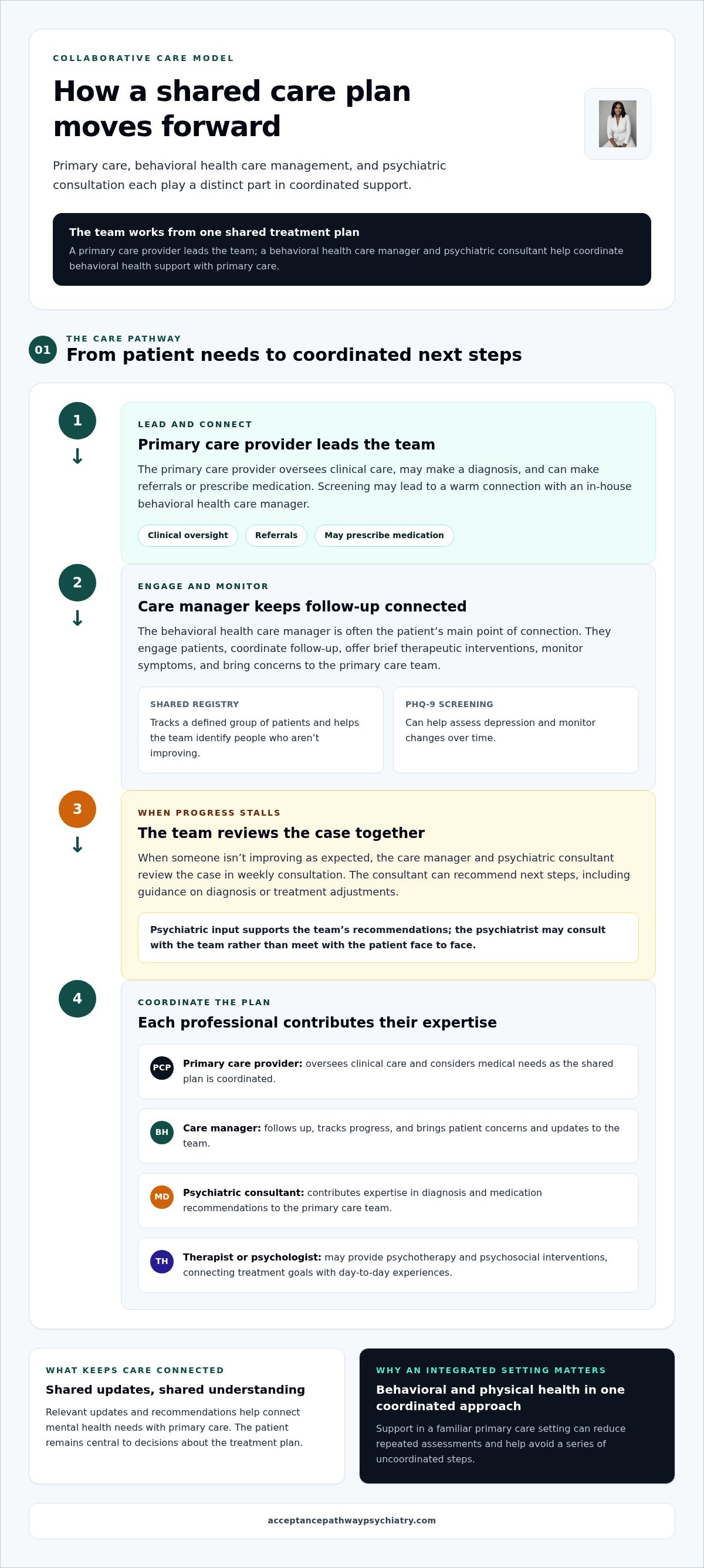
In integrated primary care, the primary care provider leads a team that supports behavioral health alongside physical health. The team may include a behavioral health care manager, a consulting psychiatrist, and other professionals, such as a psychologist or social worker. A therapist may provide psychotherapy, while a psychiatrist can advise on diagnosis, medication, and treatment planning. The team’s makeup depends on the care model and the patient’s needs. Collaborative care with a therapist and psychiatrist brings complementary expertise together, although the psychiatrist may consult with the team rather than meet with the patient directly.
A behavioral health care manager is often the patient’s main point of connection within the team. This professional engages patients, follows up, offers brief therapeutic interventions, monitors symptoms, and coordinates with the primary care provider. For example, the manager may check whether a patient’s mood is changing and bring concerns to the team. The manager also maintains a shared registry, which tracks a defined group of patients and helps identify people who aren’t improving. A PHQ-9 screening can help assess depression and monitor changes over time.
When progress stalls, the care manager and psychiatric consultant review the case in weekly consultation. The psychiatrist offers recommendations to the primary care team, including guidance on diagnosis or treatment adjustments. The primary care provider oversees clinical care, may prescribe medication, and can make referrals. Psychologists and therapists may contribute psychotherapy or other psychosocial interventions. This division of work lets each professional focus on a distinct part of care while keeping treatment coordinated. Integrated behavioral and physical health care can also reduce repeated assessments when patients receive support in a familiar primary care setting.
Access remains a practical concern. About 127 million Americans live in areas with a shortage of mental health professionals. The Association of American Medical Colleges projected a potential U.S. shortage of 44,900 nonprimary care specialty physicians, including psychiatrists, by 2036. Collaborative care uses psychiatric consultation to support primary care teams, extending a psychiatrist’s input beyond individual office visits. Reimbursement has designated time thresholds: CPT code 99492 is used to bill the first 70 minutes in the first initial month of collaborative care. CPT code 99493 is used to bill the first 60 minutes in any subsequent month. CPT code 99494 is used to bill each additional 30 minutes in any month. CPT code G2214 is used to bill the first 30 minutes in the first month of care or any subsequent month.
These billing codes describe time-based care management; they don’t mean every practice offers this model. In a coordinated team, screening may lead to a primary care diagnosis and a warm connection with an in-house care manager. The manager helps the patient engage with the plan and tracks progress. For someone seeking integrated behavioral and physical health care, this model can connect primary care, therapy, and psychiatric recommendations in a shared approach, rather than a series of uncoordinated steps.
Collaborative Care Model team roles
In collaborative mental health care, a therapist provides psychotherapy while a psychiatrist contributes diagnostic and medication expertise. The primary care provider leads the treatment plan, with team members sharing relevant updates and recommendations.
Collaborative Care Team Structure
The Collaborative Care Model organizes primary care and behavioral health professionals around a shared plan. A primary care provider leads the team, which may include a behavioral health care manager and a psychiatric consultant.
This structure gives each person a defined way to contribute information. For example, a care manager can bring a patient’s concerns about progress to the primary care team, where the psychiatric consultant can offer recommendations. Shared communication helps connect mental health needs with primary care.
Care Team Member Responsibilities
The primary care provider oversees clinical care, makes referrals, and may prescribe medication. A behavioral health care manager engages the patient, coordinates follow-up, provides brief therapeutic interventions, and tracks progress in a shared registry.
The registry helps the team track whether patients are moving toward their goals, rather than relying only on individual appointments. If someone isn’t improving, the team can revisit the treatment plan and consider other recommendations. This gives patients a clearer way to raise concerns and understand what happens next.
Therapist and Psychiatrist Roles
A therapist supports the patient through psychotherapy and psychosocial strategies. The therapist can connect treatment goals with day-to-day experiences, such as recognizing patterns that affect mood or behavior.
A psychiatrist contributes expertise in diagnosis and medication recommendations. In the Collaborative Care Model, the psychiatrist may consult with the primary care team instead of meeting with the patient face to face. This distinction helps patients understand who provides direct therapy and who advises the wider team.
These roles work best when providers share an understanding of the patient’s goals and current care. For example, a therapist’s observations about a patient’s response to treatment can inform the team’s discussion, while the primary care provider considers medical needs. The patient remains central to decisions about the treatment plan.
Coordination gives each professional a way to respond when needs change. A patient can tell the care manager about new difficulties, discuss therapy goals with the therapist, and bring medication questions to the primary care provider. The team can consider those updates together instead of treating each concern as unrelated.
For readers considering coordinated support, integrated mental health care can include both psychotherapy and medication management, with care shaped around individual needs.
Patient steps for coordinating care
To find clinicians who work together, ask your primary care provider or therapist how they coordinate treatment and share updates. Clarify your goals, communication preferences, and what information you want included in a shared plan.
Patient-Centered Shared Care Plans
A patient-centered care plan brings your priorities, treatment goals, interventions, and progress into one coordinated approach. This helps each provider understand how their work connects to what you want to change. For example, you might set improving sleep as a goal and discuss how therapy, medication management, or health conditions affect it.
Before a care meeting, write down what matters most and share it with your behavioral health care manager. Include changes you’ve noticed, treatment questions, and barriers to following the plan. The care manager can organize these details for the primary care provider and other clinicians. As your needs change, the team can revisit goals and update interventions together.
A shared plan can clarify who handles each part of care. It may identify which clinician discusses therapy goals, who reviews medication questions, and how progress will be monitored. This helps you know where to bring a concern instead of repeating the same information at every appointment.
Communication and Patient Consent
Coordinated communication means relevant providers exchange treatment information so decisions reflect the same patient goals. In the United States, the Health Insurance Portability and Accountability Act (HIPAA) generally permits providers to share protected health information for treatment without specific patient authorization, subject to exceptions.
Even so, you can ask which clinicians will communicate, what details they plan to share, and how updates will reach you. Therapists may seek written authorization before sharing clinical information with a psychiatrist. Read the authorization carefully, note its scope, and ask for changes if it includes information you don’t want shared.
Give each clinician practical context to make information sharing useful. You might tell your therapist that your primary care provider is considering medication, or tell your psychiatrist which interventions you’re practicing in therapy. Share changes in symptoms and health conditions promptly. Clear updates help providers understand how treatment fits together.
Finding Providers Who Work Together
Look for a clear coordination process, not simply two clinicians treating you at the same time. Ask your therapist or primary care provider whether they communicate with psychiatric clinicians, how they exchange updates, and who coordinates follow-up. The answers can show whether teamwork is built into the care arrangement.
Ask how the team handles practical situations, such as a medication concern or a change in your treatment goals. Identify the main contact for care coordination and how to share updates between appointments. If a care manager is involved, ask how they support your plan and monitor progress.
In an initial conversation, explain what you hope to address and mention relevant health conditions or current interventions. Ask how providers involve you in decisions and keep the treatment plan aligned with your priorities. This helps you understand how the team will work with you, not just with one another.
Collaborative care in private practice and academic medicine
Collaborative care connects therapy and psychiatric input through shared treatment goals and communication. A therapist and psychiatrist can coordinate care around telehealth appointments, even when they meet with you separately.
Collaborative Care in Different Practice Settings
Collaborative care can take place in primary care programs, private practices, or academic medical settings. The setting shapes how providers organize communication, appointments, and clinical consultation.
In an integrated program, a care manager may coordinate updates within the primary care team. In private practice, a therapist and psychiatrist can coordinate directly around shared goals. Academic medicine may bring multiple clinical disciplines into care, making clear responsibilities especially useful. In each setting, ask who coordinates follow-up and how treatment decisions are shared.
Combining Therapy and Medication
Therapy and medication can address different parts of a mental health concern, with communication helping align care. An illustrative composite case describes a client who attended weekly therapy for six months before a psychiatric consultation was suggested.
Before the medication evaluation, the client experienced panic attacks 2-3 times per week. During the initial medication trial, the therapist and psychiatrist communicated every 2-3 weeks. Within eight weeks of starting medication, the client’s panic attacks decreased to 1-2 per month. The case shows how clinical updates can inform ongoing support, not a guaranteed outcome for every person.
Two years later, the client continued monthly therapy and saw the psychiatrist every 3-4 months for medication management. This ongoing pattern illustrates how therapy and medication support may continue at different intervals as needs evolve.
Collaborative Care Compared With Separate Visits
Separate visits mean seeing a therapist and psychiatrist independently; collaborative care adds planned communication around your treatment. Coordination can connect therapy goals, medication decisions, and changes in symptoms.
For example, a therapist may notice that anxiety is affecting daily routines, while a psychiatrist reviews medication response. When they communicate, each provider can consider the other’s observations while discussing next steps. Without an established process, you may need to carry updates between appointments yourself. Ask who coordinates clinical information and how you can contribute your priorities.
Providing Collaborative Care Through Telehealth
Telehealth can support coordinated care when therapy and psychiatric appointments happen virtually and providers communicate about shared goals. Ask whether appointments are separate, how updates are exchanged, and who handles follow-up.
For example, you might attend a virtual therapy session and discuss medication questions in a separate psychiatric appointment. Share relevant changes with both providers and clarify how they coordinate. Virtual appointments can make participation more flexible, while clear communication connects the care plan across visits.
Evidence for collaborative care
Collaborative care has been tested in more than 100 randomized controlled trials in the United States. Its benefits include coordinated treatment, progress monitoring, and evidence-based support for conditions such as depression. Risks include fragmented communication when providers don’t share updates, or a treatment plan that doesn’t reflect the patient’s priorities. Clear roles and regular review help address these challenges.
Research on the Collaborative Care Model spans three decades, with more than 80 randomized, controlled trials demonstrating its effectiveness. The model uses measurement-based treatment, meaning teams track symptoms and compare progress with defined goals. For example, a patient and care team can review depression symptoms over time, then adjust interventions when the agreed outcomes aren’t being reached. This approach makes follow-up part of treatment, not an afterthought.
Evidence also points to improved depression outcomes among racial and ethnic minority populations. A systematic review found strong evidence of this benefit. Collaborative care has been used in primary care settings, including rural and urban communities and care for veterans. Integrating behavioral health with primary care can make treatment more accessible in familiar health care settings, while shared monitoring helps teams identify when a patient may need a revised approach.
Brief counseling can be part of this integrated model. A behavioral health care manager may provide brief therapeutic interventions, check in with patients, and track symptoms. For someone experiencing anxiety, this might include discussing practical coping strategies and reviewing whether they help between appointments. The team can consider those updates alongside clinical measures when planning next steps. Therapy, medication recommendations, and follow-up can then contribute to a coordinated treatment plan.
Collaborative care also creates a structure for adapting treatment. When progress falls short of a patient’s goals, providers can review the care plan and consider other interventions. The patient’s experience matters alongside symptom measures: persistent concerns, treatment preferences, and difficulties following the plan all provide useful context. This shared review supports decisions based on clinical outcomes, not simply the number of appointments.
The model’s evidence supports integrated care, not a guarantee that every person will respond in the same way. Your needs, goals, and experience remain central to decisions about treatment. If you’re considering how medication support could fit alongside mental health care, explore medication management as one part of a coordinated approach.
Acceptance Pathway Psychiatry PLLC: Medication Management
Acceptance Pathway Psychiatry PLLC offers Medication Management for people seeking psychiatric support as part of their mental health care. Medication appointments provide space to discuss symptoms, treatment goals, and how medication fits alongside other supports. The practice also offers Psychotherapy, Creyos Cognitive Testing, and Integrative Wellness Services.
If you’re considering medication support or want to explore psychotherapy as part of your care, learn more about the practice’s services. Share what you hope to address and what kind of support you’re looking for.
Visit Acceptance Pathway Psychiatry PLLC to learn more or get in touch.
Choose a Next Step That Fits Your Needs
Care can move forward one conversation at a time. Consider what you’d like help with now, what progress would feel meaningful, and which questions you want your providers to discuss together. These reflections offer a starting point for collaborative care with a therapist and psychiatrist, with your priorities at the center.
Acceptance Pathway Psychiatry PLLC offers Medication Management, Psychotherapy, and Creyos Cognitive Testing. If you’re considering support with medication, therapy, or cognitive testing, explore these services and consider which best matches your current goals. You can also share the questions you’re bringing to care, so your next conversation has a clear focus.
Contact Acceptance Pathway Psychiatry PLLC to learn more about taking that next step. You deserve care that makes room for your experience and supports the progress you’re working toward.
Frequently Asked Questions
What is Collaborative Care?
Collaborative Care is a structured approach that connects primary care with behavioral health treatment through defined team roles and ongoing review. Unlike an informal referral, it includes tracking patient progress and revisiting care when needs change. For example, a primary care visit may lead to behavioral health support, with follow-up organized around agreed treatment goals rather than a one-time handoff.
What Is Integrated Care?
Integrated care brings physical and mental health services into a coordinated approach. It can include communication between a primary care clinician and behavioral health professionals, even when they work in different locations. For example, a person managing a chronic medical condition and depression may benefit when both concerns inform care planning. The term describes coordination broadly, not one specific staffing model or treatment method.
What is collaborative care between a therapist and psychiatrist?
It means the therapist and psychiatrist coordinate your care instead of working as completely separate resources. The therapist can focus on psychotherapy and personal goals, while the psychiatrist contributes psychiatric assessment and medication expertise. Depending on the arrangement, they may communicate directly or work through a care coordinator. Their shared focus is to ensure treatment decisions reflect your needs, preferences, and response over time.
How do therapists and psychiatrists coordinate treatment and share information?
They can coordinate through secure clinical communication, shared treatment goals, and updates about relevant changes in symptoms or care. For example, you might authorize your therapist to share a brief treatment summary with your psychiatrist before a medication discussion. Providers can clarify who will send updates and how decisions will be communicated to you. A written release can specify what information may be shared and with whom.
How much does collaborative therapy and psychiatric care cost in the U.S.?
There is no single national price for combined therapy and psychiatric care. The total depends on factors such as each clinician’s fees, appointment frequency, visit length, and whether services are billed separately or through a coordinated program. Insurance benefits can also affect your out-of-pocket responsibility. For a useful estimate, separate therapy visits, psychiatric evaluations, medication follow-ups, and any applicable plan cost-sharing.
Does insurance cover coordinated care with a therapist and psychiatrist?
Coverage depends on your insurance plan, the clinicians’ network status, the services provided, and how those services are billed. A plan may handle psychotherapy and psychiatric visits under different benefits, even when the clinicians coordinate. Review your plan documents for behavioral health benefits, referral requirements, deductible, and cost-sharing terms. These details help clarify what your coverage applies to and which expenses remain yours.
What privacy rules apply when a therapist and psychiatrist coordinate care?
In the United States, HIPAA generally permits providers to share protected health information for treatment without specific patient authorization, subject to exceptions. You can still ask what information will be shared and with which providers. Substance use disorder treatment records have additional federal privacy protections under 42 Code of Federal Regulations Part 2. A written authorization may also define the scope of information shared in a particular care relationship.
How do I get started with a therapist and psychiatrist working together?
Start by telling your current clinician or primary care provider what support you want, such as therapy plus a medication evaluation. Ask whether they can coordinate with another professional and how updates will be handled. Before appointments, prepare a short list of goals, current treatments, and questions. If you’re starting with new providers, explain your preference for coordinated communication during the first conversation.


