

Persistent problems with planning, setting goals, organizing tasks, or managing emotions can be a reason to seek an evaluation. Testing for executive functioning skills may help clarify what’s getting in the way, especially when these difficulties affect school, work, relationships, or daily responsibilities. A meaningful assessment draws on more than one source of information rather than relying on a single test.
If you’re wondering whether these struggles point to an executive function difficulty, that uncertainty is understandable. These challenges can overlap with other concerns and are not a measure of effort or character. An assessment can identify patterns and clarify where support may help.
This article explains who may benefit from testing, what evaluators observe and ask, and how assessments and interviews work together. It also covers factors that can affect executive function, including ADHD, autism spectrum disorder, stress, and sleep difficulties, to help you understand what may be contributing to the challenges.
Key Takeaways
- Executive function supports planning, working memory, emotional regulation, and goal-directed decisions; assessment can explore how these skills affect everyday life.
- Notice what kinds of prompts or assistance help with tasks, since those patterns can offer useful context about working memory and independence.
- Adult rating questionnaires can help organize observations, but they are only one part of understanding executive-function challenges.
- Interviews with children and the people who know them can show how difficulties vary across home, school, and other settings.
- ADHD, autism, health conditions, stress, loneliness, poor sleep, and limited exercise can affect executive function, so context matters when interpreting results.
What is executive function?
Executive function is a set of cognitive skills that helps people pursue goals, make decisions, and solve problems. The frontal lobe manages these skills, including working memory, self-awareness, and emotional regulation. Difficulties can show up as trouble planning, organizing, scheduling, or finishing everyday tasks.
An executive function assessment is a structured way to understand how these skills work in daily life. Formal tools may combine performance tasks, questionnaires, and observations, because no single assessment measures every executive function in a child. Evaluators may consider whether a child can follow instructions, plan a sequence, or shift strategies when a task changes.
Executive function skills support independent action and self-management. Working memory, for example, holds information long enough to use it, while inhibition helps someone pause before acting. The Behavioral Assessment of the Dysexecutive Syndrome in Children (BADS-C) evaluates areas such as planning, sequencing, flexibility, impulsivity, and following instructions.
Formal assessments use standardized tasks or rating scales; informal assessments use checklists and observations. A Stroop task, for instance, measures inhibition by asking someone to ignore distracting information and focus on a relevant feature. Parents and teachers can also explain how reminders, routines, or school assignments affect a child’s performance.
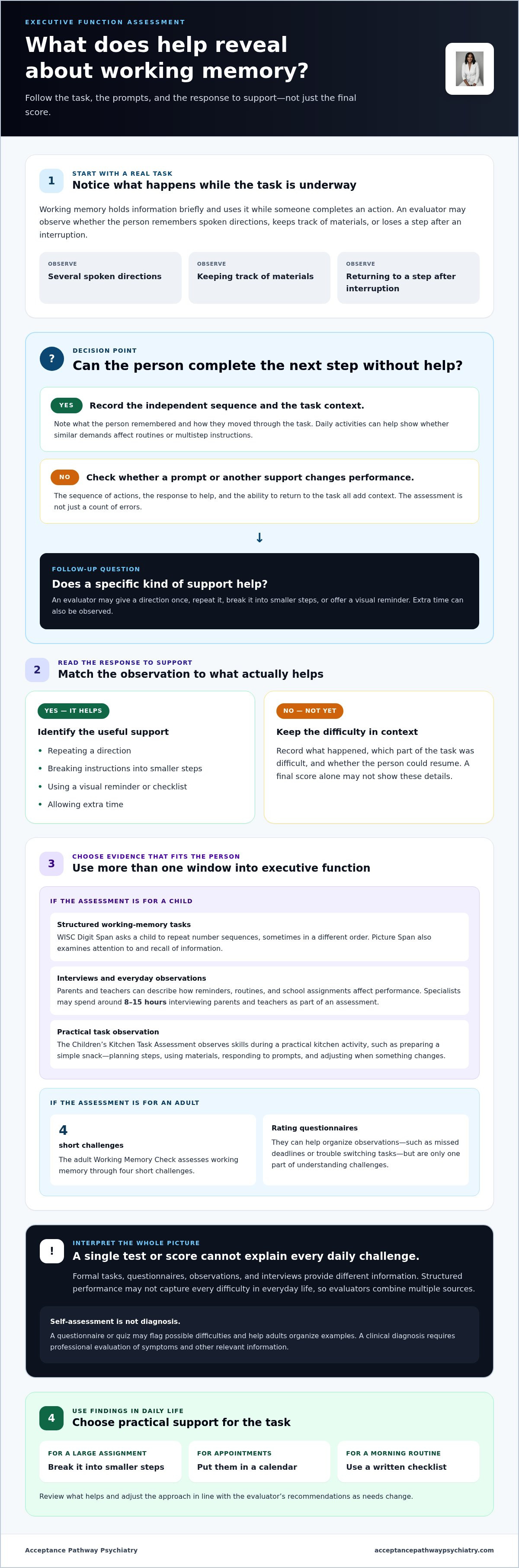
A self-assessment is a questionnaire or quiz that can flag possible executive function difficulties. It may help adults organize examples, such as missed deadlines or trouble switching tasks, but it cannot diagnose a condition. A clinical diagnosis requires professional evaluation of symptoms and other relevant information.
The Children’s Kitchen Task Assessment (CKTA) observes executive skills during a practical kitchen activity. Preparing a simple snack, for example, can show how a child plans steps, uses materials, responds to prompts, and adjusts when something changes. These observations add everyday context to results from paper-based or computerized measures.
To get tested, note specific examples of difficulties at home, work, or school, then discuss them with a qualified mental health professional. Testing may include an interview, questionnaires, and cognitive tasks; for a child, specialists may spend around 8-15 hours interviewing parents and teachers as part of an assessment.
There’s no single duration for every evaluation because the process depends on the person’s needs and the combination of interviews, rating forms, and tasks. Executive function tests also have limits: performance in a structured setting may not capture every daily challenge, so evaluators combine results from multiple sources rather than relying on one score.
Use assessment findings to choose practical support for specific tasks. You might break a large assignment into smaller steps, put appointments in a calendar, or use a written checklist for a morning routine. Review what helps, then adjust the approach in line with the evaluator’s recommendations as needs change.
Observing assistance, prompts, and working memory
An assessment can show how someone holds information in mind and uses it to complete a task. Observing the prompts and assistance needed can help identify which supports make tasks easier.
Working Memory
Working memory is the ability to hold information briefly and use it while completing an action. During a task, an evaluator may note whether a child remembers several spoken directions, keeps track of materials, or loses a step after an interruption. This pattern can reveal strengths and challenges that a final score alone may not show.
WISC working-memory subtests, including Digit Span and Picture Span, examine how a child attends to and recalls information. Digit Span, for example, asks the child to repeat number sequences, sometimes in a different order. These tasks provide structured observations, while daily activities can show whether similar demands affect school routines or multistep instructions.
Working Memory Checks
A working memory check uses short challenges to see how someone holds and applies information. The adult Working Memory Check assesses this skill through four short challenges. Results can help identify which information is harder to retain, such as spoken instructions or details needed to solve a problem.
Checks are most useful when interpreted alongside observations and reports from daily life. An adult might remember an appointment but lose track of the steps needed to prepare for it. That distinction helps separate remembering information from organizing actions around it.
Evaluators also note how much assistance a person needs and what kind works. They might give a direction once, repeat it, break it into smaller steps, or offer a visual reminder. The key is to observe what changes: does performance improve with repetition, a checklist, or extra time? These details make support needs clearer.
For example, a child asked to sort materials and then begin a worksheet may start independently but forget the second direction. If a brief prompt helps the child resume, the evaluator records both the difficulty and the helpful support. The assessment is not just a count of errors. The sequence of actions, response to help, and ability to return to the task all provide useful context.
Adults can use similar observations at work or home. Missing a step while following a recipe differs from forgetting the recipe’s instructions. Tracking the task, distractions, and prompts needed can make an assessment more relevant to everyday routines.
These findings can guide practical strategies, such as written steps, reminders, or dividing a large task into smaller actions. Cognitive testing options can help explore cognitive skills as part of a broader understanding of daily challenges.
Adult executive-function behavior ratings
Adult behavior ratings describe executive-function patterns through reported examples. They can help organize concerns about work, home routines, and learning.
Adult Executive Function Quizzes
An adult executive-function quiz asks about everyday behaviors related to focus and self-management. Some quizzes assess sustained focus and distinguish attention drifting from acting too quickly. For example, someone might consider whether their attention fades during a long meeting or they respond before hearing a full question.
Answers can help identify situations to discuss in a clinical evaluation. A rating is most useful when it points to specific actions, such as losing track of steps while preparing a meal or struggling to return to a task after an interruption.
Adult Self-Tests
An adult self-test is an informal way to identify symptoms associated with executive-function difficulties. It can help someone gather examples before seeking a professional assessment, but it cannot establish a diagnosis. Examples might include missed appointments, difficulty starting paperwork, or trouble shifting plans.
The Executive Skills Questionnaire-Revised (ESQ-R) is a 25-item self-report measure of executive functioning skills. Its questions can help adults reflect on behavior across areas such as time management and emotional regulation. A response describes the person’s perspective, not a complete clinical picture.
A behavior rating turns observations into a consistent set of responses. Informal checklists and questionnaires can be useful when formal tests are unavailable or someone is not qualified or permitted to administer them. For instance, a checklist might ask how often someone forgets a planned step and invite a specific example from a workday.
Use a quiz result to notice patterns, not as a label. Note the setting, the task, and what happened: “I missed the final step when a coworker interrupted me” gives more context than “I’m disorganized.” Repeated examples can show whether a difficulty occurs in one routine or across work and home.
Developmental history also matters when interpreting adult ratings. A clinician may ask, for example, whether difficulty organizing school assignments began in childhood or appeared after work demands changed. This context can help distinguish longstanding patterns from challenges tied to a particular situation.
Before a clinical appointment, choose a few examples and describe their impact. Note what helps, such as calendar alerts for appointments or written steps for a multistage task. A clinician can consider these details alongside ratings and other assessment information when evaluating learning, attention, or executive-function concerns.
Interviews with parents, teachers, caregivers, and children
Interviews collect examples of how executive-function challenges appear across a child’s daily settings. Specialists may spend around 8-15 hours interviewing a child’s parents and teachers as part of an assessment.
For a child or adolescent, an evaluation can combine interviews, rating forms, and tasks. Comparing examples from home and school helps show whether difficulties occur across settings or with particular demands, such as starting homework or shifting between classroom activities.
A parent interview gathers developmental and everyday details from someone familiar with the child’s routines. A parent might describe how the child follows a morning checklist, responds to a change in plans, or remembers school materials. Teachers can share examples of classroom work, transitions, and group activities, while caregivers can describe routines in another setting.
Children and adolescents also offer important perspectives. An evaluator may ask what happens when an assignment feels difficult, which reminders help, or how a sudden schedule change feels. A child’s account can clarify the effort behind an action adults observe, such as leaving a worksheet unfinished or asking for directions again.
Parent quizzes are informal questionnaires that help caregivers notice possible executive-function patterns. A parent can record examples of planning, flexibility, or emotional regulation and share them during an assessment. A quiz can organize concerns, but it cannot diagnose a condition or replace an evaluation by a qualified professional.
Child and adolescent executive-function ratings are structured reports about everyday behaviors. Parent and teacher ratings may differ because tasks and expectations vary between home and school. A student, for example, might manage a familiar home routine but struggle to track several classroom instructions. That contrast gives the evaluator context, not a simple pass-or-fail result.
Playful quizzes for children ages 8 to 12 present questions or activities in an approachable format. A prompt might ask what the child would do if a game’s rules changed, inviting them to explain their actions and flexibility. Such activities can make it easier to collect the child’s perspective, but their answers remain informal observations, not a clinical diagnosis.
To prepare, parents can bring a brief record of examples from different settings. Note the task, what the child did, what support was offered, and whether it changed the outcome. A teacher’s example of a missed instruction can be compared with a parent’s account of forgotten chores. These details help an evaluator interpret ratings alongside interviews and assessment results.
Conditions that can affect executive function
Executive dysfunction means difficulty using skills such as planning, attention, and emotional regulation in everyday situations. It describes a pattern of challenges, not a diagnosis. Trouble starting a task, for example, may have several contributing factors, so an assessment considers the person’s circumstances alongside observed abilities.
ADHD can affect executive function, but executive function difficulties are not the same as ADHD. Symptoms can overlap. Someone who often loses track of instructions, for instance, may need a fuller evaluation to understand whether attention concerns, planning challenges, or another factor best explains the difficulty.
Autism spectrum disorder can also affect executive functioning. For some people, a change in a familiar routine can make it harder to shift plans or organize next steps. Noting where the challenge occurs, such as during transitions at school or work, gives an evaluator useful context without treating one behavior as proof of a condition.
Alzheimer’s disease, dementia, and brain tumors can cause symptoms of executive dysfunction. These conditions differ, so new difficulties with planning or decision-making should be considered alongside other changes in thinking and everyday functioning. A family member, for example, may notice that familiar household tasks have become harder than before.
Stress, loneliness, lack of sleep, and lack of exercise can affect executive function. A demanding week may make concentration harder, while poor sleep can make it harder to remember steps the next day. These factors can affect daily functioning even when someone has no diagnosed executive-function disorder.
A brief symptom screen can help organize concerns, but it cannot establish the cause. Record when a difficulty appears, what was happening, and how it affected an everyday task. For example, note whether missed deadlines occur mainly during stressful periods or persist across different settings and routines.
A timeline can help distinguish a recent change from a longstanding pattern. An evaluator may consider developmental history, current health concerns, emotional state, and functioning at home, school, or work. Comparing these details can clarify whether executive-function challenges occur alongside another condition or temporary strain.
Support should address the needs identified, not just the label attached to them. Depending on the concerns, care may include therapy focused on emotional regulation or help addressing a related mental health condition. If these patterns are affecting daily life, discuss your concerns with a mental health professional to explore appropriate assessment and support.
Acceptance Pathway Psychiatry PLLC: Medication Management
Acceptance Pathway Psychiatry PLLC offers Creyos Cognitive Testing to explore cognitive skills alongside concerns about attention, memory, or planning. When executive-function challenges occur with emotional distress or other mental health symptoms, Psychotherapy can offer space to understand their impact and work toward practical strategies.
Medication Management may be relevant when a mental health condition is part of the clinical picture and medication is being considered as part of care. Integrative Wellness Services offer another form of support. The right next step depends on what you’re experiencing and hope to understand, whether that means exploring cognitive testing or discussing mental health concerns.
To learn more or discuss your needs, contact Acceptance Pathway Psychiatry PLLC.
Take the Next Step Toward Clarity
Testing for executive functioning skills can help you understand what feels difficult and identify more useful ways forward. You don’t need to have every concern neatly explained before seeking support. A few examples of what’s affecting daily life can help start the conversation.
Acceptance Pathway Psychiatry PLLC offers Creyos Cognitive Testing, Psychotherapy, and Medication Management. These services can support discussions about cognitive concerns and mental health needs. A good next step is to talk about what you’ve noticed and the support you’re looking for.
If you’re ready to explore that conversation, contact Acceptance Pathway Psychiatry PLLC. Your experiences deserve thoughtful attention, and taking one step toward understanding them can help you move forward with greater clarity.
Frequently Asked Questions
Who Should Take This Test?
Consider an evaluation if difficulties with planning, follow-through, organization, or emotional regulation repeatedly interfere with daily responsibilities. An adult might miss important work steps despite understanding the assignment, or a child might struggle to start schoolwork without repeated reminders. Testing for executive functioning skills can clarify these patterns, especially when you bring examples from different settings and explain how long they have affected daily life.
What are executive functioning skills and how are they assessed?
Executive functioning skills are mental abilities that help someone plan, manage attention, hold information in mind, and regulate behavior toward a goal. An assessment can combine task performance, questionnaires, observation, and discussion of real-life examples. An evaluator might compare how someone handles a timed task with how they manage a multistep routine at home, providing context beyond a single score.
What tests measure executive functioning in children and adults?
Tools vary by age and the questions being explored. For children, the BADS-C assesses areas such as planning and flexibility; the Tower of Hanoi examines planning ahead, while the Wisconsin Card Sorting Test measures hypothesis testing and flexibility. Adults may complete the 25-item ESQ-R self-report measure. Stroop, Go-No Go, and Stop-Signal tasks examine different aspects of inhibition and response control.
How does a neuropsychological evaluation test executive functioning?
A neuropsychological evaluation examines executive skills alongside other areas of thinking, using selected tasks and background information. An evaluator may look at attention, memory, planning, and how someone approaches unfamiliar problems. Difficulty completing a task could involve several cognitive demands, so results are interpreted in context rather than treated as a stand-alone explanation. Findings can help guide further assessment or support.
What is the difference between performance-based executive function tests and rating scales?
Performance-based tests measure how someone responds to structured tasks during an assessment, while rating scales summarize reported behavior in everyday situations. Someone might do well on a brief planning task but still struggle to organize weekly responsibilities. Comparing both types of information can show differences between what someone can do in a focused setting and what routinely happens at home, work, or school.
Who can diagnose executive functioning difficulties in the United States?
A qualified mental health professional can evaluate executive-function concerns and assess whether another condition may explain them. A questionnaire or cognitive test alone cannot establish a diagnosis. Bring examples of the difficulties, their effect on daily responsibilities, and any relevant history to the appointment. The clinician considers that context alongside assessment findings to explain the results and decide whether further evaluation is appropriate.
Can ADHD, autism, anxiety, depression, or sleep problems affect executive function test results?
ADHD and autism can affect executive functioning, while stress or lack of sleep can influence how someone manages cognitive tasks. Anxiety, depression, and sleep concerns are also important to discuss during an assessment, so the evaluator can understand what else is happening in the person’s life. Note whether concentration or task completion changes with sleep quality, emotional strain, or demands at school and work.
What do executive function test results mean, and what happens after testing?
Results describe patterns of performance and reported difficulties; they don’t define someone’s potential or explain every challenge on their own. Ask which findings relate most clearly to a daily task, such as starting paperwork or remembering several instructions. Use that information to choose a practical support, such as written steps or a calendar reminder, then discuss how to tell whether it helps with the specific difficulty.


