

Evidence-based therapy for depression isn’t one fixed method; it brings together research evidence, a therapist’s clinical expertise, and your needs and preferences. For major depression, treatment typically involves 12-20 sessions, though the approach and pace can vary. The goal is to choose a thoughtful, collaborative path rather than apply the same formula to everyone.
It makes sense to want to know what therapy involves before you begin. Cognitive behavioral therapy (CBT) helps people notice and reframe unhelpful thought patterns, while interpersonal therapy (IPT) focuses on relationships and life changes that may affect mood. This article explains what makes therapy evidence-based, how CBT and IPT may work, and how mood tracking, reflection, and other practices can support treatment. It also explores how care can be shaped around your circumstances, so you can approach the next step with a clearer sense of what to expect.
Key Takeaways
- Learn how evidence, clinical judgment, and your preferences work together to shape depression treatment.
- See what CBT sessions may involve and how thought patterns can connect with mood and daily actions.
- Understand how interpersonal therapy explores relationship changes and their effect on emotional wellbeing.
- Discover how mood tracking and therapeutic practice can help make progress easier to notice and discuss.
- Consider how psychotherapy and medication management may fit into a care plan tailored to your needs.
Psychoeducation, mood tracking, and therapeutic homework
In depression psychotherapy, psychoeducation helps people understand how thoughts, feelings, behavior, and relationships can interact. A therapist might explain how withdrawing from friends can reduce opportunities for connection, while low mood can make reaching out feel harder. Naming this cycle gives therapy a practical focus: notice what happens, explore what maintains it, and build skills that support everyday functioning.
Mood tracking can turn that discussion into useful information for sessions. A brief daily note might record mood, sleep, activity, and one meaningful event, such as a conversation or missed meal. The therapist and patient can look for patterns together rather than treating one difficult day as the whole picture. Tracking is a tool for reflection, not a test or a judgment.
Therapy exercises between appointments give patients a chance to practise skills in daily life. A therapist might suggest scheduling one manageable activity, noting mood before and after, or trying a different response to a recurring negative thought. The task should connect to a therapy goal and feel realistic. If it becomes overwhelming, that is useful to discuss and adjust at the next session.
Evidence-based care brings together research, clinical expertise, and the patient’s characteristics and preferences. Psychotherapy can help people identify unhelpful beliefs and behaviors and work toward healthier alternatives. It can also build coping strategies and support everyday functioning. Reviewing progress and concerns openly allows the therapist to adapt the approach when a task or technique isn’t helping.
Interpersonal psychotherapy (IPT) focuses on how relationships and life changes connect with depression. Common areas of work include grief, conflict, role transitions, and difficulty building or maintaining relationships. IPT for major depression is usually limited to 12-16 weekly sessions. Adults receiving IPT attend an average of 16 to 20 sessions, so the actual course can reflect the person’s needs and treatment plan.
Online therapy can provide structured psychotherapy for depression; the format alone doesn’t determine whether the work is evidence-based. Privacy, a reliable connection, and a focused therapeutic relationship help make remote sessions workable. Insurance coverage and out-of-pocket costs depend on plan benefits, network status, deductibles, and copayments or coinsurance, so there’s no single typical amount that applies to everyone.
Psychotherapy and medication management are distinct parts of depression care. A psychiatric provider considers symptoms, daily functioning, and how treatment is going when managing medication. When therapy and medication are both part of care, patients can discuss changes and concerns with the relevant clinician to support a coordinated understanding of progress.
What are Cognitive Behavioral Therapy Session Like?
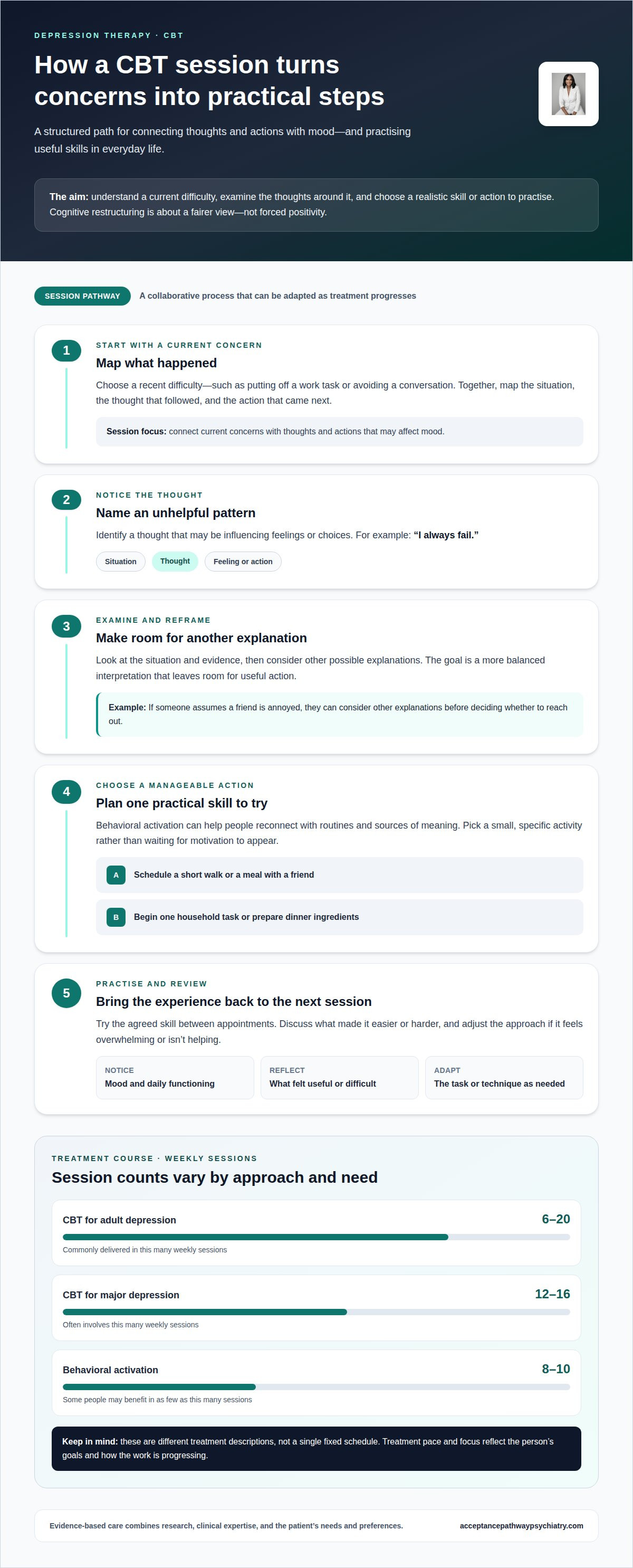
A cognitive behavioral therapy session connects current concerns with thoughts and actions that may affect mood. For adult depression, CBT is commonly delivered in six to 20 weekly sessions; major depression often involves 12-16 weekly sessions.
Cognitive Restructuring in CBT
Cognitive restructuring is a CBT practice that involves identifying and examining unhelpful thoughts, then developing a more balanced interpretation. A therapist may help a patient explore a thought such as “I always fail” by looking at the situation, the evidence, and other possible explanations. Repeated negative thinking can shape emotions and choices. The aim isn’t forced positivity, but a fairer view that leaves room for useful action.
Behavioral Activation and Activity Scheduling
Behavioral activation uses planned, manageable activities to help people reconnect with routines and sources of meaning. A therapist might help schedule a short walk, a meal with a friend, or one household task, then discuss what made it easier or harder. Some people may benefit from behavioral activation in as few as 8-10 sessions. The approach offers a practical way to address withdrawal without waiting for motivation to appear first.
Sessions may focus on a current difficulty, such as putting off a work task or avoiding a conversation. The therapist and patient can map what happened, which thought followed, and what action came next. Then they can choose a skill to practise before the next appointment. For example, someone who assumes a friend is annoyed might consider other explanations before deciding whether to reach out.
Behavioral therapy also supports gradual re-engagement with activities that depression has pushed aside. The plan can begin with a small, specific step, such as opening a book or preparing ingredients for dinner. Adults receiving behavioral therapy for depression attend an average of 20-24 weekly sessions. The pace and focus of treatment reflect the person’s goals and how the work is progressing.
Some therapists also draw on dialectical behavior therapy (DBT) skills, including mindfulness, emotional regulation, and distress tolerance. These skills can help people pause during intense emotions, notice what is happening, and choose a response. DBT was initially developed to treat borderline personality disorder, and its skills may also offer tools relevant to depression. A session might practise naming an emotion before acting on an urge to withdraw.
Progress isn’t measured only by feeling better during an appointment. A therapist may discuss changes in sleep routines, social contact, or the ability to manage daily responsibilities. These examples connect cognitive and behavioral work with everyday functioning and give patients a clearer basis for discussing which strategies feel useful.
Hope, flexibility, and empirically supported treatments
In depression care, hope can rest on a clear plan, meaningful goals, and room to adjust. Evidence-based practice brings together research, clinical expertise, and the patient’s characteristics and preferences.
The American Psychological Association's evidence-based practice policy is built on research evidence, clinical expertise, and each patient's characteristics. A mental health professional can consider how an approach fits a person’s symptoms, goals, and preferences.
Treatment Planning and Selection
Treatment planning is a shared process for matching research-supported care with a person’s needs and circumstances. The American Psychological Association adopted its evidence-based practice policy in 2005, bringing research evidence, clinical expertise, and patient characteristics into treatment selection. That balance matters because a plan should make clinical sense and feel workable in daily life, rather than relying on a method simply because it has a familiar name.
Assessment helps establish a starting point for the plan. For major depression, assessment takes one to three sessions. A mental health professional may consider symptoms, their effect on functioning, personal history, and the patient’s priorities. For example, someone whose negative thinking centers on conflict may value interpersonal work, while another person may prefer a structured focus on thoughts and behavior.
Therapy Options, Sessions, and Finding a Therapist
Therapy options, session plans, and clinician fit shape how evidence-based care works in practice. For major depression, psychotherapy typically involves 12-20 sessions, while assessment takes one to three sessions. The number and focus of appointments can vary with the treatment approach and progress, so the plan should be reviewed as care continues.
When looking for a depression therapist in the United States, consider a mental health professional whose clinical work includes depression and whose approach fits your needs. In an initial conversation, you can discuss the therapy method, goals, and how progress will be reviewed. A clear explanation of the plan helps you understand what the work involves and whether it feels collaborative.
Monitoring progress gives patients and therapists a way to notice change beyond a single difficult day. They might review mood, sleep, relationships, or daily responsibilities and compare observations over time. If a strategy isn’t helping, the plan can be revisited. For moderate to severe major depression, psychotherapy combined with medication is described as the most comprehensive treatment approach; medication decisions should be part of a plan that also considers symptoms and functioning.
A mental health professional may use the depression criteria in the DSM-5, published by the American Psychiatric Association, to diagnose depression. Depression medication management aims to improve symptoms, daily functioning, and quality of life, with treatment plans monitored for effectiveness and tolerability. A study of more than 1,200 counseling clients found that those who expected their therapist to both support and challenge them improved the most.
Mindfulness-Based Cognitive Therapy may reduce relapse rates by approximately 50% for clients with three or more prior depression episodes. Depression treatment plans may incorporate diet, exercise, and lifestyle adjustments. For mild-to-moderate depression, regular physical activity such as 30-minute walks has been shown to produce antidepressant effects comparable to medication.
Interpersonal therapy
Interpersonal therapy (IPT) addresses connections between depression symptoms and a person’s relationships or changing life roles. Rather than treating every conflict as the cause of depression, IPT explores how current interpersonal patterns affect mood and daily functioning. The therapist and patient identify a focus, set practical goals, and review changes in communication and support.
IPT for major depression is usually limited to 12-16 weekly sessions. Its focused structure can help make the work concrete: a patient experiencing grief might explore how the loss has changed routines, relationships, and sources of support. Someone facing a new caregiving role might examine expectations, communication, and ways to ask for help. The goal is to strengthen the person’s ability to manage the present challenge.
Common IPT focus areas include grief, role disputes, role transitions, and difficulty forming or maintaining relationships. For a role dispute, a therapist may help clarify what each person expects, identify repeated misunderstandings, and practise a more direct conversation. When someone is going through a transition, sessions can explore what has changed and which relationships or routines might offer stability. These steps connect emotional symptoms with real-life situations.
CBT, IPT, and behavioral activation start from different places. CBT examines how thoughts and actions influence feelings; IPT focuses on relationships and life changes; behavioral activation builds planned activity and re-engagement. Each approach has a distinct structure, allowing the clinical focus to match a person’s symptoms, goals, and circumstances.
When depression persists despite treatment, planning begins with a review of symptoms, previous treatment, daily functioning, and the patient’s preferences. CBT and IPT are evidence-based psychotherapy options; for moderate to severe major depression, a treatment plan can also consider medication alongside psychotherapy. The approach should address what remains difficult, such as persistent negative thinking, relationship strain, or reduced participation in daily life.
Matching interventions to needs starts with setting a specific goal. If conflict with a family member is causing distress, IPT may focus on communication and role expectations. If harsh self-judgment is prominent, CBT can examine those thought patterns. If withdrawal has narrowed daily life, behavioral activation can support gradual re-engagement. A mental health professional can review progress and adjust the focus as symptoms and circumstances change.
Across these approaches, the patient’s experience helps guide the work. A therapist may ask which relationships feel supportive, what has changed recently, and which practical step seems possible. Preparing for a conversation or returning to a valued activity can give sessions a clear direction without assuming everyone needs the same intervention.
Definition and origins of evidence-based therapy
Evidence-based therapy for depression uses research findings, a clinician’s expertise, and the person’s needs and preferences. The American Psychological Association adopted its evidence-based practice policy in 2005, emphasizing those three parts together. This matters because research can guide care without turning treatment into a fixed script. A treatment plan should reflect the person’s symptoms, history, values, and response to the work.
Research helps identify therapies studied for depression, but it doesn’t determine the best fit on its own. Clinical expertise helps a mental health professional interpret that evidence alongside a person’s circumstances, and the patient’s preferences matter too. One person may want to examine recurring thoughts, while another may prefer to focus on relationships or rebuilding daily routines.
Evidence-based practice is more than choosing a popular technique. A therapist considers whether an approach fits the concern, explains its purpose, and reviews how it is working. If a treatment plan includes CBT, sessions might examine a negative thought and identify a more balanced response. If low activity is a major difficulty, the plan might instead include a small, scheduled action.
Depression can affect everyday routines, including sleep, eating, work, and relationships. Those changes can help shape therapy goals. For example, a patient who has stopped cooking might start by planning one simple meal, then discuss what supported or got in the way of that step. This isn’t a test of willpower. It gives the therapist and patient a concrete way to understand daily barriers and adjust the plan.
Evidence-based care also means paying attention to progress over time. A therapist and patient can review changes in mood, functioning, and the ability to complete meaningful activities. If a strategy feels difficult or doesn’t address the main concern, that information can guide a conversation about adapting treatment. Each person’s needs are different, so the plan may change as circumstances shift.
The key point is that “evidence-based” describes how care is selected and adjusted, not a promise of a particular outcome. Research informs the options, professional judgment helps apply them, and the patient’s experience shapes the work over time. This framework can make treatment decisions clearer, especially when depression affects thoughts, eating, relationships, and daily responsibilities at once.
If you’re considering a structured plan for depression, explore psychotherapy options as a possible next step.
Acceptance Pathway Psychiatry PLLC
Acceptance Pathway Psychiatry PLLC offers psychotherapy and medication management for people seeking support with depression. These services provide space to discuss therapy approaches, clarify treatment goals, and consider whether medication management belongs in your care plan. Creyos Cognitive Testing and Integrative Wellness Services are also available.
If depression is affecting your relationships, routines, or daily functioning, a conversation with a mental health professional can help you explore next steps. Contact Acceptance Pathway Psychiatry PLLC to discuss your care.
Take the Next Step at Your Own Pace
Choosing evidence-based therapy for depression doesn’t mean you need every answer before you begin. Start by naming what feels hardest right now, what you hope might change, and what kind of support feels manageable. Those priorities can shape a conversation about care that respects your experience and makes room for adjustments as your needs evolve.
Progress can begin with a clear, honest discussion, even if you’re still unsure which approach fits. If you’re ready to explore support, contact Acceptance Pathway Psychiatry PLLC to discuss a possible next step. You deserve care that takes your concerns seriously and treats your goals as part of the process. Move forward one conversation at a time.
Frequently Asked Questions
What Is Evidence-Based Therapy?
Evidence-based therapy for depression uses research, professional expertise, and a person’s preferences and circumstances to guide care. A therapist might explain why an approach fits a concern, agree on a goal such as returning to a regular routine, and review whether sessions are helping. Research informs choices, but it doesn’t replace the patient’s voice or make every treatment plan the same.
What Are Common Factors in Therapy?
A collaborative relationship and empathy are common factors that contribute to positive therapy outcomes. A therapeutic alliance means that the patient and therapist share an understanding of the goals and how to approach them. For example, a patient might say a technique feels uncomfortable or irrelevant, giving the therapist a chance to explore the concern together. Feeling heard and working collaboratively can make sessions more purposeful.
How effective is cognitive behavioral therapy for depression?
Between 60% and 70% of people with depression respond positively to cognitive behavioral therapy. CBT focuses on connections between thoughts, emotions, and actions, with sessions applying strategies to a person’s concerns. For example, someone who avoids answering messages might examine the thoughts behind that choice and plan a manageable response. How improvement is understood can include mood and changes in daily functioning.
What evidence supports psychotherapy alone versus therapy combined with antidepressants?
For moderate to severe major depression, psychotherapy combined with medication is described as the most comprehensive treatment approach. Psychotherapy alone may also be considered as part of a treatment plan, depending on symptoms, needs, and preferences. Therapy uses structured conversations and skills, while medication management focuses on medication use and monitoring. The plan can be reviewed as symptoms and daily functioning change.
What are the risks and side effects of psychotherapy for depression?
Psychotherapy can involve emotionally difficult conversations, especially when sessions address painful memories, conflict, or loss. This discomfort differs from medication side effects. Tell your therapist if a topic feels overwhelming, confusing, or too fast. Together, you can pause, clarify the purpose of an exercise, or adjust the pace. Discussing concerns openly helps keep therapy focused on your needs and goals.
Which evidence-based therapies are recommended for treatment-resistant depression?
Electroconvulsive therapy (ECT) and transcranial magnetic stimulation (TMS) are options for treatment-resistant depression when other treatments have not been successful.


