

Procrastination isn't a character flaw or a sign of laziness; it's a neurological roadblock that no amount of "trying harder" can fix. You likely know the heavy weight of the "shame spiral" all too well. It is that exhausting cycle of setting high-stakes goals only to feel completely paralyzed by a simple, multi-step task. If you feel like you're constantly falling short of your potential, you aren't failing at life. Your brain's internal management system is simply hitting a biological wall.
Finding effective executive dysfunction treatment adults can trust starts with moving past the guilt and looking at the hard science. You deserve to understand why your mind works the way it does. This guide will show you how a combination of precision cognitive testing, medication management, and specialized therapy can help you regain control over your focus and life. We will explore a clear clinical roadmap, featuring objective tools like Creyos cognitive testing, to bridge the gap between where you are and where you want to be. By the end, you'll have a better understanding of how to improve your professional and personal functioning through a supportive, evidence-based partnership.
Key Takeaways
- Recognize that your struggle is rooted in the brain's internal management system, shifting the perspective from shame to a clear neurological understanding.
- Learn how objective tools like Creyos testing provide the clarity needed for effective executive dysfunction treatment adults can use to bridge the gap between potential and performance.
- Discover why combining medication to stabilize neurobiology with psychotherapy to build practical skills creates a powerful synergy for lasting change.
- Explore how an integrative wellness plan, including sleep and stress management, acts as the necessary foundation for long-term cognitive health.
- See how a comprehensive psychiatric evaluation serves as a supportive roadmap for your personal evolution and improved professional functioning.
Understanding Executive Dysfunction in Adults: More Than Just "Focus"
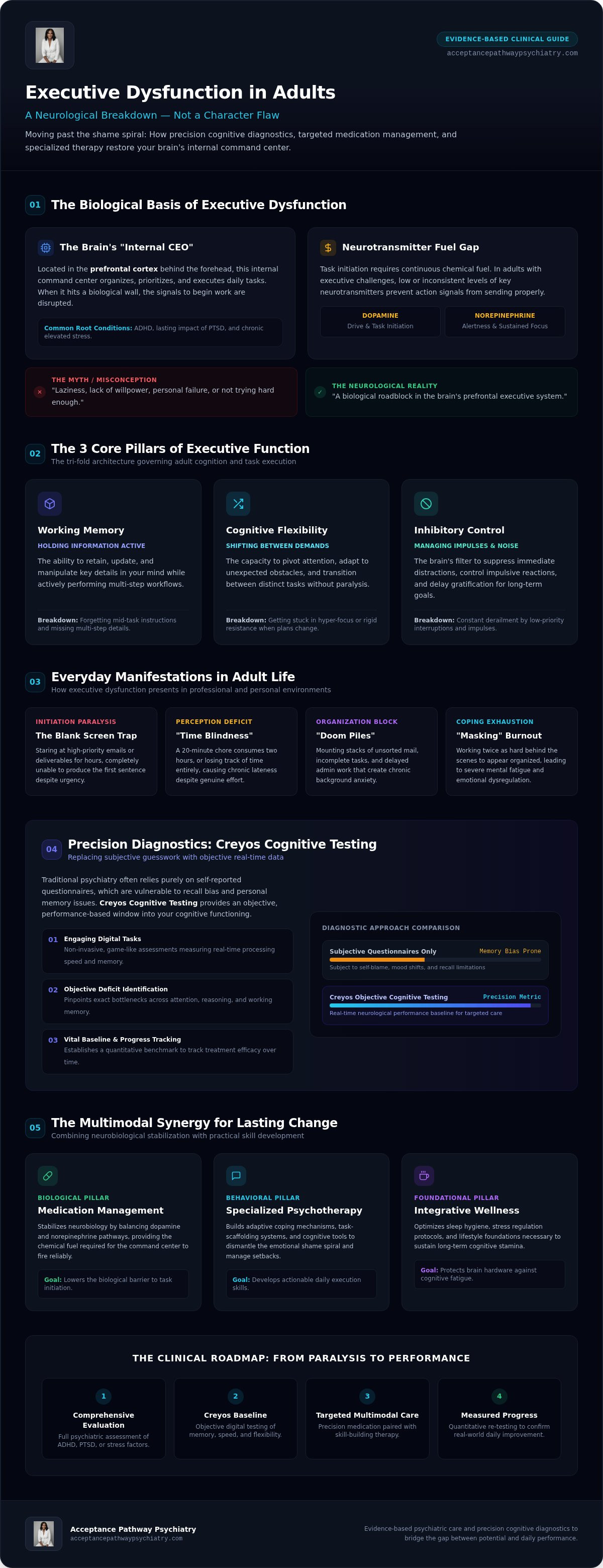
Imagine your brain is a large corporation. Executive function acts as the "CEO," the command center responsible for planning, organizing, and executing every task on your plate. When this system falters, it isn't just a matter of losing focus; it's a breakdown in the very processes that allow you to navigate daily life. Understanding What is Executive Dysfunction? involves looking at three core pillars: working memory (holding information in mind), cognitive flexibility (shifting between tasks), and inhibitory control (managing impulses).
For many, this struggle isn't temporary. While anyone can experience brain fog during periods of high stress, chronic executive dysfunction is often rooted in neurodevelopmental conditions like ADHD or the lasting impact of PTSD. It shows up in the "doom piles" of unsorted mail, the crushing weight of missed professional deadlines, and an underlying sense of emotional dysregulation that makes even small setbacks feel like catastrophes. Recognizing these patterns is the first step toward finding a clinical roadmap that works.
To better understand this concept, watch this helpful video:
The Biological Basis of "Feeling Stuck"
This sense of being paralyzed isn't a lack of willpower. It's biological. The prefrontal cortex, the area of your brain right behind your forehead, is the primary site for decision-making. In adults with these challenges, there is often an imbalance in neurotransmitters like dopamine and norepinephrine. These chemicals act as the fuel for your brain's command center. When the fuel levels are low or inconsistent, the "CEO" can't send the necessary signals to get started. Seeking professional executive dysfunction treatment adults can rely on helps address these chemical gaps, moving the focus from self-blame to clinical solutions.
Common Adult Symptoms You Might Recognize
You might find yourself staring at a high-priority email for an hour, unable to type the first word. This is a breakdown in task initiation. You might also struggle with "time blindness," where a twenty-minute chore suddenly consumes two hours, or you're perpetually late despite your best efforts. Over time, the effort of "masking"-trying to appear organized to the outside world-leads to profound mental fatigue. This exhaustion is a sign that your brain is working twice as hard to achieve what others might do instinctively. You aren't failing; your hardware just needs a different set of tools.
The Role of Precision Diagnostics: Creyos Cognitive Testing
Self-reporting is a valuable starting point, but it's often limited by our own biases or the very memory issues we're trying to solve. When seeking executive dysfunction treatment adults often find that objective data is the missing link. While traditional psychiatry relies heavily on subjective questionnaires, modern precision diagnostics allow us to see how your brain actually functions in real-time. This isn't just for research settings; it's a practical tool that provides a clear window into your cognitive world.
Creyos Cognitive Testing offers a non-invasive, performance-based way to measure brain function. By identifying specific deficits in memory, attention, or reasoning, we move away from guesswork and toward targeted care. This data creates a vital baseline. It allows us to track your progress over time, ensuring that your Executive Dysfunction Treatment Options are actually moving the needle on your daily efficiency. Understanding your unique cognitive profile is the first step toward a partnership rooted in clarity rather than frustration.
What to Expect During a Cognitive Assessment
The assessment itself is designed to be engaging rather than intimidating. You'll complete a series of digital, game-like tasks that measure how you process information and respond to challenges. It is vital to remember that this isn't an IQ test. We aren't measuring your intelligence; we're measuring your daily cognitive efficiency. Because these tools are digital, you can often complete them through telehealth appointments from the comfort of your own home. This environment reduces the anxiety often associated with clinical testing, allowing for a more accurate reflection of your typical mental state.
Turning Data into a Personalized Treatment Plan
Data is only as good as the plan it informs. Your test results play a direct role in shaping your medication management. For instance, if the data shows significant struggles with inhibitory control, we might prioritize different medications than if your primary challenge is working memory. This precision reduces the "trial and error" phase that many adults find so discouraging.
Beyond medication, these insights help us tailor your psychotherapy goals. We can focus on building specific "software" skills to support the areas where your "hardware" needs the most help. We believe that understanding cognitive assessment for ADHD is the first step toward clarity and personal evolution. If you're ready to move past the shame and toward a clinical roadmap, scheduling a comprehensive psychiatric evaluation is an excellent way to begin your journey toward wholeness.
Comparing Treatment Modalities: Medication vs. Psychotherapy
Effective executive dysfunction treatment adults often find most success with is a dual approach. Think of medication as the hardware of a computer and psychotherapy as the software. If the hardware is glitchy, even the best software won't run smoothly. Conversely, the fastest processor in the world is useless without the right programs installed. Stimulants and non-stimulants work to level the neurological playing field by balancing dopamine and norepinephrine. This doesn't change who you are. A common fear is that medication will stifle creativity or dull your personality. In reality, most adults find that by clearing the mental clutter, their true creative potential is finally accessible.
Medication provides the biological stability needed to engage with the world, but it doesn't teach you how to organize a calendar or break down a project. That is where therapy comes in. By combining these two modalities, you address the root neurological cause while simultaneously building the practical skills required for daily life. This integrated care is what allows for a sustainable shift in how you function both at work and at home.
Medication Management: A Compassionate Approach
We approach psychiatric medication management with a "start low and go slow" philosophy. This isn't about rushing to the highest dose; it's about finding the precise window where you feel most like yourself, but with better focus and less internal noise. Ongoing management and consistent monitoring are essential for safety. It prevents that exhausting rollercoaster effect where you feel capable one day and completely overwhelmed the next. We also look at the bigger picture. Often, executive dysfunction is complicated by underlying anxiety or depression. Treating these co-occurring conditions is vital for long-term efficacy and your overall sense of wholeness.
Therapeutic Strategies for Executive Success
While medication helps the brain engage, therapy teaches you what to do once you're focused. Cognitive Behavioral Therapy (CBT) for executive function focuses on practical, real-world changes rather than just abstract talk. One key concept is "scaffolding." This involves externalizing your memory and planning through tools like digital alerts, visual timers, and physical planners. We help you build these external supports so your brain doesn't have to carry the full load alone. For those whose executive struggles are tied to trauma, we use trauma-informed care. This ensures we address the root cause of the "freeze" response rather than just treating the symptoms. It's about building a life that supports your brain, not forcing your brain to fit a mold that wasn't made for it.
Building a Multimodal Treatment Plan for Long-Term Success
Many adults start their journey by trying one thing at a time. They might try a new planner or start a medication, yet they still feel like they're spinning their wheels. A "meds-only" approach often provides the biological capacity to focus, but it doesn't teach you what to do with that focus. Conversely, a "therapy-only" approach might provide great strategies that your brain simply isn't quiet enough to implement. True executive dysfunction treatment adults can rely on for the long term requires a multimodal plan. It's about combining clinical expertise with a holistic look at your daily life.
This brings us to the "skill vs. pill" conversation. Medication provides the ability; it is the neurological foundation that makes focus possible. Therapy provides the strategy; these are the specific techniques that help you navigate a complex world. We view the provider-patient relationship as a collaborative partnership. You are the expert on your lived experience, and we are here as your compassionate guides to help you weave these different threads together into a cohesive way of being.
The Synergy of Integrated Care
Integrated care is powerful because the components support one another. When medication stabilizes your neurobiology, it becomes much easier to actually engage in and remember your therapy sessions. You can utilize ADHD treatment for adults frameworks to create a structure that actually sticks. We also recognize that you don't live in a vacuum. Involving family members or partners in the process can provide the "social scaffolding" needed to maintain progress when things get difficult. This team-based approach ensures you aren't carrying the burden of change entirely on your own.
Lifestyle Adjustments That Support Clinical Treatment
Clinical care works best when it's supported by integrative wellness. Sleep hygiene is perhaps the most critical foundation. A single night of poor sleep can significantly impair next-day executive function, making even the best treatment plan feel ineffective. Simple environmental modifications, like reducing visual clutter or using noise-canceling headphones, can also lower your daily cognitive load. We often incorporate mindfulness practices to help you manage the emotional frustration that naturally comes with executive challenges. By staying grounded, you can approach your goals with patience rather than panic. If you are ready to build a plan that treats you as a whole person, schedule your telehealth appointment today to begin.
Your Pathway to Clarity: Acceptance Pathway Psychiatry
The journey toward cognitive clarity is deeply personal. It requires a space where clinical expertise meets genuine empathy. We believe that your struggle with focus and organization isn't a character flaw or a list of failures. Instead, it's an opportunity for personal evolution. Finding effective executive dysfunction treatment adults can trust means finding a provider who acts as a collaborative partner. At Acceptance Pathway Psychiatry PLLC, we combine high-level clinical knowledge with a warm, human-centric approach to help you regain control over your life.
We understand that busy professionals often face significant barriers when seeking care. Between demanding careers and personal responsibilities, finding time for traditional office visits can be a challenge. Our telehealth model provides the flexibility you need. By offering virtual appointments across the country, we ensure that high-quality psychiatric care is accessible regardless of your schedule. You can receive a comprehensive psychiatric evaluation from the comfort of your own home, allowing you to start your journey in an environment where you already feel safe.
A Non-Judgmental Environment for Growth
Psychological safety is the cornerstone of our practice. We strive to create a non-judgmental environment where you can speak openly about your challenges without fear of criticism. We see ourselves as a supportive witness to your progress, standing as an ally while you navigate the complexities of your neurobiology. This partnership is built on transparency. We prioritize clear communication regarding insurance and payment processes, ensuring you have the information needed to make informed decisions about your care. Our goal is to lower every barrier to help, allowing you to focus entirely on your healing and growth.
Getting Started with Your Evaluation
Taking the first step is often the most difficult part of the process. However, seeking help is a profound sign of strength and self-awareness. It shows a commitment to your own well-being and a desire to reach your full potential. Our process for executive dysfunction treatment adults is designed to be steady and methodical, mirroring the therapeutic pace you need to feel grounded. You can begin by booking a virtual consultation through our simple online portal. This initial meeting is a time for us to listen, understand your unique experience, and begin mapping out a clinical roadmap tailored to your specific needs.
You don't have to navigate this alone. Whether you are struggling with chronic procrastination or the mental fatigue of masking, there is a pathway forward. We are here to provide the steady, reliable presence you deserve as you move toward wholeness. Begin your journey toward cognitive clarity today.
Embrace a New Chapter of Cognitive Clarity
You now understand that your struggle with focus and organization is a biological challenge, not a personal failure. By moving toward a multimodal treatment plan, you can finally bridge the gap between your potential and your daily reality. Precision tools like evidence-based Creyos cognitive testing offer the objective data needed to move beyond guesswork. When you combine this diagnostic clarity with medication management and specialized therapy, you build a sustainable foundation for long-term progress.
Finding the right executive dysfunction treatment adults can rely on is about more than just managing symptoms; it's about reclaiming your sense of self. We invite you to experience compassionate, non-judgmental clinical care through our convenient telehealth appointments nationwide. You don't have to carry the weight of unmet potential alone. Our team is ready to act as a supportive witness to your personal evolution. Schedule Your Comprehensive Evaluation Today to begin your journey toward wholeness. You have the strength to start this process, and we are here to walk beside you every step of the way.
Frequently Asked Questions
Can executive dysfunction be cured in adults?
While executive dysfunction isn't "cured" like a temporary illness, it is highly treatable through a combination of neurobiological support and skill building. Most adults find they can significantly improve their functioning and quality of life. The goal is to move from a state of constant overwhelm to one of predictable management. By addressing the root causes, you can evolve past the paralysis that once defined your daily experience.
What is the most effective medication for executive dysfunction?
There is no single "best" medication, as every brain responds differently to stimulants and non-stimulants. Some individuals benefit from traditional stimulants that boost dopamine, while others find success with newer NDSRIs like Simtriyo, which was approved in July 2026. The most effective approach involves working closely with a provider to monitor your response. This ensures your medication management is tailored to your specific cognitive needs and overall health.
How does Creyos cognitive testing help with treatment?
Creyos provides an objective baseline of your brain's performance across areas like memory, attention, and reasoning. This moves beyond subjective questionnaires, which can be influenced by your mood or recent stress levels. With this data, your provider can see exactly where the neurological roadblocks are located. It allows for more precise executive dysfunction treatment adults can use to track real, measurable progress over time rather than relying on guesswork.
Is executive dysfunction the same thing as ADHD?
Executive dysfunction is not a formal diagnosis; it's a cluster of symptoms that describe a breakdown in cognitive management. While it is a hallmark of ADHD, it also appears in conditions like autism, PTSD, and depression. ADHD is a specific neurodevelopmental disorder, whereas executive deficits are the functional result of how the brain processes information. Understanding this distinction helps in creating a treatment plan that addresses your specific neurological profile.
Can I receive executive dysfunction treatment through telehealth?
Yes, you can access comprehensive executive dysfunction treatment adults through virtual appointments. Acceptance Pathway Psychiatry provides telehealth services nationally, ensuring that busy professionals can receive expert care without the need for travel. These sessions include psychiatric evaluations, medication management, and psychotherapy. Modern digital tools like Creyos are also designed for remote use, allowing for a thorough diagnostic process from the comfort and safety of your own home.
How long does it take to see results from treatment?
The timeline for seeing results depends on the specific modalities used in your plan. Medication can often lead to noticeable shifts in focus and impulse control within a few days or weeks. However, building the "software" skills through psychotherapy typically takes several months of consistent practice. You are learning to rewire long-standing habits and thought patterns. Progress is usually steady and methodical, leading to lasting improvements in your professional and personal life.
Is executive dysfunction treatment covered by insurance?
Many insurance plans cover psychiatric evaluations and ongoing treatment for conditions related to executive deficits. Acceptance Pathway Psychiatry accepts several major plans, including Aetna, UnitedHealthcare, and Wellcare. It is important to verify your specific benefits, as coverage for specialized services like cognitive testing can vary between providers. Our team is committed to transparency and will help you understand your insurance options and any potential out-of-pocket costs before you begin.
What happens if I leave adult executive dysfunction untreated?
Leaving these challenges unaddressed often leads to a cycle of chronic stress and professional burnout. The "shame spiral" of unmet potential can take a heavy toll on your mental health, potentially worsening underlying anxiety or depression. Over time, the constant effort of masking symptoms results in profound mental fatigue. Seeking treatment isn't just about productivity; it's about protecting your long-term well-being and building a life that feels manageable and fulfilling.


