

What if supporting your partner with PTSD means doing less, rather than trying harder to fix what they’re feeling? Learning how to support a partner with PTSD can feel uncertain, especially when reminders of trauma, conflict, or closeness bring an unexpected reaction. Your care matters, but you don’t have to become your partner’s therapist or take responsibility for their recovery.
It’s understandable to worry about saying the wrong thing or making a difficult moment worse. Steady support isn’t about having perfect words. It’s about responding with empathy, respecting your partner’s choices and personal space, and remembering that your needs matter, too.
This guide offers practical ways to respond during distress, discuss support preferences when you’re both calm, and set boundaries that protect your well-being. You’ll also learn when professional or crisis support may be appropriate, so you can offer care without taking over your partner’s decisions.
Key Takeaways
- PTSD can affect connection and communication in different ways. Don’t assume withdrawal or avoidance means your partner doesn’t care.
- When distress arises, ask what would help, listen, offer choices, and respect the answer instead of taking control.
- Learn how to support a partner with PTSD while protecting both their autonomy and your own well-being.
- Raise psychotherapy or psychiatric care as options to explore together, without pressure or shame.
- Recognize when the situation may call for professional or crisis support. You don’t have to manage it alone.
How to Support a Partner with PTSD: Begin with Safety and Understanding
You don’t need perfect words or clinical expertise to support someone you love. A calm presence, respect for their choices, and a willingness to listen can matter more than having an answer for every difficult moment. Learning how to support a partner with PTSD starts with standing alongside them, not taking charge of their recovery.
Post-traumatic stress disorder (PTSD) is a mental health condition that can develop after experiencing or witnessing trauma, with symptoms that affect a person’s thoughts, feelings, and sense of safety. Experiences and support needs differ from person to person. A brief overview of Post-traumatic stress disorder (PTSD) can provide background, but it can’t tell you exactly what your partner is experiencing.
This video focuses on complex PTSD, a related but distinct topic, and offers another perspective on relationships and support.
What PTSD may look like in a relationship
PTSD may affect sleep, mood, concentration, closeness, or how someone responds to reminders of trauma. Your partner might seem withdrawn, feel more on edge, or have difficulty staying present during a stressful interaction. These are possibilities, not a checklist for diagnosing someone. One behavior alone doesn’t explain what a person is feeling or why they’re responding a certain way.
Try not to reduce your partner to a diagnosis or assume they’re dangerous, unreliable, or unwilling to connect. Their needs may change across situations, and a response that feels confusing to you may be connected to their experience without defining who they are.
Start by asking what support feels helpful
Talk privately when you’re both relatively calm, rather than trying to settle the question during a tense moment. You might ask, “When things feel difficult, would you prefer me to listen, sit quietly with you, help with something practical, or give you space?” Offering choices gives your partner room to identify what feels supportive.
Respect their answer, including “I’m not sure” or “I don’t want to talk about it.” They don’t have to explain the trauma or justify every reaction for you to treat their feelings with care. You can ask whether they’d like you to check in later, then follow their lead. Showing care without diagnosing, treating, or controlling symptoms is a grounded place to begin.
What PTSD Can Mean for Connection, Communication, and Trust
A reminder of trauma can affect someone’s sense of safety or make it harder to stay present in a conversation. A sound, place, interaction, or unexpected change may bring up distress, even when the current situation is different from the past. Your partner may need time or space before they can talk through what happened between you.
Withdrawal can feel personal, especially if you’re hoping for closeness or reassurance. But distance can mean different things, and you can’t know the reason from the behavior alone. A symptom, by itself, isn’t proof of what your partner feels about you. Try to stay curious rather than blame yourself or assume your partner intends to reject you. The U.S. Department of Veterans Affairs offers practical ways you can help, including guidance for communicating with someone affected by PTSD.
Talk about needs when neither partner is overwhelmed
Choose a calm, private moment for a brief conversation about what helps during difficult situations. Focus on preferences and practical signals, not the details of the trauma or demands for reassurance. You might ask, “If you start feeling overwhelmed, how would you like me to check in?” or “Is there anything you’d prefer I avoid doing?”
Agree on options you can both remember, such as a word or gesture that means “I need a pause.” Treat these as flexible ideas, not permanent rules. Needs can shift with circumstances, so revisit the conversation gently and make room for both partners’ comfort and boundaries.
Respond gently when a reminder or difficult moment arises
In the moment, aim for calm and clarity rather than a long explanation. Use a steady voice and simple language, and keep your posture relaxed. Before touching, moving closer, or stepping in to help, ask, “Would you like me to stay nearby?” or “Would you prefer some space?” If your partner asks for distance, respect it when it’s safe to do so.
Try not to debate whether their response is reasonable while distress is high. You can discuss what happened later, when you’re both ready, without dismissing their experience or setting aside your own. Knowing how to support a partner with PTSD includes allowing a pause and returning to the conversation with care.
If these moments repeatedly strain communication, professional care may be one option to explore together, without pressure. Acceptance Pathway Psychiatry PLLC offers psychotherapy and medication management for PTSD and other mental health concerns.
Do You Need to Fix PTSD? Support Without Taking Over
You can’t fix PTSD for your partner, and love or reassurance can’t replace professional care. That doesn’t make your support unimportant. It means your role is to be a caring partner, not a therapist, symptom monitor, or manager of someone else’s recovery. You can encourage your partner to explore care while leaving decisions about whether and what treatment to pursue with them and a qualified professional.
Support works best as a collaboration. Ask what kind of help is welcome, listen to the answer, and offer practical assistance only with consent. Taking over can feel like care to you but pressure to your partner, especially if it means demanding personal details or directing their choices.
Helpful support versus taking responsibility for recovery
Use this comparison as a guide, not a set of rules. What feels helpful can differ from person to person, so check in and adjust together.
| Supportive actions | Actions that may pressure or control |
|---|---|
| Listen without requiring your partner to explain the trauma. | Insist they disclose details or justify their reactions. |
| Ask permission before offering help and follow preferences you’ve discussed. | Police symptoms, repeatedly check for signs, or treat every change in mood as a problem to correct. |
| Offer to help with a task or explore care options if they want support. | Choose a provider, decide on treatment, or manage appointments without being asked. |
If your partner is open to professional help, you might ask, “Would you like me to sit with you while you look at options, or would you rather do that on your own?” An offer leaves the choice with them. You can mention psychotherapy or medication management as options to discuss with a qualified clinician, without prescribing a plan yourself.
Protect your own well-being and relationship boundaries
Being supportive doesn’t mean being available for every conversation or setting aside your own needs. Name your limits calmly and specifically: “I care about you, and I can listen for a while. Then I need time to rest, and we can return to this later.” A boundary explains what you can offer. It isn’t a punishment or a promise that symptoms will change.
Your own support matters, too. Consider talking with someone you trust or seeking help from a mental health professional for yourself. The U.S. Department of Veterans Affairs shares support for family and friends of those with PTSD, including attention to supporters’ well-being. Learning how to support a partner with PTSD also means recognizing that caring for yourself can help you stay connected without taking responsibility for recovery.
If you’re considering professional support for PTSD, Acceptance Pathway Psychiatry PLLC offers psychotherapy and medication management as options to explore with a qualified professional.
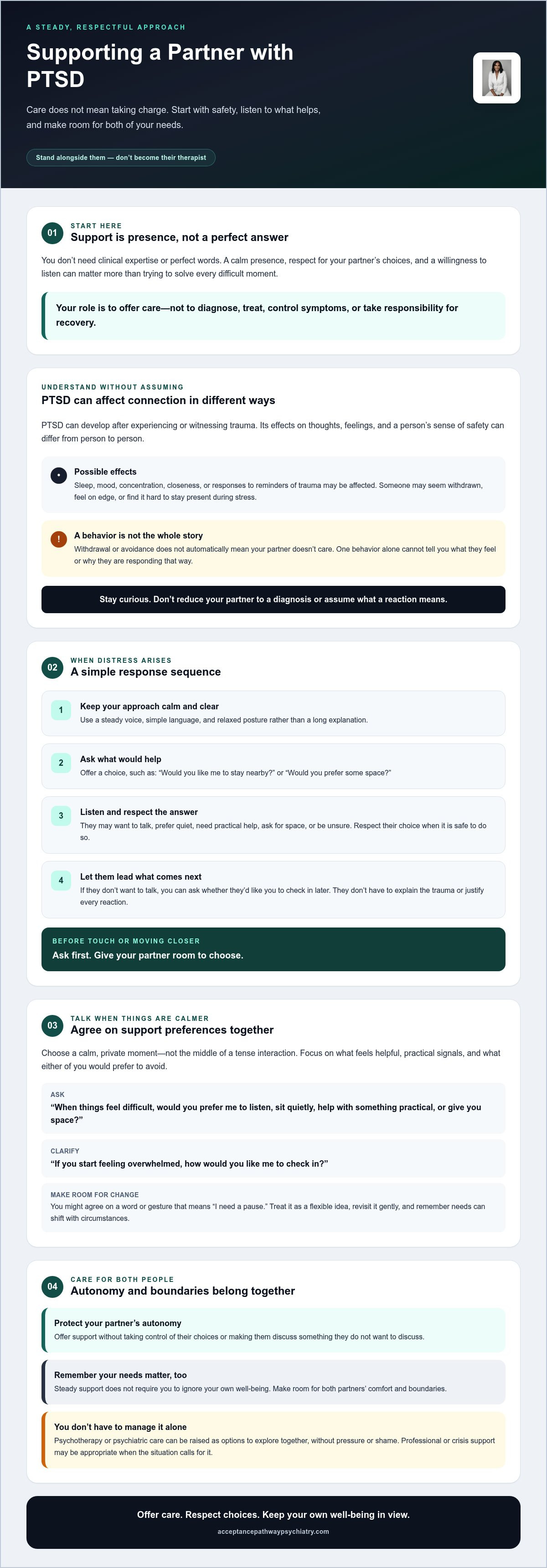
How to Support a Partner with PTSD in Everyday Life
In a difficult moment, a simple sequence can help you respond without guessing or taking over. The best approach may vary, so treat this as a starting point and adapt it together.
- Ask: “What would feel helpful right now?”
- Listen: Give your partner time without interrupting or asking them to explain the trauma.
- Offer choices: “Would listening or practical help feel better right now?” You might also offer quiet company or space.
- Respect the answer: If they say “not now” or choose space, accept that without pressing.
- Check in later: When things feel calmer, ask whether they want to talk or would rather leave it for now.
This routine can guide how to support a partner with PTSD, but it isn’t a script you have to follow perfectly. Your partner might prefer something different on another day.
What to say, and what to avoid
Validation acknowledges what your partner is feeling without minimizing it, investigating the cause, or promising that everything will be fixed. Try phrases such as:
- “That sounds hard. I’m here with you.”
- “You don’t have to explain anything right now.”
- “Would you like me to listen, help with something, or give you room?”
Avoid comments like “just move on,” “you’re overreacting,” or “tell me exactly what happened.” They can make someone feel dismissed or pressured. Silence can also be supportive when you offer it gently: “We don’t have to talk. Would you like me to sit nearby?” Let your partner decide whether that feels comforting.
Create predictable, consent-based routines together
During a calm conversation, agree on small ways to communicate about privacy, social plans, physical affection, and requests for space. You might choose a word or gesture that means “I need a pause,” or ask before inviting others into plans that affect your partner. A signal should open a conversation about what’s needed, not become a rule that overrides either person’s boundaries.
For check-ins, agree on a simple question or a time to reconnect instead of repeatedly asking for reassurance. Later, talk about what worked and what didn’t. Keep the plan flexible, and change it by mutual agreement as your circumstances or preferences shift.
If your partner would like to explore professional care, psychotherapy or medication management may be options to discuss with a qualified clinician. Explore PTSD mental health care options with Acceptance Pathway Psychiatry PLLC.
When to Seek Professional Help: Partner's Next Steps
Professional support can be worth exploring if PTSD symptoms are making daily life or relationships harder to manage. Raising the idea doesn’t mean diagnosing your partner or deciding what care they need. It can be an invitation to consider options with a qualified clinician, at their pace.
How to bring up professional support with care
Choose a calm moment and describe what you’ve noticed without labeling your partner. For example: “I’ve noticed sleep seems difficult lately, and I’m concerned about how you’re feeling. Would you like to talk about getting support?” Keep the focus on care, not blame or an ultimatum.
Ask whether they’d like help finding information or prefer to take the lead. Psychotherapy and psychiatric care, including medication management, are options they can discuss with a qualified clinician. If they decline, respect their choice and leave room to revisit the conversation if they’re open to it. You can offer care without taking control of their decisions.
Acceptance Pathway Psychiatry PLLC offers psychotherapy, medication management, and telehealth appointments for people seeking care related to PTSD. If your partner is interested, they can explore these options and decide what feels appropriate to discuss with a clinician.
Know what to do if safety becomes an immediate concern
Ongoing distress and immediate danger call for different responses. If you’re worried but there’s no immediate threat, encourage your partner to contact a mental health professional or a crisis resource. In the United States, call or text 988 for the Suicide & Crisis Lifeline. Veterans and their loved ones can call 988 and press 1, or text 838255 to reach the Veterans Crisis Line.
If someone is in immediate danger or needs urgent emergency assistance, call 911. Don’t try to manage an emergency by yourself. Acceptance Pathway Psychiatry PLLC is not an emergency crisis service, so contact emergency services or a crisis line for urgent help.
Knowing how to support a partner with PTSD includes recognizing when professional or crisis support may be needed. You can offer to stay nearby or help make a call if your partner wants that, while keeping safety and their choices in view. Seeking help is one possible next step, not a measure of how much you care or how well you’ve supported them.
Take the Next Step at a Pace That Feels Right
Learning how to support a partner with PTSD isn’t about finding perfect words or preventing every difficult moment. It’s about building trust through steady, respectful care, asking what feels helpful, and making room for both your partner’s choices and your own needs.
Keep communication open when you’re both calm, and remember that you can encourage professional support without directing your partner’s recovery. Small, thoughtful steps can help you stay connected while recognizing that you don’t have to manage everything alone.
If your partner is interested in exploring care, Acceptance Pathway Psychiatry offers psychotherapy and medication management for PTSD and other mental health concerns, with in-person and telehealth appointments available. Explore mental health care and appointment options.
Your care matters, and support can begin with one respectful conversation at a time.
Frequently Asked Questions
Is PTSD a person’s fault?
No. PTSD is a mental health condition, not a choice or a character flaw. You can’t determine what caused someone’s symptoms from the outside, and each person’s experience is individual. Offer care without pressing for trauma details or deciding what recovery should look like. Listening, respecting their privacy, and asking what support they welcome can help you stay connected without making assumptions about their past.
Can I trigger my partner’s PTSD without meaning to?
Some situations or reminders may bring distress, but you can’t reliably predict every response or prevent every difficult moment. Talk together about known preferences when you’re both calm and ready. Ask before touching or helping, and respect a request for space. If your partner reacts strongly, avoid assuming you caused it or treating the reaction as proof that you did something wrong. You can check in later, when it feels appropriate.
How should I respond when my partner is having a difficult moment?
Keep your voice calm and your words simple. Ask, “Would listening, practical help, or some space feel best right now?” Offer choices, then respect the answer. Don’t demand an explanation or debate whether the reaction makes sense while your partner is distressed. If you believe someone is in immediate danger, follow emergency guidance rather than trying to manage the situation alone. In the United States, call 911 for immediate danger; call or text 988 for crisis support.
What should I avoid saying to a partner with PTSD?
Avoid minimizing comments like “just move on,” pressuring your partner to describe the trauma, or promising that everything will quickly be fine. These responses can dismiss their experience or ask them to share more than they want to. Instead, acknowledge what they’ve said and ask what support they’d prefer. There’s no single perfect phrase. A respectful, steady response matters more than having a scripted answer ready.
Can a relationship help someone recover from PTSD?
A caring relationship can offer connection and practical support, but it can’t guarantee recovery or replace professional care. Ask what feels useful, respect your partner’s decisions, and encourage them to explore professional support if they’re open to it. You don’t have to take responsibility for treatment. Protecting your own well-being and setting compassionate boundaries can also help you remain present in the relationship without taking over.
How can I encourage my partner to get professional help?
Bring it up during a calm moment. Describe what you’ve noticed without diagnosing or labeling your partner, then ask whether they’d like help exploring options or prefer to take the lead. Offer practical assistance only if they welcome it. A qualified clinician can discuss appropriate care, including psychotherapy or psychiatric services. Acceptance Pathway Psychiatry offers psychotherapy, medication management, and telehealth appointments, but your role is to support your partner, not choose treatment for them.
What happens if my partner may be in immediate danger?
Take an immediate safety concern seriously. If someone is in immediate danger, call 911 for emergency assistance. In the United States, call or text 988 to reach the Suicide & Crisis Lifeline for crisis support. Veterans and their loved ones can call 988 and press 1, or text 838255 for the Veterans Crisis Line. Stay with the person only if it’s safe for you to do so, and don’t rely on an article or a mental health practice as crisis care.


