

Deciding how to explain depression to your boss starts with what feels safe and useful to share. You aren’t obligated to discuss your mental health or name your condition. If you need a workplace adjustment, the Americans with Disabilities Act may apply to certain mental health conditions and may require reasonable accommodations unless they would create undue hardship, according to the U.S. Equal Employment Opportunity Commission.
It’s understandable to feel unsure about speaking up. You may want your boss to understand how depression affects your work while protecting your privacy and considering how the conversation might unfold.
This article will help you consider workplace risks before disclosing, choose a private time, and plan what to say. It also explains when professional documentation may be relevant, what you can ask for, and how to keep the conversation focused on what you’re comfortable sharing.
Key Takeaways
- You can decide whether to disclose and share only the information that helps explain a work-related need.
- Consider workplace culture and privacy before choosing how to approach the conversation.
- A quiet, private time can make it easier to discuss your concerns and possible work adjustments.
- Professional documentation may help support an accommodation request, depending on what your employer asks for.
- Psychotherapy and Medication Management can support your mental health as you consider what may help at work.
How Do You Talk to Your Boss About Your Depression?
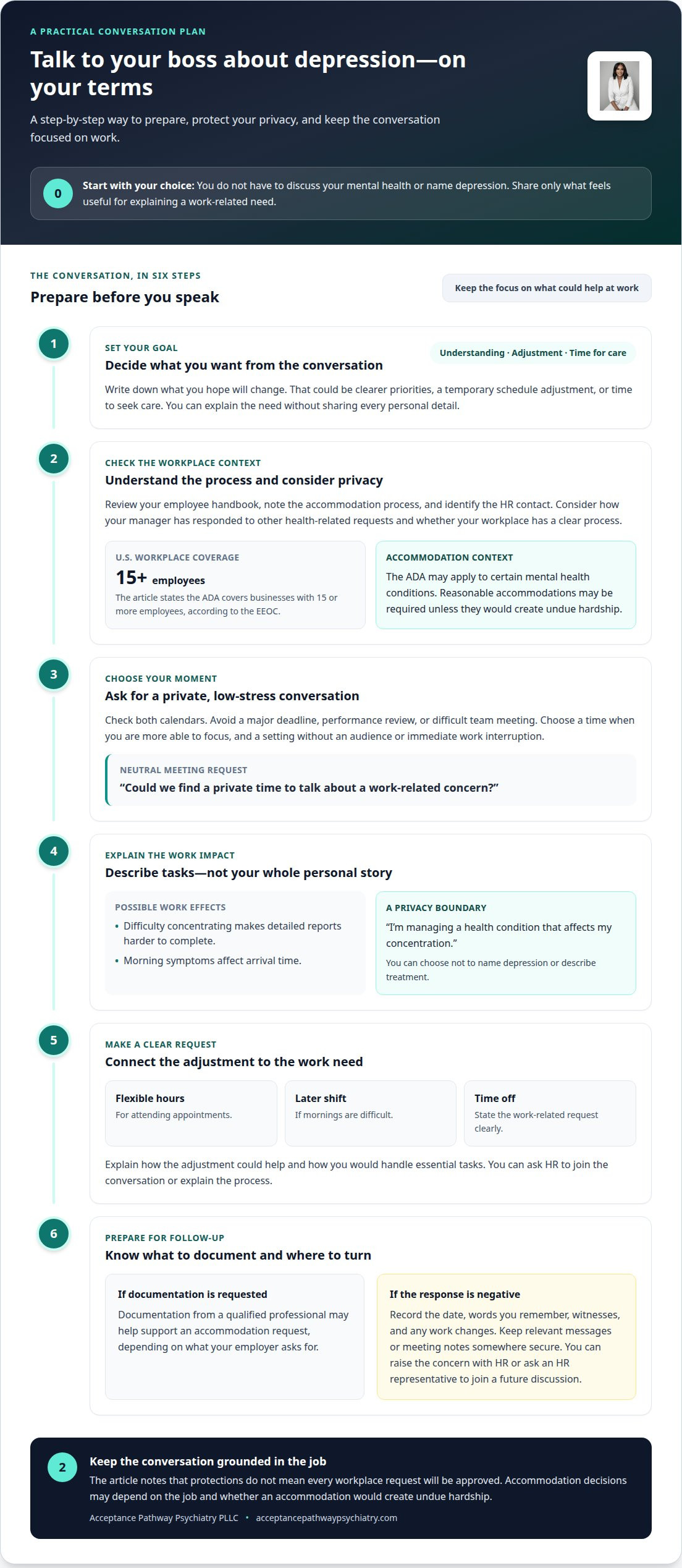
First, decide what you want from the conversation: understanding, a work adjustment, or time to seek care. You can explain those needs without sharing every personal detail.
Deciding Whether to Disclose
Disclosure means choosing whether to tell your boss that a mental health condition is affecting you. You don’t have to discuss your mental health or name depression, so weigh any practical benefit against your comfort and workplace circumstances. Write down what you hope will change, such as clearer priorities or a temporary schedule adjustment. If you’re considering how to explain depression to your boss, start with the work issue you want to address. A qualified mental health professional can help you consider your options outside work.
Describing Effects on Work
Describe how your experience affects specific tasks without assuming you need to explain your full condition. For example, you might say that difficulty concentrating makes detailed reports harder to complete, or that morning symptoms affect your arrival time. This gives your boss useful context and keeps the discussion work-focused. The Americans with Disabilities Act may apply to certain mental health conditions and may require reasonable accommodations unless they would create undue hardship, according to the U.S. Equal Employment Opportunity Commission.
Choosing How Much to Share
Set a boundary around personal details while sharing what your boss needs to know. You could say, “I’m managing a health condition that affects my concentration,” without naming depression or describing treatment. How much you share may depend on whether you’re asking for understanding or requesting an accommodation. Before the meeting, write down one sentence about the work impact and one about the support you’re seeking. This can help you stay focused if the conversation feels difficult.
Requesting Time Off or Flexibility
If you’re requesting time off or flexibility, make a clear, work-related request and explain how it could work. You might ask for flexible hours to attend appointments or a later shift if mornings are difficult. Describe the adjustment you’re seeking, how it would help, and how you would handle essential tasks. Review your company’s HR policies and available mental health resources, such as an employee assistance program if your workplace offers one. You can also ask HR to join the conversation or explain the process.
Assessing whether the workplace is safe for disclosure
If your boss reacts negatively, pause the discussion and record what was said, when it happened, and who was present. You can raise the concern with HR and keep copies of relevant emails or meeting notes.
Workplace Rights and Protections
Workplace protections are legal safeguards against discrimination and can affect how you approach disclosure. In the United States, the Americans with Disabilities Act covers businesses with 15 or more employees, according to the U.S. Equal Employment Opportunity Commission.
The U.S. Equal Employment Opportunity Commission says the ADA prohibits employers from discriminating against an employee because of a disclosed mental illness. Examples include firing someone, denying a promotion, or forcing them to take leave because of that condition. These protections don’t mean every workplace request will be approved; reasonable accommodations may depend on the job and whether an accommodation would create undue hardship.
Before speaking, gather practical information: review your employee handbook, note the accommodation process, and identify the HR contact. If your employer has a mental health program, find out what support it describes and how employees access it. This can help distinguish a formal process from a manager’s personal response.
Disclosure Risks and Negative Reactions
Consider how your workplace handles private health information and employee concerns. Think about specific examples: how has your manager responded to other health-related requests, and does your organization have a clear HR process? If past interactions feel unpredictable, you might speak with HR first or ask them to join the meeting.
Consider job-related safety, too. An employer may ask about mental health when objective evidence suggests a condition could prevent someone from doing the job or create a safety risk. If your work involves operating equipment, for example, focus on any task-specific concern and the support that could help you work safely.
If your boss dismisses your request, makes a negative comment, or changes your duties after disclosure, record the details while they’re fresh. Keep the account factual: include the date, the exact words you remember, any witnesses, and related changes to your work. Save relevant messages somewhere secure that you can access.
Then choose a measured next step. You might send HR a brief written summary and ask how the company addresses the concern. If a meeting becomes tense, you can calmly end it and request that an HR representative join future discussions. A written record can help you explain what happened without relying only on memory.
Choosing a private, low-stress time to talk
Planning the conversation gives you more control over your privacy, timing, and key points. Choose a setting where you and your manager can talk without an audience or an immediate work interruption.
Check your calendar and your manager’s schedule before asking to meet. Avoid a day with a major deadline, performance review, or difficult team meeting. If symptoms are harder at certain times, choose a time when you’re more able to focus. For example, if mornings are difficult, ask for an afternoon conversation instead of trying to explain everything during a rushed check-in.
Request a private meeting in neutral language that doesn’t reveal more than you want. You could write, “Could we set aside time to discuss a health matter and a work adjustment?” A general calendar title can help protect your privacy if others can view your schedule. If your workplace doesn’t have a private room, ask about meeting in a closed office or speaking by phone.
- Choose a time without an urgent deadline or a scheduled team discussion.
- Ask for a private setting and use a neutral meeting title.
- Write down the main point and the work support you want to discuss.
Decide whether you’d prefer to talk in person, by phone, or by video. An in-person conversation may feel more personal, while a written request can help organize your thoughts if speaking feels difficult. You could also request a meeting and bring a short outline. For instance, note the affected work task, the adjustment you’re seeking, and a question about the company process.
Plan a calm opening so you don’t have to find the words under pressure. You might say, “I’d like to discuss a health condition that’s affecting my work and talk about possible support.” Keep a few notes nearby, and pause if you need time to gather your thoughts. If your manager has to leave or the conversation feels rushed, ask to continue in private another time.
After the meeting, send a concise written recap within 48 hours, as recommended in the article’s workplace guidance. Summarize the request, any next steps, and who will follow up. Keep the message factual and focused on the arrangement discussed, such as a schedule change or a plan to revisit workload. A written recap can help both of you remember what was agreed.
Documentation from a qualified professional
Professional documentation may help explain a mental health condition when workplace support requires more than a conversation. A mental health screening isn’t a diagnosis, and documentation may need to come from a qualified professional, usually a doctor or therapist.
An employer may request documentation of a mental illness. If that happens, ask what information is needed, who should receive it, and how to submit it. A clear request can help you prepare without sharing unrelated medical details. For example, ask whether the employer needs confirmation of a condition, information about work-related limitations, or documentation for a specific accommodation request.
Start with the professional involved in your care. Explain the work issue and the adjustment you’re considering, such as flexibility for appointments or a change to a particular task. A doctor or therapist can explain what documentation they can provide based on their professional assessment. Don’t assume a screening result alone counts as a diagnosis or workplace document.
Before sharing anything, compare the employer’s request with the documents you have and keep the discussion focused on its stated purpose. If the request is unclear, ask HR what information they need and how to submit it. Avoid including personal history unrelated to the request. This helps you prepare while keeping the discussion centered on workplace needs.
- Write down the requested document and the person or office receiving it.
- Tell your doctor or therapist which work task or accommodation is involved.
- Keep a copy of what you submit and note when you sent it.
Documentation can describe a health matter without replacing your own explanation of its impact. For instance, a clinician’s note may support your request, while you explain that appointments affect your availability on certain afternoons. Keep the roles distinct: the professional provides clinical documentation, and you identify the work change you want to discuss.
If you’re unsure how to begin, bring the employer’s written request to your next appointment. Ask your doctor or therapist what they can document and whether they need details about your job duties. This can make the request more specific. Once you receive a document, read it carefully before sharing it and confirm that it addresses the employer’s stated need.
Keep related records together, including the request, your response, and follow-up messages. A folder or secure digital file can make it easier to find documents if HR asks about them again. If your employer requests more information, ask for the request in writing so you and your qualified professional can respond to the specific question.
Concerns about discussing depression with a boss
Disclosure can feel risky because it involves both your health and your working relationships. The decision isn’t simply “tell” or “hide.” You can choose what to share, with whom, and for what purpose.
Career concerns are real for employees weighing this choice. In NAMI’s 2025 workplace poll, 42% of employees worried that disclosing mental health struggles could negatively affect their careers. That worry doesn’t predict your manager’s response, but it can help explain why preparing boundaries matters. Identify the outcome you want before deciding whether a conversation serves it.
You can take an incremental approach. For example, first describe a work-related need without naming depression, then decide whether more context would help. You might say, “I’m dealing with a health issue and need to discuss a schedule adjustment.” This lets you ask for support while limiting disclosure. If your manager asks personal questions, you can redirect to the work impact or pause before responding.
- Write down what you want your manager to understand.
- Choose the details you’re comfortable sharing and those you’ll keep private.
- Decide whether HR should join or receive your request instead.
Anxiety about disclosure can make the conversation harder to plan. Before a meeting, practise your opening sentence with someone you trust or write it in your notes. If speaking feels overwhelming, request a meeting by email and bring a short written summary. A mental health professional can help you explore your concerns and prepare language that feels manageable.
Think about what you’ll do after either response. If your boss listens, agree on a specific next step, such as discussing a schedule change with HR. If the response feels dismissive, calmly end the conversation and make a factual record afterward. Note the date, what was said, and any work-related follow-up. A clear record can help you explain the situation if you raise it through company channels later.
You don’t have to settle every concern before seeking support. If anxiety or depression is affecting your day-to-day wellbeing, talk with a mental health professional about care and ways to prepare for workplace conversations.
Acceptance Pathway Psychiatry PLLC: Medication Management
Acceptance Pathway Psychiatry PLLC offers Medication Management and Individual Therapy for people seeking support with depression and related mental health concerns. If you’re weighing workplace disclosure while considering care, you can discuss symptoms and possible next steps in a supportive setting. Psychotherapy can also help you work through depression’s emotional effects and prepare for difficult conversations. Creyos Cognitive Testing and Integrative Wellness Services are additional offerings.
You don’t have to resolve every workplace decision before seeking support. A mental health professional can help you understand your needs and consider what support may fit. Contact Acceptance Pathway Psychiatry PLLC to learn about its care options.
Take Your Next Step at Your Own Pace
Before your next work conversation, choose one manageable step. You might write a private note about what you want your manager to understand or decide which details you’d rather keep personal. Planning how to explain depression to your boss can take time, and one conversation doesn’t have to resolve everything.
Give yourself room to consider your work needs alongside your mental health. A mental health professional can help you reflect on symptoms, discuss care options, and prepare for difficult conversations. You can seek support even if you haven’t decided whether to disclose at work.
If you’d like to explore care, contact Acceptance Pathway Psychiatry PLLC. You deserve to approach this decision with care and at a pace that feels right for you.
Frequently Asked Questions
Should I tell my supervisor about my mental illness?
It’s your decision, and you aren’t obligated to discuss your mental health with your supervisor. Consider whether sharing could help address a specific work need, such as missed deadlines or difficulty attending fixed shifts. You could begin with the impact rather than the diagnosis, then decide whether more detail feels useful. If you’re unsure, write down the benefit you hope for and the privacy concern you’re weighing.
How do you tell your boss you have depression?
Open briefly and directly, and connect the conversation to your reason for speaking. For example: “I have depression, and I’d like to discuss how it’s affecting my work and what support may help.” Adapt the wording to your comfort; you can describe a health condition without naming it. A short written note can help you stay on track if anxiety makes it hard to speak spontaneously.
What are professional ways to explain depression is affecting your work?
Describe observable effects on your work rather than judging your performance or sharing unnecessary personal history. For example, explain that low concentration makes it harder to review detailed spreadsheets, or that symptoms have affected your attendance at morning meetings. Then identify what you want to discuss, such as setting priorities or a temporary schedule adjustment. Specific examples help your manager understand the work issue without requiring a full account of your mental health.
Should you tell your boss or HR about depression?
Choose whom to speak with based on what you need. A supervisor may be the right person to discuss deadlines or daily tasks; HR may explain workplace procedures or join a meeting. If you’re concerned about speaking alone, you can ask HR to attend. For example, send HR a neutral message asking about the company’s accommodation process, without sharing personal health details in a team channel.
What workplace accommodations can employees request for depression in the United States?
Possible requests include flexible work hours, a later shift, or flexibility in work location. You might request a schedule that allows you to attend appointments or a quieter place for focused tasks. The Americans with Disabilities Act may apply to certain mental health conditions and may require reasonable accommodations unless they create undue hardship, according to the U.S. Equal Employment Opportunity Commission. Describe the work barrier and the adjustment you’re proposing.
Can an employer require a diagnosis or medical documentation for depression accommodations?
An employer may request documentation when you seek an accommodation, but a screening alone doesn’t establish a diagnosis. Documentation may need to come from a qualified professional, usually a doctor or therapist. Ask what information is requested and which workplace process applies. For instance, clarify whether the employer needs information about a work-related limitation or documentation supporting a particular adjustment.
What protections does the ADA provide for employees with depression?
The ADA may apply to certain mental health conditions and may require reasonable accommodations unless they cause undue hardship. The U.S. Equal Employment Opportunity Commission says the ADA prohibits discrimination because of a disclosed mental illness, including firing an employee or denying a promotion for that reason. In the United States, it covers businesses with 15 or more employees, according to the U.S. Equal Employment Opportunity Commission. The facts and requested accommodation matter.
Can an employer legally fire you for disclosing depression in the United States?
According to the U.S. Equal Employment Opportunity Commission, an employer cannot fire an employee because of a disclosed mental illness when the ADA’s protections apply. Disclosure does not determine every employment decision: the ADA doesn’t excuse an employee from performing essential job duties, and a specific safety concern may matter. If you’re told your job is at risk, keep relevant messages and record the stated reason, meeting date, and any changes to your duties.


