

You can request changes that make it easier to do your job, such as flexible scheduling for therapy, remote work, adjusted breaks, a quieter workspace, or written instructions. Under the ADA, requesting mental health accommodations at work may be an option if a mental health condition substantially limits a major life activity and an accommodation would help you perform your job’s essential functions. Focus your request on the work-related challenge and the change that could help, rather than sharing your full medical history.
Bringing up a personal health concern at work can feel difficult, especially when you’re unsure what to disclose or whether your situation qualifies. You don’t need a perfect solution to begin: the accommodation process can start with a conversation about the barriers you face and possible ways to address them.
This article explains who may qualify for ADA protections, which accommodations you can request, and what information an employer may ask for. It also covers how medical documentation can describe your functional needs while keeping the focus on practical support at work.
Key Takeaways
- Consider practical changes such as adjusted schedules, quieter workspaces, or written instructions that address specific work barriers.
- You can focus an accommodation request on how your condition affects your work and what support may help, rather than sharing your full medical history.
- The ADA applies to organizations with 15 or more employees, according to the U.S. Equal Employment Opportunity Commission.
- Medical documentation can describe functional limitations and the need for an adjustment without making your diagnosis the focus.
- Eligible employees may take up to 12 weeks of job-protected, unpaid leave in a 12-month period for serious health conditions, including mental health conditions, according to the U.S. Department of Labor.
What mental health accommodations can I ask for at work?
Possible accommodations include flexible scheduling, remote work, adjusted breaks, and time away for treatment. When requesting mental health accommodations at work, describe the work barrier and the change that could help you perform essential duties.
ADA Accommodations and FMLA Leave
An ADA accommodation changes how work is done, while FMLA leave provides eligible employees with job-protected time away. Understanding the difference can help you consider whether an adjustment that lets you keep working or time away better fits your needs.
According to the U.S. Department of Labor, the Family and Medical Leave Act (FMLA) allows eligible employees to take up to 12 weeks of job-protected, unpaid leave in a 12-month period for serious health conditions, including mental health conditions. FMLA eligibility typically requires 12 months of employment, 1,250 hours worked, and employment at an organization with 50 or more employees, according to the U.S. Department of Labor.
The FMLA and ADA address different needs, so one option doesn’t automatically replace the other. Leave may be relevant when treatment or recovery requires time away; an ADA accommodation may help you continue working with a change to your schedule or environment. For an employment discrimination charge, the filing deadline may be 300 days when the employer is also covered by a state or local employment discrimination law, according to the U.S. Equal Employment Opportunity Commission.
Flexible Schedules and Remote Work
A flexible schedule changes when or how long you work, while remote work changes where you perform your duties. Either option may address a specific work barrier, but the arrangement needs to fit the job’s essential responsibilities.
For example, an adjusted start time could accommodate a recurring therapy appointment, while remote work could reduce difficulties with commuting or a distracting office. Other possible scheduling changes include part-time hours or compensatory time. Explain how the arrangement relates to your needs and how you would complete essential tasks.
Flexible break timing may also help you manage symptoms during the workday. Focus the accommodation discussion on the schedule or work setting that helps you meet job expectations, rather than assuming one arrangement works for everyone.
Leave, Breaks, and Therapy Appointments
Time off, additional breaks, or flexibility for therapy appointments can support treatment and recovery needs. Sick leave may provide time away for therapy, treatment, recovery, or related appointments.
A leave of absence may be an accommodation, though leave is generally considered a last resort when another effective option would allow you to keep working. If time away could help you return to essential duties, unpaid leave may be an option to discuss. When requesting mental health accommodations at work, you can explain which work activities are affected even if you don’t have a specific accommodation in mind.
If you’re permanently unable to perform your regular job, reassignment to an available job you can perform may be considered as an accommodation. The key question is whether the proposed change supports your ability to perform essential work responsibilities.
Must I disclose a mental health condition to my employer?
You don’t have to disclose a mental health condition just to work or accept a job. To request an accommodation, explain the work-related limitation and connect it to a change that could help.
Accommodation Eligibility and Undue Hardship
ADA accommodation eligibility depends on whether a disability affects major life activities and whether a reasonable change could help you perform essential job functions. The ADA applies to organizations with 15 or more employees, according to the U.S. Equal Employment Opportunity Commission.
A qualified employee may request reasonable accommodations, but an employer isn’t required to approve every proposed change. An employer must provide an effective accommodation unless doing so would cause undue hardship, meaning significant difficulty or expense. The employer should consider whether another effective option could address the same workplace barrier.
The Interactive Accommodation Process
The interactive process is a discussion between you and your employer about work barriers and possible accommodations. It’s important because the right solution depends on your job’s essential duties and your specific needs.
You can make your request in writing and suggest options, such as written instructions, adjusted breaks, or a quieter workspace. You can also ask your employer to suggest alternatives. Keep a record of your request and the responses, then explain how each proposed change could support your work duties.
Your request can identify you as a person with a disability without revealing your full medical history. Explain which task is difficult, how your condition affects your ability to complete it, and what adjustment might help. For example, you might describe difficulty concentrating in a noisy work area and request a quieter workspace.
An employer may ask for limited medical documentation when a disability or need for accommodation isn’t known or obvious. The documentation can explain the functional limitation and why an adjustment may help; it doesn’t need to provide unrestricted access to your medical records. Any medical information the employer receives must remain confidential, including from coworkers.
If your employer refuses a reasonable accommodation, you can file a discrimination charge with the U.S. Equal Employment Opportunity Commission. The general filing deadline is 180 days after the alleged violation; it may be 300 days when the employer is also covered by a state or local employment discrimination law, according to the Commission.
Sharing functional limitations and medical documentation
Useful accommodation information connects a health-related limitation to a work task. A clear description keeps the discussion focused on what could help you perform your job.
Sharing Functional Limitations
A functional limitation describes how a condition affects a work activity, rather than simply naming a diagnosis. This distinction matters because the accommodation discussion centers on a workplace barrier and a practical adjustment.
For example, an employee with depression might explain that a noisy workspace makes it difficult to concentrate on detailed reports. They could describe the task, when the difficulty occurs, and how a quieter setting might help. A request can also explain how remote work, written instructions, or adjusted breaks relate to the limitation.
Medical Documentation for Requests
Medical documentation supports an accommodation request by describing a condition’s effects at work and the change that may help. It gives the employer relevant information to consider without requiring a complete medical history.
A clinician’s note can describe a limitation, its effect on job duties, and a relevant adjustment. For instance, it might explain why scheduled breaks support an employee’s ability to complete focused work. A doctor’s note confirming the need for an adjustment is usually enough documentation.
Documentation should address practical questions: Which work activity is affected? What limitation creates difficulty? What adjustment could help? A diagnosis alone may not explain why a particular workplace change is useful. You can refer to attached medical documentation and explain how it relates to the requested accommodation.
Employers should request medical documentation only when a disability or need for accommodation isn’t known or obvious. Any request should focus on information relevant to the accommodation. Employers may seek limited documentation, but they can’t demand full access to medical records. This helps distinguish information needed to assess a request from unrelated treatment details.
Medical information obtained from an employee must remain confidential, including from coworkers. You can share relevant information with the person handling your request while keeping private details out of general workplace conversations. Coworkers may need to know about a schedule or task change, but they don’t need your diagnosis or treatment history.
Once you and your employer agree on an accommodation, document the arrangement in writing. Record the change, the tasks it addresses, when it begins, and how responsibilities will be handled. For remote work, for example, clarify which duties will be completed remotely and how you’ll participate in required meetings.
Keep a record of your request, submitted documentation, agreed changes, and follow-up discussions. If the adjustment doesn’t address the barrier, describe what remains difficult and discuss alternatives. This creates a shared record of the process and helps distinguish an implementation problem from a concern about discrimination.
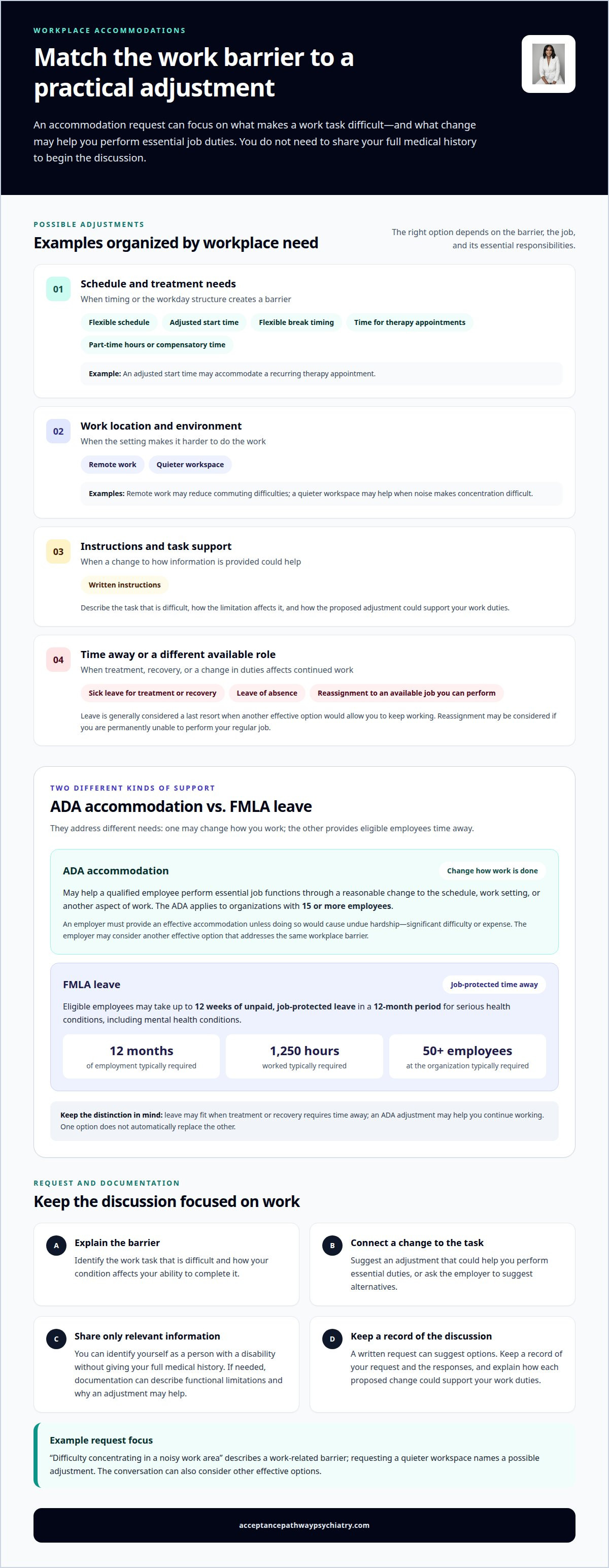
Examples of workplace accommodations for mental health conditions
Accommodation examples are most useful when they address a specific barrier to performing essential tasks. The Americans with Disabilities Act protects qualified people with disabilities from employment discrimination, including people with a history of psychiatric disabilities or those regarded as having one.
Start by identifying where your workday becomes difficult. A crowded area may make sustained concentration harder, while frequent priority changes may complicate task completion. A supervisor’s meeting style or unclear assignment expectations can also create barriers. Describing the task and its impact helps connect an accommodation to a practical need.
Depending on the job and the barrier, possible changes include:
- A private office or cubicle, or a workspace away from noisy machinery.
- Noise-reducing adjustments or increased natural lighting in the work area.
- A recorder for meetings or training, a noise-canceling headset, or an electronic organizer.
- Large assignments divided into smaller tasks, with relevant support or training.
- Regular check-ins, daily checklists, or meeting notes to clarify priorities and expectations.
These examples address different needs: an organizer may support task tracking, while meeting notes can clarify decisions. Your input helps shape an individualized arrangement. An employer may need to adjust a supervisor’s leadership practices, though changing the supervisor generally isn’t required as an accommodation.
Mental health conditions can carry stigma, but you don’t have to share your diagnosis with coworkers. Employers must keep medical information confidential. Harassment or discriminatory treatment related to a disability is a separate workplace concern from whether an accommodation is effective. Focus your request on work needs, and keep records of incidents to distinguish accommodation discussions from concerns about mistreatment.
Accommodation decisions also consider whether a proposed change is reasonable and would create undue hardship. A significant risk of substantial harm to you or others may be considered a direct threat under the ADA. This is a specific safety standard, not a general assumption based on a diagnosis. Employers should assess the situation and available information rather than rely on stigma about mental health conditions.
Cost doesn’t automatically rule out a practical adjustment. A change such as clearer task instructions may require planning rather than equipment, while a headset or meeting recorder involves a purchase. The relevant question is whether an effective adjustment addresses the barrier without causing undue hardship.
Who may request mental health accommodations under the ADA
The ADA doesn’t make diagnosis alone the deciding factor. Eligibility depends on whether you have a qualifying disability and can perform the job’s essential duties with a reasonable accommodation. That distinction matters: people with the same disorder may have different limitations, responsibilities, and support needs.
The ADA defines disability in part as a mental or physical impairment that substantially limits one or more major life activities. Examples include thinking, concentrating, communicating, or caring for oneself. Depression, anxiety, PTSD, and substance use disorders may be covered when they meet that standard. A diagnosis doesn’t automatically establish that someone qualifies for a workplace accommodation.
For accommodation eligibility, the practical focus is the relationship between the limitation and essential job functions. An employee who struggles to concentrate in an open office may be able to perform core duties in a quieter workspace. A worker who needs treatment appointments may need a schedule adjustment. An accommodation should address a real work-related barrier while allowing the person to meet essential responsibilities.
The ADA Amendments Act of 2008 broadened the definition of disability, extending employment protections to more people. Protection can also apply to people with a history of psychiatric disability or people regarded as having one. These protections against discrimination are distinct from the accommodation process: an employee seeking a workplace change needs to communicate a disability-related limitation and the need for support.
Applicants may also request accommodations during hiring, such as a change to the interview process. Current employees can make a request at any point during employment, including after a change in treatment or job duties. A supervisor or another appropriate workplace contact can receive the request. You don’t need to propose a perfect solution; explain the barrier and ask to discuss options.
Federal employees may also refer to the Rehabilitation Act of 1973. State laws can provide broader coverage than federal law, so protections may vary by location. The key takeaway is that eligibility depends on the person’s functional limitations, job duties, and whether an accommodation could enable them to perform essential work, not simply on the name of a disorder.
If symptoms or treatment are affecting your work, explore mental health support to discuss care that may help you manage those challenges.
Acceptance Pathway Psychiatry PLLC
Acceptance Pathway Psychiatry PLLC provides mental health care for people whose symptoms affect daily life, including work. If anxiety, depression, ADHD, PTSD, or bipolar disorder affects your well-being, Individual Therapy or Medication Management may support your care. Creyos Cognitive Testing and Integrative Wellness Services are also available.
Mental health treatment and workplace accommodations serve different purposes: care addresses your health needs, while an employer considers changes that may help you perform essential job duties. If you’re looking for support alongside an accommodation request, contact Acceptance Pathway Psychiatry PLLC to discuss your mental health care needs.
Choose a next step that supports your well-being
Caring for your mental health and requesting workplace support can be separate, meaningful steps. Consider what might help you feel steadier day to day, then decide what you’re ready to discuss with your employer. You don’t need to have every answer before you begin.
When requesting mental health accommodations at work, keep the conversation grounded in your needs and the work barriers you experience. If you’d also like support with your mental health, Acceptance Pathway Psychiatry PLLC offers care that can help you explore your concerns and treatment goals. You can contact Acceptance Pathway Psychiatry PLLC to discuss care that fits your needs.
It’s okay to take this one step at a time. A thoughtful conversation can help you move toward a work environment and care plan that better support your well-being.
Frequently Asked Questions
What accommodations can I ask for?
Ask about a change that addresses a specific work barrier, such as an electronic organizer for tracking deadlines or breaking a large assignment into smaller tasks. A meeting recorder or training notes may help if retaining spoken instructions is difficult. Describe the work problem and invite a discussion of options. The key question is whether the change supports your duties without removing an essential job function.
How is “disability” defined?
Under the ADA, disability includes a physical or mental impairment that substantially limits a major life activity. Major activities can include thinking, communicating, or caring for oneself. The definition focuses on an impairment’s effects, not simply the diagnosis on a medical record. For example, two people with the same condition may experience different limitations in daily life, so their accommodation needs may differ.
What if I’m worried about stigma or retaliation?
The ADA protects accommodation requests from retaliation. Keep a dated record of your request, relevant replies, and any workplace changes that concern you. Medical information an employer receives must remain confidential, including from coworkers. If you experience harassment or believe you’ve faced retaliation, record what happened and when. A written timeline can help you explain your concern clearly when seeking guidance.
Where can I get additional help or guidance?
The Job Accommodation Network offers workplace accommodation guidance by phone at 1-800-526-7234. The ADA National Network also provides information and technical assistance through its regional centers at 1-800-949-4232. These resources can help you understand accommodation options and workplace rights. For an employment discrimination concern, the U.S. Equal Employment Opportunity Commission explains how to file a charge and which deadlines may apply.
Who should I disclose to?
Share your accommodation request with an employer representative who can address workplace changes, such as human resources, an accommodation coordinator, or your supervisor. You can start with the work limitation and the adjustment you’re seeking, rather than sharing personal details with coworkers. If your supervisor isn’t the right contact, ask who handles accommodation requests. Keep a copy of written messages and any documentation you provide.
“Psychiatric disability” or “mental illness”?
Both terms describe mental health experiences, but they serve different purposes. “Mental illness” is commonly used in health and everyday conversations; “psychiatric disability” emphasizes how a mental health condition may affect work or other activities. Use the wording that feels comfortable when discussing your experience. For an accommodation discussion, describing the specific work impact can clarify your needs better than choosing a label alone.
What mental health conditions qualify as disabilities under the ADA at work?
Depression, anxiety, PTSD, and substance use disorders are examples of conditions that may qualify for ADA accommodation protections. A diagnosis by itself doesn’t determine eligibility: the condition must meet the ADA disability definition, and the person must be able to perform essential job functions with an effective accommodation. Relevant details include the condition’s effects on major life activities and how those effects relate to work.
How do I request a mental health accommodation from my employer?
Make your request to an appropriate employer representative, in writing if that feels helpful. Identify a work task affected by your condition, describe the barrier, and explain what change could help. For example, you might request written follow-up after verbal instructions. Suggest an option or ask to discuss alternatives. Keep a copy of your message and note the date, response, and agreed next steps.


