

A psychiatrist’s credentials matter, but so does whether you feel heard. Finding a psychiatrist who listens means looking at the whole fit: credentials, insurance, availability, experience relevant to your needs, communication style, and approach to care. A psychiatrist can diagnose mental health conditions and prescribe medication when needed, so it helps to understand what you hope to get from care.
It’s reasonable to want a psychiatrist who takes your concerns seriously, explains options clearly, and includes you in decisions. Finding a psychiatrist who listens can feel like a lot to manage, especially when you’re already working through difficult feelings. You can approach the search one step at a time.
This guide will help you assess practical details, identify experience that aligns with your needs, and notice whether a psychiatrist’s communication style feels collaborative. You’ll also learn how to use referrals and prepare for an initial appointment, so you can make a more informed choice about the care that feels right for you.
Key Takeaways
- Confirm that a psychiatrist’s credentials and insurance arrangements align with your needs, and ask for several referral options in case availability is limited.
- Look for experience relevant to the concerns you want help with, and remember that changing clinicians can be appropriate if the fit doesn’t feel right.
- Notice whether the psychiatrist listens, explains care clearly, and includes you in decisions about treatment.
- Consider how medication management, psychotherapy, and other parts of a care approach may fit your priorities.
- Use referrals from trusted sources and prepare a concise overview of your concerns to make the first appointment more useful.
Checking credentials, insurance, and availability
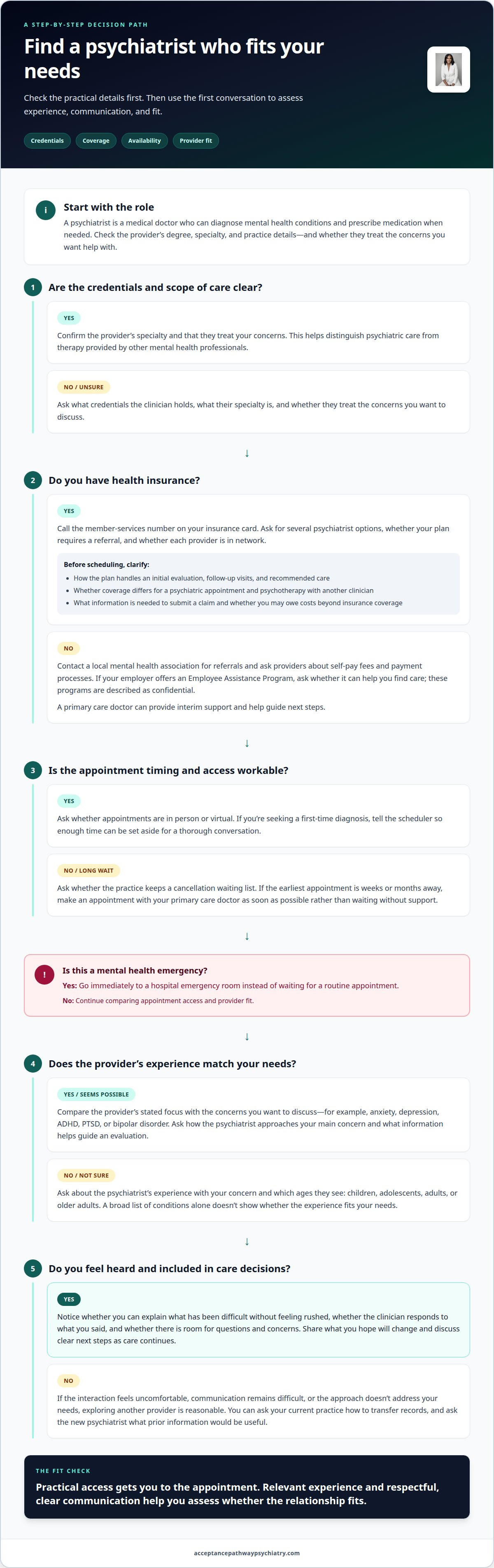
- Confirm the clinician’s role and credentials. A psychiatrist is a medical doctor who can diagnose mental health conditions and prescribe medication when needed. Review the provider’s professional profile for their degree, specialty, and practice details. If anything is unclear, ask what credentials the clinician holds and whether they treat your concerns. This helps distinguish psychiatric care from therapy provided by other mental health professionals.
- Start with your insurance plan’s referral options. Call the member-services number on your insurance card and ask for psychiatrist names and contact information. Request several options because a listed provider may not be accepting patients or may have a long wait. Some plans allow you to see a psychiatrist without a referral, but rules vary. Ask your insurer whether your plan requires one and whether the psychiatrists named are in network.
- Clarify coverage before scheduling. Ask your insurer how your plan handles an initial evaluation, follow-up visits, and recommended care. Coverage may differ between a psychiatric appointment and psychotherapy with another clinician. Ask what information is needed to submit a claim and whether you may owe costs beyond what insurance covers. If paying yourself, review the practice’s self-pay fees and payment process before booking. Costs depend on the service and individual circumstances, so confirm the details with the practice.
- Explore practical routes if you don’t have insurance. Contact a local mental health association for referral options, then call providers to ask about self-pay arrangements. If your employer offers an Employee Assistance Program, ask whether it can help you find care; these programs are described as confidential. A primary care doctor can also provide interim support and help guide your next steps. If the earliest appointment is weeks or months away, make an appointment with your primary care doctor as soon as possible rather than waiting without support.
- Compare appointment timing and access. When calling, ask about the next available appointment, whether the practice keeps a cancellation waiting list, and whether appointments are in person or virtual. If you’re seeking a first-time diagnosis, tell the scheduler so enough time can be set aside for a thorough conversation. A cancellation list may open the possibility of an earlier visit. In a mental health emergency, go immediately to a hospital emergency room instead of waiting for a routine appointment.
Finding a provider with relevant experience
Match a psychiatrist’s experience to the concerns you want help with, then notice how the relationship feels. You can change providers; ask how to transfer relevant medical records to your new practice.
-
Review Experience and Areas of Focus
Compare a provider’s stated focus with the concerns you want to discuss, such as anxiety, depression, ADHD, PTSD, or bipolar disorder. Look for descriptions of experience treating those concerns, not just a broad list of conditions. In an initial conversation, ask how the psychiatrist approaches your main concern and what information helps guide an evaluation. A long profile or many listed specialties doesn’t automatically mean the experience fits your needs.
-
Assess Provider Fit
Use an initial appointment to notice whether the psychiatrist understands your concerns and responds respectfully. Consider whether you can explain what has been difficult without feeling rushed and whether the clinician responds to what you said. A good fit doesn’t require agreement on every detail, but there should be room to ask questions and discuss concerns about care. If the interaction feels uncomfortable or the provider lacks relevant experience, exploring another option is reasonable.
- Check the ages served. Ask whether the psychiatrist sees children, adolescents, adults, or older adults, and confirm that the answer matches the person seeking care. Age range matters when arranging an appointment for a teenager or older family member. A provider who primarily sees adults, for example, may not be the right match for an adolescent. Checking this before scheduling can help you focus on clinicians whose practice fits the patient’s stage of life.
-
Build a Long-Term Provider Relationship
Look for a clinician who makes room for ongoing conversations, not just a first appointment. Share what you hope will change and notice whether the psychiatrist helps turn those priorities into clear next steps. Bring up changes in symptoms, questions, or concerns as care continues. A working relationship can develop over time, but you shouldn’t feel pressured to stay if communication remains difficult or the approach doesn’t address your needs.
- Plan a thoughtful transition if you switch. Contact your current practice and ask how it sends records to another provider. Ask the new psychiatrist which prior information would be useful, such as previous diagnoses, medications tried, or treatment history. Then follow the offices’ instructions for moving those records. A clear handoff can give the new clinician context and help you avoid having to reconstruct every detail from memory. If you’re exploring a different care approach, collaborative psychiatric care may be a useful starting point.
Choosing a psychiatrist who listens and communicates clearly
A psychiatrist is a medical doctor who can diagnose mental health conditions and prescribe medication when needed. Therapists focus on emotional or behavioral therapies, while psychiatric nurse practitioners have nursing training focused on psychiatric mental health.
If your psychiatrist dismisses symptoms or interrupts you, restate the concern and explain its effect, such as trouble sleeping or working. If the conversation still doesn’t address what you raised, consider another provider.
- Prepare the main points you want understood. Before an appointment, write down the symptoms affecting you most and an example of how each affects daily life. For instance, note when anxiety makes it hard to leave home or how low mood affects meals and routines. A short list can help you return to important details if the conversation feels difficult or moves quickly.
- Notice whether the psychiatrist listens before responding. Share a concern and pay attention to whether the clinician lets you finish, asks relevant follow-up questions, and responds to what you actually said. If you mention interrupted sleep, for example, a useful discussion should address that concern rather than shift to an unrelated topic. Listening doesn’t mean agreeing with every conclusion; it means taking your experience seriously.
- Ask for clear explanations of unfamiliar terms. When a psychiatrist uses a clinical phrase or suggests a next step, ask what it means for your situation. You might say, “Could you explain how that relates to the symptoms I described?” Notice whether the answer is understandable and leaves room for another question. Clear explanations help you take part in decisions rather than feel expected to accept a plan you don’t understand.
- Bring questions about treatment choices. Ask what a recommended approach is intended to address and how your concerns inform the decision. If medication is discussed, ask what the psychiatrist wants you to understand about the recommendation. If therapy or another approach comes up, ask how it connects to your goals. The conversation should help you understand the options and share what matters to you.
- Speak up when you feel dismissed. Name the specific moment and its impact: “I wasn’t able to finish describing how often this happens.” Then ask to return to that point. A concrete example gives the psychiatrist a chance to understand what felt unhelpful. If the pattern continues and you don’t feel heard, you can seek care from another provider.
- Reflect after the appointment. Write down whether you could raise your concerns, understand the explanations, and discuss next steps. For example, note whether your question about concentration received a direct response. Use these observations to decide what to clarify at a future visit and whether communication feels collaborative enough to continue.
Collaborative, person-centered psychiatric care
Person-centered care connects treatment decisions to your symptoms, priorities, and daily life. Use these steps to assess whether the plan feels understandable and collaborative.
- Name the changes you want help with. Choose specific examples, such as sleeping more consistently, managing anxiety at work, or returning to an activity you value. Explain which concern feels most pressing and why. These details help shape a conversation around your priorities rather than a plan based only on a diagnosis. If your goals change, bring that into a later discussion.
- Ask how each treatment option relates to your goals. When a psychiatrist discusses medication, therapy, or another approach, ask what concern it is intended to address. If difficulty concentrating affects work, for example, ask how the proposed care connects with that challenge. A clear explanation helps you consider whether the plan addresses the issue that brought you to care.
- Discuss medication and therapy as parts of care. Some people receive both medication management and therapy, whether from one clinician or more than one. If multiple professionals are involved, discuss what each person is helping you address and how their roles fit your priorities. Acceptance Pathway Psychiatry PLLC offers medication management and individual therapy, creating space to discuss how these services may fit your care.
- Share what has and hasn’t worked for you. Describe previous experiences concretely, such as a treatment that helped with sleep or an approach that was difficult to maintain. Explain any concerns about trying something similar again. This gives the psychiatrist useful context for discussing options. You can also describe what feels manageable in your routine instead of agreeing to a plan that doesn’t reflect your circumstances.
- Make room for questions before deciding. Ask the psychiatrist to explain unfamiliar terms, the purpose of a recommendation, and what the next step involves. If you feel uncertain, say which part you want to understand better. For example, ask how a suggested change relates to your goal of managing anxiety. A collaborative discussion makes room for your perspective and helps you take part in decisions.
- Review whether care still fits your needs. As care continues, notice whether the concerns you raised remain part of the conversation. Bring a specific example to an appointment, such as a change in your ability to manage a daily task. Tell the psychiatrist what feels helpful and what still needs attention. Revisit your priorities when life circumstances or treatment goals shift, so conversations stay connected to your experience.
Finding a psychiatrist through referrals or online platforms
Use trusted referrals and online directories to build a shortlist, then compare which options match your needs and preferences.
- Ask your primary care doctor for a referral. A doctor who knows your health history may suggest a psychiatrist based on your concerns. Explain what you want help with, such as anxiety symptoms or questions about a possible diagnosis. If you’re new to mental health care, ask whether the doctor can guide you toward a suitable next step. A referral is a starting point, not an obligation to choose that person.
- Ask a therapist about psychiatric referrals. Therapists may be able to recommend a psychiatrist through their professional connections. If you already see a therapist, describe the support you’re seeking, such as discussing medication alongside therapy. Ask why the suggested psychiatrist may be relevant to your needs, then decide whether to explore the referral.
- Use community connections if they feel comfortable. Attending a local NAMI support group may help you learn which counselors or psychiatrists other attendees see. You can listen without sharing personal details, then note any names that come up. If you belong to a church or another faith community, you could ask a pastor or spiritual leader for a referral. Treat community suggestions as leads, not as a substitute for your own preferences.
- Search online with a clear shortlist in mind. Use directory filters to narrow results by location, appointment format, concerns, and insurance where those options appear. Then read each psychiatrist’s profile for stated areas of focus and the age groups served. For example, if you’re looking for support with ADHD, note whether the profile mentions that concern. Online descriptions can help you identify possible matches, but they don’t show how a conversation will feel.
- Turn referrals and search results into a useful comparison. Keep a short list of names and record where each came from, what concerns their profile addresses, and what questions remain. For example, one referral may come from your therapist, while another appears in an online directory. Notice which options seem aligned with your priorities, then take the next step that feels manageable. Explore psychiatric care options as you consider what kind of support may fit.
Your primary care doctor may be able to refer you to a psychiatrist based on their experience. Describe your symptoms and mention if you’re new to mental health care. The doctor may be able to guide you toward a next step.
If you’re unsure what support to seek, describe what you hope to address and ask whether a referral may be appropriate. You can weigh the suggestion alongside your own preferences.
Acceptance Pathway Psychiatry PLLC
Acceptance Pathway Psychiatry PLLC offers psychiatric care that can reflect your concerns and preferences. Services include medication management, psychotherapy, Creyos Cognitive Testing, and Integrative Wellness Services. These options can support conversations about symptoms, treatment priorities, and next steps without assuming one approach suits everyone. Bring questions about communication, care preferences, or what you hope to address to a psychiatric evaluation or therapy appointment. To explore care with Acceptance Pathway Psychiatry PLLC, schedule an appointment by phone, email, or online form.
Take the Next Step at Your Own Pace
Finding a psychiatrist who listens is about more than choosing someone from a list. Give yourself room to notice how care feels as conversations continue. Bring your questions, share what matters most, and pay attention to whether the next steps are understandable and connected to your needs. If something is unclear, asking for a different explanation is a meaningful part of participating in your care.
You don’t need to have every concern neatly organized before reaching out. You can start by describing what prompted you to seek support and what you hope will change. That conversation can help you decide whether the practice’s approach feels like a useful fit.
If you’re ready to explore care or discuss what you’re looking for, contact Acceptance Pathway Psychiatry PLLC. Choosing a next step can take time, and you’re allowed to move at a pace that feels manageable. Your perspective belongs in the conversation.
Frequently Asked Questions
How can I find a psychiatrist who listens and takes my concerns seriously?
Look for a psychiatrist who makes room for your perspective and responds to the concerns you raise. Share a specific example during an appointment and notice whether the response reflects what you meant. Afterward, write down what felt understood and what still needs clarification. This reflection can help you decide what to discuss next, rather than relying only on whether the visit felt comfortable in the moment.
What questions should I ask a psychiatrist during a first appointment?
Ask how you’ll assess whether care is helping, what changes should prompt you to reach out, and how your priorities will shape next steps. You might also ask what information is useful to track between visits, such as changes in sleep or daily routines. These questions can clarify how care works over time and your role in reviewing progress.
How can I tell whether a psychiatrist is a good fit for me?
Consider whether the psychiatrist’s approach feels workable in your life, not only whether the conversation was pleasant. Think about whether you could raise a concern, understand the response, and discuss a relevant next step. After each visit, note what helped and what you want handled differently. Patterns across conversations can give you a clearer sense of fit.
How do I find a psychiatrist who offers telehealth and listens well?
Look for a practice that offers virtual appointments, then assess communication during your conversation. Acceptance Pathway Psychiatry PLLC offers telepsychiatry, which requires a reliable internet connection and a private space. Choose a room where you can speak comfortably without being overheard. Notice whether the psychiatrist gives you room to explain your concerns and responds directly, just as you would in person.


