

A prescription can be clinically appropriate and still require an insurer’s approval before the plan covers it. Prior authorization means the prescriber submits information to the health plan for review before the medication is covered. To understand how to get prior authorization for psychiatric medication, first check your plan’s formulary and find out what information it requires.
Facing this process can feel like one more obstacle between you and care. The request may involve clinical details or a trial of another medication, but knowing what to expect can make the next steps clearer.
This article explains how to review your formulary, what happens when a prescriber submits a request, and how decisions, costs, and timelines can vary. It also covers what to do if a request is denied, so you can have a more informed conversation about your care.
Key Takeaways
- Prior authorization is an insurer’s review before coverage for a medication, and requirements can affect how quickly treatment is accessed.
- Check your plan’s formulary for coverage status, restrictions, and tier so you understand what may apply to a prescription.
- If your plan requires step therapy or a tier exception, learn what clinical information the request may need and how the review works.
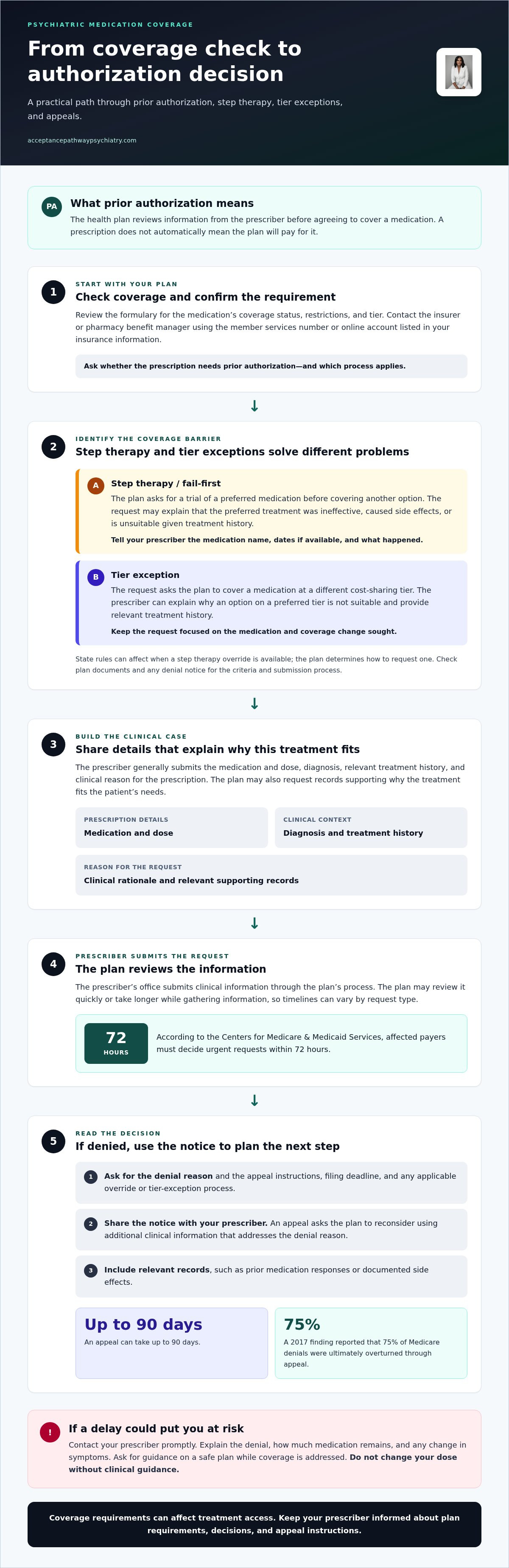
- Timelines vary by request type; according to the Centers for Medicare & Medicaid Services, affected payers must decide urgent requests within 72 hours.
- Medication management can help you discuss treatment options and insurance-related questions as part of your mental health care.
What does prior authorization mean?
Prior authorization is a health plan’s review before it agrees to cover a prescribed medication. If approval is required and denied, the plan may not pay for that medication.
How authorization affects treatment access
Authorization requirements can delay access when a patient needs approval before filling a psychiatric prescription. A 2017 survey found that 90% of physicians said prior authorization significantly negatively affected patients. People with mental health conditions who struggled to access medication because of drug coverage were 73% more likely to have an emergency room visit and had a 71% higher number of days in inpatient hospitalization. These findings show why delays matter to treatment continuity.
Why psychiatric medications need approval
A health plan may require approval to review a medication’s clinical rationale and coverage rules before paying for it. Plans can apply these requirements to manage coverage, including for medications they consider higher cost. One in four medications in the United States have some prior authorization limitations. For patients, this means a clinician’s prescription does not always mean the plan will cover the medication automatically.
For a psychiatric medication request, the prescriber generally submits the medication and dose, diagnosis, relevant treatment history, and clinical reason for the prescription. The plan may also request records explaining why the treatment fits the patient’s needs.
Fail-first requirements
A fail-first requirement, also called step therapy, asks a patient to try a plan-preferred medication before the plan covers another option. For example, a plan may require trying a less expensive medication before covering a more expensive prescription. This requirement matters because the preferred option may not fit the patient’s treatment history or prior response. Those details can help explain the clinical reason for requesting a different medication.
To start, contact your health insurer or pharmacy benefit manager using the member services number or online account listed in your insurance information. Ask whether the prescription needs prior authorization and which process applies. The prescriber’s office can then submit clinical information through that process.
If a request is denied, ask the plan for its reason and appeal instructions. A Medicaid study of beneficiaries with bipolar disorder found that medication prior authorization requirements were associated with treatment discontinuation and reduced engagement with mental health services. Sharing coverage barriers with your prescriber can help inform the next treatment discussion.
Can you handle step therapy and tier exception requests?
Step therapy and tier exceptions address different coverage barriers. Step therapy requires trying another medication, while a tier exception seeks a different coverage tier. A physician’s clinical explanation can help show why the requested medication fits the patient’s treatment needs.
Step therapy and fail-first policies
Step therapy, or a fail-first policy, requires trying a plan-preferred medication before the plan covers another option. The insurer may ask whether the preferred treatment was ineffective, caused side effects, or was unsuitable given the patient’s history. If you’ve already tried it, tell your prescriber the medication name, dates if available, and what happened. This helps distinguish a completed trial from a treatment that isn’t appropriate.
State laws and step therapy overrides
State rules can affect when a step therapy override is available, while the patient’s plan determines how to request one. An override request may explain that the preferred drug could cause harm, has already failed, or would interrupt a stable treatment plan. Check the denial notice and plan documents for the override criteria and submission process. These details help your physician focus supporting records on the reason that applies.
Tier exceptions are different: they ask the plan to cover a medication at a different cost-sharing tier. The prescriber can explain why an option on a preferred tier isn’t suitable and provide relevant treatment history. Keep the request focused on the specific medication and coverage change sought.
Appealing a denied authorization
An appeal asks the plan to reconsider a denial using additional clinical information. Read the denial notice for the appeal process and filing deadline, then share it with your prescriber. Include the denial reason and records that address it, such as prior medication responses or documented side effects. People can appeal a decision about treatment their provider considers necessary under the Mental Health Parity and Addiction Equity Act. An appeal can take up to 90 days.
Options after a denial
If a psychiatric medication request is denied, ask for the reason, appeal instructions, and whether a step therapy override or tier exception applies. A 2017 finding showed that 75% of Medicare denials were ultimately overturned through appeal, so review the decision rather than assuming it is final.
If delaying or stopping medication could be dangerous, contact your prescriber promptly. Explain the denial, how much medication remains, and any change in symptoms. Ask for guidance on a safe plan while the coverage issue is addressed. Don’t change your dose without clinical guidance.
For ongoing questions about medication choices and treatment, medication management can support a conversation about your care and coverage concerns.
Medication prior authorization timelines
Medication requests may be reviewed quickly or delayed while the plan gathers information. Knowing the applicable review window helps you plan refills and keep your prescriber informed.
For affected payers, CMS-0057-F sets specific decision windows. According to the Centers for Medicare & Medicaid Services, affected payers must decide urgent prior authorization requests within 72 hours. For non-urgent requests, affected payers must issue decisions within 7 calendar days, effective January 1, 2026. These requirements do not mean every plan or request follows the same process, so identify which rules apply to your coverage.
Outside those deadlines, medication prior authorization is often approved within a few days. A specialized medication can take up to a few weeks, especially when the plan needs additional clinical records. Manually handled requests commonly take 10 to 14 days, while a review can take up to five business days. Delays of up to a month are not uncommon. The request’s completeness and the plan’s review process affect the actual wait.
Urgency matters. For affected payers, the CMS-0057-F urgent review window is 72 hours. An urgent request can sometimes be approved in as little as 24 hours, and clinicians can usually request an expedited 72-hour review. Tell the prescriber’s office if a delay could interrupt treatment or affect patient care. Ask whether the request was marked urgent and whether the plan needs more information.
Don’t wait until your prescription runs out to start a renewal. Request known renewals as soon as possible, then ask the prescriber’s office how it will track the submission. Keep the submission date, plan contact details, and any reference number together. If the plan requests records, respond promptly through the stated process. A pending request is not an approval, so confirm the decision before assuming coverage is active.
There is no universal temporary supply of psychiatric medication while authorization is pending. Contact the pharmacy and prescriber promptly to ask whether a short supply is available under the prescription and plan rules. If you could run out, discuss a safe treatment plan. Share the medication name, remaining supply, and expected refill date so they can assess the immediate issue.
If the plan denies the request, the decision notice explains the next steps and appeal process. An appeal can take up to 90 days, so tell your prescriber about the denial and any approaching refill gap. If symptoms worsen or you feel unsafe, seek urgent help through appropriate local emergency or crisis services. For ongoing patient care, keep your prescriber updated as the coverage decision progresses.
Prior authorization costs and turnaround times
Approval and affordability are related but separate questions. A plan’s review can affect when a prescription is covered, while your benefits determine your share of the cost.
Costs associated with authorization
Prior authorization is a coverage review, not an estimate of what you’ll pay at the pharmacy. After approval, your out-of-pocket amount can still depend on your plan’s deductible, copayment, coinsurance, and medication tier.
For example, a plan may approve a prescribed medication but place it on a tier with different cost-sharing from another covered option. Ask the insurer or pharmacy benefit manager how the medication is classified and what your share will be after approval. This helps separate the approval decision from the pharmacy charge.
If the plan denies coverage, ask whether it covers an alternative medication and how that option is classified. A preferred alternative may have different cost-sharing, but it may not fit your clinical needs. Discuss the plan’s reason with your prescriber before changing treatment. Don’t assume approval means the prescription will cost the same as another medication.
Before filling the prescription, confirm the decision and coverage details with the plan or pharmacy. Keep the medication name, approval notice, and pharmacy estimate together. If the estimate differs from what the plan described, ask which benefit or tier was applied. This gives you specific information to discuss with the insurer and prescriber.
Authorization turnaround times
Medication authorization can take a few days, while a more specialized medication can take up to a few weeks. Manually handled requests commonly take 10 to 14 days. A review can take up to five business days, and delays of up to a month are not uncommon. The review process and any request for additional clinical records can affect the timeline.
For affected payers, CMS-0057-F requires standard decisions within 7 calendar days for non-urgent requests, effective January 1, 2026. The Centers for Medicare & Medicaid Services states that affected payers must decide urgent requests within 72 hours. These timelines apply to affected payers, so identify the plan handling your request.
To track a pending request, ask the prescriber’s office when it was submitted and whether the plan needs more information. Record the submission date and any reference number, then follow up with the insurer or pharmacy benefit manager if the expected review window passes. If a refill is approaching, tell the prescriber promptly so timing can be considered in your treatment plan.
Checking a plan formulary
A formulary lists the medications a health plan covers, along with its coverage rules. Reviewing the current formulary can show whether a psychiatric medication requires prior authorization, step therapy, or another coverage review.
Start with your insurer’s member portal or plan documents, and locate the formulary for your exact plan and coverage year. Search by both the generic and brand names, if you know them. A medication used for depression, for example, may appear under its generic name even when the prescription identifies a brand name.
Check the entry carefully rather than relying on the word “covered.” Look for prior authorization, step therapy, quantity limits, and the medication’s tier. These terms describe different rules: a coverage review may require information from the prescriber, step therapy may require trying a preferred option, and tier placement affects your share of the cost. Note the exact wording to discuss with your prescriber or pharmacy benefit manager.
Compare the formulary entry with the prescription details. A different strength, dosage form, or brand may have different coverage requirements. If you can’t find a clear match, call the plan’s member services number and ask them to search for the exact medication name and strength. Write down the representative’s answer, date, and any reference number.
Medicaid, Medicare, and marketplace plans each have their own coverage documents and review processes. Find the formulary for your specific plan, then follow its instructions for prior authorization or an exception request. If a medication is excluded or restricted, ask the plan which review process applies and share its response with your prescriber.
Before the pharmacy submits a claim, confirm that it has your current insurance information and is processing the prescription through the correct benefit. Ask whether the plan has received an authorization request or whether the prescription is being rejected for another formulary rule. A rejected claim can reflect a missing review, a step requirement, or a mismatch in the submitted medication details.
Save the formulary entry or note the page, medication, and restriction. If the plan’s terms are unclear, ask your prescriber to compare them with your treatment history and prescription. For support discussing medication choices alongside your mental health needs, explore medication-related care options.
Prior authorization requires a prescriber to obtain health plan approval before the plan covers a specific medication. Whether you need a referral to see a psychiatrist or specialist depends on your plan. If a referral is required, you’ll need to meet with a primary care doctor to discuss your symptoms and request one.
Acceptance Pathway Psychiatry PLLC: Medication Management
Acceptance Pathway Psychiatry PLLC offers Medication Management to support conversations about psychiatric medication and treatment goals. If a coverage rule, formulary restriction, or denial raises questions about your options, discussing it with a prescriber can connect your treatment history with the next care decision. Bring the medication name and any plan notice you’ve received to make the discussion more specific.
Medication decisions can be considered alongside other aspects of mental health care. Acceptance Pathway Psychiatry PLLC offers Psychotherapy, Creyos Cognitive Testing, and Integrative Wellness Services. Each supports a different part of care, depending on your needs and goals.
To discuss medication management as part of your mental health care, contact Acceptance Pathway Psychiatry PLLC.
Move Forward With a Clearer Care Conversation
Your next step can be a conversation about what you need from treatment, your concerns, and what feels manageable. If you’re thinking about how to get prior authorization for psychiatric medication, bring your questions and any coverage notices to a care discussion. This can help keep the focus on your mental health goals as you consider options with a prescriber.
Acceptance Pathway Psychiatry PLLC offers Medication Management, Psychotherapy, and Creyos Cognitive Testing as part of its mental health services. These offerings support different needs, from discussing medication care to exploring therapy or cognitive testing. You can focus on the conversation that best fits what you’re seeking now.
To take a thoughtful next step, contact Acceptance Pathway Psychiatry PLLC. You deserve care conversations that make room for your questions and your experience.
Frequently Asked Questions
Are psychiatric medications covered by insurance?
Psychiatric medications are often covered, but each plan sets its own formulary, restrictions, and cost-sharing. A medication may require prior authorization or a trial of another option before coverage applies. Two plans may treat the same medication differently, even for the same diagnosis. Check the formulary for your specific plan and coverage year, then compare its requirements with the prescription details.
What is prior authorization for psychiatric medication and why is it required?
Prior authorization is a health plan review that happens before coverage for a particular medication is approved. The plan may use it to assess whether the prescription meets its coverage criteria, including whether you should try a preferred alternative first. To understand how to get prior authorization for psychiatric medication, ask the plan which clinical criteria apply so your prescriber can address the relevant details.
How do I check whether my psychiatric medication requires prior authorization?
Search your plan’s current formulary using the medication’s generic name and brand name, if applicable. Match the strength and dosage form on the prescription, then look for labels such as prior authorization, step therapy, or quantity limits. If you’re learning how to get prior authorization for psychiatric medication, call the number on your insurance card when the listing is unclear. Ask about the exact medication and note any reference number.
How long does psychiatric medication prior authorization usually take, and how can I check its status?
Many medication requests are approved within a few days, while specialized prescriptions can take up to a few weeks. Under CMS-0057-F, affected payers must issue standard decisions within 7 calendar days for non-urgent requests, effective January 1, 2026; the Centers for Medicare & Medicaid Services says urgent requests must be decided within 72 hours. To track yours, ask the prescriber’s office for the submission date and reference number, then contact the plan.
How can I find covered alternatives or use a step-therapy exception for psychiatric medication?
Ask your plan about covered alternatives in the same medication category and check each option’s restrictions. Share the list with your prescriber, who can consider your treatment history, prior response, and side effects. If a required first-choice medication is unsuitable, ask the plan how to request an exception. Supporting information should explain why that option may not fit your circumstances, rather than relying only on a preference for another medication.


