

What if you didn’t have to wait until things felt unbearable to talk with a psychiatrist? If you’re wondering how to know if you need a psychiatrist, consider how symptoms are affecting your daily life, not whether they seem “serious enough.” Persistent changes in mood, anxiety, sleep, focus, or your ability to manage responsibilities may be a reason to seek a professional perspective.
It’s understandable to feel uncertain about psychiatric care. An evaluation isn’t a judgment, and it doesn’t automatically lead to medication. It’s a collaborative conversation to help clarify what you’re experiencing and what support may fit your needs. At Acceptance Pathway Psychiatry, an initial psychiatric evaluation typically lasts 60 to 90 minutes, allowing time to discuss your concerns and possible next steps.
This article covers signs that an evaluation could be useful, what to expect, and questions to bring. You’ll also learn how psychotherapy and medication management can be considered as individualized options, so you can approach seeking support one manageable step at a time.
Key Takeaways
- When considering how to know if you need a psychiatrist, look at whether changes in your mood, thoughts, or behavior persist, feel intense, or interfere with everyday life.
- A psychiatric evaluation can help make sense of symptoms by considering their patterns, your health history, and the context around them.
- Psychiatric care may be a useful next step when you have questions about diagnosis, medication, or possible health factors.
- Before a first conversation, jot down what concerns you, how it affects your life, relevant history, and questions you want answered.
- Support can include therapy, medication management, or a combination, shaped around your needs and priorities.
How to know if you need a psychiatrist: start with what has changed
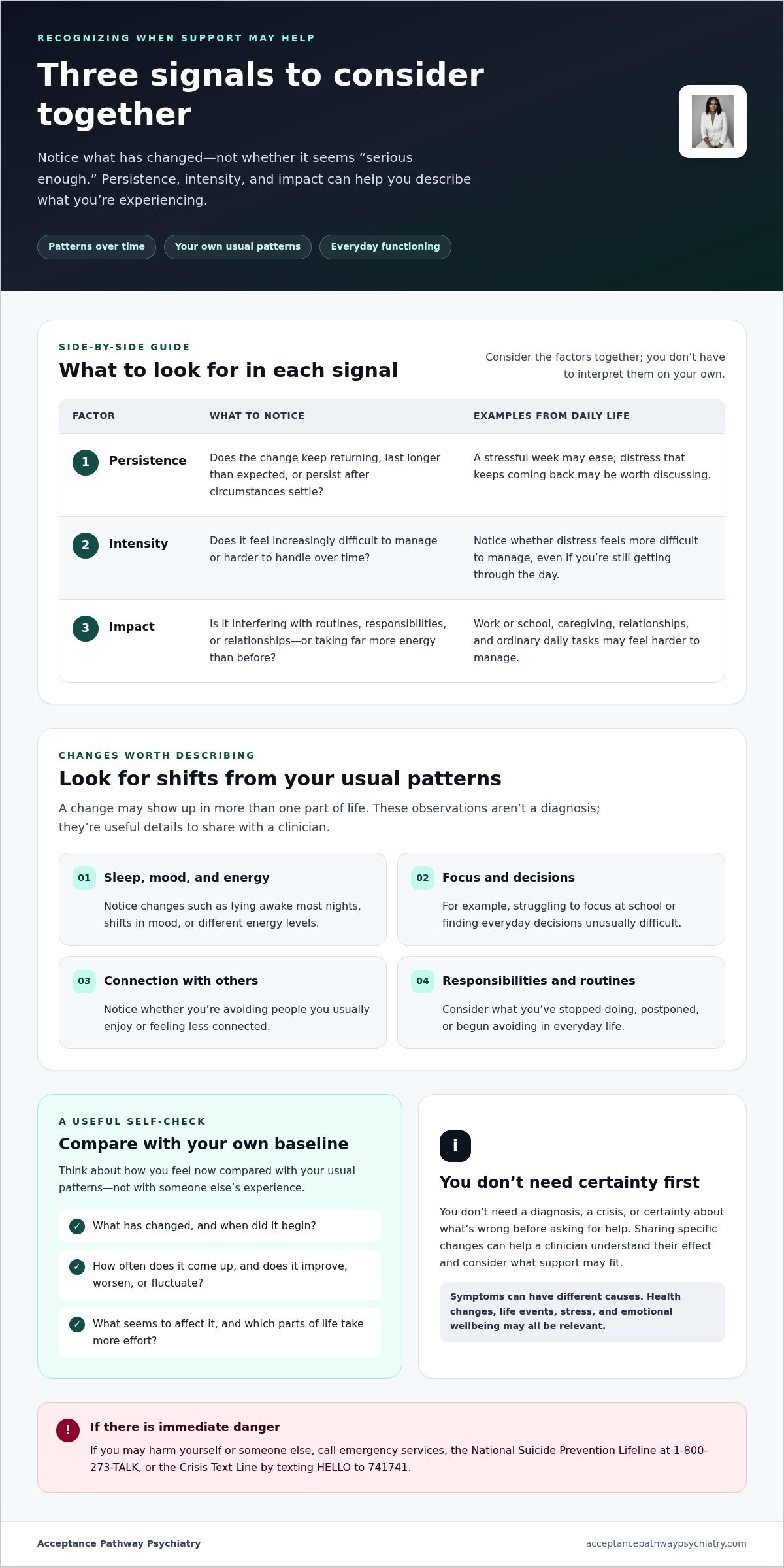
You don’t need a diagnosis, a crisis, or certainty about what’s wrong before asking for help. If you’re wondering how to know if you need a psychiatrist, start by noticing what has changed and how it affects you. One difficult day happens to everyone. Changes that persist, return, intensify, or make everyday responsibilities harder may be worth discussing with a professional.
Look at three factors together: persistence, intensity, and impact. A stressful week may ease as circumstances settle. But if distress keeps returning, feels increasingly difficult to manage, or interferes with routines and relationships, it may help to talk with a clinician. You don’t have to decide what the symptoms mean on your own.
Notice shifts in sleep, mood, concentration, energy, or how connected you feel to others. A change might mean lying awake most nights, struggling to focus at school, avoiding people you usually enjoy, or finding everyday decisions unusually difficult. These observations aren’t a diagnosis, but they’re useful details to share during an evaluation. A clinician can explore possible explanations and the context around them. For a general overview of the field, see What is psychiatry?
When emotional or behavioral changes deserve attention
Changes deserve attention when they keep returning, last longer than you expected, or feel harder to handle over time. Anxiety, depression, panic, mood shifts, trauma responses, and sleep difficulties are examples of concerns people may bring to a clinician. They aren’t a diagnostic checklist, and experiencing one doesn’t automatically mean you have a mental health condition. A professional assessment can help make sense of what’s happening.
Symptoms can have different causes, and more than one factor may be involved. Health changes, life events, stress, and emotional wellbeing can all be relevant. Rather than labeling yourself, note when the change began, what seems to affect it, and whether it has improved, worsened, or fluctuated. That context can help a clinician explore your concerns carefully.
How symptoms may affect everyday functioning
Consider which parts of life take more effort than they used to. Are you finding it harder to meet responsibilities at work or school, care for someone, stay present in relationships, or keep up with daily routines? You might still be managing, but using far more energy than before. Struggling to do ordinary tasks can be meaningful, even if others don’t see it.
- Notice what you’ve stopped doing, postponed, or begun avoiding.
- Pay attention to changes in focus, follow-through, patience, or connection with others.
- Compare how you feel now with your own usual patterns, not with someone else’s experience.
You don’t need to prove that things are “bad enough.” Sharing specific changes can help a clinician understand their effect and consider what support may fit. If you’re in immediate danger or may harm yourself or someone else, call emergency services, the National Suicide Prevention Lifeline at 1-800-273-TALK, or the Crisis Text Line by texting HELLO to 741741.
What a psychiatric evaluation can clarify about your concerns
A psychiatric evaluation is a structured conversation about what you’ve been experiencing, your health history, and what you hope to understand or change. It gives you and the clinician a chance to look beyond a single difficult moment and consider how symptoms have developed, what may influence them, and what support could be appropriate. At Acceptance Pathway Psychiatry, an initial evaluation typically lasts 60 to 90 minutes.
The goal isn’t to fit you into a label as quickly as possible. A clinician considers patterns, timing, personal circumstances, and relevant health information before discussing possible explanations. The same concern, such as trouble concentrating, may have different contributing factors for different people. More context can help shape a thoughtful assessment and clarify whether psychiatric care, therapy, or another support approach may suit your needs.
An evaluation doesn’t automatically result in a diagnosis or prescription, and having one doesn’t commit you to a particular treatment. It’s a chance to ask questions, share your priorities, and understand possible next steps. If you’re still considering how to know if you need a psychiatrist, learning what an assessment involves may make the decision feel more manageable. Signs you might need a psychiatrist can also offer a general overview of concerns people may discuss with a psychiatrist.
What information may help a clinician understand your experience
You don’t need a perfect timeline or a prepared explanation. A few notes can help you describe what’s happening and what you’d like help understanding. Consider when the concern began, how often it comes up, whether its intensity changes, and what seems to affect it. You might also note relevant changes in sleep, mood, concentration, health, medications, relationships, or life circumstances.
Bring questions that matter to you, such as what the assessment may clarify or which support options could be considered. If a topic feels difficult to discuss, you can say so and share what feels manageable during the appointment. It’s okay to start with the concern that feels easiest to explain.
Why symptoms do not establish a diagnosis by themselves
Different health conditions and life circumstances can overlap in how they affect mood, sleep, energy, or focus. That’s why one symptom alone can’t tell the whole story. A clinician explores how concerns relate to one another, when they occur, and what else may be happening in your life before considering possible explanations.
Assessment is a process of exploring, not a test you have to pass. Use the conversation to describe your experience, ask what remains uncertain, and discuss a useful next step. If a psychiatric evaluation feels appropriate, learn about psychiatric evaluations at Acceptance Pathway Psychiatry.
Psychiatrist, therapy, or both: how to think about the next step
You don’t have to know exactly what kind of care you need before getting started. A psychiatric evaluation can help when you have questions about diagnosis, medication, or whether health factors may relate to what you’re experiencing. Therapy offers a space to explore thoughts, emotions, behavior, and ways of coping with a clinician. Some people choose one approach; others consider both.
A psychiatric evaluation doesn’t mean medication is required. Medication management may be discussed if it fits your concerns and preferences, but it’s one possible part of care, not an automatic outcome. Therapy can also be a meaningful support on its own or alongside psychiatric care. For a fuller explanation of how professional roles differ, see the separate psychiatrist-versus-therapist article.
Questions that may point toward a psychiatric evaluation
You might consider an evaluation if concerns keep returning, disrupt parts of your life, or feel difficult to understand. These questions can help you identify what you want from an initial conversation. None of them, or any single symptom, proves that psychiatric treatment is necessary. They’re starting points for discussion.
- Would I like help understanding what may be contributing to my experience?
- Do I have questions about whether medication could be an option for me?
- Could my health history or current medications be relevant to these concerns?
- Would it help to discuss therapy, psychiatric care, or a combination?
When therapy may be part of the conversation
Therapy can help you examine patterns, make sense of emotions, and build ways to cope with challenges. Individual therapy and other therapy formats may be considered according to your needs. If medication is part of what you’re wondering about, you can discuss your questions without committing to a particular choice. This psychiatric medication management guide explains how medication options can be approached as part of individualized care.
Use this quick reflection table to connect what’s on your mind with a question to bring to an initial conversation. You don’t need to have every answer before you begin.
| What you’re considering | A question to bring |
|---|---|
| Understanding a persistent or disruptive concern | Could an evaluation help clarify what may be contributing? |
| Medication as a possible option | What factors would guide whether medication is appropriate for me? |
| Exploring thoughts, feelings, or coping patterns | Could therapy support the goals I have right now? |
| Considering more than one kind of support | How might therapy and psychiatric care work together? |
Your priorities matter. Start with the question that feels most important and talk through possible options at a manageable pace.
How to prepare for a first conversation about psychiatric care
You don’t need to arrive with a diagnosis or a perfectly organized account of what’s happening. A few notes can help you explain what concerns you and what you hope to get from the conversation. The aim is to share enough to begin exploring your needs, not to prepare a case or decide on treatment in advance.
Try this simple sequence:
- Identify your main concerns. Choose the changes or questions you most want to discuss.
- Note their impact. Consider how they affect your routines, relationships, work, school, or caregiving.
- Gather relevant history. Write down current medications and health or treatment details you think may matter.
- Prepare questions. Include what you’d like to understand about symptoms, diagnosis, therapy, or medication.
Your priority might be making sense of a change, learning what support could fit, or simply having a place to talk it through. It’s okay if that priority changes during the appointment.
A simple notes list to bring to an appointment
Keep the notes brief and practical. Record when a concern began, how often it occurs, what seems to affect it, and whether it has changed over time. Add examples of how it affects daily activities, along with relevant health or treatment history and a list of current medications, if available. A short list is enough; you don’t have to document everything.
For attention-related concerns, a clinician can discuss whether additional information may help guide the evaluation. Creyos Cognitive Testing is an optional, provider-referred, self-pay supportive clinical tool. It’s an online, gamified assessment and doesn’t replace a full neuropsychological evaluation. Short assessments take 15 to 20 minutes; comprehensive assessments can take up to 40 minutes or longer. They can be completed at home on a desktop, laptop, or tablet. You can learn more about cognitive assessment for ADHD as one way to understand this kind of testing.
What to expect from an initial evaluation
An initial Psychiatric Evaluation typically lasts 60 to 90 minutes. The clinician may ask about your current concerns, health and treatment history, goals, and daily functioning. The conversation is meant to build understanding, not require you to accept a specific diagnosis or treatment. You can ask for clarification, share what feels manageable, and take part in discussing possible next steps.
In-person and telepsychiatry appointments are available. For a telepsychiatry appointment, you’ll need a reliable internet connection and a private space. The appointment format and setting that help you feel comfortable can be part of your preparation, too.
If you’re ready to explore whether an evaluation may be useful, you can learn about psychiatric evaluations with Acceptance Pathway Psychiatry. You don’t need to have every answer before beginning the conversation.
Taking a supportive next step with Acceptance Pathway Psychiatry
Deciding to seek help can bring up mixed feelings. You may want clarity while also feeling unsure about what an appointment might lead to. Acceptance Pathway Psychiatry PLLC offers Psychiatric Evaluations, Medication Management, and therapy in a compassionate, evidence-based, collaborative, and non-judgmental setting. The first conversation is an opportunity to share what’s happening and explore what kind of support may fit, not a test you need to pass.
Care is shaped around individual needs. An evaluation can help you and the clinician discuss your concerns, health history, and goals, then consider possible next steps together. You can raise questions, explain what matters most, and take time to understand the options. If you’re still weighing how to know if you need a psychiatrist, start by describing what has changed and what you hope to clarify.
Care options can be discussed collaboratively
After learning about your concerns, a clinician can discuss evaluation findings and possible next steps with you. Psychotherapy may offer a place to explore thoughts, emotions, behaviors, and coping. Medication management may also be considered when it aligns with your needs and preferences. These are options to discuss, not requirements or guaranteed outcomes. Ask about the purpose of each approach and share any concerns before deciding what feels appropriate.
Acceptance Pathway Psychiatry offers in-person appointments and telepsychiatry. For a telepsychiatry appointment, you’ll need a reliable internet connection and a private space. Thinking about which format would help you feel comfortable can be one small part of planning your first conversation.
Choose a manageable way to reach out
You can request an appointment by phone, email, or online form. When you reach out, share that you’re interested in an evaluation, mention the main question you’d like help exploring, and state whether you prefer an in-person or telepsychiatry appointment. You don’t need to explain everything at once. A short message that names your concern and preferred way to connect is a reasonable beginning.
If you’re ready to take that step, learn about care or request an appointment with Acceptance Pathway Psychiatry. Writing down questions beforehand, such as what an evaluation involves or how treatment options are discussed, can help you feel prepared while leaving room for the conversation to follow what matters most to you.
Seeking an evaluation is a conversation, not a commitment to a specific treatment. You remain part of decisions about what happens next, and it’s okay to take the process one step at a time.
Let your next step begin with a question
You don’t have to feel completely certain before seeking support. If you’re still asking how to know if you need a psychiatrist, let that question be a starting point, not a test you must answer alone. Begin by sharing what you’re unsure about and what you hope might feel different. A thoughtful conversation can help you consider your options at a pace that respects your needs and preferences.
At Acceptance Pathway Psychiatry, care is compassionate, evidence-based, and collaborative. Bring your questions and take time to understand what different forms of support may involve. Reaching out doesn’t mean you’ve agreed to a particular diagnosis or treatment. It opens the door to discussing what could be helpful.
If you’re ready to explore that possibility, explore psychiatric care and request an appointment. You deserve to be met with care and respect as you decide what comes next. One manageable step is enough to begin.
Frequently Asked Questions
How do I know if I need a psychiatrist or just need more time?
There’s no fixed amount of time you must wait before asking for help. If you’re unsure how to know if you need a psychiatrist, consider whether the concern is easing or instead returning, intensifying, or making daily life harder. You can seek an evaluation while still uncertain; it’s a way to explore what’s happening, not a declaration that something is seriously wrong. If you feel unsafe, contact emergency services, the National Suicide Prevention Lifeline at 1-800-273-TALK, or the Crisis Text Line by texting HELLO to 741741.
Can I see a psychiatrist even if I do not want medication?
Yes. You can seek a psychiatric evaluation to discuss concerns, understand possible explanations, or ask whether your health history may relate to symptoms, even if you don’t want medication. You can state that preference at the beginning of the conversation and ask about non-medication approaches, such as therapy. A clinician can discuss options with you, and you can ask questions before deciding whether a recommended next step feels right.
What happens during a first psychiatric evaluation?
A first evaluation is a clinical conversation, not a test you need to pass. The clinician may ask what prompted you to seek care, what you hope to understand, and what you’ve already tried. If a question feels unclear, ask what the clinician is trying to learn from it. You can correct details or say when you’re unsure; an honest, approximate answer is more useful than feeling pressured to provide a perfect account.
How long should mental health symptoms last before I seek help?
You don’t have to wait for symptoms to last a specific number of days or weeks. Consider seeking support if they’re troubling you, keep returning, or affect sleep, responsibilities, or relationships, even if the pattern is recent. For example, a sudden change that interferes with caring for yourself deserves attention without waiting for a set timeline. If symptoms are severe, rapidly worsening, or involve immediate danger, contact emergency services, the National Suicide Prevention Lifeline at 1-800-273-TALK, or the Crisis Text Line by texting HELLO to 741741.
Is a psychiatric evaluation the same as a diagnosis?
No. An evaluation is the process of understanding your concerns and considering what may explain them; a diagnosis is one possible outcome, not an automatic result. The clinician may discuss a diagnosis, explain that more information is needed, or focus on possible support options. You can ask what a conclusion means, what information it’s based on, and whether there are other explanations to consider.
What if I am worried about someone else who may need a psychiatrist?
Share what you’ve noticed without assigning a diagnosis. You might say, “I’ve noticed you seem overwhelmed lately, and I’m here if you want to talk.” Listen, ask what kind of support they’d welcome, and offer practical help, such as sitting with them while they look into care. If they may be in immediate danger, contact emergency services, the National Suicide Prevention Lifeline at 1-800-273-TALK, or the Crisis Text Line by texting HELLO to 741741.
Can I have a psychiatric appointment online?
Yes. Acceptance Pathway Psychiatry offers telepsychiatry appointments. You’ll need a reliable internet connection and a private space for the visit. Beforehand, choose a place where you can speak comfortably, check that your device is charged, and keep any notes you want to refer to nearby.


