

What if “my therapist recommended a psychiatrist” is an invitation to explore more support, not a sign that something is terribly wrong? It’s understandable if the suggestion brings up worries that therapy has failed or that you’ll be expected to take medication. A referral isn’t a verdict, and it doesn’t commit you to a particular treatment.
Your therapist may see psychiatric care as one way to better understand what you’re experiencing or consider additional options alongside therapy. You can ask what prompted the recommendation and share your concerns before deciding what feels right.
This guide explains what the recommendation may mean, what to expect from a psychiatric evaluation, and how to prepare questions for a first appointment. You’ll also learn how therapy and psychiatric care can work together, so you can consider next steps at your own pace and make an informed decision with your care team.
Key Takeaways
- “My therapist recommended a psychiatrist” can be a chance to explore another perspective, not proof that therapy has failed.
- A psychiatric evaluation is a conversation about your concerns, health history, goals, and possible care options. Acceptance Pathway Psychiatry’s initial evaluations typically last 60 to 90 minutes.
- Psychiatric care and therapy may complement each other, and a referral doesn’t mean you have to take medication.
- Ask your therapist what they hope a psychiatric consultation will add, then take time to consider your questions and next steps.
- A collaborative evaluation gives you an opportunity to discuss care options at a pace that feels right for you.
My Therapist Recommended a Psychiatrist: What Could the Recommendation Mean?
Hearing a therapist suggest a psychiatrist can catch you off guard. You might wonder whether they think your situation is more serious than you realized, or whether you’ve done something wrong in therapy. Those reactions are understandable, but the recommendation alone doesn’t establish a diagnosis or explain exactly what your therapist believes is happening.
Think of it as an invitation to consider another perspective. A psychiatrist is a medical doctor with specialized training in mental health. If you’re unfamiliar with the role, What is a Psychiatrist? offers a basic overview. A consultation gives you a chance to discuss your concerns and consider options with a clinician who approaches mental health from a medical perspective.
Why might a therapist suggest a psychiatric consultation?
Your therapist may believe a medical evaluation could help clarify symptoms, explore treatment options, or address questions that have come up in therapy. You might discuss changes in sleep, concentration, or mood, or how stress is affecting your daily routine. These are examples of topics to discuss, not evidence of a particular condition.
Ongoing distress or limited progress may also prompt a therapist to suggest another perspective. That doesn’t mean therapy has failed. It may be an opportunity to consider whether additional support or a different approach could be useful. The reason varies from person to person, so ask your therapist what led to the recommendation and what they hope a consultation might add.
If the suggestion feels unclear, you could ask:
- What have you noticed that makes you recommend a psychiatric consultation?
- What questions or concerns might an evaluation help address?
- How might psychiatric care fit alongside the work we’re doing in therapy?
A specific answer can replace guesswork with a clearer understanding of your therapist’s thinking. You can also tell them if the recommendation makes you anxious or brings up past experiences with care. Your response is part of the conversation, not a reason to feel judged.
Does a psychiatrist recommendation mean I have to take medication?
No. Attending an evaluation doesn’t commit you to medication. A consultation is an opportunity to talk about what you’re experiencing and consider possible next steps. If medication comes up, you can discuss potential benefits, concerns, alternatives, and how each option relates to your preferences and goals.
You’re allowed to ask questions, take time to think, and share what you do or don’t feel comfortable considering. Medication may be one option to discuss, but it isn’t automatically required or the right choice for every person or situation. A thoughtful conversation makes room for your perspective.
A referral is a suggestion to explore support, not a diagnosis or an obligation. If my therapist recommended a psychiatrist is the thought weighing on you, you don’t have to interpret it as a verdict. Start by asking what prompted the suggestion. Understanding the reason can help you decide what, if anything, you’d like to explore next.
What Happens During a Psychiatric Evaluation After a Referral?
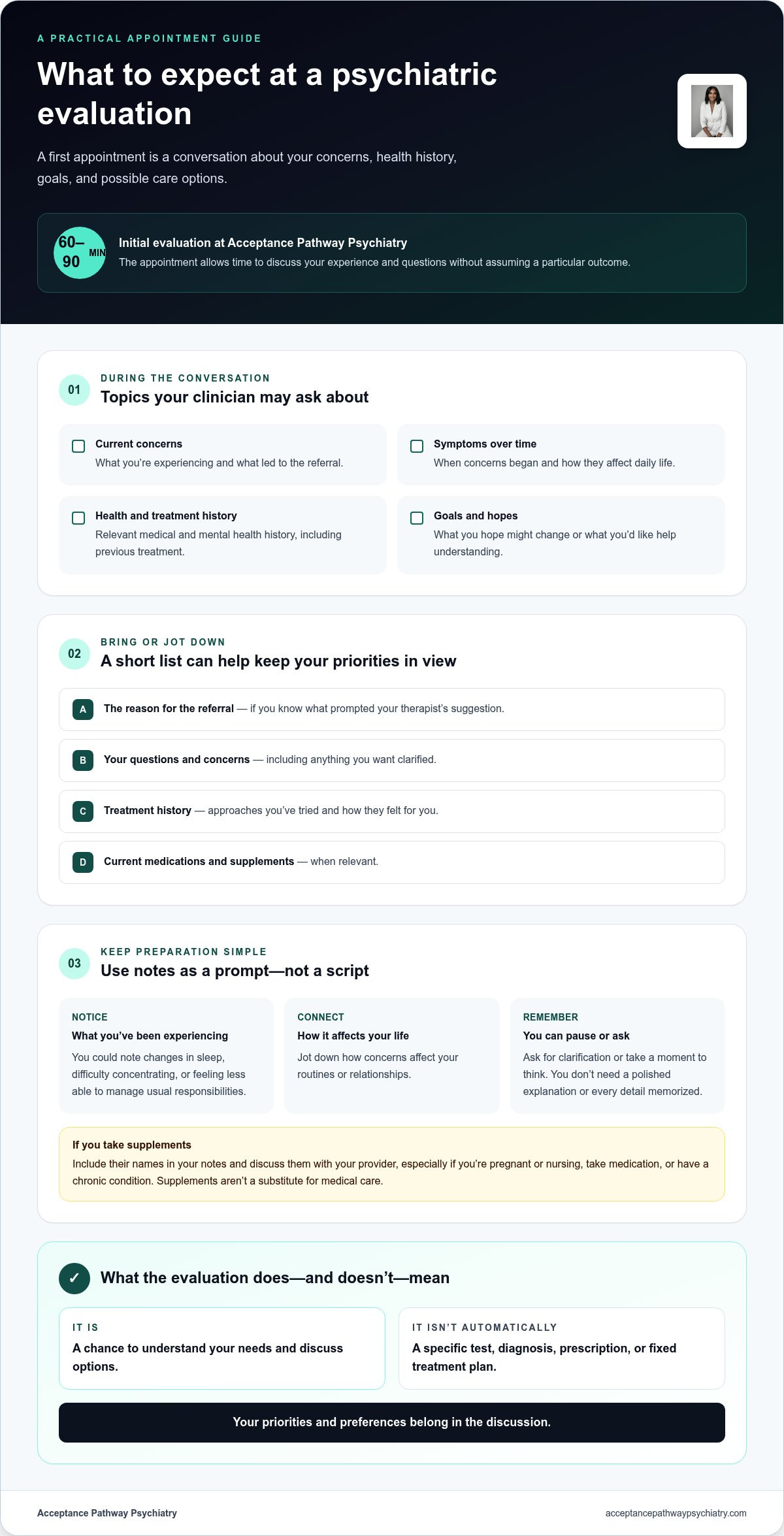
If my therapist recommended a psychiatrist, knowing what the first appointment may involve can make the next step feel less uncertain. A psychiatric evaluation is a conversation about your concerns, health history, goals, and possible care options. At Acceptance Pathway Psychiatry, an initial psychiatric evaluation lasts 60 to 90 minutes. That time allows you to discuss your experience and questions without assuming a particular outcome.
The clinician may ask about your symptoms, when they began, how they affect daily life, and what you’ve already tried. They may also discuss relevant medical and mental health history, including previous treatment. Share what feels most important, even if you’re not yet sure how to explain it.
What topics may come up at the first appointment?
The conversation can cover what led to the referral, your current concerns, and what you hope might change. To help you prepare, bring or jot down:
- The reason your therapist suggested a consultation, if you know it
- Questions you want answered and concerns you’d like to discuss
- Relevant treatment history, including approaches you’ve tried and how they felt for you
- Current medications and supplements, when relevant
You don’t need to arrive with a polished explanation or remember every detail. Your priorities and preferences belong in the discussion. The clinician may ask follow-up questions to understand your perspective, but the evaluation doesn’t guarantee that a specific test, diagnosis, or treatment decision will happen during that visit.
How can I prepare without feeling overwhelmed?
Keep preparation simple. Write a short list of what you’ve noticed, how it affects your routines or relationships, and what you’d like help understanding. You might note changes in sleep, difficulty concentrating, or feeling less able to manage usual responsibilities. Bring the list and use it as a prompt if you feel nervous.
If you take supplements, include their names in your notes and discuss them with your provider, especially if you’re pregnant or nursing, take medication, or have a chronic condition. Supplements aren’t a substitute for medical care. If you’re unsure what a question means or need a moment to think, it’s okay to ask for clarification or pause before responding.
An evaluation is a chance to understand your needs and discuss options, not an automatic prescription or a fixed treatment plan. You can ask what a recommendation involves, share what matters to you, and take time to consider possible next steps. The purpose is an informed conversation, not arriving with all the answers.
Acceptance Pathway Psychiatry offers psychiatric evaluations through a compassionate, collaborative approach. Learn more about psychiatric evaluation and care.
Therapy, Psychiatry, and Medication: How Can These Options Fit Together?
Therapy and psychiatric care can address different parts of your well-being. Psychotherapy often offers space to explore emotions, relationships, patterns, and personal goals while building coping skills. Psychiatric care may include an evaluation of symptoms and health history, followed by a discussion of possible care options, including medication when appropriate.
These approaches don’t have to compete. Some people continue therapy while also consulting a psychiatrist. Others may choose one form of support or explore options over time. There’s no single combination that suits everyone, and a referral doesn’t mean your current care is inadequate. If my therapist recommended a psychiatrist has left you wondering whether medication is expected, remember that an evaluation is a conversation, not a commitment to begin treatment.
What does each type of support focus on?
Psychotherapy can help you make sense of your experiences and work toward goals through conversation, reflection, and practical skills. Psychiatric care adds a medical perspective. A clinician can discuss symptoms and relevant health factors, then consider whether medication management or another option may fit your needs. Neither approach is universally better. Your priorities and circumstances matter when deciding what support to explore.
Medication is one possible topic, not an automatic outcome. You can ask about potential benefits, concerns, alternatives, and how an option might fit with your goals. You can also say that you’re not ready to consider medication. A collaborative discussion makes room for your preferences instead of treating a particular treatment path as settled.
For a closer look at how the two forms of support may work alongside each other, explore this guide to combining therapy and medication management.
Can my therapist and psychiatrist work together?
Coordination may help your care team understand shared goals and keep their approaches aligned, but it’s an option rather than a requirement. You can decide whether you want your therapist and psychiatric clinician to communicate. If you do, ask what information might be shared, how your consent is handled, and what you’d prefer to keep within each relationship.
For example, you might want both clinicians to understand that improving sleep or managing anxiety is a priority, while still discussing sensitive topics privately in therapy. You can also ask whether you’ll be involved in any communication between them. Your comfort matters, and you can raise questions before agreeing to share information.
The goal isn’t to choose a “right” combination once and for all. It’s to understand what each kind of support offers and make choices that reflect your needs. At Acceptance Pathway Psychiatry, psychiatric evaluation and medication management can support an informed conversation about care options, while psychotherapy offers space for ongoing emotional exploration and personal goals. Your care can be discussed collaboratively, with your perspective included.
What Should I Do After My Therapist Recommends a Psychiatrist?
If my therapist recommended a psychiatrist is on your mind, you don’t have to decide everything at once. Take the next step in a way that helps you feel informed, rather than pressured. A simple sequence can turn an unexpected suggestion into a manageable choice.
- Ask. Find out what your therapist hopes a psychiatric consultation could add.
- Reflect. Notice what feels unclear or concerning, including questions about medication or sharing information.
- Decide. Consider whether you want to schedule an evaluation now or discuss the recommendation further with your therapist first.
- Prepare. Write down your questions and priorities so you have them handy during the appointment.
There’s no need to treat the recommendation as an instruction to act immediately. A conversation with your therapist can help you understand their reasoning and decide whether an evaluation feels useful to you.
What questions can I ask my therapist first?
It’s okay to be direct, especially if the suggestion felt confusing or uncomfortable. You might ask:
- What concerns led you to recommend a psychiatric consultation?
- What could an evaluation help clarify?
- Would you be open to sharing relevant background with the psychiatrist if I consent?
Being honest about your reaction can help your therapist respond to what you need, not just explain the referral.
What questions can I bring to a psychiatrist?
Use your appointment to discuss what you hope to understand and what matters to you. For example, ask what the evaluation may clarify, what care options could be discussed, and how follow-up might work. If medication is a concern, say so and ask about potential benefits, possible side effects, and alternatives. You can also discuss your goals and preferred pace.
If you’d like your psychiatrist and therapist to coordinate, ask how that communication would work and what information might be shared. You can raise questions about consent before agreeing to any information exchange. Coordination can be helpful for some people, but it doesn’t have to happen automatically.
Consider practical details, too. Psychiatric care at Acceptance Pathway Psychiatry is available in person and through telepsychiatry. A telepsychiatry appointment requires a reliable internet connection and a private space. Choosing a format that fits your circumstances may make it easier to take part in the conversation. You can consider the options at your own pace.
Before an appointment, keep a short note on your phone or on paper with your main questions, current concerns, and relevant treatment history. You don’t need to prepare a perfect summary. If something isn’t clear during the discussion, ask the clinician to explain it in different words. You can also say you need time to think before deciding on a suggested next step.
If you’re ready to explore a psychiatric evaluation, learn about psychiatric care with Acceptance Pathway Psychiatry.
Explore Psychiatric Support in a Safe, Collaborative Space
If your therapist recommended a psychiatrist, exploring the suggestion can start with a conversation that respects your questions and preferences. Acceptance Pathway Psychiatry PLLC offers compassionate, evidence-based psychiatric evaluations and medication management. The goal is to discuss your concerns and possible care options together, not to assume that one treatment path is right for everyone.
A psychiatric evaluation gives you a chance to share what has been going on, what you hope to understand, and what matters to you as you consider support. Medication management provides a setting to discuss medication options when appropriate, including your questions and preferences. You can raise uncertainty openly, whether you’re unsure what an evaluation involves or simply want to learn before making decisions.
What can collaborative psychiatric care look like?
Collaborative care begins by making room for your perspective. A clinician can discuss your concerns, priorities, and goals with you, then consider possible next steps together. That conversation may include psychiatric evaluation, medication management, or psychotherapy, depending on what is relevant to your needs. There isn’t one plan or combination that applies to every person.
If you’re already working with a therapist, coordination may be considered when you want it and consent to information sharing. You can discuss what would be useful to communicate and what questions you’d like each clinician to address. Your preferences remain part of the conversation as you explore the kind of support that feels appropriate.
How can I take a first step when I feel ready?
When you’re ready to explore care, appointments may be scheduled by phone, email, or online form. You don’t need to have every concern neatly organized before reaching out. Questions, hesitation, and uncertainty can all be part of an initial conversation. You can begin by explaining what prompted your interest and what you’d like to learn.
Care is available in person and through telepsychiatry. For a virtual visit, you’ll need a reliable internet connection and a private space. Thinking about which format would feel more comfortable can help you plan, without requiring you to have every detail figured out in advance.
Acceptance Pathway Psychiatry’s approach is collaborative and non-judgmental. You can share what you’re comfortable discussing and ask for clarification as you go. Exploring psychiatric support doesn’t require you to commit to medication or a specific treatment plan. If you feel ready, contact Acceptance Pathway Psychiatry to schedule an appointment.
If you or someone else is in immediate danger or experiencing a crisis, contact emergency services, call 1-800-273-TALK, or text HELLO to 741741. These resources are for crisis support, rather than routine appointment scheduling.
Take Your Next Step at a Pace That Feels Right
If my therapist recommended a psychiatrist, you can let your next step reflect what matters to you, not only the surprise of hearing the suggestion. You don’t need to arrive with a firm decision about treatment. It’s enough to be curious about what a conversation might help you understand.
You might begin by naming one question you want answered or thinking about what would help you feel heard. After a conversation, give yourself room to reflect: What felt useful? What remains unclear? What next step feels manageable? You’re an active participant in shaping your care, and taking time to consider your choices is part of that process.
If you feel ready to explore psychiatric support, explore compassionate psychiatric care and appointment options. Acceptance Pathway Psychiatry’s collaborative approach makes room for your questions and preferences as you consider what support may fit.
You don’t have to have every answer before beginning. One thoughtful step can be enough, and you can build from there with care and self-respect.
Frequently Asked Questions
Is it normal for a therapist to recommend a psychiatrist?
Yes. A therapist may suggest a psychiatric consultation when another perspective or additional support could be useful. The recommendation alone doesn’t establish a diagnosis or mean your symptoms are severe. Ask what prompted the suggestion and what your therapist hopes a consultation might clarify. Their explanation can help you understand the recommendation and decide what it means for you.
Does seeing a psychiatrist mean I have to take medication?
No. An appointment is a chance to discuss your concerns, relevant history, goals, and possible care options. You can tell the clinician what you’re comfortable considering and ask questions before making decisions. If you’re worried about side effects or prefer to explore alternatives, say so. You don’t need to agree to a treatment simply because it’s discussed. Gathering information can be a useful first step.
Can I keep seeing my therapist after a psychiatrist referral?
In many situations, people continue therapy while also exploring psychiatric care. The two services may support different needs, so a referral doesn’t automatically mean therapy is ending. If you want your clinicians to coordinate, discuss that with your therapist and ask what information would be shared. Communication should reflect your wishes and consent. You can also ask how ongoing therapy might fit with any recommendations, rather than assuming either clinician will make that decision for you.
What should I tell a psychiatrist at my first appointment?
Start with what’s bothering you now and how it affects everyday life, such as work, sleep, relationships, or routines. Mention relevant care you’ve tried, what felt helpful or unhelpful, and what you’d like to be different. A short question list can keep your priorities in view. Bring information about current medications or supplements if relevant. You don’t need a perfect timeline. Ask the clinician to explain unfamiliar terms or recommendations in plain language.
How long does an initial psychiatric evaluation take?
At Acceptance Pathway Psychiatry, an initial psychiatric evaluation lasts 60 to 90 minutes. That time allows for discussion of your concerns, relevant history, goals, and possible next steps. Appointment lengths can differ across practices, so don’t assume another clinician follows the same schedule. The length of a visit also doesn’t mean a particular diagnosis or treatment decision will necessarily be reached. Use the time to ask questions and make sure your main concerns are heard.
What happens if I feel uncomfortable with the recommendation?
Feeling uncertain or uncomfortable is a valid reason to ask for more context. Tell your therapist what feels difficult, whether it’s concern about medication, not knowing what an evaluation involves, or something else. Ask them to explain why they suggested it and what they hope you’ll learn. You can take time to consider that information. A consultation can help you gather perspective, but you don’t have to agree to every option discussed.
Can I have a psychiatric appointment online?
Yes. Acceptance Pathway Psychiatry offers telepsychiatry appointments. A virtual visit requires a reliable internet connection and a private space so you can participate comfortably and speak without others overhearing. Before scheduling, consider whether you’ll have both during the appointment. If you have questions about taking part online, raise them when arranging your visit. Telepsychiatry is an appointment option, not a substitute for emergency support when someone needs immediate help.
What should I do if I am in a mental health crisis right now?
If you’re in immediate danger or facing a mental health crisis, contact emergency services now. Acceptance Pathway Psychiatry doesn’t provide urgent or emergency care for new clients, so don’t wait for a routine appointment. You can also call the National Suicide Prevention Lifeline at 1-800-273-TALK or text HELLO to 741741 for the Crisis Text Line. Reaching out for crisis support is a practical step toward getting help in the moment.


