

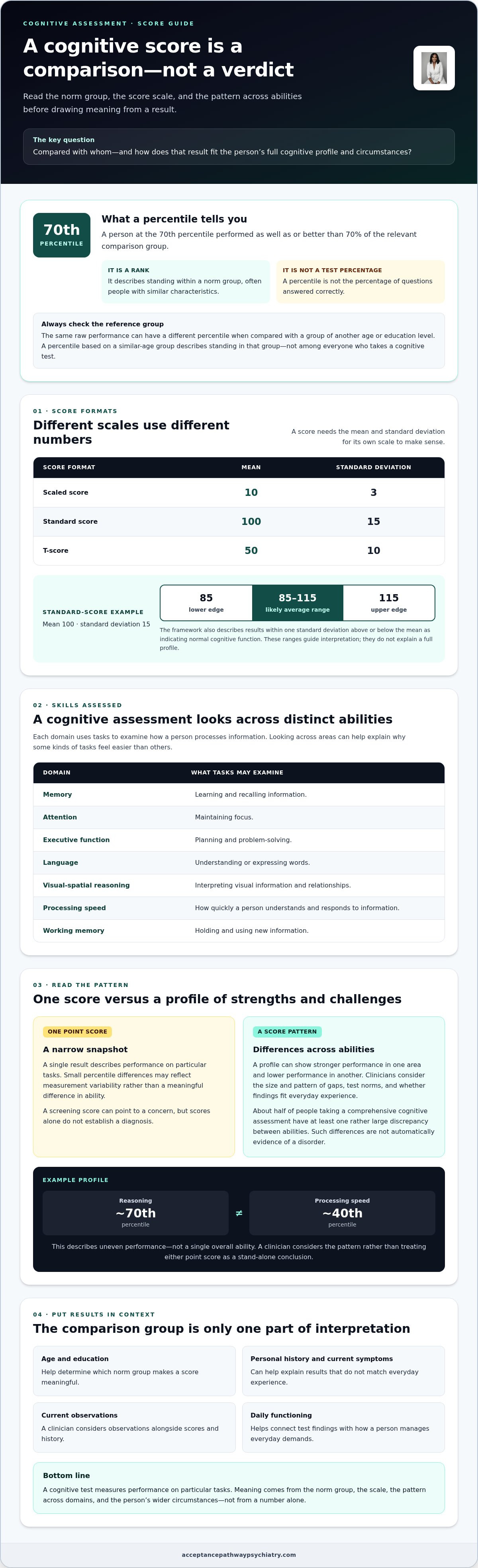
A score is a comparison, not a verdict. Cognitive tests measure skills such as memory, attention, reasoning, and processing speed, and interpreting cognitive assessment results means considering how a person performed relative to an appropriate comparison group. A score at the 70th percentile means the person performed as well as or better than 70% of that group.
It’s understandable to focus on the number, especially when a result seems higher or lower than expected. But age, education, personal history, current symptoms, and differences between cognitive skills all shape what a score may mean.
This article explains what cognitive tests measure, how age-adjusted comparisons work, and why a screening result can’t tell the whole story on its own. You’ll also learn how clinicians consider results alongside a person’s circumstances and when further assessment may help clarify the picture.
Key Takeaways
- Read scores as part of a pattern of cognitive strengths and challenges, not as a verdict about ability.
- Consider how age and education affect which comparison group makes a score meaningful.
- Use personal history and current symptoms to understand results that may not match everyday experience.
- Recognize that a screening score can point to a concern, but it cannot identify a specific condition or its cause on its own.
What Is a Cognitive Test?
A cognitive test measures abilities such as reasoning, memory, or processing speed and compares scores with a norm group. Results can help identify patterns relevant to learning or cognitive disorders, but scores alone don’t establish a diagnosis.
Reading Norm-Based Scores and Percentiles
A norm-based score shows how performance compares with a reference group, often people with similar characteristics, such as age or educational background. A percentile expresses that comparison as a rank. At the 70th percentile, a person performed as well as or better than 70% of the comparison group.
A percentile isn't the percentage of questions answered correctly. A percentile rank of 50 means the person scored better than 50% of the normative sample. The specific norm group matters: the same raw performance can have a different percentile when compared with a group of another age or education level.
Before interpreting a percentile, check the norm group named in the report. For example, if a report compares someone’s performance with that of people of a similar age, the percentile describes their standing within that group, not among everyone who takes a cognitive test. This context is essential when interpreting cognitive assessment results.
Understanding Score Bands and the Mean
A score band groups nearby results to show a range of performance, while the mean marks the average on a scale. Bands help prevent overreading a single point: small percentile differences may reflect measurement variability rather than a meaningful difference in ability.
Scales use different units, so a score needs its scale's mean and standard deviation for context. Common neuropsychological formats include scaled scores with a mean of 10 and standard deviation of 3, standard scores with a mean of 100 and standard deviation of 15, and T-scores with a mean of 50 and standard deviation of 10.
On a standard-score scale with a mean of 100 and standard deviation of 15, 85 to 115 is described as the likely average range. The framework also describes results within one standard deviation above or below the mean as indicating normal cognitive function. These ranges guide interpretation; they don't explain a person's full profile.
A profile can show stronger performance in one area and lower performance in another. About half of people taking a comprehensive cognitive assessment have at least one rather large discrepancy between abilities. Such differences aren’t automatically evidence of a disorder. Their meaning depends on the size and pattern of the gaps, the test’s norms, and whether the results fit the person’s everyday experience.
For example, a reasoning score around the 70th percentile alongside a processing-speed score around the 40th percentile describes uneven performance, not a single overall ability. A clinician considers score bands and patterns across the assessment rather than treating either point score as a stand-alone conclusion.
What Does a Cognitive Assessment Measure?
A cognitive assessment examines distinct areas of thinking, including memory, attention, executive function, language, and visual-spatial reasoning. A clinician interprets these domains alongside assessment findings, personal history, and current observations. For children, educators and child psychologists can help connect results with learning support.
Domains Assessed in Cognitive Testing
Cognitive domains are specific mental abilities assessed through tasks designed to examine how a person processes information. Memory tasks may test learning and recall, while attention tasks examine focus. Other tasks assess language, reasoning, executive function, and visual-spatial skills.
These areas help describe how thinking works across different demands. Executive function, for example, supports planning and problem-solving, while language tasks involve understanding or expressing words. Visual-spatial reasoning involves interpreting visual information and relationships. Looking at each domain can clarify why someone handles one kind of task comfortably but struggles with another.
Processing speed and working memory can also matter in a child’s learning profile. Processing speed reflects how quickly a child understands and responds to information, so difficulty may show up as slower task completion at school. Working memory involves holding and using new information, which can affect learning and problem-solving.
Interpreting Patterns Across Domains
A domain pattern describes how results compare across different cognitive abilities, rather than treating one score as the whole picture. Stronger reasoning alongside lower memory performance, for example, may point to different support needs than difficulties across several areas.
Memory and non-memory patterns can also guide follow-up questions. Significantly low memory scores alongside preserved performance in other domains may be consistent with amnestic mild cognitive impairment. In non-amnestic mild cognitive impairment, memory may be preserved while one or more other domains are impaired.
With the latter pattern, follow-up may look closely at judgment, problem-solving, and navigating everyday tasks. These patterns can inform further assessment, but they don’t establish a diagnosis by themselves. Interpreting cognitive assessment results means considering how domain findings fit with history, observations, and daily functioning.
Who Interprets Results and Uses Them?
A physician or other clinician considers assessment scores alongside a person’s history, diagnostic information, and current observations. This broader review matters because a cognitive test measures performance on particular tasks, not every aspect of a person’s life or health.
For children, educators and child psychologists can help families connect cognitive findings with classroom experiences and learning support. A cognitive assessment may clarify why a child performs well in some areas but has difficulty in others. It complements academic assessment, which focuses on learned knowledge and acquired skills, rather than replacing it.
For example, a child who has difficulty retaining new information may benefit from strategies that support memory, while slow task completion may call for attention to processing speed. This pattern helps families and educators consider targeted support and review how well it fits the child’s progress.
For a structured look at cognitive domains, Creyos Cognitive Testing is one option to consider as part of understanding a person’s cognitive profile.
Context from patient history and reported symptoms
A cognitive score describes performance during an assessment, while history and current symptoms help explain how that performance fits daily life. Clinicians consider results alongside patient history, other diagnostic information, and current observations, rather than treating a test as a stand-alone diagnosis.
For example, someone may report increasing difficulty remembering appointments even when a brief screening result appears typical. A normal screening score doesn’t rule out cognitive impairment when symptoms are present; further testing may help clarify the concern. Conversely, a score that raises questions needs to be understood in context, not treated as a diagnosis by itself.
How History and Symptoms Shape Interpretation
Sleep, mood, and medication history can all be relevant to reported changes in thinking. Insomnia and sleep apnea can significantly affect cognition, while major depression can also affect cognitive performance. These factors help explain why a person’s day-to-day functioning may differ from what a single test suggests.
Medication details matter, too. Side effects and drug interactions can contribute to cognitive difficulties in seniors, as can over-the-counter medications with strong anticholinergic properties. A useful history includes what the person has noticed, when the change began, and any relevant changes in sleep, mood, or medication. These details put assessment findings in practical context.
When interpreting cognitive assessment results, the key is how test findings fit the person’s reported experience. For instance, difficulty with reasoning or problem-solving may affect work tasks differently from trouble recalling recent conversations. Specific examples help distinguish a concern that shows up in daily life from an isolated test result.
Reading Reports and Considering Follow-Up
A report is easier to understand when read in parts: the assessment’s purpose, the skills measured, the person’s pattern of results, and the interpretation. Look for findings related to the concern that prompted testing and how the report connects them with observed functioning. A score without that context says less about everyday abilities.
Follow-up depends on the overall picture. If symptoms continue despite a normal screening score, additional testing may be needed. A below-normal screening result may lead to further assessment or a visit with a neurologist. When initial screenings show consistent results and no deficits, additional cognitive testing may not be needed.
To make a report actionable, connect its findings to specific situations. If memory difficulties interfere with following conversations, note an example. If attention affects task completion, describe when it happens. This gives the clinician clearer information to consider when deciding whether further evaluation or monitoring could help.
Useful questions include: Which findings relate most closely to my symptoms, and what other factors might affect them? Does this report suggest follow-up testing, and what changes in my daily functioning should I track?
Limitations of cognitive screening
A screening test offers a brief look at mental functioning, not a complete clinical explanation. Its findings can be useful, but it cannot identify a specific disease, the cause or location of brain impairment, or future decline with certainty.
Reliability and Validity Limits
Reliability concerns whether a test gives consistent results, while validity concerns whether it measures the ability it intends to assess. A short screen with 15 to 20 items is less valid than a full battery measuring the same ability. A small set of questions can miss difficulties that appear in other tasks or settings.
A screening score can flag a concern in mental functioning, but it cannot determine the severity or cause of impairment. For example, a low result doesn’t establish Alzheimer’s disease or dementia. It signals a reason to consider the person’s symptoms and other clinical information, rather than treating the score as a diagnosis.
Screening Compared With Comprehensive Assessment
A cognitive screen is a brief check for possible difficulty, while a comprehensive assessment uses more than one screening test and examines performance in greater detail. Neuropsychological testing refers to a more detailed assessment across cognitive domains.
This distinction matters when a screen doesn’t capture the person’s everyday experience. Someone might report language or spatial difficulties even though a brief screen doesn’t clearly show them. A broader assessment can examine multiple abilities and help clarify what a short result cannot explain.
Common screens vary in their tasks and duration. One test involving memorizing words, naming pictured objects, and copying a drawing takes about 15 minutes. Another, involving counting and identifying objects, takes about 10 minutes. A screen involving recalling three words and drawing a common object usually takes about three minutes.
Those tasks sample specific abilities. Recalling three words, for example, provides information about that task, not a complete account of memory, reasoning, attention, or problem-solving. A screening result is therefore an initial signal, not a full profile of how someone performs across different demands.
Online cognitive assessments can take as little as one hour. A longer format still needs careful interpretation: duration alone doesn’t show whether a test measures every ability relevant to someone’s concerns. The tasks included and the way results are interpreted shape what the assessment can tell someone.
When a screening result is below normal, follow-up testing can provide more information because screens aren’t designed to diagnose conditions on their own. A clinician considers the result alongside reported symptoms and other diagnostic information. This combination helps determine whether further assessment is useful, rather than asking one brief score to answer every clinical question.
Age-adjusted cognitive assessment results
Age adjustment compares a patient’s performance with that of people of a similar age, rather than applying one expectation to every age group. This matters because cognitive skills and test performance are interpreted against an appropriate comparison group, not by a raw score alone.
Age is one part of the comparison. Education level and background may also shape which norms make a score meaningful. A result that seems low compared with a broad population may look different against a norm group with similar characteristics. Interpreting cognitive assessment results therefore starts with understanding who the test uses as its reference group.
Some reports use T-scores, where average performance is set at 50. That value is a reference point, not a diagnosis or a complete description of ability. A patient reading a T-score should consider the specific cognitive skill measured, the norms applied, and how the finding fits the reason for evaluation.
For example, an age-adjusted result describes performance relative to the relevant age group. It doesn’t directly show how the same person’s skills have changed over time. Someone concerned about a recent change should consider the current finding alongside symptoms, history, and any earlier assessment results. The comparison group answers one question; change over time addresses another.
Age-adjusted scores also need careful interpretation in children. A cognitive assessment may identify strengths and areas of difficulty relative to a child’s age group, helping explain differences in learning. For instance, a child may reason well but take longer to complete classroom tasks. That pattern can help adults understand support needs without treating one score as a summary of the child’s potential.
Age context matters for adults, too. A provider may perform a cognitive test after age 65, even when no underlying condition affecting cognition is suspected. In that situation, age-adjusted results offer a comparison with peers, while reported symptoms and everyday function help frame what the evaluation means for that patient.
To understand a result, identify the norm group, the skill being evaluated, and whether the report uses an age-adjusted score. Then consider whether the finding matches changes in daily activities or learning. Age adjustment provides context; it doesn’t erase the importance of personal history or explain the cause of a concern on its own.
If you want a structured way to explore cognitive skills, learn about Creyos Cognitive Testing as part of your evaluation.
Acceptance Pathway Psychiatry PLLC: Medication Management
Acceptance Pathway Psychiatry PLLC offers Creyos Cognitive Testing to help you explore cognitive skills and understand assessment findings. When test results raise questions or cognitive concerns occur alongside changes in mood, a broader conversation about your mental health may help put those findings in context.
Depending on your needs, Medication Management and Individual Therapy can support care for conditions such as depression, anxiety, ADHD, PTSD, and bipolar disorder. Integrative Wellness Services are also available. These services offer ways to discuss how symptoms and treatment relate to your daily experience, without treating a cognitive score as a diagnosis.
If you’d like to discuss cognitive testing or mental health care, contact Acceptance Pathway Psychiatry PLLC.
Turn Your Results Into a Clear Next Step
A cognitive report can raise personal questions that a score alone cannot resolve. Consider what you want to understand better, such as a change in concentration, memory, or daily tasks. Bring those concerns into a conversation about what the findings may mean for your wellbeing and what support could be helpful.
Interpreting cognitive assessment results can help you describe what you’re noticing and explore possible next steps with care. A thoughtful approach to interpreting cognitive assessment results keeps the focus on your experience, not just a number. Acceptance Pathway Psychiatry PLLC offers Creyos Cognitive Testing, Medication Management, and Psychotherapy as part of its mental health services.
If you’re ready to discuss your questions or explore care, contact Acceptance Pathway Psychiatry PLLC. You can take the next step at a pace that feels right for you.
Frequently Asked Questions
What can I expect after the test?
After testing, expect to review what the tasks assessed and how the findings relate to the reason for evaluation. A useful next step is to bring examples of changes you’ve noticed, such as difficulty following a familiar recipe or keeping track of appointments. Discuss whether the results suggest follow-up, monitoring, or no additional testing at this time. Understanding the next step can help turn a score into a practical plan.
When the Tests are Done, What Do I Get?
After an assessment, you can ask for an explanation of the findings and how they connect with your concerns. Depending on the assessment, results may include a score summary and an interpretation of performance on the tasks. Ask which abilities were assessed, what the report can and cannot tell you, and whether the findings point to follow-up. This helps distinguish what the test provides from questions that require other clinical information.
What do common cognitive assessment scores mean?
Common scores describe performance in different ways, so their meaning depends on the scale and comparison group. A raw score counts performance on test items, while a standardized score places it in context against a norm group. A percentile describes relative standing, not the percentage of answers correct. Read the explanation attached to each score rather than comparing numbers from different tests as if they used the same scale.
How are cognitive assessment results compared with age-based norms?
Age-based norms compare a person’s performance with results from a relevant age group. For example, a child’s score is interpreted against age-related expectations rather than adult norms. The comparison group and its characteristics matter, so ask which norms were used and whether education or background also shaped the reference group. Age adjustment provides context; it doesn’t explain a change or identify its cause by itself.
What do percentile ranks, standard scores, and confidence intervals mean?
A percentile rank shows how a result compares with a norm group, while a standard score expresses performance on a standardized scale. A confidence interval gives a range around a score to represent uncertainty in the estimate. This discourages treating a single point as exact. For example, if two scores’ intervals overlap, their apparent difference may be less meaningful than the individual numbers suggest.
How reliable are cognitive assessment results, and what factors affect them?
Results are most useful when considered as evidence from specific tasks, not as a complete measure of a person’s ability. Short screens sample fewer skills, so they may not capture a difficulty that appears in another domain. Small score changes can occur, and repeated assessments can help show trends. Ask whether a difference is large enough to matter and whether it fits changes noticed in everyday life.
How can education, language, culture, and health affect cognitive test results?
Education and background can affect which comparison group makes a score meaningful. Language and cultural familiarity with instructions or test tasks can also shape how someone understands what is being asked. Health factors matter, too: sleep problems, depression, and medication effects can affect cognition. Share relevant details with the clinician so the interpretation accounts for circumstances that may influence test performance.
What does a cognitive assessment reveal about strengths and weaknesses?
An assessment can show how performance differs across abilities, helping describe a person’s cognitive profile rather than reducing it to one overall result. For a student, findings may indicate whether visual, auditory, or hands-on learning approaches feel easier. That information can help families and educators consider tailored learning strategies. The assessment doesn’t capture every skill or determine a person’s full potential.


