

A cognitive test can show how memory, language, attention, executive function, and visuospatial skills are working. What cognitive testing reveals is a pattern of performance, not a diagnosis: a screening result can flag a concern, but it can’t identify its cause on its own.
It’s understandable to wonder what a cognitive testing score means, especially when changes in thinking feel worrying or affect everyday life. Results make more sense alongside personal history, usual abilities, and health, rather than as a standalone verdict.
This article explains what cognitive tests assess, how brief screenings compare with online tests, and how a personal baseline can help put changes in context. It also explores how results may relate to aging, mood, and other health conditions, and what a screening can and can’t tell you.
Key Takeaways
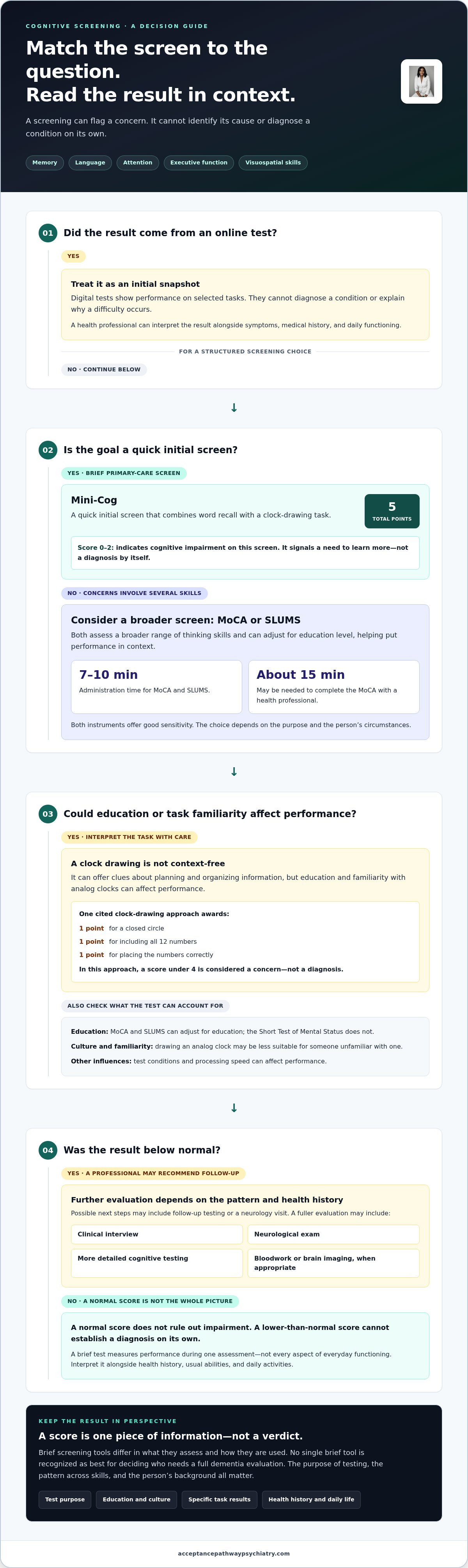
- Brief screening tools differ in what they assess and how they’re used; the right result needs context, not just a score.
- A clock-drawing task can offer clues about planning and organization, but education and familiarity with analog clocks can affect performance.
- Online tests can offer an initial snapshot, while a health professional can interpret results alongside your history and daily experiences.
- A personal baseline can help make changes over time easier to recognize, especially when viewed alongside other health information.
- Thinking changes can have different contributors, including mood-related concerns, so understanding the broader picture matters.
What are the types of cognitive screening tests?
Cognitive screening can flag signs of mild cognitive impairment or dementia, but it can’t identify a specific disease or its cause. For ADHD or learning disorders, cognitive tests may show patterns in attention, memory, or other skills; screening alone cannot diagnose these conditions.
Brief tools are designed for different settings and questions. The Mini-Cog is a quick initial screen often used in primary care. It combines word recall with a clock-drawing task. Its total score is five points; a score from zero to two indicates cognitive impairment. A low score signals the need to learn more, not a diagnosis by itself.
The Montreal Cognitive Assessment (MoCA) and Saint Louis University Mental Status (SLUMS) examination assess a broader range of thinking skills. They take seven to ten minutes to administer, while completing the MoCA with a health professional may take about 15 minutes. The MoCA is scored out of 30 points. Both instruments offer good sensitivity and can adjust for education level, which helps place performance in context.
Choosing a validated cognitive assessment starts with its purpose. A quick screen may suit a brief primary care visit, while a clinician may choose a broader test when concerns involve several skills. Education matters: MoCA and SLUMS can account for it, while the Short Test of Mental Status does not. Cultural familiarity matters, too. For example, drawing an analog clock may be less suitable for someone unfamiliar with one. No single brief tool is recognized as best for deciding who needs a full dementia evaluation.
A screening score is only one part of the picture. Education, culture, test conditions, and processing speed can all affect performance. A normal score doesn’t rule out impairment, and a lower-than-normal result can’t establish a diagnosis. Even a validated test measures performance during one assessment, not every aspect of someone’s everyday functioning.
After a below-normal result, a health professional may recommend follow-up testing or a neurology visit. A fuller evaluation may include a clinical interview, neurological exam, more detailed cognitive testing, bloodwork, or brain imaging when appropriate. The next step depends on the pattern of results and the person’s health history. This helps clarify whether a change merits further evaluation and what may be contributing to it.
What Is a Cognitive Test?
A cognitive test uses structured questions and tasks to sample skills such as memory, language, attention, and problem-solving. A clinician interprets performance alongside health history and daily activities, rather than as a standalone verdict.
Cognitive Tasks and Test Administration
A cognitive examination may combine spoken questions, written tasks, recall, and drawing to sample different mental skills. For example, a clock-drawing task asks someone to draw a clock face and place its numbers and hands. The task can offer clues about executive function, including planning and organizing information.
Taking or administering SAGE means following the test instructions and completing its tasks as directed. In a broader assessment, a psychometrist may present written and spoken tasks, while a clinical interview explores education, medical history, social life, and everyday activities. Those details help put performance in context.
Interpreting and Scoring Results
A cognitive test score summarizes performance on specified tasks; it doesn’t explain the cause of a difficulty. The clock-drawing example awards one point for a closed circle, one for including all 12 numbers, and one for placing them correctly. The cited clock-drawing approach considers a score under four a concern.
That score needs context. People with fewer than five years of education may make more clock-drawing errors, and the task may not suit someone unfamiliar with analog clocks. A screening result should therefore be considered alongside the person’s background and other findings.
Scores can also reveal different cognitive strengths and challenges. Cognition includes five key areas: memory, language, attention, executive functions, and visuospatial skills. Difficulty remembering words, for instance, differs from trouble organizing a drawing. Slower processing speed can also affect overall performance.
Some assessments use particular task formats to look at these abilities. The Short Test of Mental Status is an eight-item questionnaire assessing memory and executive function. Another screening format combines word memorization, picture naming, and copying a drawing, and takes about 15 minutes. Each task offers a limited view of performance.
A normal result doesn’t rule out cognitive impairment, while a lower-than-normal score can’t establish a diagnosis on its own. Education, familiarity with a task, and performance across different areas all matter. For example, difficulty drawing a clock alongside memory concerns gives different information than one isolated error. The examination and everyday experience help make the score meaningful.
Rather than treating a score as a label, use it as one piece of information to discuss with a health professional. The person’s history, results on specific tasks, and daily activities can help determine whether a more detailed assessment would clarify the picture.
Are online cognitive tests accurate?
Online cognitive tests can offer a useful snapshot of thinking, but their scores have limits. A digital result can highlight performance on selected tasks; it cannot diagnose a condition or explain why a difficulty occurs. A health professional can interpret the result alongside symptoms, medical history, and daily functioning.
Digital and traditional assessments differ in how they present tasks. A screen may ask someone to remember words, identify objects, or respond to prompts, while an in-person examination can include spoken instructions and direct observation. Both formats can measure selected skills, but a score reflects only performance on the tasks included. For example, a test focused on memory won’t show every aspect of language or problem-solving.
Computerized cognitive tests use a device to present tasks and record responses. The device may standardize how questions appear, but the setting still matters. Screen size, familiarity with a keyboard or touchscreen, distractions, and comfort reading instructions can shape performance. Someone who struggles with a device may find a timed response harder, even when that difficulty doesn’t reflect their usual thinking.
At-home tests also lack some of the context available during a professional evaluation. A clinician can ask what changed, when it began, and how it affects everyday activities. For instance, trouble completing an online memory task could relate to distraction, unfamiliar instructions, or a broader cognitive concern. The score alone cannot distinguish between those possibilities, establish a diagnosis, or identify a cause.
Time depends on the test. Cognitive screening tests usually take 5-15 minutes, while one assessment involving counting and identifying objects takes about 10 minutes. A short completion time doesn’t automatically make a test more accurate. The number of tasks, the skills assessed, the instructions, and the conditions of administration all affect what a result can show.
Online results are best treated as a starting point for discussion, not a final evaluation. If a score raises concern, share it with a health care provider and describe specific examples, such as forgetting an appointment or struggling to follow a familiar recipe. Those details help connect test performance with changes in daily life.
Before interpreting an online score, note the test name, date, device used, and any conditions that affected your attention. Compare results only when the same test is used under similar conditions. A change across repeat attempts can prompt a conversation, but it doesn’t confirm impairment or explain its source.
Digital testing can make structured tasks accessible, while traditional assessment adds personal context and follow-up. For a clearer understanding, pair the score with concerns about memory, language, or daily tasks, then discuss both with a health professional.
Cognitive baseline testing and personalized reference points
In the United States, cognitive testing costs depend on the assessment, setting, and services involved; insurance coverage depends on plan terms and billing. There isn’t one price or coverage rule that applies to every patient, so the specific assessment and insurance arrangement shape the answer.
A baseline records how someone performs on cognitive tasks at a particular time. Later results can be compared with that personal reference point, rather than judged only against general expectations. For example, a change in memory performance may matter more when considered alongside the person’s earlier score, symptoms, and everyday experience.
Age and risk factors help shape when a baseline may be useful. Adults aged 55 and older may consider regular cognitive assessments. For some younger adults, baseline testing may be appropriate as early as age 30, particularly when neurological risk is increased. A family history of dementia can also make a personal reference point useful for recognizing changes over time.
Repeat testing provides a way to track performance. Cognitive baseline testing is typically repeated every one to three years, depending on age, risk factors, and clinical guidance. Comparisons are most meaningful when the same assessment is administered under similar conditions. A new score should be read alongside changes in daily function, health, and symptoms, rather than treated as evidence of disease on its own.
Follow-up may be considered when results are low or borderline, or when memory or other cognitive symptoms affect everyday activities. A health professional may recommend additional evaluation or referral. Younger onset, defined here as occurring before age 65, is a possible reason for referral to a neurologist, neuropsychologist, or geriatrician. The type of specialist depends on the concerns being assessed and the information needed.
A specialist evaluation can add different kinds of information. It may include a neurological examination, more in-depth cognitive testing, bloodwork, or brain imaging when appropriate. These steps help explore whether a change relates to a neurological condition, another health issue, or a combination of factors. A screening result can prompt a closer look, but it doesn’t identify a specific disease or its cause.
Medicare’s Annual Wellness Visit includes an assessment for possible cognitive impairment. It’s one setting where concerns can be raised and documented. A patient can describe concrete examples, such as missing familiar appointments or struggling with routine tasks, so the assessment reflects more than a score. Tracking symptoms and personal history gives follow-up comparisons clearer meaning.
There is no single standard cost for cognitive testing; it varies with the assessment, setting, and services involved. Insurance may cover it depending on the patient’s plan and how the service is billed.
Neurodegenerative and other health conditions
Cognitive screening can help show which thinking skills have changed, but it cannot identify a disease by itself. A pattern involving memory, attention, or daily activities gives a doctor useful clinical information. The same concern may relate to mild cognitive impairment, dementia, depression, or another health issue, so context matters.
Age-related memory changes aren’t automatically dementia. Cognitive impairment is more common among older people, but it isn’t a normal part of aging. Someone with mild cognitive impairment may notice more memory trouble than peers yet continue usual daily activities. Symptoms may remain stable or improve, although mild cognitive impairment also carries a higher risk of developing dementia.
Alzheimer’s disease is one possible cause of progressive cognitive changes. The Alzheimer’s Association reports that 10 to 15 percent of people with mild cognitive impairment progress to dementia each year. That figure describes a group, not an individual’s future. A cognitive assessment helps identify areas of concern, while a doctor considers symptom history and everyday function.
Other health conditions can affect thinking, too. Depression and anxiety may contribute to concentration or memory difficulties, and addressing mood concerns may help cognitive function. Some cognitive impairment can also arise from treatable conditions, including depression and urinary tract infections. That’s why new confusion or memory changes deserve a broader clinical assessment, rather than an assumption that Alzheimer’s is responsible.
An assessment can also consider what family members observe. The Eight-item Informant Interview to Differentiate Aging and Dementia uses eight questions to help distinguish signs of normal aging from mild dementia. An informant’s examples, such as changes in familiar routines, can add context to a patient’s test performance. The interview supports assessment; it doesn’t establish a diagnosis on its own.
When screening identifies a concern, follow-up may include a neurological examination, more detailed cognitive testing, bloodwork, or brain imaging when appropriate. These steps help explore possible causes and whether changes affect everyday independence. A normal screening result also doesn’t rule out impairment, particularly if symptoms continue or daily tasks become harder.
Results can guide a conversation about the next useful step. A doctor may consider when changes began, mood, medical history, and specific cognitive strengths or difficulties. For example, memory concerns alongside depression may call for a different evaluation than steadily worsening thinking with growing difficulty managing familiar activities.
If changes in thinking or mood are affecting daily life, discuss your cognitive health concerns as part of a broader mental health conversation.
Acceptance Pathway Psychiatry PLLC: Medication Management
Acceptance Pathway Psychiatry PLLC offers Creyos Cognitive Testing for people seeking a clearer picture of their cognitive strengths and areas of difficulty. When memory or concentration concerns occur alongside depression, anxiety, ADHD, PTSD, or bipolar disorder, psychotherapy and medication management may also be relevant parts of mental health care.
Testing can provide information to discuss during care, while a person’s symptoms and experiences help shape that conversation. Medication management addresses medication as part of treatment, and psychotherapy offers space to work through emotional and behavioral concerns. These services support different needs; they aren’t a substitute for urgent or emergency care.
Contact Acceptance Pathway Psychiatry PLLC to discuss Creyos Cognitive Testing or mental health care.
Choose a Next Step That Feels Right
Understanding what cognitive testing reveals is most useful when the results become part of a broader conversation about your wellbeing, not a label that defines you. Consider what you want to understand next: which changes concern you most, how they affect daily life, and what kind of support would feel helpful. Bringing those questions forward can help keep the conversation focused on your priorities.
Acceptance Pathway Psychiatry PLLC offers Creyos Cognitive Testing, psychotherapy, and medication management. These services address different needs, from gaining cognitive information to working through emotional concerns or discussing medication as part of mental health care. Sharing what you’ve noticed can help shape a conversation around the support you’re seeking.
If you’re ready to talk through cognitive testing or mental health care, contact Acceptance Pathway Psychiatry PLLC. You can take the next step at a pace that feels comfortable, with your questions and experiences guiding the conversation.
Frequently Asked Questions
Why might I need cognitive testing?
You might consider cognitive testing if changes in thinking affect work, routines, or conversations. For example, repeatedly losing track of steps while cooking or struggling to follow a familiar discussion can be useful to describe during an appointment. Testing can document performance and help frame further evaluation. It can also provide a reference point if you or someone close to you notices a change.
Are there any risks to testing?
Standard cognitive testing uses questions and mental tasks, so it doesn’t involve a physical procedure. A task that feels difficult may bring up frustration or worry, especially if you’re already concerned about memory. You can tell the person administering the test if instructions are unclear or you need them repeated. A score is information to discuss, not a judgment of your abilities or worth.
What can I expect after the test?
After testing, expect to review which tasks were assessed and how your performance will be considered. If a result raises concern, a provider may discuss further assessment or other relevant health information. You can prepare by noting specific changes you’ve noticed, such as difficulty remembering a recent conversation. Sharing when the change happens and how it affects your routine can make the follow-up discussion more useful.
What do the results mean?
Results describe how you performed on the tasks included in the assessment. Understanding what cognitive testing reveals means looking at the pattern of responses, not treating one score as a complete explanation. Difficulty recalling words may be worth discussing, but it doesn’t identify the cause. Ask how the findings relate to your daily experiences, health history, and changes noticed by people who know you well.
What does the test measure?
A cognitive test may assess memory, language, attention, executive function, and visuospatial skills. The exact areas depend on the tasks used. For example, remembering words samples memory, while following instructions and organizing a response can draw on attention and planning. No single task represents every thinking ability, so the mix of tasks matters when understanding what the assessment covers.
What happens during the test?
You’ll complete structured mental tasks, which may include answering questions, remembering information, or drawing. Some assessments also begin with a conversation about medical history, education, and everyday activities. Follow the instructions as given, and mention if you didn’t hear or understand a prompt. That distinction helps the person administering the test interpret a missed response more accurately.
What does cognitive testing measure?
Cognitive testing measures performance across selected thinking skills, not a person’s intelligence or overall value. One assessment might ask you to recall information after a short delay; another may examine how you organize a response. Knowing what cognitive testing reveals can help you discuss a specific strength or difficulty with a clinician. The test determines which skills are sampled, so results from different assessments may not be directly comparable.
What can cognitive test results reveal about memory, attention, language, and reasoning?
Results can show relative strengths or difficulties across tasks involving memory, attention, language, and reasoning. For example, a person may remember information well but have difficulty sustaining focus during a longer task. That pattern gives a clinician a clearer topic for discussion, not a diagnosis by itself. Its meaning depends on the assessment, personal history, and whether similar challenges appear in everyday life.


