

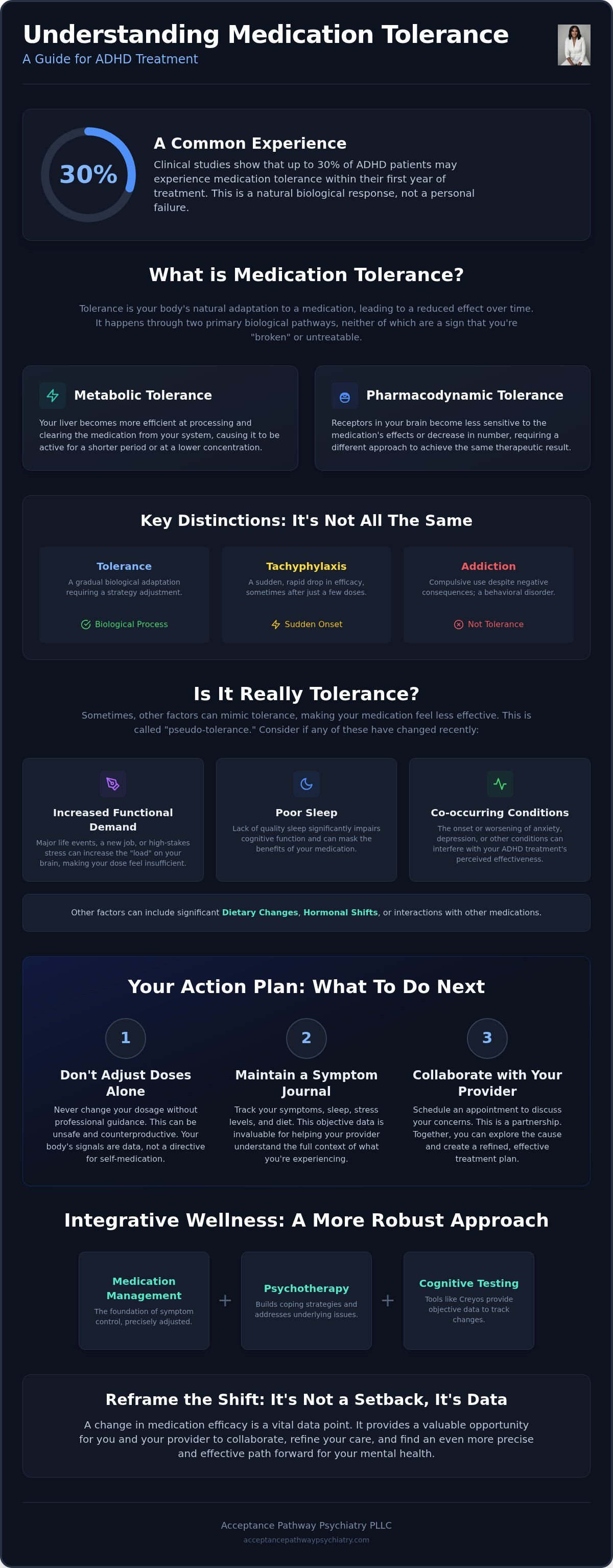
Clinical studies from Diligence Care Plus show that medication tolerance affects up to 30% of ADHD patients within their first year of treatment, yet many people still feel like they've personally failed when it happens. You likely remember the relief you felt when your symptoms first began to lift, only to find that familiar fog or anxiety creeping back in months later. It's common to worry that you're untreatable or that you're stuck in a cycle of increasing dosages, but this shift in efficacy is a natural biological response, not a sign that you're broken.
If you're wondering about medication tolerance what to do next, we're here to help you navigate this transition with clarity and confidence. You'll learn how to identify true tolerance and discover the collaborative steps you can take with your provider to restore your mental health balance. We'll also look at how objective tools like Creyos cognitive testing and new developments, such as the July 2026 approval of Simtriyo, allow us to refine your treatment plan through a supportive, data-driven partnership.
Key Takeaways
- Understand that medication tolerance is a natural biological process of adaptation, not a sign that you are untreatable or "broken."
- Learn to distinguish between true physiological tolerance and "pseudo-tolerance" caused by major life stressors or increased functional demand on the brain.
- Discover exactly regarding medication tolerance what to do, including the importance of maintaining a symptom journal and why professional guidance is essential before any dosage changes.
- Explore how combining medication with psychotherapy and Creyos cognitive testing creates a more robust, integrative approach to your mental health.
- Reframe a shift in medication efficacy as a vital data point that allows you and your provider to collaborate on a more precise and effective treatment plan.
What is Medication Tolerance? Understanding the Body's Adaptation
When your medication begins to feel less effective, it's natural to feel a sense of loss or even a touch of fear. You might wonder if your condition is worsening or if you've somehow reached the limit of what medicine can do for you. However, this shift is often a sign of your body doing exactly what it was designed to do: maintain balance. In clinical terms, this drive for stability is known as homeostasis. Your body is a highly adaptive system that constantly works to stabilize its internal environment. When a medication introduces a change, your system eventually adjusts to that new "normal," requiring a different approach to achieve the same therapeutic effect.
Understanding the underlying mechanics can help demystify the experience. What is drug tolerance? Essentially, it occurs through two primary biological pathways. Metabolic tolerance happens when your liver becomes more efficient at processing the medication, clearing it from your system faster than before. Pharmacodynamic tolerance is more common in mental health care; it occurs when the receptors in your brain become less sensitive to the drug's presence or decrease in number. Neither of these processes indicates a lack of willpower or a personal failing. Tolerance is a physiological adaptation of your system rather than a psychological failure of your character.
It's also vital to clarify that tolerance is distinct from addiction or substance use disorder. While addiction involves compulsive use despite negative consequences, tolerance is simply a biological adjustment that requires a professional adjustment in strategy. If you're wondering about medication tolerance what to do, the first step is recognizing that your body is communicating with you. This communication provides essential data for your provider to refine your care, ensuring your treatment remains as effective as the day you started.
Tolerance vs. Tachyphylaxis: Why Efficacy Might Drop Suddenly
While most tolerance develops gradually over months or years, some people experience an acute, rapid-onset drop in effectiveness known as tachyphylaxis. This can happen within just a few doses or even 24 hours. It's particularly common with certain stimulants used for ADHD or specific benzodiazepines. Unlike the slow decline of standard tolerance, tachyphylaxis is a sudden reaction where the body's receptors become saturated or exhausted quickly. Recognizing this distinction helps your psychiatrist determine whether you need a different dosing schedule or a new class of medication altogether.
The Role of Neuroplasticity in Treatment Evolution
Your brain is not a static organ; it possesses neuroplasticity, which is the ability to reorganize and change in response to its environment and the treatments you receive. This means your treatment plan should be an evolving journey rather than a fixed destination. Your initial dose was a successful starting point, but as your brain evolves and heals, your needs may naturally shift. We view this as an evolution of care rather than a plateau. By using tools like Creyos cognitive testing, we can track these subtle changes in your cognitive function to ensure your medication management stays aligned with your brain's current state.
Is It Really Tolerance? Identifying Factors That Mimic a Drop in Efficacy
You might feel certain that your body has developed a drug tolerance, but sometimes the issue isn't the medication itself. Clinicians often refer to this as "pseudo-tolerance." This happens when external factors or internal changes make your usual dose feel less effective, even though your brain's receptors haven't actually changed. It's a subtle distinction, but it's vital because it changes the conversation around medication tolerance what to do to find relief. Understanding whether you are facing a biological shift or a lifestyle hurdle is the first step toward feeling better.
One of the most overlooked factors in treatment efficacy is "functional demand." Think of your medication as a bridge. Under normal circumstances, it carries you across your daily tasks with ease. However, if you experience a major life transition, like a career change or the loss of a loved one, the "traffic" on that bridge increases significantly. Your brain is working much harder to process grief or high-stakes stress, which can make a previously perfect dose feel like it’s barely making a dent. In these moments, it isn't that the medicine stopped working; it's that the weight you're carrying has grown heavier.
The Impact of Lifestyle and Routine on Absorption
Subtle changes in your daily habits can also sabotage how your body processes treatment. For instance, consuming high amounts of caffeine or certain acidic juices around the time you take your meds can alter stomach pH and interfere with absorption. Even switching to a different generic manufacturer can cause a noticeable shift in how you feel. Different fillers used by various labs can affect how quickly a drug enters your bloodstream, leading to a perceived loss of efficacy. Consistency in timing, nutrition, and sleep quality are the foundations that allow your medication to perform its role effectively.
Using Cognitive Testing to Uncover the Truth
To move beyond guesswork, we often utilize objective data. Creyos cognitive testing allows us to measure your brain's performance in areas like focus, memory, and reasoning with clinical precision. By comparing these results to your personal baseline, we can see if your cognitive scores are actually dropping or if you're simply feeling the emotional weight of a stressful month. This data-driven approach ensures we aren't just guessing about your health. If you're feeling overwhelmed by these changes, our team at Acceptance Pathway Psychiatry PLLC can help you distinguish between a biological plateau and a temporary life hurdle.
Finally, consider that a secondary condition might be emerging. It's common for underlying anxiety to mimic the symptoms of ADHD or for a physical health change, like a thyroid imbalance, to mirror the fatigue of depression. When these new layers appear, they can make your primary treatment feel less potent. Addressing these "masking" symptoms often restores the balance you thought you'd lost, proving that your original medication is still doing its job.
What to Do When You Suspect Medication Tolerance
Noticing that your treatment is losing its edge can be disheartening, but it's important to stay steady. Your first instinct might be to increase your dose on your own, but please resist this urge. Changing your regimen without supervision can lead to unpredictable side effects or mask the very data your provider needs to help you. If you are noticing a shift in how you feel, you might be searching for medication tolerance what to do to regain your stability. The most effective path forward is a structured, collaborative one that prioritizes your safety and long-term health.
Start by becoming a curious observer of your own experience. We recommend keeping a symptom journal for at least a week before your next appointment. Track when you take your medication, when you notice symptoms returning, and any external triggers like poor sleep or high stress. When preparing for your visit, focus your notes on functional impact, such as stating "I can no longer focus for more than 20 minutes," rather than simply saying "I feel bad." This level of detail allows your psychiatrist to see the practical reality of your day and make more precise adjustments during your medication management session.
Collaborative Strategies Your Provider Might Suggest
Once you share your observations, your provider has several clinical tools to explore. They might suggest a dose adjustment to find your current "therapeutic window," which often shifts as your body adapts. Another option is medication augmentation, where a secondary agent is added to enhance the primary medication's effectiveness. For those managing ADHD, your provider might discuss a "medication holiday." These brief, supervised breaks can help reset receptor sensitivity. This strategy is supported by updated 2026 clinical guidelines as a way to maintain long-term efficacy without constantly increasing dosages.
Switching Medications: Navigating the Transition
If adjustments to your current regimen don't bring the desired relief, it may be time to consider a new class of medication. This is a standard and often very successful part of psychiatric care. To ensure your safety, we use a process called "cross-tapering." This involves slowly decreasing your current medication while gradually introducing the new one, which helps minimize withdrawal symptoms or "washout" periods. It's helpful to remember that switching isn't a sign that you are "broken" or untreatable. Instead, it's a proactive step toward a treatment that better aligns with your brain's current evolution and needs.
Integrative Wellness: Boosting Medication Efficacy Through Holistic Care
While finding the right prescription is a significant milestone, we view medication as just one essential tool in a much larger wellness toolbox. Think of your brain's chemistry as the "hardware" of a computer. Medication helps repair and maintain that hardware, ensuring the physical circuits are functioning correctly. However, even the best hardware requires high-quality "software" to run efficiently. This is where psychotherapy, including Cognitive Behavioral Therapy (CBT) and Dialectical Behavior Therapy (DBT), comes in. Therapy provides the coping skills and behavioral patterns that allow you to navigate life's challenges, ultimately reducing the heavy lifting your medication has to do on its own.
Supporting your neurotransmitter health through lifestyle choices is another way to maximize your treatment's potential. Adopting an anti-inflammatory diet rich in omega-3 fatty acids and antioxidants can create a more hospitable environment for brain signaling. Regular physical activity also plays a vital role by naturally boosting dopamine and serotonin levels. If you're exploring medication tolerance what to do to stay stable, don't overlook your sleep hygiene. Consistent, restorative sleep is the foundation of neuro-stability; without it, you're more likely to experience "breakthrough" symptoms that feel like a loss of medication efficacy but are actually signs of a fatigued nervous system.
The Synergy of Therapy and Medication Management
Combining psychotherapy with your medication management creates a powerful synergy for long-term stability. Therapy helps you identify and manage the specific life stressors that can make your medication feel less effective. By learning new behavioral strategies to handle anxiety or depression, you build internal resilience. Over time, these new skills can lead to a state where your brain requires less chemical support, potentially allowing for lower maintenance doses while achieving the same level of mental clarity and emotional balance.
Mind-Body Practices for Neuro-Stability
Mindfulness and meditation are more than just relaxation techniques; they are active ways to calm a hyper-reactive nervous system. These practices help address the root causes of symptom fluctuations by training your brain to stay grounded during periods of high "functional demand." We frame these wellness habits as a way to "protect" your medication's effectiveness. By lowering your baseline stress, you ensure that your treatment isn't constantly fighting against a flood of stress hormones. Our Integrative Wellness Services are designed to support this holistic balance, treating you as a whole person rather than a set of symptoms.
Finding Your Path Forward with Acceptance Pathway Psychiatry PLLC
Reaching a point where your treatment feels less effective can be a lonely experience, but it's actually an invitation to deepen your healing journey. At Acceptance Pathway Psychiatry PLLC, we don't view a plateau as a failure of the patient or the medicine. Instead, we see it as a vital clinical data point that helps us fine-tune your path toward wellness. Our philosophy is rooted in the belief that you're a partner in your care, not just a recipient of a prescription. When you're unsure about medication tolerance what to do, the most important step is reaching out to a team that values your voice and respects your unique internal experience.
We provide a warm, non-judgmental environment where you can speak openly about your frustrations and fears. Our goal is to create a sense of psychological safety that allows you to explore new options without the anxiety of being misunderstood or dismissed. We understand that the journey toward mental health isn't a straight line. It's a process of constant evolution, and we're here to serve as steady, reliable guides. Whether you're feeling the return of old symptoms or simply a sense of stagnation, we're committed to helping you find the clarity you need to move forward.
Precision Psychiatry: Objective Data Meets Empathetic Care
To provide the most effective care, we combine our clinical intuition with objective, data-driven tools. We utilize Creyos cognitive testing to gain a clear picture of your brain's current functioning, allowing us to build a personalized treatment plan based on facts rather than guesswork. During a comprehensive psychiatric evaluation, we take the time to look at the whole picture of your life, from your biological responses to your environmental stressors. This intersection of high-level science and deep empathy at Acceptance Pathway Psychiatry PLLC ensures that your treatment plan is as precise as it is compassionate.
Taking the Next Step Toward Stability
Stability is possible, even when the path feels uncertain. We make it easy to access the support you need through both telehealth appointments and in-person evaluations, ensuring that distance or scheduling is never a barrier to your progress. By offering medication management and psychotherapy together, we ensure that every aspect of your mental health is being addressed simultaneously. If you're ready to discuss medication tolerance what to do for your specific situation, we invite you to schedule a consultation with us today. Remember that a shift in your treatment's effectiveness is simply the beginning of a more refined chapter of your healing. We're here to witness your progress and support your evolution toward wholeness.
Your Journey Toward Sustainable Healing
Understanding that medication tolerance is a natural biological adaptation can help replace frustration with a proactive plan. We've explored how identifying pseudo-tolerance and utilizing integrative wellness tools can protect your long-term progress. When your brain's hardware and software work in harmony, you can move past plateaus with confidence and clarity. This shift in efficacy isn't a sign that you're broken; it's simply a signal that your care needs to evolve along with your body.
If you're currently navigating medication tolerance what to do next, you don't have to figure it out alone. We provide comprehensive psychiatric evaluations and use Creyos cognitive testing for objective results to ensure your care is precise and effective. Our team is dedicated to offering compassionate, trauma-informed care that treats you as a whole person rather than a collection of symptoms.
You deserve a treatment plan that remains as dynamic and resilient as you are. Schedule your medication management consultation today to begin this new, more refined chapter of your recovery. We're here to be a supportive witness to your growth and a steady partner in your continued evolution toward wholeness.
Frequently Asked Questions
Can I develop a tolerance to any psychiatric medication?
While it is possible to develop a tolerance to many psychiatric medications, it is much more common with certain classes like stimulants or benzodiazepines. Tolerance is a biological adaptation where your brain's receptors become less sensitive to a substance over time. This doesn't happen to every person or with every drug, but it's a recognized part of long-term medication management that your provider can help you navigate.
Is medication tolerance the same thing as addiction?
No, tolerance and addiction are two very different clinical concepts. Tolerance is a purely physiological process where your body adapts to a medication, requiring a different approach to achieve the same therapeutic effect. Addiction involves a compulsive drive to use a substance despite harmful consequences. You can experience tolerance as a normal part of your treatment journey without ever developing an addiction or substance use disorder.
How long does it typically take for medication tolerance to develop?
The timeline for developing tolerance is highly individual and depends on the specific medication and your unique biology. Some people might notice a change in efficacy within a few months, while others stay on the same dose for many years without any shift. For instance, data from Diligence Care Plus indicates that about 30% of ADHD patients experience some level of tolerance within their first year of treatment.
What are the first signs that my medication might be losing its effectiveness?
The earliest signs usually involve a subtle return of the symptoms you were initially treating, such as a shorter attention span or rising anxiety levels. You might also notice that the medication seems to "wear off" earlier in the day than it used to. If you're concerned about medication tolerance what to do, the first step is to document these specific moments of symptom breakthrough in a journal.
Can a 'medication holiday' really help reset my tolerance?
Yes, a supervised "medication holiday" can be an effective way to reset your brain's receptor sensitivity, particularly for ADHD medications. By taking a brief, planned break from the drug, your body has a chance to recalibrate. However, this strategy isn't appropriate for all medications, such as antidepressants, which require a steady blood level. Never attempt a medication holiday without the direct supervision and guidance of your psychiatrist.
What should I tell my psychiatrist if I feel my medication isn't working anymore?
Focus on the functional impact the change is having on your daily life during your appointment. Instead of a general statement about feeling worse, provide concrete examples like "I can no longer focus on my work tasks after 2:00 PM." Sharing objective data from Creyos cognitive testing or your symptom journal helps your provider determine if the issue is true biological tolerance or a result of new life stressors.
Will I have to keep increasing my dose forever if I develop tolerance?
No, increasing the dosage is only one of many strategies we use to restore balance. Continually raising a dose can eventually lead to more side effects, so we often look at other options first. These might include switching to a different class of medication, adding a secondary agent to boost efficacy, or using psychotherapy to build stronger coping skills. The goal is always to find the lowest effective dose for your needs.
Can therapy help if I've become tolerant to my medication?
Therapy is a vital part of the plan when you're considering medication tolerance what to do to maintain your stability. While medication addresses the chemical balance in your brain, psychotherapy provides the behavioral "software" to manage your symptoms. By strengthening your coping strategies, you can often reduce the overall demand on your medication, making it easier to stay balanced even if your physiological response to a drug changes.


