

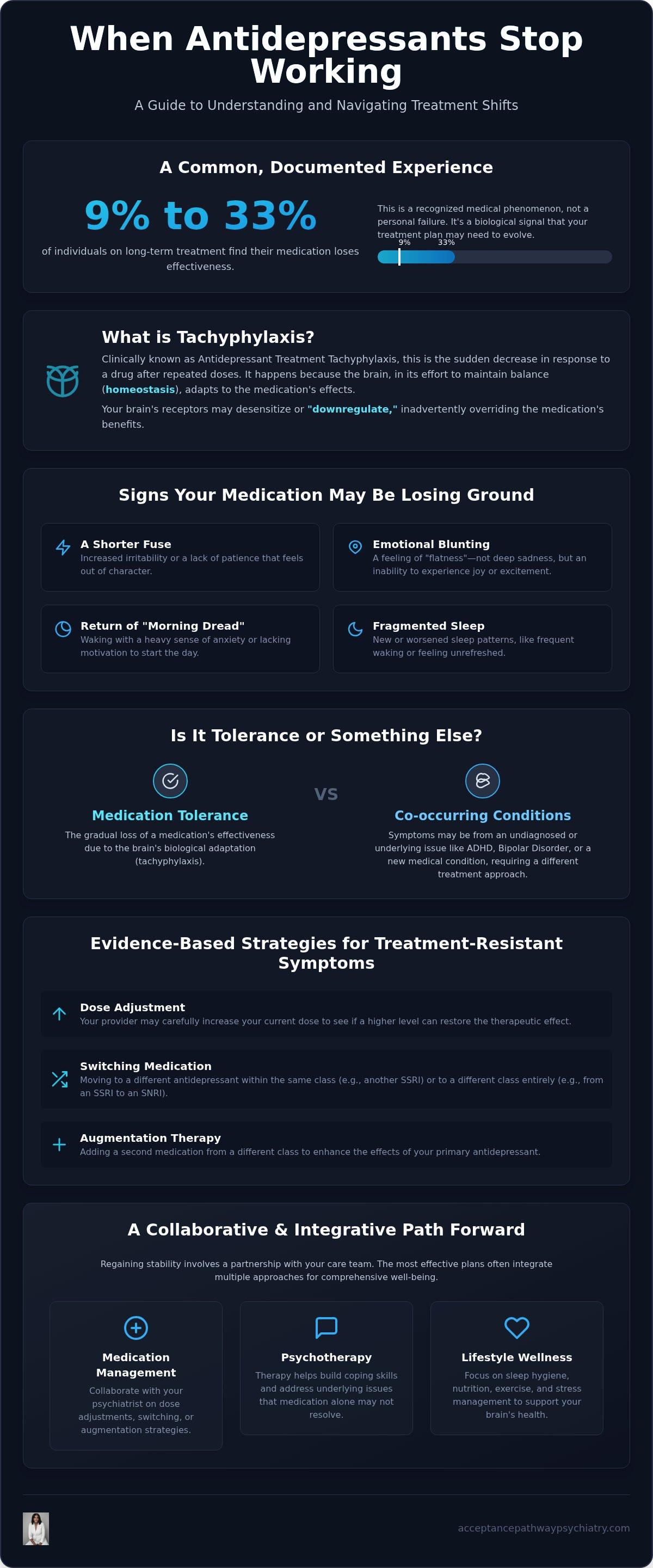
Research indicates that between 9% and 33% of individuals on long-term treatment find their medication eventually loses its effectiveness. If you've felt your symptoms creeping back despite staying consistent with your dose, you aren't imagining things. It's a recognized medical phenomenon often called tachyphylaxis. It's deeply frustrating to experience the return of debilitating symptoms and wonder what to do when antidepressants stop working. You might even feel a sense of defeat or fear that you'll be stuck in a cycle of psychiatric trial and error forever, but this shift is often a biological signal rather than a personal failure.
This guide is here to reassure you that stability is still possible and that your journey hasn't stalled; it's simply evolving. You'll discover the biological reasons behind these shifts and learn about the clinical and integrative strategies used to regain your mental well-being. We will walk through how to prepare for your next psychiatric consultation and explore the latest evidence-based options for 2026, including medication management and psychotherapy. This overview ensures you have a clear plan to move forward with confidence alongside a supportive care team.
Key Takeaways
- Understand the clinical phenomenon of tachyphylaxis and why a return of symptoms is a biological event rather than a failure of your character.
- Discover the specific biological and life factors that explain when antidepressants stop working so you can better communicate with your provider.
- Learn how to differentiate between simple medication tolerance and complex co-occurring conditions like ADHD or Bipolar Disorder that might require a different approach.
- Explore evidence-based strategies for treatment-resistant symptoms, including dose adjustments and switching medication classes.
- Gain a clear framework for a collaborative partnership with your care team that integrates medication, psychotherapy, and lifestyle wellness.
Understanding 'Antidepressant Poop-Out' and Breakthrough Depression
It's a heavy weight to carry when you feel the familiar fog of depression returning after months or even years of stability. You might feel like you've done something wrong or that your progress was an illusion. However, research indicates that between 9% and 33% of people on long-term treatment experience a loss of effectiveness. This is a documented medical event, not a reflection of your strength or your commitment to healing. Understanding what happens when antidepressants stop working is the first step toward reclaiming your balance.
Many people experience a "honeymoon phase" with new medications where symptoms lift significantly. When this period ends, it can feel like a sudden drop, but often it's just the body finding a new baseline. A true loss of efficacy is different. It's a persistent decline where the medication no longer provides the support it once did. Validating this experience is essential because it allows you to move from self-blame toward a collaborative solution with your care team.
What is Tachyphylaxis?
The clinical term for this experience is Antidepressant treatment tachyphylaxis. This occurs because the brain is an incredibly adaptive organ that constantly seeks a state of homeostasis, or internal balance. When a medication introduces a steady stream of neurochemicals, the brain's receptors may eventually desensitize or "downregulate" to compensate for the drug's presence. Tachyphylaxis is the sudden decrease in response to a drug after repeated doses. Essentially, your brain works so hard to maintain its own equilibrium that it inadvertently overrides the medication's beneficial effects.
Signs Your Medication May Be Losing Ground
Identifying the shift early can help you and your provider make proactive adjustments. It's often subtle at first, appearing as small changes in your daily rhythm rather than a sudden crash. You might notice:
- A shorter fuse: Increased irritability or a lack of patience that wasn't there a few months ago.
- Return of the "Morning Dread": Waking up with a heavy sense of anxiety or difficulty finding the motivation to start the day.
- Emotional Blunting: A feeling of "flatness" where you don't feel deep sadness, but you also cannot experience joy or excitement.
- Fragmented Sleep: New changes in your sleep patterns, such as waking up frequently or feeling unrefreshed after a full night's rest.
Distinguishing between a temporary "dip" caused by external stress and a true loss of medication power is vital. A dip usually resolves once a specific stressor passes. In contrast, when antidepressants stop working due to biological tolerance, the symptoms remain regardless of how much you try to manage your environment or stress levels.
Why Medications May Lose Effectiveness Over Time
Finding the right medication is often a journey of patience and hope. When that progress begins to slip, it's natural to feel a sense of alarm. However, the reasons behind this shift are usually rooted in the complex way your body and brain interact with treatment. Understanding these factors can help you move away from self-blame and toward a proactive conversation with your provider about your next steps.
Biology is never static. Your brain, hormones, and lifestyle are constantly shifting, and sometimes these changes outpace the support your current prescription provides. This state is often referred to as breakthrough depression, where symptoms return despite a consistent treatment plan. Identifying the specific "why" behind your symptoms is the first step in adjusting your strategy.
The Role of Neuroplasticity and Adaptation
Your brain is remarkably resilient and adaptive. This quality, known as neuroplasticity, allows you to learn and grow, but it also means your brain is constantly trying to maintain its own internal balance. When you take an antidepressant, it changes the levels of neurotransmitters like serotonin or norepinephrine. In response, your brain may attempt to find a new equilibrium by adjusting its receptors.
In some cases, the brain might "downregulate," or reduce the number of available receptors, because it senses an abundance of a specific chemical. This adaptation isn't a sign that your brain is broken. On the contrary, it's a sign of a healthy, functioning system that is doing exactly what it was designed to do: adapt to its environment. When antidepressants stop working due to this biological tolerance, it simply means your treatment plan needs to evolve alongside your brain's natural changes.
External Factors: Stressors and Lifestyle
Life doesn't happen in a vacuum, and external pressures can physically alter your internal chemistry. Chronic stress triggers the release of cortisol, a hormone that can eventually override the benefits of your medication. If you've recently experienced a major life transition, such as grief, job loss, or a change in your daily routine, your brain may require more support than it did during calmer periods.
Emerging research also highlights the connection between gut health and mental well-being. Inflammation in the body or changes in your digestive system can interfere with how your body absorbs and metabolizes medication. Additionally, hormonal shifts during pregnancy, menopause, or thyroid fluctuations can change your metabolic rate, making a previously perfect dose feel insufficient. Even subtle interactions with alcohol or new prescriptions for physical ailments can disrupt the delicate balance of your psychiatric care.
Our team at Acceptance Pathway Psychiatry PLLC views these shifts as opportunities to refine your care rather than obstacles to your recovery. By looking at the whole picture, we can help you determine if your current dose needs optimization or if a different class of medication might better suit your current needs.
Differentiating Tolerance from Misdiagnosis or Co-occurring Conditions
Sometimes, the feeling that your medication is failing isn't about the drug itself. It's about the target. A thorough psychiatric re-evaluation is often the most compassionate step you can take for yourself. If you are wondering what to do when antidepressants stop working, it's essential to look beyond the surface of your mood. Underlying physical health issues like a Vitamin D deficiency, anemia, or sleep apnea can mimic the symptoms of a worsening depression. Without addressing these root causes, even the most effective psychiatric medication will struggle to keep you feeling your best.
The "brain fog" many people experience is another critical factor. While it feels like a heavy blanket of sadness, it may actually be a cognitive impairment that requires a different clinical approach. Identifying whether your struggle is purely emotional or partly cognitive helps us refine your path forward. This distinction is vital because it changes the conversation from "the med isn't working" to "we need to address a different part of the brain." It's a subtle shift that can make a profound difference in your daily life. It's also a common reason why it feels like your journey has stalled when antidepressants stop working as expected.
The ADHD and Depression Overlap
Lethargy and a lack of motivation are hallmark signs of depression. However, they are also central to executive dysfunction in ADHD. If your brain is struggling to initiate tasks or focus, you might feel a deep sense of failure that looks like depression. In these cases, stimulants or specific non-stimulants might be the missing piece. To help differentiate between these conditions, we use Creyos cognitive testing. This tool allows us to measure objective brain function, such as memory and attention, rather than relying solely on subjective feelings. It provides a clearer picture of how your brain is actually processing information, ensuring we aren't treating the wrong condition.
When It’s Actually Bipolar Disorder
Another reason you might feel like your treatment is failing is an underlying mood cycling pattern. For some, antidepressants can inadvertently trigger "mixed states" or subtle hypomania, which can eventually lead to a crash. These breakthrough symptoms often align more with Bipolar Disorder than Major Depressive Disorder. If this is the case, adding a mood stabilizer can provide the grounding effect that an antidepressant alone cannot achieve. Recognizing these patterns is a vital part of understanding why it feels like your medication has reached its limit. It allows us to pivot toward a strategy that prioritizes stability over simple elevation.
Strategic Options for Treatment-Resistant Symptoms
Once we've ruled out co-occurring conditions like ADHD or physical health issues, the focus shifts to refining your pharmacological strategy. It's a common misconception that simply increasing a dose is the only solution when antidepressants stop working as they should. In reality, dose optimization is about finding the "sweet spot" where efficacy is highest and side effects are minimal. Sometimes, pushing a dose higher only leads to more physical burdens without improving your mood, making a different strategic approach necessary.
The "Switch Strategy" involves moving to a different class of medication entirely. If an SSRI isn't providing relief, we might explore an SNRI or an atypical antidepressant that targets different neurotransmitter pathways. For other patients, augmentation is the most effective route. Augmentation involves adding a second medication to enhance the first one's effect. This might include adding a low-dose antipsychotic or lithium to act as a clinical booster for your primary treatment, providing the extra support your brain needs to regain stability.
Switching vs. Augmenting: Which is Right for You?
Deciding whether to switch or augment depends on your unique history and how you've responded to medications in the past. Switching is often preferred if the current medication is causing significant side effects. To ensure safety, we use "cross-tapering." This is a methodical process where we slowly decrease the old medication while introducing the new one, which helps to minimize potential withdrawal symptoms. Augmenting is often the choice when a medication is partially working, and we want to build on that existing foundation. Both strategies require patience and a steady, supportive partnership with your provider.
Integrating Psychotherapy for Synergy
Medication is a powerful tool, but it works best when paired with personal growth. Think of medication as the "hardware" of your mental health, while psychotherapy services act as the "software" update. Therapy provides the skills and resilience needed to navigate life's challenges, while the medication stabilizes the biological environment. Clinical evidence consistently shows that combined treatment leads to better long-term outcomes for chronic or recurrent depression than either treatment alone. It's about treating the whole person, not just the symptoms.
If you're feeling stuck and unsure of when antidepressants stop working for good, remember that your treatment plan can and should evolve. Stability is still within reach through a customized, evidence-based approach. If you are ready to explore a plan tailored to your specific needs, contact Acceptance Pathway Psychiatry PLLC to discuss how our medication management and therapy integration can support your journey.
A Collaborative Path Forward: Integrative Medication Management
At Acceptance Pathway Psychiatry PLLC, we believe your care should feel like a partnership. You're the expert on your own life, and we're the clinical guides who walk beside you. This collaborative model is vital when you face the challenge of when antidepressants stop working. Instead of simply swapping one prescription for another, we look at the whole picture. We want to ensure your mental health is supported from every biological and environmental angle.
Telehealth makes this ongoing partnership easier. It allows for consistent, accessible monitoring during medication transitions without the stress of travel. During these check-ins, we work together to create a personalized "Safety Plan." This plan identifies your specific early warning signs, such as subtle changes in sleep or appetite. Having this roadmap in place ensures you know exactly how to reach out and what steps to take if you notice symptoms returning.
The Integrative Wellness Advantage
Our approach incorporates integrative wellness services that focus on nutrition, movement, and sleep hygiene. These lifestyle interventions aren't just "extra" steps. They actively support neurogenesis, which is the brain's ability to grow new neurons and repair existing pathways. By improving your internal environment, you reduce the heavy burden placed on the medication alone. We see you as a whole person rather than a diagnosis. We understand that your biology is heavily influenced by how you nourish your body and how well you rest your mind.
Your First Step: A Comprehensive Evaluation
The path to lasting stability starts with a clear understanding of where you are today. During a medication management consultation, we take the time to listen to your history, your frustrations, and your goals. We often use Creyos cognitive testing to get an objective look at your brain function. This data ensures your new plan is tailored to your unique cognitive profile rather than a one-size-fits-all guess. Understanding when antidepressants stop working is just the beginning of a deeper conversation about your long-term health.
This data-driven, compassionate approach removes the uncertainty that often haunts psychiatric treatment. We're here to be a supportive witness to your journey and an ally in your progress. If you're ready to find a more sustainable and holistic way to manage your mental health, schedule a psychiatric evaluation to find your path forward.
Reclaiming Your Mental Well-Being
Feeling the return of symptoms is a biological hurdle, not a personal failure. We've explored how biological tolerance and life stressors play a role, and why precise diagnostics are essential for your next steps. It's a recognized medical reality that occurs when antidepressants stop working, but it's also a signal that your treatment plan is ready to evolve. By combining evidence-based medication management with Creyos cognitive testing, we can move beyond guesswork to find a strategy that truly resonates with your unique brain chemistry and internal experience.
You deserve a partnership that values your wholeness and respects your history. Our compassionate, trauma-informed care is designed to be a steady, non-judgmental presence as you navigate this transition. Take the next step in your healing journey with a comprehensive evaluation at Acceptance Pathway Psychiatry.
Stability isn't a fixed destination but a process of constant refinement and support. You don't have to manage these shifts alone; hope and progress are still within your reach as we work together to find your new baseline.
Frequently Asked Questions
How do I know if my antidepressant has truly stopped working?
You know your medication has stopped working when you experience a persistent return of symptoms that lasts for at least two weeks despite consistent dosing. This often looks like a shorter fuse, returning morning dread, or a sense of emotional flatness that feels different from your baseline. Tracking these changes in a journal can help you and your provider differentiate a temporary dip from a true loss of efficacy.
Can stress make my depression medication less effective?
Chronic stress can definitely interfere with your medication's effectiveness by raising cortisol levels that physically override the benefits of your prescription. High stress creates a biological environment that is difficult for a standard dose to manage on its own. Adjusting your treatment plan or adding supportive therapies like psychotherapy can help your body regain its balance during difficult seasons. It's about treating the environment, not just the symptoms.
What is the difference between medication tolerance and a relapse?
Medication tolerance, or tachyphylaxis, occurs when your brain receptors desensitize to the drug over time. A relapse is typically a worsening of the underlying condition or a response to new life stressors that outpace your current treatment. While the symptoms look similar, the clinical approach to solving them is different. This often requires either a dose adjustment or a change in medication class to re-engage your brain's pathways.
Is it dangerous to switch antidepressants suddenly?
Switching antidepressants suddenly can be dangerous because it may lead to discontinuation syndrome or a rapid return of severe symptoms. Most providers use a method called cross-tapering to safely transition you from one drug to another. This steady, methodical process allows your brain to adapt to the new chemistry while slowly letting go of the old one. It is a safer way to manage transitions and minimize uncomfortable physical side effects.
How long should I wait before deciding a medication isn't working?
You should generally wait at least four to eight weeks to judge a new medication's full effect. However, if you've been stable for a long time and notice a decline, track your symptoms for two to four weeks before consulting your provider. Understanding when antidepressants stop working requires a patient observation of these patterns over a consistent period. This timeline ensures that your provider has enough data to make an informed clinical decision.
Can lifestyle changes help my antidepressant work better again?
Lifestyle changes like improved sleep hygiene and anti-inflammatory nutrition can significantly support your medication's efficacy. These habits promote neurogenesis and create a healthier biological foundation for your treatment to build upon. Integrating wellness services helps reduce the heavy lifting your medication has to do alone. This holistic approach often leads to better long-term stability and a more resilient sense of well-being that isn't entirely dependent on a pill.
What should I tell my doctor if I feel my symptoms returning?
Tell your doctor exactly which symptoms have returned and when you first noticed the change in your mood or energy levels. Be specific about any new life stressors, physical health changes, or sleep disruptions you're experiencing. This detailed information helps your provider determine when antidepressants stop working due to biological tolerance versus external factors. Clear communication ensures your provider can act as an ally in adjusting your path forward.
Are there non-medication options if I've tried multiple antidepressants?
Psychotherapy and integrative wellness services are powerful evidence-based options if you've struggled with multiple medication trials. We also use Creyos cognitive testing to objectively measure brain function and identify if co-occurring conditions like ADHD are complicating your recovery. These non-medication strategies provide a holistic way to rebuild resilience. They offer a path to relief that focuses on the whole person rather than just adjusting a single chemical balance.


