

Entrepreneurship can be rewarding, yet it can also take a real toll on mental well-being. Mental health support for entrepreneurs matters because the pressures of building a business, from financial uncertainty to long hours and isolation, can contribute to anxiety, burnout, or depression.
Feeling stretched thin doesn’t mean you’re failing as a founder. The demands of running a business can make it harder to rest, maintain relationships, and notice when stress is becoming too much. Recognizing those pressures is a practical first step toward caring for yourself.
This article explores why entrepreneurs may face mental health challenges, how stressors can affect founders and startup employees, and how those challenges may show up. It also covers everyday ways to support well-being, including work boundaries, movement, mindfulness, and connection. You’ll find guidance on when professional support may help, so you can consider options that fit your needs without turning self-care into another task to perfect.
Key Takeaways
- Understand how the pressures of entrepreneurship can affect mental well-being, and why struggling isn’t a personal failure.
- Recognize common stressors for founders and startup employees, including financial uncertainty, long hours, and isolation.
- Learn how anxiety, burnout, and depression may show up, and why noticing changes early can matter.
- Explore practical ways to support well-being, such as setting work boundaries, making time for movement, and staying connected.
- Consider when psychotherapy or medication management may be helpful alongside personal wellness routines.
Are entrepreneurs more likely to struggle with mental health?
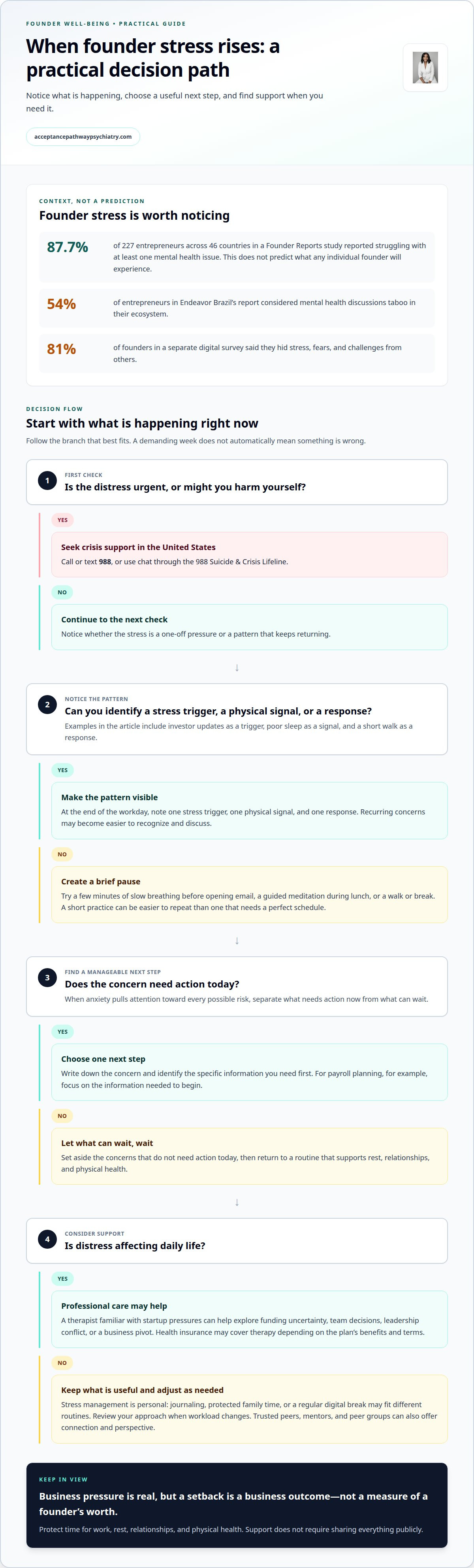
Entrepreneurs may face distinct pressures, but business ownership doesn’t determine anyone’s mental health. A Founder Reports study of 227 entrepreneurs across 46 countries found that 87.7% reported struggling with at least one mental health issue. That finding points to a meaningful need for mental health support for entrepreneurs, while not predicting what any individual founder will experience.
Without insurance, therapy costs vary by provider, location, session format, and treatment needs. The cost depends on the case and is given after a quote request.
Think of well-being as part of managing your resources: a business needs more than one source of resilience. Protect time for work, rest, relationships, and physical health instead of investing every available hour in the company. For example, block time for a meal, a walk, and a conversation with someone outside work. These choices won’t remove business pressures, but they can help keep work from becoming your only source of identity or support.
Use self-awareness to notice stress
Self-awareness can help distinguish a demanding week from a pattern that needs attention. At the end of each workday, note one stress trigger, one physical signal, and one response. For example, you might record investor updates as a trigger, poor sleep as a signal, and a short walk as a response. Over time, recurring concerns may become easier to recognize and discuss.
Mindfulness can create a brief pause between pressure and reaction. Try a few minutes of slow breathing before opening email, or a guided meditation during lunch. A short practice is easier to repeat than a routine that requires a perfect schedule. Exercise, walks, and breaks can also help you manage stress during demanding workdays.
Focus on the next useful action
Anxiety can draw your attention to every possible risk at once. To regain focus, write down the concern, separate what needs action today from what can wait, and choose one next step. If payroll planning feels overwhelming, for example, identify the specific information you need first. This won’t resolve every uncertainty, but it can make the immediate task more manageable.
Personalized stress management works best when it fits the founder’s real routine. One person may benefit from journaling after work; another may need protected family time or a regular digital break. Review the routine when workload changes, and keep the practices that feel useful. If distress becomes urgent or you may harm yourself, people in the United States can call or text 988, or use chat through the 988 Suicide & Crisis Lifeline for crisis support.
Mental health challenges for founders and startup employees
Health insurance may cover therapy for self-employed people and small business owners, depending on the plan’s benefits and terms. A therapist familiar with startup pressures can help you explore stress related to funding, team decisions, or a business pivot.
Common Mental Health Challenges
Mental health challenges are emotional or psychological difficulties that can affect how founders and startup employees think, feel, and work. Anxiety, burnout, depression, and disrupted sleep can make everyday decisions feel harder, from responding to a customer complaint to planning payroll. Recognizing these patterns matters because strain can affect personal well-being and a team’s ability to work steadily.
Founder Support and Therapist Fit
Founder support can combine practical peer connection with professional care that recognizes the pressures of building a business. When considering a therapist, think about whether you can discuss funding uncertainty, leadership conflict, and the emotional weight of a pivot. A good fit makes room for the whole person, not just the company’s latest milestone. Peer groups and trusted mentors can also offer connection and perspective.
Stigma Around Founder Mental Health
Stigma is the fear that discussing mental health will lead others to see a founder as less capable. In Endeavor Brazil’s report, 54% of entrepreneurs considered mental health discussions taboo in their ecosystem. A separate digital survey found that 81% of founders hid stress, fears, and challenges from others. In practice, a founder might share one concern with a trusted co-founder before it grows into isolation.
Investor perceptions can make openness feel complicated. A founder may worry that disclosing anxiety will undermine confidence in the business, even when the concern is workload or uncertainty. Seeking support in a private, appropriate setting can help separate personal care from investor updates. Clear boundaries about what to share can make it easier to seek help without disclosing everything publicly.
Startup Setbacks and Founder Self-Worth
A startup failure or pivot is a business outcome, not a measure of a founder’s worth. If a product launch misses its goals, separate the event from the personal conclusion: “This approach didn’t work” is different from “I can’t succeed.” That distinction can reduce self-blame and help you consider lessons, team needs, and the next decision more clearly.
Try writing down the facts of a setback, the assumptions it challenged, and one lesson for the next decision. For example, a founder changing the target customer can treat the pivot as a response to new information, rather than proof of personal failure. If distress is affecting daily life, professional mental health care can provide space to work through those concerns.
Common entrepreneurial stressors
Entrepreneurial stress often comes from carrying business uncertainty alongside personal responsibilities. In Endeavor Brazil’s report, 75% of entrepreneurs said they felt pressure from other people’s expectations. That pressure can come from investors, employees, family, or customers. A founder deciding whether to delay a launch may feel responsible to each group at once, even when their expectations conflict.
Time demands can narrow life outside work. A digital survey of startup founders found they spent 60% less time with their spouses and 58% less time with their children. Those changes can leave less room for connection and recovery. Another common strain is feeling that personal life is being postponed: in Endeavor Brazil’s report, 62% of entrepreneurs said they felt they were sacrificing the present for future success.
Endeavor Brazil’s report surveyed 118 tech founders and found that 70% felt lonely during their entrepreneurial journey. Loneliness can make difficult decisions feel heavier, especially when a founder believes they must appear confident. Working 70 or more hours a week can add pressure by leaving little space to reflect or reconnect. Together, these demands can become psychological stressors and contribute to burnout.
Stress reduction works best when it responds to the moment, not just a planned routine. During a tense investor call, notice whether your shoulders are tight or your breathing has become shallow. Pause before answering, take a few slower breaths, then identify the question that needs a direct response. This mindful check-in can create a small gap between a stressful trigger and your next action.
For ongoing workload pressure, break a large task into a defined work period, then step away briefly before returning. One suggested rhythm is a 90-minute work block followed by a 20-minute break. Use the pause to move, drink water, or look away from screens rather than switching to another work channel. A structured pause can make demanding tasks feel more contained, especially when the day includes back-to-back decisions.
You can also set a boundary around a recurring stressor. If messages interrupt dinner, silence work notifications during that time and set a clear window for replies. If expectations are the strain, tell a colleague which task you can complete first and which must wait. These choices won’t remove business uncertainty, but they can protect your attention and relationships while pressures continue.
Effective management means setting clear limits while also making room for recovery. Entrepreneurs can use meditation, deep breathing, or yoga as mindfulness practices for stress relief. A few minutes of mindfulness practice each day can improve focus, reduce anxiety, and promote emotional balance. A personalized stress-management routine might also include journaling, hobbies, or regular digital detoxes. Defined working hours, turning off work communications during personal time, and scheduling downtime can help avoid burnout with the guidance of Acceptance Pathway Psychiatry PLLC.
Mental health conditions among entrepreneurs
Entrepreneurs can experience mental health conditions alongside the demands of running a business. In one study described in the available findings, 72% of entrepreneurs reported mental health concerns, while 49% had experienced one or more mental health conditions. These figures describe different measures, concerns and experienced conditions, rather than a diagnosis for every founder. The key takeaway: business success doesn’t reveal someone’s inner well-being.
Michael Freeman found entrepreneurs were twice as likely as the average population to experience depression, psychiatric hospitalization, and suicidal thoughts. These comparisons underscore why changes in mood, sleep, concentration, or daily functioning deserve attention. For example, losing interest in familiar activities and struggling with routine decisions may signal more than a difficult workday. A qualified mental health professional can help assess these changes and discuss care options.
Consider professional mental health care when distress persists, disrupts work or relationships, or makes everyday tasks difficult. Reach out if anxiety, low mood, sleep disruption, or changes in habits interfere with daily functioning, rather than waiting for a business crisis. Thoughts of suicide require urgent support. Describing the change clearly, such as “I haven’t been sleeping and can’t focus,” can help you begin a conversation about care.
Mental health challenges can affect employees as well as founders, though the pressures may differ. A startup employee might experience ongoing anxiety after repeated role changes, while a founder could feel depressed after losing a major customer. In either case, persistent symptoms deserve attention beyond performance reviews or productivity tools. Therapy offers space to explore thoughts, identify patterns, and develop approaches suited to individual needs.
Practical habits can support well-being, but they aren’t a substitute for clinical care when symptoms affect daily life. A founder might track mood and sleep alongside workload, then bring those observations to a therapy appointment. The record can help show whether distress follows a specific trigger or continues across settings. Mental health support for entrepreneurs can include discussing symptoms, personal history, and treatment preferences, not just business demands.
Care is individual. When discussing treatment, a mental health professional can consider symptoms, how long they have lasted, their effect on daily functioning, and your preferences. Medication management may be part of care for some people; therapy may help others work through recurring thoughts or stress patterns. A useful next step is to describe what has changed and how it affects work, relationships, rest, or self-care.
What mental health challenges are common among entrepreneurs and small business owners?
A digital survey of startup founders from a global community found that 37% experienced anxiety, 36% experienced burnout, and 10% had panic attacks. These results describe that survey, not every entrepreneur or small business owner. They show how different forms of distress can arise alongside business demands, and why it helps to notice what changes in your own thoughts, feelings, and daily functioning.
Anxiety may show up as persistent worry about revenue, customer decisions, or an upcoming presentation. Burnout can feel like exhaustion and growing distance from work that once felt meaningful. A panic attack may involve an intense, sudden wave of fear. These experiences differ, so labeling every difficult day as burnout or anxiety may obscure what kind of support would help.
Business pressures can also shape how distress shows up. A shop owner facing uncertain sales might repeatedly check daily figures, while a founder preparing for a product launch may struggle to focus on routine tasks. For employees, unclear priorities or changing responsibilities can create strain. A digital survey found that 54% of startup founders were very stressed about their businesses, underscoring that business stress can feel substantial without defining anyone’s diagnosis.
Try a simple check-in: note the situation, the feeling, and what changed in your behavior. For example, record whether a difficult client conversation led to hours of rumination or avoiding the next call. Review your notes for recurring patterns, such as anxiety around financial decisions or exhaustion after constant problem-solving. This can clarify what is affecting you and provide specific examples to discuss during care.
Support can matter before distress becomes overwhelming. Yet a digital survey of startup founders found that 77% refused to seek qualified professional help. That finding highlights a gap between experiencing strain and reaching out; it doesn’t mean people should manage symptoms alone. Consider professional care if distress persists, disrupts relationships or work, or makes everyday responsibilities feel difficult. Therapy can provide a setting to explore concerns and identify approaches suited to your situation. Explore psychotherapy support if you’re ready to discuss what you’ve been experiencing.
Acceptance Pathway Psychiatry PLLC
Acceptance Pathway Psychiatry PLLC offers mental health care for entrepreneurs whose stress, anxiety, or mood concerns affect daily life. Psychotherapy can provide space to explore leadership pressures and develop coping strategies. Medication Management, Creyos Cognitive Testing, and Integrative Wellness Services may also support care, depending on your needs and goals.
Consider seeking support when distress persists, disrupts relationships or work, or makes everyday responsibilities harder to manage. A conversation can focus on what you’re experiencing and what kind of care may fit, without reducing your well-being to business performance. If you’re ready to discuss support, contact Acceptance Pathway Psychiatry PLLC.
Make space for your next step
Your well-being deserves attention alongside your business responsibilities and decisions. A useful next step is to name one change you’ve noticed and how it affects your day. Perhaps it’s harder to concentrate during meetings, or rest no longer feels restorative. Put that observation into words, then consider what kind of support might feel constructive. You don’t need a complete explanation before starting a conversation.
Seeking mental health support for entrepreneurs can be a way to care for yourself as a person, not another task to optimize for work. You can talk about what you’re experiencing, what matters to you, and which approach feels appropriate. A thoughtful conversation can help you consider next steps at a pace that respects your needs.
If you’re ready to explore support, contact Acceptance Pathway Psychiatry PLLC. Taking that first step can create room to focus on your well-being with care and intention.
Frequently Asked Questions
How can therapy help entrepreneurs?
Therapy can help entrepreneurs work through emotional strain and develop ways to respond to recurring challenges. For example, a founder dealing with conflict between co-founders can use sessions to clarify concerns, prepare for a difficult conversation, and notice how stress affects decision-making. Therapy can also help separate personal identity from business outcomes. The process is collaborative: you and the therapist can explore what feels most pressing and choose useful goals.
How can entrepreneurs find affordable mental health support in the United States?
Start by reviewing your health plan’s behavioral health benefits, including in-network options, telehealth coverage, and any visit limits. If you’re self-employed, compare available plans during enrollment and consider how premiums, deductibles, and cost-sharing fit your budget. Ask about payment arrangements before starting care. Understanding coverage and expected costs can help you choose a sustainable option without waiting until work or home life is severely affected.
What mental health resources and crisis hotlines are available to entrepreneurs?
For immediate crisis support in the United States, call or text 988, or use the chat service from the 988 Suicide & Crisis Lifeline. If someone is in immediate danger or needs urgent medical support, call 911. For ongoing concerns, a mental health professional can discuss care options. A trusted person, such as a family member or colleague, can also help you stay connected while you seek support.
Are there mental health programs or peer support groups specifically for entrepreneurs?
Entrepreneurs can seek founder peer groups, mentoring circles, and professional communities that welcome candid conversations, not just business updates. Ask whether a group discusses leadership strain, uncertainty, or work boundaries. Peer connection can offer shared perspective, while therapy provides private, individualized care. These forms of support serve different purposes, and you may use one or both depending on your needs.
What are practical ways entrepreneurs can manage stress, burnout, anxiety, and depression?
Choose a small routine that fits your workday: take a walk between meetings, pause for slow breathing before a stressful call, or set a firm time to stop checking messages. Track changes in sleep, mood, or concentration to notice patterns. These habits may support daily well-being, but persistent symptoms or difficulty managing everyday responsibilities call for professional assessment and care.


