

What if distance alone isn’t the best way to choose psychiatric care? Searching for “psychiatry near me” can help you find options, but the right fit also depends on the support you need, appointment access, and whether you feel heard.
If you’re unsure whether to seek psychiatric care, you’re not alone. A psychiatrist can evaluate mental health concerns and discuss options such as medication management and psychotherapy. It’s reasonable to want clear information about appointment formats and payment, and to feel respected rather than judged.
This guide explains what psychiatric care can include and how to compare practical factors such as access, treatment approaches, and payment options. It also covers what to expect at a first appointment, so you can take the next step at your own pace.
At Acceptance Pathway Psychiatry, care can include medication management, psychotherapy, Creyos Cognitive Testing, and integrative wellness services. Appointments are available in person and virtually. Your concerns and preferences can help shape a thoughtful, collaborative approach to care.
Key Takeaways
- A “psychiatry near me” search can help you find care options, but search results alone can’t tell you whether a clinician is the right fit.
- Learn how an initial conversation, assessment, shared goals, and follow-up can shape an individual care pathway.
- Compare in-person and virtual appointments by considering travel, privacy, internet access, comfort, and follow-up logistics.
- Prepare for a first appointment by noting your concerns, how long you’ve experienced them, previous care, questions, and goals.
- Consider how medication management, psychotherapy, Creyos Cognitive Testing, and integrative wellness services may relate to different support needs.
Psychiatry Near Me: What the Search Can, and Cannot, Tell You
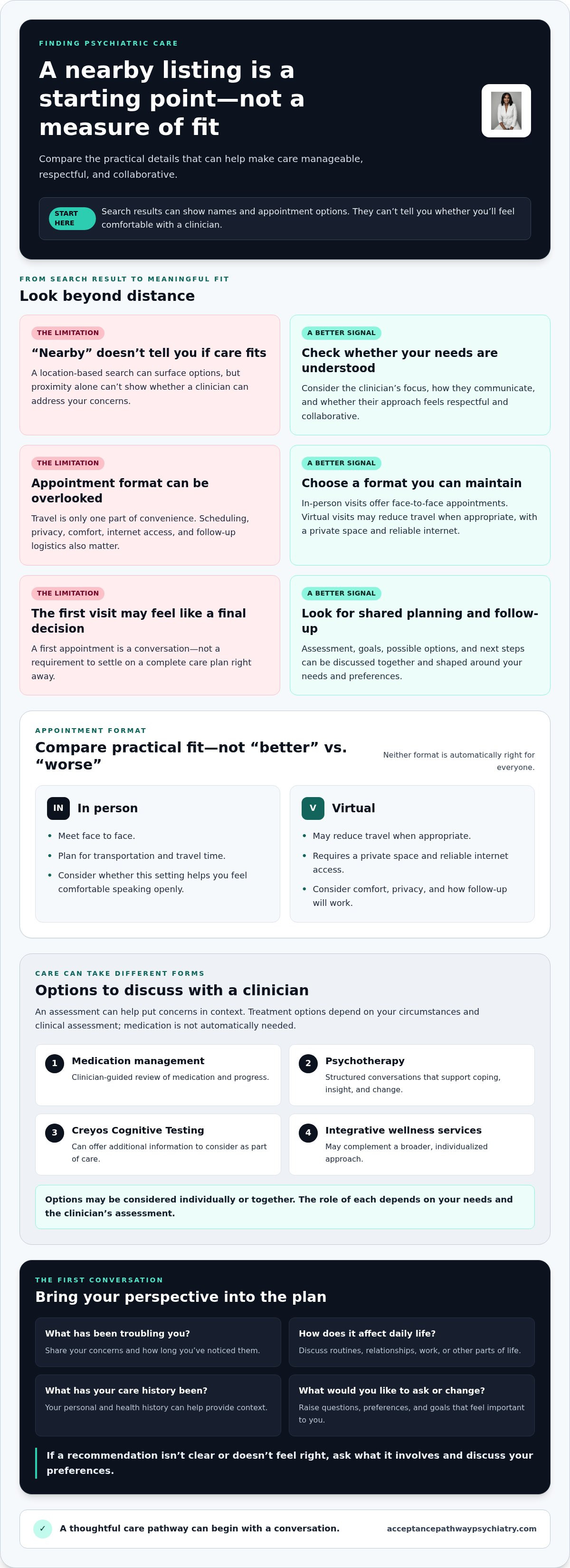
A search for “psychiatry near me” can surface names and appointment options, but it can’t tell you whether you’ll feel comfortable speaking with a particular clinician. Psychiatric care can include assessment, discussion of treatment options, and planning next steps together. Treat search results as a starting point, not a measure of personal fit.
Useful fit factors include whether the clinician can address your concerns, whether appointment formats and scheduling work for you, how they communicate, and whether follow-up can support continuity. You deserve care that takes your experience seriously and gives you room to ask questions.
This video offers a look at using a directory as one part of your search:
What does a psychiatrist help with?
Psychiatrists assess and provide treatment support for emotional, behavioral, and mental health concerns. These may include depression, anxiety, ADHD, PTSD, or bipolar disorder. The process begins by understanding your concerns rather than assuming a diagnosis or that medication is right for everyone. Care might include medication management, psychotherapy, or other parts of an individualized plan. For a broader overview of what psychiatry is, see this introduction to the medical specialty.
Psychiatric care is a clinical process for understanding mental health concerns and developing appropriate support, not simply a directory of nearby providers. An assessment and treatment plan should reflect your concerns, history, preferences, and clinical needs.
What does “near me” mean when looking for care?
Search engines may use location signals to show options they consider nearby. Proximity is only one part of convenience, however. Appointment format, scheduling, privacy, and the ability to attend follow-up visits also matter. An in-person appointment may suit someone who prefers meeting face to face. A virtual visit may reduce travel when it’s appropriate and you have a private space and reliable internet access.
As you compare options, consider whether the clinician’s focus matches your needs, whether their approach feels respectful, and how care can continue after the first conversation. A nearby listing can help you discover a possibility. The right pathway is one that makes appointments manageable and supports an ongoing, collaborative relationship.
What Psychiatric Care Can Include Beyond a First Appointment
A first appointment is often the start of a conversation, not a requirement to settle on a complete care plan right away. The clinician may ask what has been troubling you, how long you’ve noticed it, how it affects daily life, and what you hope might change. Your history and preferences matter, too. You can ask questions, share concerns, and work together to identify possible next steps.
Psychiatric care can involve assessment, shared goals, and follow-up shaped by your needs and clinical assessment. There isn’t one pathway that fits everyone. The American Psychiatric Association offers more information about psychiatry as a medical specialty and the support it can encompass.
Psychiatric evaluation and collaborative treatment planning
An evaluation helps a clinician understand your concerns in context. You might discuss symptoms, personal and health history, daily routines, and how challenges affect relationships, work, or other parts of life. The clinician may ask clarifying questions, and you can raise what feels most important or uncertain. Together, you can discuss goals and potential care options without assuming a diagnosis or a particular result.
Shared planning keeps your perspective in the conversation. If a recommendation isn’t clear or doesn’t feel right for you, ask what it involves and discuss your preferences.
Medication management, psychotherapy, and additional support
Medication management focuses on clinician-guided review of medication and progress, while psychotherapy uses structured conversations to support coping, insight, and change. These approaches may be considered individually or together, depending on your circumstances and clinical assessment. Medication isn’t automatically needed, and a plan may evolve as you and your clinician discuss what support is appropriate.
Acceptance Pathway Psychiatry provides medication management and psychotherapy, along with Creyos Cognitive Testing and integrative wellness services. Cognitive testing can offer additional information to consider as part of care, while integrative wellness services can complement a broader, individualized approach. The role of each service depends on your needs and the clinician’s assessment.
If you’re considering ongoing support, this psychiatric medication management guide can help you prepare questions for a conversation. You can also explore psychiatric care options at Acceptance Pathway Psychiatry.
In-Person or Virtual Psychiatry: Compare Access, Privacy, and Practical Fit
Choosing an appointment format is a practical part of finding care. Neither in-person nor virtual visits are automatically the better choice for everyone. Consider what makes it easier for you to speak openly, attend appointments, and maintain follow-up. If you’re searching for psychiatry near me, remember that convenience includes more than physical distance.
| Consideration | In-person appointment | Virtual appointment |
|---|---|---|
| Travel | Plan for transportation and travel time. | Avoids the trip, though you’ll need a suitable place to join. |
| Privacy | A dedicated clinical setting may feel private and separate from home. | Choose a space where you can speak comfortably without interruption. |
| Technology | No internet connection is needed for the visit itself. | A reliable internet connection and device are important. |
| Comfort | May suit people who prefer face-to-face conversation. | May feel more comfortable for people who prefer meeting from their own space. |
| Follow-up | Consider whether travel and scheduling are manageable over time. | Consider whether your space and connection will work for ongoing visits. |
When might in-person appointments feel like a better fit?
A face-to-face conversation in a dedicated clinical setting may feel grounding if you’d rather meet outside your home. Practical details matter, too. Think about how you’ll get there, how travel fits your schedule, and whether you can attend follow-up appointments without added strain. These preferences can guide your choice, but they don’t mean in-person care is clinically better for every person or concern.
What should I consider before a virtual psychiatry appointment?
Before a virtual visit, consider whether you’ll have a private space, a reliable connection, and a device that lets you communicate comfortably. Privacy can be especially important when discussing personal concerns. Acceptance Pathway Psychiatry offers virtual appointments, so you can consider this format alongside your circumstances and preferences.
Payment is another part of access. Review your insurance and payment options as you plan, since coverage and costs vary. Acceptance Pathway Psychiatry provides assistance navigating insurance and payment options. For additional resources for finding help, the National Institute of Mental Health offers guidance for exploring mental health support.
Acceptance Pathway Psychiatry offers both in-person and virtual appointments. Explore psychiatric appointment options as you decide which format may fit your needs and support continuity of care.
How to Move from a Psychiatry Search to a First Appointment
Once you’ve found a possible care pathway, a little preparation can make the first conversation feel more manageable. You don’t need to arrive with a diagnosis or a polished explanation. A few notes can help you remember what matters and give the clinician a useful starting point.
- 1. Name your main concerns. Write down what’s been difficult lately, such as changes in mood, focus, sleep, or daily routines.
- 2. Note the timeline and impact. Include when you first noticed the concern, whether it has changed, and how it affects everyday life.
- 3. Gather relevant background. List current medications and relevant health history. Brief notes are enough; you don’t need to organize every detail perfectly.
- 4. Consider your goals and questions. Think about what you hope to understand or work toward, and what you’d like to know about care.
- 5. Prepare for the appointment format. Consider whether an in-person or virtual visit is more practical for you, along with any access or payment questions.
What information can help you prepare?
Your notes can be simple: “I’ve felt persistently anxious for a while,” “concentrating has become harder,” or “this is affecting my work.” Add relevant history and medications you take, including details you’re unsure about. You can bring the list, read from it, or use it as a reminder. The clinician can guide the conversation and ask follow-up questions.
What questions can help you understand the care process?
Questions can make the conversation collaborative. Choose the ones that matter most to you:
- How will we identify goals for care and revisit them over time?
- What might follow-up look like, and how will we discuss next steps?
- Are appointments available in a format that fits my circumstances?
- How can I understand the insurance and payment process?
If you’ve searched for psychiatry near me and are ready to take a calm next step, your notes and questions can help you begin with what matters most. Acceptance Pathway Psychiatry offers medication management and psychotherapy, with care shaped around individual needs and clinical assessment. Explore psychiatric care options.
Finding a Psychiatry Care Pathway with Acceptance Pathway Psychiatry
After searching for psychiatry near me, it can help to understand what care with a specific practice may include. Acceptance Pathway Psychiatry offers in-person and virtual appointments, along with services for different mental health needs. The approach is compassionate and collaborative: your concerns and preferences are part of the conversation.
A range of services for different mental health needs
Acceptance Pathway Psychiatry provides care for depression, anxiety, ADHD, PTSD, and bipolar disorder. The right starting point depends on your concerns and a clinician’s assessment. You might discuss medication management, psychotherapy, or whether another service could be relevant. These conversations help clarify options without assuming that one treatment or diagnosis fits everyone.
Additional services include Creyos Cognitive Testing and integrative wellness services. Cognitive testing may be a useful topic to discuss when questions about attention or thinking are part of your concerns. For background on the role of testing in ADHD assessment, see this cognitive assessment guide for ADHD. A clinician can help put testing in context and discuss how it relates to your needs.
Medication management provides clinician-guided review of medication and progress. Psychotherapy offers structured conversations that may support coping, insight, and personal change. Integrative wellness services can also be part of the care conversation. Which services are appropriate depends on your individual concerns and clinical assessment.
A compassionate first step, at a manageable pace
You don’t need a perfect script to begin. Share what has been difficult, mention what you hope to understand, and ask questions as they come up. If you’re unsure where to start, a brief description of how your concerns affect daily life can open the conversation. Care is a partnership, and your perspective matters as options are discussed.
Practical details matter, too. Acceptance Pathway Psychiatry provides assistance with insurance and payment options, so these topics can be part of planning your care. Coverage and payment arrangements depend on individual circumstances, so review your own details as you plan.
Whether you’re considering an in-person visit or a virtual appointment, you can take the next step at a manageable pace. Explore care with Acceptance Pathway Psychiatry.
Take a Thoughtful Next Step Toward Care
A search for psychiatry near me can help you discover options, but the right pathway also depends on whether care fits your concerns, communication preferences, and access needs. Psychiatric support can continue beyond an initial conversation, with assessment, shared goals, and follow-up shaped around your circumstances.
Preparing a few notes about what you’re experiencing, your history, and the questions you want to ask can make a first appointment feel more manageable. You don’t need to have everything figured out before you begin. A respectful conversation can help you explore possible next steps at your own pace.
Acceptance Pathway Psychiatry offers in-person and virtual appointments, with services including medication management, psychotherapy, cognitive testing, and integrative wellness. The collaborative approach gives you space to discuss what matters and consider care that aligns with your needs. Explore care with Acceptance Pathway Psychiatry.
Seeking support is a meaningful step, and you can take it one conversation at a time.
Frequently Asked Questions
Is a psychiatrist the right professional for anxiety or depression?
A psychiatrist may be one option for discussing anxiety, depression, or other mental health concerns. They can learn about your symptoms, consider whether an assessment may help, and discuss possible approaches to care. Symptoms alone don’t confirm a diagnosis, and not everyone needs medication. Acceptance Pathway Psychiatry provides care related to anxiety and depression. The best starting point depends on your needs, preferences, and the kind of support you’re seeking.
Can I see a psychiatrist online instead of in person?
Yes, virtual psychiatry appointments are an option for some people, while others prefer meeting in person. Consider whether you’ll have a private space, reliable internet access, and a device that supports a comfortable conversation. The appointment’s purpose and your preferences may also shape which format feels suitable. Acceptance Pathway Psychiatry offers virtual appointments.
How do I find a psychiatrist near me who accepts my insurance?
Start by reviewing your insurance plan’s mental health benefits and its information about in-network care, referrals, and cost sharing. Then consider whether the provider’s services and appointment format fit your needs. A psychiatry near me search can help you discover options, but it won’t establish whether a specific plan is accepted. Acceptance Pathway Psychiatry provides assistance with insurance and payment options; coverage depends on your individual plan and circumstances.
What should I expect at my first psychiatry appointment?
A first appointment commonly gives the clinician time to understand your concerns, symptoms, relevant health history, and goals. You can bring a short list of medications, experiences, or questions you want to discuss. You don’t need to explain everything perfectly. The conversation can help clarify possible next steps, which should be discussed collaboratively and based on your individual circumstances. It’s okay to ask for clarification or share what feels most important to you.
Can a psychiatrist provide therapy as well as medication management?
Psychiatric care can include medication management, and some practices also provide psychotherapy. Medication management involves clinician-guided review of treatment and progress, while psychotherapy uses structured conversations to support coping, insight, and change. Acceptance Pathway Psychiatry offers both services. How they may fit together depends on your concerns, preferences, and clinical assessment. A care plan shouldn’t assume that medication alone or therapy alone is right for everyone.
What if I need immediate mental health help?
If you or someone else is in immediate danger, call 911 or go to the nearest emergency department. In the United States, call or text 988 to reach the Suicide & Crisis Lifeline for crisis support. Don’t wait for a routine appointment when immediate safety support is needed. If you’re unsure what to do, contacting emergency services or 988 can connect you with support focused on the urgent situation.


