

What matters most in a mental health evaluation for work may not be the questions you’re asked, but who requested it and what happens to your answers. It’s understandable to feel uneasy when the purpose is unclear, especially if you’re worried that a diagnosis or personal history could affect your job.
The type of evaluation matters. A clinical appointment focused on symptoms and care needs may differ from a workplace screening or fitness-for-duty assessment. The evaluator, reason for the request, and information shared with an employer can vary. Clarifying those details before you begin can help you understand what to expect.
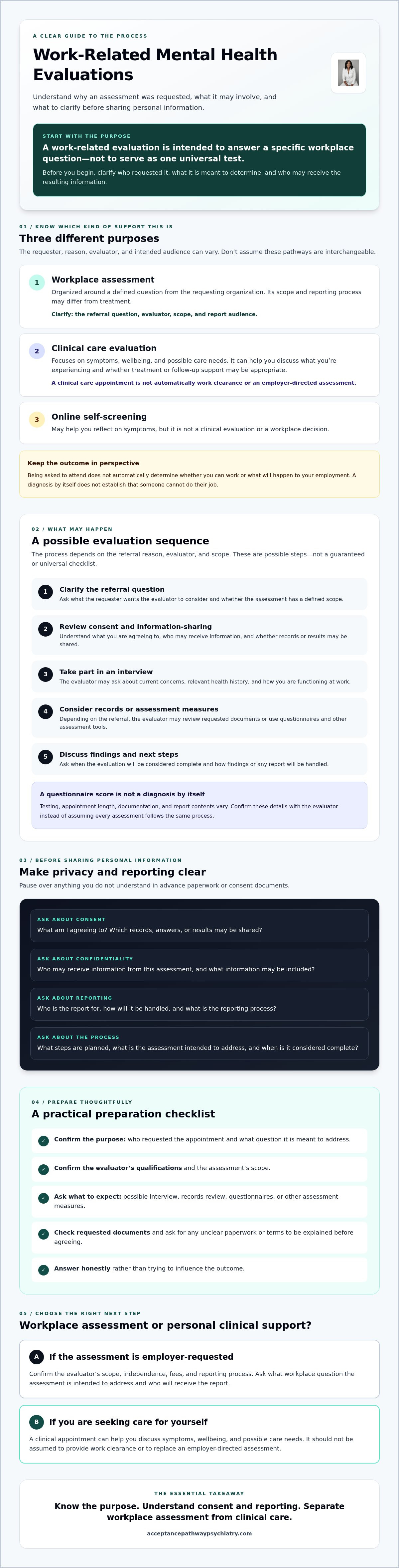
This guide explains why an evaluation may be requested, what it might involve, and what to ask about consent, confidentiality, reporting, and next steps. You’ll also learn how to prepare and distinguish an employer-directed assessment from clinical support. A mental health evaluation can help you discuss what you’re experiencing, but a clinical care appointment may not serve as work clearance. Understanding the purpose and boundaries can help you make informed choices about appropriate support.
Key Takeaways
- A mental health evaluation for work addresses a specific workplace question. Clarify who requested it and what the assessment is meant to determine.
- Ask the evaluator what the process may involve, including an interview, records review, or assessment measures.
- Before sharing personal information, clarify consent, confidentiality, and what may be included in a report to your employer.
- Prepare by confirming the appointment’s purpose, the evaluator’s qualifications, and any documents requested. Answer honestly rather than trying to influence the outcome.
- Separate an employer-requested assessment from clinical care. Before scheduling, confirm the evaluator’s scope, independence, fees, and reporting process.
What Is a Work Mental Health Evaluation and Why?
A mental health evaluation for work is an assessment intended to answer a specific question related to someone’s job. It isn’t one universal test. The person or organization requesting it, the reason, the evaluator, and the report’s intended audience can all vary. Being asked to attend doesn’t automatically determine whether you can work or what will happen to your employment.
A workplace assessment is different from personal mental health care and from an online self-screening. A self-screening may help you reflect on symptoms, but it isn’t a clinical evaluation or a workplace decision. For a broader overview of the assessment process, see What Is a Psychological Evaluation?
For a general introduction to mental health evaluations, watch this video:
How do treatment evaluations differ from workplace assessments?
A clinical evaluation focuses on your symptoms, wellbeing, and possible care needs. It can help you and a clinician discuss what you’re experiencing and whether treatment or follow-up support may be appropriate. Psychiatric evaluations at Acceptance Pathway Psychiatry PLLC are part of clinical care, not a promise of work clearance or an employer-directed assessment.
A workplace assessment, by contrast, is organized around a defined question from the requesting organization, such as whether a particular work-related concern needs further evaluation. Its scope and reporting process may differ from treatment. A clinician providing your ongoing care may not be the evaluator your employer requests, because the roles and purposes aren’t necessarily the same.
Why might an employer or worker consider an evaluation?
A request may arise after a specific job-related concern, as part of a return-to-work process, or in connection with a request for workplace accommodation. Ask for the reason to be explained clearly. Find out who initiated the assessment, what question it is meant to address, and who will receive the resulting report. For an overview of how employers structure occupational screenings and health assessments, check out Persona Health.
A diagnosis by itself doesn’t establish that someone can’t do their job. Work ability depends on the person and the job-related question being considered. An employment process may prompt an assessment, while someone may also seek clinical support voluntarily because they’re struggling. Understanding which situation applies can help you identify the right next step without assuming the evaluation has already decided the outcome.
What Happens During a Mental Health Evaluation for Work?
The process depends on the referral reason, the evaluator, and the assessment’s scope. Before answering personal questions or providing records, ask what the evaluation is intended to address, what steps are planned, and how the information will be used. If you receive paperwork in advance, note any terms or requests you want explained before you agree to them.
A mental health evaluation for work may follow a sequence like this:
- Clarify the referral question. Find out what the requester wants the evaluator to consider and whether the assessment has a defined scope.
- Review consent and information-sharing. Ask what you’re agreeing to, who may receive information, and whether records or results will be shared.
- Complete an interview. The evaluator may ask about current concerns, relevant health history, and how you’re functioning at work.
- Consider records or measures. Depending on the referral, the evaluator may review requested documents or use questionnaires and other assessment tools.
- Discuss next steps. Ask when the evaluation will be considered complete and how any findings or report will be handled.
Screening questionnaires can help organize information, but a score alone doesn’t establish a diagnosis. Testing, appointment length, documentation, and report contents vary. Confirm these details with the evaluator rather than assuming every assessment follows the same process.
What questions or information might the evaluator discuss?
Questions may cover what prompted the referral, your perspective on the concern, current symptoms, and any effect on work-related functioning. Relevant health history may also come up. Not every topic applies to every evaluation, and questions should relate to its stated purpose. If the evaluator requests records or a particular assessment, ask how that information relates to the referral question and whether it is necessary for the stated scope.
Who receives the report, and what might it include?
The referral question helps define what the evaluator assesses and reports. Before sharing sensitive information, ask who will receive the report, whether anyone else may access it, and what topics it may cover. Depending on the assessment, a report might describe relevant findings or offer recommendations related to the question. These are possibilities, not guaranteed outcomes. Ask whether you’ll receive a copy and how results will be communicated.
For general information about workplace protections, consult the U.S. Department of Labor’s guidance on employee rights for mental health. If your concern is personal wellbeing or care rather than an employer’s referral question, you can explore whether psychiatric evaluation and ongoing care may fit your needs. Clinical care is not the same as a workplace assessment or work-clearance service.
Privacy, Consent, and Workplace Rules: What Should You Clarify?
It’s reasonable to want to know who will see your information before agreeing to a mental health evaluation for work. Privacy depends on the evaluation’s purpose, who is conducting it, what you authorize, and applicable federal and state law. Don’t assume that everything you tell an evaluator will automatically remain private from an employer, or that an employer will receive your complete clinical history.
HIPAA doesn’t automatically prevent information from being shared with an employer in every situation. The rules can depend on the evaluator’s role, the records involved, the circumstances of the assessment, and any authorization you sign. Ask the evaluator to explain the specific information-sharing arrangements for your evaluation, including what the authorization permits.
What should you ask before signing a release?
Read any consent or authorization form before signing. If a term is unclear, ask for an explanation. You can ask:
- Who requested the evaluation, and what question is it intended to address?
- Who will receive the report or other information, and could it be shared with anyone else?
- What records, findings, or details may be disclosed?
- Can the authorization be limited by type of information, recipient, or purpose?
- Are there exceptions or circumstances that could permit or require disclosure?
Don’t rely on a general promise of confidentiality. Ask the evaluator to explain how the form applies to this assessment, and consider getting qualified advice if you’re unsure about its effect.
How do ADA and EEOC considerations fit in?
Federal disability and employment protections may be relevant, but how they apply depends on the situation. Rules can differ for job applicants and current employees, and the reason for an inquiry or assessment matters. The Americans with Disabilities Act and guidance from the Equal Employment Opportunity Commission address workplace disability issues, but they don’t resolve every individual case. State or local protections may also apply.
General legal protections don’t guarantee a particular employment outcome. An evaluation alone doesn’t determine your rights or what an employer may do. If you have a question about whether a request is appropriate, what you’re required to disclose, or how to respond, consider speaking with a qualified employment or disability-rights adviser. Confirm current guidance with the EEOC, the U.S. Department of Health and Human Services for HIPAA questions, and relevant state authorities. This information is general and isn’t individualized legal advice.
How to Prepare for a Work-Related Mental Health Evaluation
A little preparation can help you feel more grounded and understand what the evaluation is asking. Before your mental health evaluation for work, confirm the appointment details and purpose with the requesting organization or evaluator. Find out who will conduct it, what qualifications they have, what documents or assessments are expected, and how the results will be handled. If you have a referral letter or instructions, compare them with what you were told and ask about anything that seems unclear.
Preparation isn’t about rehearsing answers or trying to produce a particular result. Be accurate and honest. If you’re unsure how to answer a question, say so and ask for clarification. Your perspective matters, including what has been difficult and what support you think might help.
What documents and questions should you bring?
Bring only documents the evaluator has requested or that you’ve agreed to provide. Ask how they’ll be used and stored. A short written note can help you remember useful details, especially if you feel nervous or find it hard to organize your thoughts during an appointment.
- Appointment information, the referral question, and any instructions you received.
- A list of current medications and relevant care history, if requested or useful to the assessment.
- Specific examples of work-related concerns, such as tasks or situations that have become harder, without overstating or minimizing your experience.
- Questions about who receives the report, when it may be completed, any fees, and who is responsible for follow-up.
If a requested document or assessment seems unrelated to the stated purpose, ask the evaluator to explain its relevance before proceeding.
What if you feel anxious or disagree with the process?
Feeling uncertain is understandable. Raise concerns with the evaluator or the organization that arranged the appointment. You can ask them to explain a question, describe what a test involves, or clarify whether you can pause for a break. Breaks may depend on the assessment process, so ask what’s possible rather than assuming they’re guaranteed.
If a barrier could affect your participation, such as difficulty with the appointment format or a testing requirement, ask whether an adjustment can be considered. If cognitive testing is part of the assessment, ask what it measures and how the results relate to the referral question. Any questions about ADHD-focused cognitive assessment should be directed to a qualified clinician.
If your goal is to discuss symptoms and care needs rather than complete an employer-directed assessment, Acceptance Pathway Psychiatry PLLC provides psychiatric evaluations and ongoing mental health care. Explore psychiatric evaluation and ongoing care to consider whether those services may fit your needs. This clinical care isn’t a workplace assessment or work-clearance service.
Choosing Your Next Step: Workplace Assessment or Personal Clinical Support?
The right next step depends on what you need answered. A workplace assessment is arranged to address a specific employment-related referral question. Personal clinical care focuses on your wellbeing, symptoms, and possible care needs. These purposes can overlap in subject matter, but they aren’t interchangeable.
| Workplace assessment | Personal clinical care |
|---|---|
| Addresses a question from an employer or other requesting organization. | Helps you discuss symptoms, wellbeing, and care options. |
| Has a defined scope and report process to clarify before scheduling. | May support evaluation and ongoing treatment planning. |
| May be conducted by an evaluator selected for the referral. | Builds on your needs and the clinical services the provider offers. |
Before scheduling a workplace assessment, ask about the evaluator’s relevant qualifications, the assessment’s scope, their relationship to the requesting organization, any fees, and who receives the report. Clarify whether the evaluator is expected to provide an independent opinion and what that means in this context. An employer-directed assessment or work-clearance evaluation isn’t among Acceptance Pathway Psychiatry PLLC’s services.
When might a clinical appointment be a helpful next step?
If you’re seeking support for anxiety, depression, ADHD, PTSD, or bipolar symptoms, a clinical appointment may offer space to discuss what you’re experiencing and possible care options. Acceptance Pathway Psychiatry PLLC provides psychiatric evaluations and ongoing care, including medication management. If medication care is relevant to your needs, read Psychiatric Medication Management: A Compassionate Guide.
Treatment and work-clearance decisions are different. A clinical appointment can address your health and care needs, but it shouldn’t be assumed to satisfy an employer’s referral or produce a work-clearance decision.
How can you contact a provider without pressure?
Describe what you’re looking for and ask directly whether the provider’s services match your purpose. If you need a workplace assessment, explain who requested it and what question it must address. If you’re seeking personal support, share the symptoms or care needs you’d like to discuss. A provider’s suitability depends on your needs and location. Virtual appointment eligibility depends on clinician licensing and where you’re located, so confirm this before arranging care.
If you’re exploring clinical support, you can contact Acceptance Pathway Psychiatry PLLC to ask whether its services may fit your needs. Personal care should not be treated as a substitute for an employer-directed evaluation. Clarifying the purpose first can help you choose an appropriate next step.
Take Your Next Step With Clarity
A mental health evaluation for work is shaped by its purpose, evaluator, and reporting boundaries. Before you proceed, clarify what the assessment is meant to address, who may receive its findings, and what your consent covers. Preparing questions and relevant information can help you feel more grounded, but you don’t need to rehearse answers or assume the evaluation decides your employment outcome.
If you’re looking for personal clinical support, keep that goal distinct from an employer-directed assessment or work-clearance request. Acceptance Pathway Psychiatry offers psychiatric evaluations, medication management, psychotherapy, and cognitive testing. In-person and virtual appointments may be available depending on your location and eligibility. These services support clinical needs and aren’t a substitute for a workplace assessment.
If you’d like to explore whether the practice’s services fit your needs, contact the practice to discuss your mental health care needs. Taking time to ask questions and choose the right kind of support is a thoughtful step forward.
Frequently Asked Questions
What is a mental health evaluation for work?
A mental health evaluation for work is an assessment intended to answer a specific question connected to someone’s job. The requester, purpose, evaluator, methods, and report process can differ by situation. It isn’t the same as treatment or an online self-screening. Before participating, clarify what the assessment is meant to address, what it may involve, and who may receive its findings.
Can an employer require a mental health evaluation?
An employer may request an evaluation in some circumstances, but whether it can require one depends on the context and applicable law. A request may relate to a specific job function or workplace concern. Rules can differ for applicants and current employees, and a diagnosis alone doesn’t establish someone’s ability to work. Ask for the reason and scope in writing, and seek qualified legal advice if you’re unsure about your rights.
Will my employer see my mental health diagnosis or evaluation results?
Not necessarily, but don’t assume the information will remain entirely private. Who receives details may depend on the evaluation, the evaluator’s role, any authorization you sign, and applicable law. HIPAA doesn’t automatically prevent every disclosure to an employer. Before sharing records or signing a release, ask exactly what may be disclosed, to whom, for what purpose, and whether you can limit the authorization.
What happens during a fitness-for-duty mental health evaluation?
A fitness-for-duty evaluation generally addresses a defined work-related question. Depending on its purpose and scope, the evaluator may review the referral, explain consent, interview you, and consider relevant records or assessment measures. The process and report vary. Ask what the evaluator is assessing, what information will be considered, who will receive the report, and how results will be communicated. The evaluation itself doesn’t automatically determine an employment outcome.
Can I refuse a mental health evaluation requested by my employer?
You can ask questions and seek advice before deciding how to respond, but the consequences of refusing depend on the circumstances, workplace policies, and applicable law. Don’t assume refusal is always consequence-free or that a request is automatically valid. Ask the employer to explain the purpose, basis, and expected process. If you’re concerned about your rights or possible workplace consequences, consider speaking with a qualified employment adviser.
How should I prepare for a work-related mental health evaluation?
Confirm the appointment details, referral question, evaluator’s qualifications, and any documents requested. Ask who will receive the report, how records will be handled, and whether there are fees or follow-up steps. You may bring relevant information about medications, care history, or work concerns if requested or useful. Answer honestly rather than rehearsing for a desired result, and ask for clarification if a question is unclear.
Can a psychiatrist provide a work-clearance letter?
A psychiatrist may be able to provide documentation when it’s clinically appropriate, but whether a letter is available or accepted depends on the provider, purpose, employer requirements, and applicable rules. A clinical appointment doesn’t automatically serve as a fitness-for-duty assessment or guarantee work clearance. Acceptance Pathway Psychiatry offers psychiatric evaluations and ongoing care, but work-clearance letters and employer-directed evaluations aren’t among its services. Ask the requesting organization what documentation it requires.


