

What if a psych evaluation is less like a test you have to pass and more like a conversation that helps make sense of what you’ve been experiencing? If you’re asking what happens in a psych evaluation, it’s natural to wonder what questions you’ll be asked, how much you’ll need to share, or whether you’ll receive a diagnosis after one appointment. You don’t need to have everything figured out before you begin.
A psychiatric evaluation is a collaborative, non-judgmental process for understanding your concerns, symptoms, and relevant history. Your clinician may use what you share to consider a diagnosis and discuss possible next steps, but medication or therapy isn’t automatic. The goal is to build a clearer picture together. Sometimes follow-up conversations help clarify what support may fit.
In this guide, you’ll learn about the typical stages of an evaluation, the topics a clinician may ask about, and simple ways to prepare. We’ll also cover what may happen afterward and how care options can be discussed with you. At Acceptance Pathway Psychiatry, an initial psychiatric evaluation lasts 60-90 minutes and can take place in person or by telepsychiatry.
Key Takeaways
- Learn what happens in a psych evaluation, from sharing your concerns to discussing possible next steps.
- Understand how symptoms, personal history, and day-to-day experiences can help shape a clinician’s impressions.
- An evaluation doesn’t guarantee a particular diagnosis or mean you’ll automatically start medication or therapy.
- A few notes about when concerns began, how they affect daily life, and what you’d like to ask can help you feel more prepared.
- Find out what follow-up may involve and how care decisions can be made collaboratively.
What Is a Psychiatric Evaluation, and What Is It For?
Not knowing what to expect can make seeking support feel intimidating. You may wonder whether you’ll be judged, what you’ll need to explain, or whether you must arrive with a clear answer. You don’t. The conversation can begin with what you’ve noticed and what feels difficult right now.
A psychiatric evaluation is a conversation and clinical assessment that helps a clinician understand emotional, behavioral, or cognitive concerns and consider what support may be appropriate. It typically explores your experiences, relevant history, and how symptoms affect daily life. The focus is tailored to your needs and the purpose of the appointment. This broader psychiatric assessment considers your overall experience rather than treating one answer as the whole story.
At Acceptance Pathway Psychiatry, an initial psychiatric evaluation lasts 60-90 minutes and is designed to be collaborative and specific to your concerns. It may take place in person or by telepsychiatry. You don’t need to arrive with a diagnosis or a perfectly organized account of your life. The purpose is to build understanding together.
What questions can an evaluation help answer?
The appointment may explore what has been troubling you, when you first noticed it, and whether it has changed over time. A clinician may ask how it affects work, school, relationships, routines, or your ability to rest. They may also ask what you hope will feel different and what kind of support you’re looking for.
To understand the full picture, the clinician may consider your emotional experiences alongside physical health and relevant life circumstances. For example, changes in sleep may be discussed in the context of stress, mood, health, or recent changes in your daily life. No single symptom or response automatically determines a diagnosis. Each detail is considered in relation to your broader experience.
Who might consider a psychiatric evaluation?
You might consider an evaluation if you want help making sense of emotional, behavioral, or cognitive changes, or if your usual ways of coping no longer feel sufficient. Anxiety, low mood, attention difficulties, and changes in sleep are examples of concerns you could bring up. You don’t need to use a particular label or be certain that a mental health condition explains what’s happening.
You can start with a simple description, such as “I’ve been feeling on edge” or “I’m having trouble focusing.” If the concern is hard to put into words, that’s useful context too. The clinician can ask questions to understand what you mean and what matters most to you.
There’s no required script. Your experiences, questions, and goals help guide the conversation, and it’s okay if those become clearer as you talk. An evaluation can be a first step toward understanding what support might fit, without committing you to a particular diagnosis or treatment.
What Happens During a Psych Evaluation? The Main Conversation and Assessment
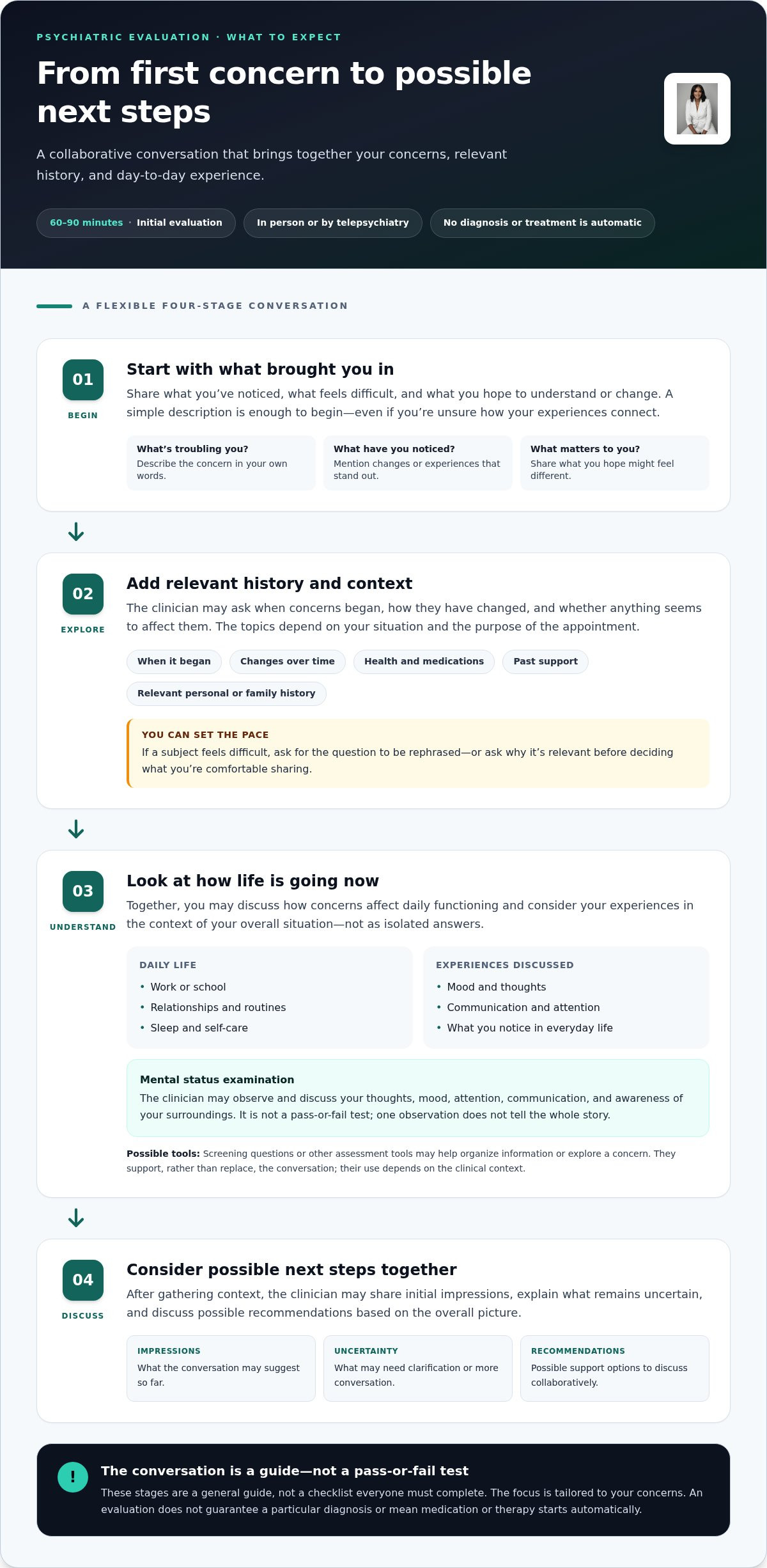
If you’re wondering what happens in a psych evaluation, there isn’t one fixed script. The conversation often moves from what brought you in to relevant background, current functioning, and possible next steps. Which topics receive the most attention depends on your concerns and the appointment’s purpose. These stages are a general guide, not a checklist everyone must complete.
- Start with your concerns and goals. The clinician may ask what prompted the appointment, what you’ve noticed, and what you hope to understand or change. You can begin with a simple description, even if you’re unsure how your experiences connect.
- Explore relevant history. You may be asked when your concerns began, how they’ve changed, and whether anything seems to affect them. Depending on your situation, the conversation may include health, medications, past support, or relevant personal and family history.
- Discuss day-to-day functioning. The clinician may ask how you’re managing at work or school, in relationships, with routines, or with sleep and self-care. They may also discuss your mood, thoughts, communication, and ability to focus to understand how you’re doing now.
- Consider what may help next. After gathering context, the clinician may share initial impressions, clarify what remains uncertain, and discuss possible recommendations. These reflect the overall picture, not one answer in isolation.
Discussing current concerns and personal history
Questions may be specific, but you don’t need polished answers. If you’ve been feeling anxious, for example, the clinician might ask when it tends to happen, what you notice in those moments, and how it affects your day. If a subject feels difficult or you need a question rephrased, you can say so. You can also ask why a topic is relevant before deciding what you’re comfortable sharing.
Understanding mental status and possible assessment tools
A mental status examination is a clinician’s way of understanding how you’re functioning during the appointment. It may involve observing and discussing your thoughts, mood, attention, communication, and awareness of your surroundings. It isn’t a pass-or-fail test, and one observation doesn’t tell the whole story.
Screening questions or other tools may help organize information or explore a particular concern, but they support rather than replace the conversation. Their use depends on the clinical context. If cognitive questions are relevant, Creyos Cognitive Testing may be considered as optional, provider-referred, self-pay supportive testing. It isn’t automatically part of every evaluation. Short assessments take 15-20 minutes; comprehensive assessments can take up to 40 minutes or longer. Creyos is a supportive clinical tool, not a replacement for a full neuropsychological evaluation.
At Acceptance Pathway Psychiatry, evaluations are tailored to your concerns and approached collaboratively. Learn more about psychiatric evaluations and what a first appointment involves.
Does a Psych Evaluation Mean a Diagnosis or Medication?
No. An evaluation doesn’t guarantee a particular diagnosis, and it doesn’t automatically mean you’ll be prescribed medication. A clinician may develop an initial impression based on what you share and other relevant information. Sometimes there’s enough information to discuss a diagnosis; sometimes more conversation or follow-up is needed. Either way, the aim is to understand your needs and consider appropriate support, not to force a predetermined outcome.
Myth: “If I go for an evaluation, I’ll leave with a diagnosis and a prescription.”
Reality: The clinician considers the overall picture, including your experiences, history, and current needs. Medication is one possible care option, not an automatic result. Recommendations can be discussed with you, and your questions and concerns are part of that conversation.
Think of an evaluation as an opportunity to explore what may be going on. A diagnosis, if offered, is a clinical impression that can help guide care, not a judgment about who you are. If the clinician needs more information, they can explain what remains unclear and discuss whether another conversation or assessment could help.
Can you disagree, ask questions, or share uncertainty?
Yes. You can ask why a question matters, request an explanation in everyday language, or say when you’re unsure how to answer. You can also share your preferences, concerns, or hesitation about a recommendation. You don’t have to disclose everything at once, and it’s reasonable to ask for time to think through information before deciding what feels right for you.
For instance, you might say, “I’m not sure medication is what I want to consider right now,” or “Can you explain what you mean by that?” Honest questions help the clinician understand what matters to you. You can discuss recommendations without treating the conversation as a test or an instruction you must accept without explanation.
How are possible recommendations discussed?
Next steps depend on the concerns being explored and what the evaluation suggests. They may include continued assessment, psychotherapy, a conversation about medication, or other supportive care. Sometimes the next step is to gather more information before choosing a direction. Recommendations should take account of your symptoms, goals, preferences, and questions.
If medication comes up, you can ask what it is intended to address, what other options may be considered, and how your response might be reviewed. Acceptance Pathway Psychiatry offers medication management and psychotherapy as possible parts of care, not automatic outcomes of an evaluation. For a closer look at ongoing medication care, read this guide to psychiatric medication management.
Decisions can develop through discussion rather than being settled by one answer. If you leave with unanswered questions, they can help shape a follow-up conversation. The goal is a thoughtful next step that reflects both clinical understanding and your perspective.
How to Prepare for a Psychiatric Evaluation Without Overthinking It
You don’t need to prepare perfectly, or at all, to begin. If thinking about what happens in a psych evaluation makes you want to rehearse every answer, remember that you’re not preparing for a test. A few notes can help you remember what feels important, but the clinician can guide the conversation and ask follow-up questions.
If it feels useful, jot down a few brief reminders before your appointment. A complete timeline or polished explanation isn’t necessary.
- Your main concerns: Write down what you’d most like help understanding, even if it’s only a few words.
- When you noticed changes: Note roughly when they began or whether they come and go. Estimates are fine.
- Effects on daily life: Include a couple of examples of how your experiences affect routines, relationships, work, school, or rest.
- Questions and preferences: List anything you want explained or any care preferences you’d like the clinician to know.
What information might be useful to bring?
A short symptom timeline or specific examples can make it easier to describe patterns, such as feeling more anxious in certain situations or having trouble concentrating during routine tasks. If readily available, note your current medications and relevant health history. You don’t need to gather a complete set of records or create a detailed written account to attend. Your notes are prompts, not a requirement.
You might also write down a question like, “What could be contributing to this?” or “What support options might fit my needs?” If you have care preferences, such as wanting to understand non-medication approaches, noting them can help you bring them into the discussion. It’s also fine to bring nothing and explain things in your own words.
What if you feel nervous or do not know what to say?
Feeling nervous is understandable, especially if you haven’t talked about these concerns before. You don’t need to find the perfect opening. You could start with, “I’m not sure where to begin, but something hasn’t felt right,” and let the clinician guide the conversation with questions.
If you don’t understand a question, you can ask, “Could you explain that another way?” If you need a moment, say, “Can we pause for a minute?” You can also tell the clinician that a topic feels hard to discuss or that you’re unsure how much you’re ready to share. That gives the clinician helpful context and lets you move at a pace that feels manageable.
Preparation can help you remember what matters, but it doesn’t guarantee a particular answer or outcome, and it doesn’t need to. If you’re ready to explore support, take the next step toward a psychiatric evaluation with Acceptance Pathway Psychiatry.
What Happens After a Psychiatric Evaluation, and How Can You Take the Next Step?
An evaluation doesn’t have to end with every question answered. The clinician may share their impressions, explain what seems clear or still needs exploring, and invite you to share your perspective. You can ask questions, clarify anything that doesn’t feel accurate, and talk about what matters most to you. The purpose is to understand your concerns together and consider a reasonable next step, not to force a decision before you feel ready.
What happens in a psych evaluation and afterward depends on your needs and the information gathered. Acceptance Pathway Psychiatry takes a collaborative, evidence-based approach, with care shaped around the individual rather than a predetermined plan.
What might follow the first appointment?
Depending on the evaluation, the clinician may discuss continued assessment, psychotherapy, medication management, or a follow-up appointment. They may also recommend taking time to consider options or gathering more information before deciding what to do next. These are possibilities, not automatic steps. A recommendation should relate to your concerns and goals, and you can ask how it may help and what other approaches could be considered.
If medication is discussed, you can talk through your preferences and questions before deciding how you’d like to proceed. Therapy may also be considered as a way to work on concerns over time. If the clinician shares an impression or recommendation you don’t understand, ask for an explanation in everyday language. You can leave with a plan to continue the conversation rather than settling every choice during one appointment.
How can you arrange an evaluation with Acceptance Pathway Psychiatry?
Acceptance Pathway Psychiatry offers in-person and telepsychiatry appointments. For a virtual visit, you’ll need a reliable internet connection and a private space where you can speak comfortably. The self-pay fee for an initial appointment is Initial Psychiatric Evaluation (60-90 min): $325.
You can schedule an evaluation by phone, email, or online form. If you’re unsure what to write or ask, a simple first message can say that you’re interested in an evaluation and would like to know the next step. You don’t need to have a diagnosis or a complete explanation ready before reaching out.
If you’re ready to begin, visit Acceptance Pathway Psychiatry to arrange an evaluation. You can start with a conversation about what you’re experiencing and what support may fit.
Make Room for a First Conversation
You don’t need certainty about what you’re experiencing before you take a step toward support. A question, a change you’ve noticed, or simply the feeling that you’d like things to be different can be a place to begin. Asking what happens in a psych evaluation doesn’t mean you need to have every answer ready. It can make it easier to start a conversation and explore what could help.
Give yourself permission to move at a pace that feels manageable. You can reach out with questions, share what you’re ready to share, and take time to consider possible next steps. Seeking care is a choice, and the conversation can help you understand your options without requiring you to decide everything in advance.
Acceptance Pathway Psychiatry offers compassionate, evidence-based care grounded in collaboration. Learn about psychiatric evaluations and care and take the first step toward a conversation about what support may fit.
Frequently Asked Questions
How long does a psychiatric evaluation take?
An initial psychiatric evaluation at Acceptance Pathway Psychiatry lasts 60-90 minutes. That allows time to discuss your concerns, relevant history, and possible next steps rather than rushing through a fixed set of questions. The conversation is tailored to you and may take a different path depending on what you want help with. You don’t need to prepare a complete account of your life before attending.
What questions will a psychiatrist ask during an evaluation?
Questions may explore what has been troubling you, when it began, and how it affects your everyday routine. A clinician may also ask about relevant health, medication, or personal history to better understand the context. For example, you could describe when a change first caught your attention, even if you’re unsure what caused it. You can ask why a question matters, request clarification, or say you’re uncertain about an answer.
Will I get a diagnosis during my first psychiatric evaluation?
Not necessarily. An evaluation helps the clinician consider your concerns, but a diagnosis isn’t guaranteed at the first appointment. If your experiences need more exploration, additional discussion or assessment may help clarify the clinical picture. You can ask what an impression means and how it relates to your concerns. The goal of a psych evaluation is to understand your experience and consider appropriate support, not to fit you into a label.
Does a psychiatric evaluation mean I have to take medication?
No. Having an evaluation doesn’t mean medication will automatically be recommended or prescribed. Depending on your needs, possible next steps may include discussing therapy, medication management, additional assessment, or follow-up. You can talk about your preferences, ask what a recommendation is intended to address, and raise concerns before making decisions. The appointment is a chance to explore appropriate support, not a commitment to one treatment path.
What should I bring to a psychiatric evaluation?
If readily available, a current medication list, relevant health information, or a few notes about what you want to discuss may be useful. You might jot down one example of a recent change or a question you don’t want to forget. These materials aren’t required, and there’s no need to assemble a complete file. If you arrive without notes, you can begin with whatever comes to mind.
Can I have a psychiatric evaluation online?
Yes, telepsychiatry appointments are available. You’ll need a reliable internet connection and a private space for the conversation. Before the appointment, choose a setting where you can speak comfortably without being overheard and position your device so you can communicate clearly. If the connection is interrupted or you need a moment to collect your thoughts, let the clinician know so you can continue as comfortably as possible.
What should I do if I am in crisis right now?
If you or someone else is in immediate danger, contact emergency services now. Acceptance Pathway Psychiatry doesn’t provide urgent-care visits for new clients, so don’t wait for a routine appointment when immediate help is needed. You can also call the National Suicide Prevention Lifeline at 1-800-273-TALK or text HELLO to the Crisis Text Line at 741741. If possible, tell someone you trust what’s happening while you seek immediate support.


